
Seeing a clean, sharp outer tread and a bald inner edge on your tyres is unnerving – especially when the car still feels “fine” to drive. Inner shoulder wear often creeps up slowly and is easy to miss until the steel cords are almost visible. Yet that narrow band of rubber is carrying a huge proportion of your braking, cornering and aquaplaning resistance, particularly at motorway speeds and in an emergency stop.
Tyres worn on the inside edge are almost never “just bad luck”. They are usually the visible symptom of deeper issues with alignment, suspension geometry, ride height, pressure or driving style. Understanding what the wear pattern is telling you helps you fix the real problem, save money on premature replacements and, most importantly, keep control when you need grip the most.
Inner edge tyre wear explained: how camber, toe and load angles degrade the contact patch
Inner edge tyre wear is primarily a geometry problem: the way the wheel sits and rolls relative to the road. When the angles are wrong, the contact patch – the small footprint of rubber touching the tarmac – is no longer flat. Instead of sharing the load across the whole tread, excessive load concentrates on the inner shoulder. Over thousands of miles that local overload literally grinds the inner ribs away.
Alignment technicians talk about three core angles: camber, toe and caster. For inner shoulder wear, camber and toe do most of the damage. Camber is the tilt of the wheel when viewed from the front; toe is whether the wheels point slightly towards or away from each other when viewed from above. When those angles are combined with speed, cornering forces and load, they dictate how the tyre scrubs as it rolls. Imagine dragging the bristles of a brush across a rough surface while tilting it; one edge of the bristles takes all the abuse – your tyre behaves the same way.
Negative camber geometry and why it scrubs the inner shoulder on front and rear axles
A small amount of negative camber (top of the wheel leaning inwards) is normal and even beneficial. It keeps more rubber on the road when the car rolls in a corner. Excessive negative camber, however, shifts the static load towards the inner edge even when driving straight. On a typical hatchback or saloon, just 1° of extra negative camber can reduce inner tread life by more than 20–30% on a long motorway commute.
On the front axle, too much negative camber often results from lowered suspension, kerb impacts or worn ball joints and bushes. At the rear, multi‑link set‑ups are particularly sensitive; a slightly bent arm or sagging spring can give a rear wheel a pronounced lean that a quick “tracking” at the front will never touch. If you drive mostly straight, you might not feel any handling issues, yet the inner shoulder steadily scrubs away.
Excessive toe-out alignment and feathering on the inner edge of directional tyres
Toe‑out means the leading edges of the front wheels point away from each other. Excessive toe‑out is another classic cause of tyres wearing on the inside edge. As the car rolls forward, each tyre wants to travel on a slightly different path. The tread blocks are twisted across the road surface, creating a saw‑tooth or feathered pattern you can feel if you run a hand along the inner ribs.
Directional tyres, with their V‑shaped or arrow grooves, often show this even more clearly. The inner edge blocks become sharp on one side and rounded on the other, like tiny chisels. Over time, the constant micro‑scrubbing generates heat and accelerates inner shoulder wear. Excessive toe‑out can be just as destructive as aggressive negative camber, especially on light front‑wheel‑drive cars that see lots of city roundabout use.
Dynamic camber gain in cornering and inner edge wear on performance cars (BMW M3, VW golf GTI)
Performance cars such as the BMW M3 or VW Golf GTI often run more negative camber from the factory to improve grip in fast bends. Their suspension geometry is designed to gain even more negative camber as the body rolls into a corner, a concept known as dynamic camber gain. On track this is fantastic: it keeps the outside tyres upright relative to the road and maximises grip.
In everyday use, with lots of spirited cornering, tight motorway slip roads and fast roundabouts, this can accelerate inner shoulder wear. The outer tyres in a turn carry huge loads on the inner ribs, and that’s where you start to see scalloping, cupping and quicker wear rates. Add a set of lowering springs or coilovers, and static negative camber increases further, making inner edge wear almost inevitable if alignment is not corrected.
Asymmetric versus directional tread patterns and how they reveal inside tyre wear
Tread pattern plays an important role in how easy it is for you to spot inner edge wear early. Asymmetric tyres have an “inner” and “outer” sidewall and often feature more rigid inner ribs and larger shoulder blocks to cope with cornering loads. When these blocks wear down faster than the rest of the pattern, the step in height is obvious if you look from underneath the car or feel along the tread.
Directional tyres, by contrast, have grooves that run in a V or arrow pattern. Inner wear on these designs can show up as a rounded, almost polished inner shoulder while the rest of the pattern still looks healthy. Because the visible part of the tyre (when you glance at it parked) is often the outer edge, inner wear is easy to overlook. A habit of turning the steering to full lock and checking the inside ribs with a torch can make the difference between catching an issue early and driving on exposed cords.
Wheel alignment faults that cause tyres to wear on the inside edge
When inner tyre wear appears, wheel alignment faults are usually high on the list of suspects. Modern suspension is highly adjustable, and small changes in camber or toe after an impact can push the geometry outside the manufacturer’s specifications. According to UK repair data, more than 60% of cars checked after hitting a significant pothole show at least one alignment reading out of tolerance, even if the steering still feels straight. That misalignment quietly chews through the inner shoulder long before any dashboard warning appears.
Incorrect front toe and camber settings after kerb impact or pothole strikes
Striking a deep pothole or clipping a kerb can bend a track rod, strut, control arm or even a wheel. The immediate symptom might just be a slight pull, a new vibration or nothing noticeable at all. Yet the front toe angle may have shifted from a mild toe‑in to excessive toe‑out, or camber may have become much more negative on one side than the other.
Once that happens, every mile you drive effectively “sands” the inner shoulder. For high‑mileage motorway drivers, this can turn a set of premium tyres into scrap in under 10,000 miles. Any significant impact that makes you wince is a good reason to have a professional alignment check rather than waiting until the next scheduled service.
Rear axle misalignment and thrust angle errors on multi‑link and torsion beam suspensions
Rear axle misalignment is an often‑overlooked cause of tyres wearing on the inside edge. On cars with multi‑link rear suspension, worn bushes or bent arms change camber and toe at the back. On torsion beam designs, a distorted beam can set the rear wheels at odd angles. This alters the thrust angle – the direction the rear axle “wants” to travel relative to the car’s centreline.
If the thrust angle is off, the car can crab slightly down the road. The driver unconsciously corrects with the steering wheel, which introduces additional toe error at the front. The result is a complex wear pattern: one rear tyre worn on the inner edge, the opposite front showing combined inner edge and feathering. A simple front‑wheel alignment will not correct a rear axle that is effectively steering the car.
Subframe shift, bent control arms and distorted hubs after collision damage
Even a relatively minor collision, such as a side impact at a junction or mounting a kerb at speed, can shift the front or rear subframe a few millimetres. Control arms, hubs and even damper brackets can bend without any obvious visual deformity. Alignment machines, however, will show readings that are far outside normal manufacturing tolerances and cannot be corrected within the available adjustment range.
In those cases, inner edge tyre wear is a symptom of a deeper structural issue. Simply adjusting toe to “green numbers” on a printout is not enough. The underlying bent component needs replacement, or the subframe must be re‑centred. Continuing to drive on such a set‑up not only destroys tyres but can compromise stability during emergency manoeuvres.
Why repeated tracking only on the front wheels (without a four‑wheel alignment) fails to cure inner wear
Many drivers are familiar with the phrase “tracking check”, often meaning a quick front‑axle toe adjustment using basic gauges. If inner tyre wear persists after repeated tracking, the usual reason is simple: only half the picture is being measured. Without checking the rear axle and the thrust line, the steering can be centred relative to the front wheels but still be offset relative to the chassis.
This can leave a hidden toe‑out condition on one front wheel or a camber mismatch that continues to overload the inner ribs. It is a bit like trying to square one corner of a picture frame while ignoring that the opposite corner is twisted; the frame will never truly sit flat. A complete four‑wheel alignment is essential when diagnosing stubborn inner shoulder wear.
Using 3D four‑wheel alignment systems (e.g. hunter, hofmann) to diagnose inside edge tyre wear
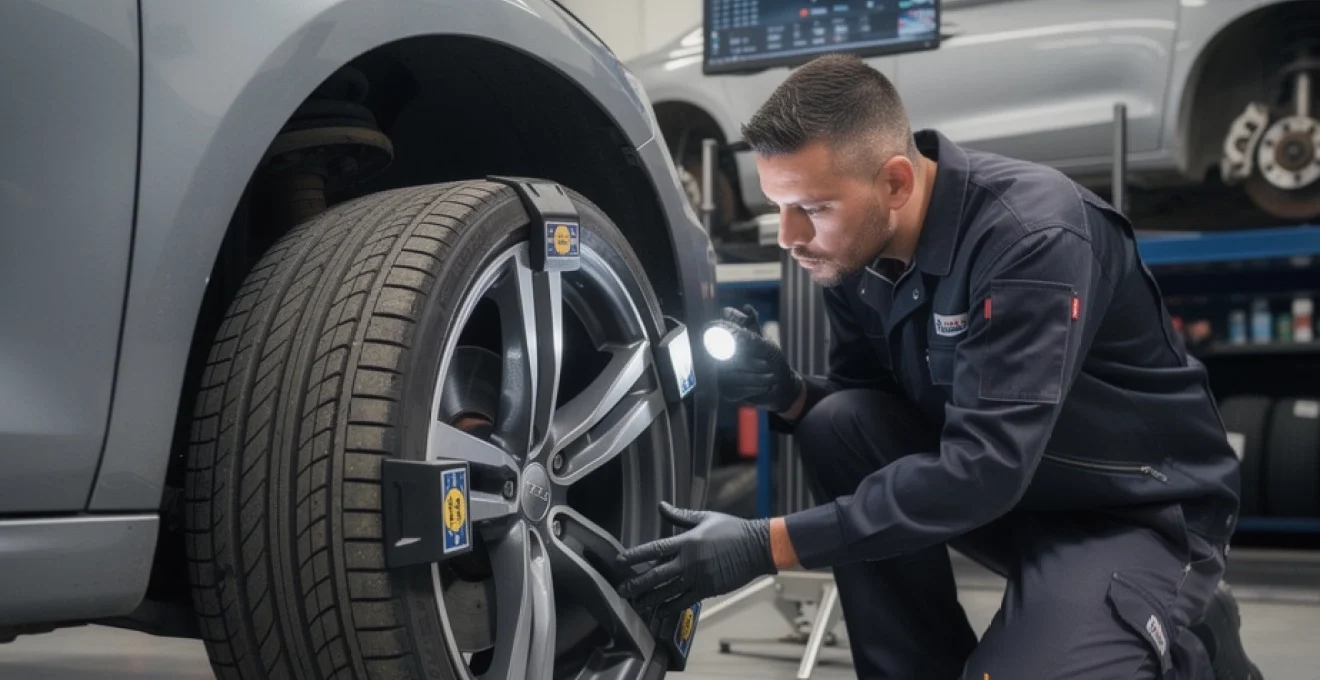
Modern 3D four‑wheel alignment systems, such as those from Hunter or Hofmann, use high‑resolution cameras and reflectors or targets mounted on each wheel. Within minutes they can measure camber, toe, caster and thrust angle for all four wheels and compare them to manufacturer data. The resulting printout provides a precise picture of why your tyres are wearing on the inside edge.
Advanced systems also allow technicians to perform live adjustments while you sit in the driver’s seat or while a specified load is placed in the car, replicating real‑world conditions. For vehicles frequently driven with heavy loads or towing, this loaded alignment can significantly reduce inner shoulder wear. Using such equipment regularly, especially after suspension work or impacts, is one of the most effective ways to protect expensive tyres and maintain safe, predictable handling.
Suspension and steering component wear leading to inner shoulder tyre damage
Even with perfect alignment off the ramp, worn suspension and steering components can cause geometry to shift dynamically as you drive, especially under braking and cornering. In other words, the readings are in the green when stationary but move out of spec at 70 mph on the motorway. This dynamic movement creates a moving contact patch that repeatedly hammers the inner ribs of the tread.
Worn lower ball joints and their effect on camber and tyre contact patch
Lower ball joints act as pivotal connections between the control arm and the hub. As they wear, free play develops, allowing the bottom of the wheel to move in and out. Under load, this play often manifests as extra negative camber, especially when cornering or braking. The tyre leans onto its inner shoulder, shrinking the effective contact patch.
On rough roads or speed‑bump‑heavy routes, this repeated camber fluctuation quickly scuffs the inner tread blocks. A tell‑tale sign can be a slight clunk over bumps combined with irregular inner wear, particularly on one side of the car. Replacing tired ball joints not only restores geometry but makes the steering feel more precise and secure.
Perished control arm bushes (wishbone bushes) causing dynamic toe changes under braking
Control arm bushes, or wishbone bushes, are rubber or hydraulic mounts that isolate the suspension arms from the chassis. As they perish, crack or delaminate with age, they allow the arms to move more than intended. Under braking, especially from high speed, the force can pull the front wheels into a toe‑out position, even if static toe is correct.
This dynamic toe change is a major cause of inner edge shoulder wear on high‑mileage cars. Drivers might notice a vague feeling when changing lanes or a tendency for the car to wander. Yet the most visible evidence is a bald inner band on the front tyres while the outer tread still has several millimetres of depth. New bushes restore stable geometry under load and often transform overall ride quality.
Loose track rod ends and steering rack play generating irregular inner edge wear
Track rod ends connect the steering rack to the wheel hubs. Any looseness here means the wheels can toe‑in or toe‑out slightly over bumps or during acceleration and deceleration. Steering rack wear can have a similar effect. This constant micro‑movement causes an irregular, patchy wear pattern on the inner tread blocks, sometimes described as “saw‑tooth” or “stepping”.
You may also feel a knock in the steering, a delay between turning the wheel and the car responding, or a shimmy at certain speeds. In professional opinion, any noticeable steering free play should be treated as both a safety concern and a likely contributor to accelerated inner shoulder wear, and corrected before fitting new tyres.
Ageing shock absorbers and dampers increasing camber change and cupping on the inner tread blocks
Shock absorbers, or dampers, control the rate at which the suspension moves. When they are worn, the wheel can bounce excessively after a bump. This bouncing causes the tyre to momentarily lose and regain contact with the road, producing cupping or scalloped dips in the inner tread blocks where the load is highest due to camber.
Studies show that by 50,000–60,000 miles many factory dampers have lost a significant proportion of their original effectiveness, even if they are not leaking. The result is not only longer stopping distances and reduced comfort but also uneven wear patterns, especially on the inner edges of driven wheels. Replacing tired dampers helps keep the contact patch flat and consistent, allowing the tyre to wear more evenly.
Incorrect ride height, lowering springs and chassis modifications
Ride height strongly influences suspension geometry. Any change – whether from intentional lowering, sagging springs or altered air suspension settings – shifts camber and toe curves. Lowering tends to increase static negative camber and can introduce bump‑steer, while a sagging corner effectively “pre‑loads” that wheel with extra negative camber. In both scenarios, the inner shoulder works harder than designed, especially on long journeys with passengers or cargo.
Lowered suspension and coilovers increasing static negative camber on mk4 golf, BMW E46 and similar platforms
Popular platforms like the Mk4 Golf, BMW E46 3‑Series and similar-era cars respond well to lowering springs and coilovers from a handling perspective. However, dropping the car by 30–40 mm without correcting camber and toe can easily push static camber beyond factory tolerance. The result is aggressive inner shoulder wear, particularly on the rear of BMWs and the front of front‑wheel‑drive Golfs.
Enthusiasts sometimes accept frequent tyre changes as “the price of stance”, but a more balanced setup is possible. Adjustable camber arms, top mounts and proper four‑wheel alignment allow a lowered car to enjoy sharp turn‑in without sacrificing the inner 20 mm of tread life. If you have just fitted coilovers, booking an alignment after the springs have settled is essential to avoid throwing away expensive performance rubber prematurely.
Sagging springs on high‑mileage vehicles reducing ride height and altering wheel alignment
Not all ride height changes are deliberate. On high‑mileage family cars and vans, coil springs can sag gradually. A rear end that sits lower than designed can give the rear wheels more negative camber and toe‑out, leading to chronic inner edge wear on the back axle. Because the change is slow, the eye adapts and the car still “looks normal” when parked.
If you notice that the gap between tyre and arch differs side‑to‑side, or the car bottoms out more easily over speed humps, it may be time to measure ride height against manufacturer data. Replacing tired springs in pairs restores correct geometry, improves stability under load and reduces that familiar pattern of rear inner shoulder baldness that plagues many ageing estates and MPVs.
Uncalibrated air suspension systems (audi A6 allroad, range rover) causing chronic inside wear
Air suspension systems on models like the Audi A6 Allroad or various Range Rover generations allow ride height to change depending on speed or off‑road mode. These systems rely on level sensors and calibrations so that each selected height maintains correct camber and toe. If a sensor fails, a bag leaks slightly or a calibration is lost after repairs, the car can run too low or high at one corner or axle.
At motorway speeds, a small height error can translate into significant extra negative camber and inner shoulder load. Because the ride often still feels plush, the first indicator is usually rapid inner wear on one or two tyres. Regularly checking for level differences between corners, along with scheduled suspension diagnostics, helps prevent this kind of hidden geometry shift.
Wheel spacers, wide alloys and stretched tyres changing scrub radius and inner shoulder load
Fitting wider alloys, wheel spacers or stretched tyres alters the scrub radius – the relationship between the tyre contact patch and the steering pivot point. Large changes can make the wheel arc differently through its travel, modifying how camber and toe behave as the suspension compresses. Combined with low‑profile, stiff sidewalls, the inner shoulder often becomes the dominant load path.
This is particularly common on cars converted to aggressive “stance” or track‑look road setups. Tyres can wear through their inner bands shockingly quickly, sometimes showing cords while the outer tread still looks almost new. If you are set on wider wheels and spacers, a detailed alignment with someone experienced in modified chassis geometry is vital to limit this effect and keep the car controllable in the wet.
Tyre pressure, load and driving style factors that accelerate inner edge wear
Geometry sets the baseline for how a tyre should contact the road, but tyre pressure, vehicle load and driving style dictate the forces that act on that contact patch. Even a perfectly aligned car can develop inner shoulder wear if it runs consistently over‑ or under‑inflated, carries excessive loads or is driven aggressively through bends. According to various fleet studies, up to 70% of vehicles on the road run with at least one tyre outside the recommended pressure range, which significantly increases uneven wear and fuel consumption.
Under‑inflation versus over‑inflation and inner shoulder overheating on motorway commutes
Under‑inflation usually causes wear on both outer edges as the sidewalls flex and the centre lifts slightly. Over‑inflation concentrates wear in the centre of the tread. However, when incorrect pressure combines with negative camber, the effect on the inner shoulder can be more subtle. An under‑inflated tyre with too much camber generates excess heat in the inner sidewall and shoulder area because the overloaded edge deforms more with every rotation.
On long motorway commutes, that repeated flexing can lead to rapid degradation, small cracks and localised wear on the inside edge. Maintaining pressure at the manufacturer’s recommendation – checked cold at least once a month and before long journeys – keeps the carcass working as designed and reduces the risk of inner shoulder overheating and eventual blowouts.
Consistent high‑speed cornering, roundabout use and inner edge scrub on front‑wheel‑drive cars
Driving style plays a bigger role than many drivers realise. Frequent high‑speed cornering, fast roundabout use and late braking all load the front outside tyre heavily, especially on front‑wheel‑drive cars. With negative camber and steering lock applied, the inner shoulder of that tyre often carries the brunt of lateral force.
Over tens of thousands of miles, this “scrub” grinds the inner ribs down much faster than casual, smoother driving would. If your commute includes numerous tight junctions or spiral slip roads, taking a more progressive approach to speed and steering input can significantly extend tyre life and reduce the risk of the inner edge hitting the legal minimum while the rest of the tread still appears healthy.
Incorrect load index selection for vans and SUVs (ford transit, VW transporter, nissan qashqai)
Vans, pick‑ups and SUVs like the Ford Transit, VW Transporter or Nissan Qashqai place heavy demands on tyres, especially when frequently loaded or towing. Fitting tyres with an incorrect or marginal load index means the carcass works closer to its limit more of the time. Combined with negative camber at the rear or front, this can drive a wedge of load into the inner shoulder and accelerate wear.
For commercial vehicles and crossovers, matching or exceeding the manufacturer’s specified load index and speed rating is critical. Heavier‑duty carcasses better resist deformation under load, keeping the contact patch more uniform. Choosing tyres specifically designed for SUV or van use, rather than purely “car pattern” tyres, can reduce inner shoulder stress noticeably.
Front–rear tyre rotation patterns and how neglecting rotation worsens inside edge wear
Front tyres on most vehicles handle steering and a large share of braking, while rears often see more stable, constant loading. If the front has a tendency to wear the inner edges due to geometry, leaving the tyres in place until they are worn out will concentrate all the damage on that single pair. Regular front–rear rotation helps spread any uneven wear characteristics across all four corners.
Manufacturers typically recommend rotation every 6,000–8,000 miles, though some performance models advise against it. For cars that allow rotation, doing so in line with the recommended pattern – and only after confirming a correct alignment – can almost double the usable life before any one inner edge approaches the legal minimum tread depth.
Diagnosing and fixing inner edge tyre wear: step‑by‑step action plan
When you notice that your tyres are worn on the inside edge, a structured approach helps reveal whether the cause is alignment, suspension, pressure, load or driving style. Treat the wear pattern as a clue, not just an annoyance. A quick look, a few simple measurements and a professional check where needed can turn a mystery into a clear plan of action.
Visual inspection checklist: reading wear patterns, feathering and cupping on the inner ribs
Begin with a thorough visual inspection. Turn the steering to full lock so you can see the inside of the front tyres, and if possible use a torch. Look for a continuous band of reduced tread on the inner 10–20 mm, feathering where tread blocks feel sharp in one direction, or cupping where small scalloped dips appear along the inner ribs.
- Check all four tyres, not just the front, for inner shoulder wear or patchy patterns.
- Note any cracks, exposed cords or bulges on the inside sidewall.
- Compare wear between left and right to see if one side is significantly worse.
These clues help indicate whether the problem is primarily camber, toe, damping or load‑related. For example, smooth continuous inner bands often point to static camber issues, while feathering suggests toe errors or steering play.
Measuring tread depth across inner, centre and outer sections with a digital gauge
A digital tread depth gauge allows you to quantify what your eyes can see. Measure in three zones across each tyre: inner, centre and outer. Take at least three readings around the circumference in each zone. Record the values; a difference of more than 1 mm between inner and centre is already significant on a lightly used tyre.
To present the data clearly, many technicians use a simple table to compare readings:
| Tyre position | Inner tread (mm) | Centre tread (mm) | Outer tread (mm) |
|---|---|---|---|
| Front left | 2.0 | 4.0 | 4.5 |
| Front right | 2.5 | 4.2 | 4.5 |
| Rear left | 3.5 | 4.5 | 4.8 |
| Rear right | 3.8 | 4.6 | 4.8 |
This kind of pattern – thin inner bands at the front – strongly suggests a front‑axle geometry issue. Systematic measurement like this provides a solid basis for discussions with an alignment specialist and helps track improvements over time.
When to replace tyres with exposed cords or uneven inner wear under UK MOT standards
Under UK MOT rules, car, van and 4×4 tyres must have at least 1.6 mm tread depth across the central three‑quarters of the tread width and around the entire circumference. Inner edge wear can take the tread below this legal limit while the outer three‑quarters still appear serviceable. If cords are visible anywhere, the tyre is unequivocally unsafe and illegal.
Once the inner tread is close to 2 mm, replacement before the next MOT is advisable, particularly for high‑speed or high‑mileage use.
Tests have shown that wet braking distances increase markedly once tread depth falls below 3 mm, especially on heavily cambered tyres where the inner shoulder does most of the water dispersal. If you can see fabric or metal wires on the inner shoulder, the tyre should not be driven on at all, even for short journeys to a garage.
Selecting tyre types and brands (michelin pilot sport, goodyear eagle F1, continental PremiumContact) to reduce inner wear
Tyre choice cannot fix bad alignment, but it can influence how gracefully tyres wear and how visible early inner shoulder problems become. Premium patterns such as Michelin Pilot Sport, Goodyear Eagle F1 or Continental PremiumContact typically use reinforced inner shoulder constructions and advanced silica compounds that better tolerate camber and toe than budget alternatives.
These tyres often have stiffer inner ribs and more even pressure distribution within the contact patch. Independent tests and fleet data frequently show 10–20% longer life under mixed driving, partly thanks to more robust shoulder designs. For cars known to be sensitive to inner wear – performance saloons, hot hatches and heavily loaded estates – investing in such tyres can provide a useful margin before any underlying geometry issue becomes critical.
Scheduling periodic four‑wheel alignment and suspension checks to prevent future inside edge wear
Preventing tyres from wearing on the inside edge is a matter of routine, not luck. A practical maintenance plan might look like this:
- Check tyre pressures and perform a quick visual inner shoulder inspection once a month and before long trips.
- Measure tread depths across each tyre every 6,000–8,000 miles and rotate front to rear where recommended.
- Book a 3D four‑wheel alignment whenever new tyres or major suspension parts are fitted, or after any heavy impact.
Adding a detailed suspension check – bushes, ball joints, track rod ends and dampers – every 2 years or 20,000 miles helps catch wear long before it degrades geometry on the move. Treat alignment and suspension health as part of the cost of running the car in the same way as oil changes and brake services. That mindset makes it far less likely that you will next see the inner cords of a tyre only when it is already too late to rely on its grip in an emergency.