
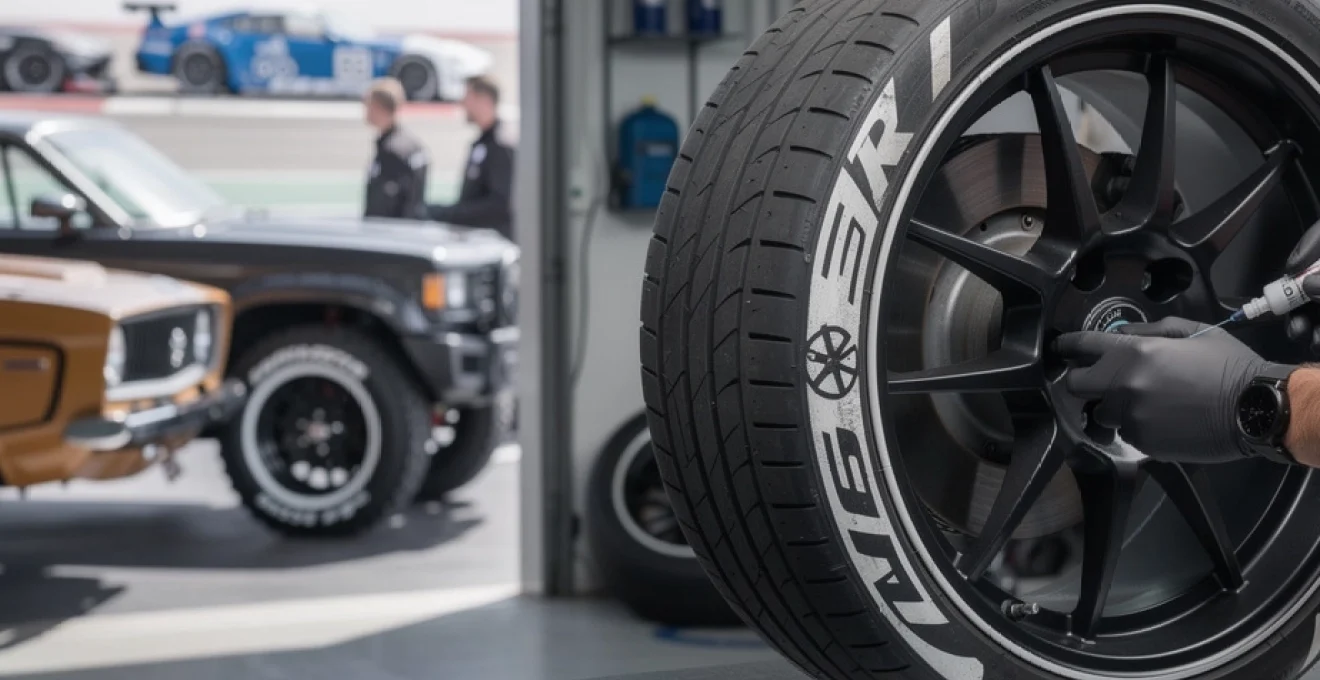
White writing on tyres divides opinion. Some drivers see raised white letters as a pure styling choice, others associate them with motorsport, and a few worry they might affect safety or MOT tests. In reality, those bright sidewalls sit at the crossroads of engineering, legislation and design. Understanding what white lettering means, how it is made, and how to look after it helps you choose between a stealthy black wall and a bold retro look without compromising safety, performance or legality.
From classic muscle cars to modern all‑terrain 4x4s, tyre sidewalls carry a surprising amount of information. The combination of sidewall codes, regulatory markings and white branding tells you far more than just the tyre’s name. If you read it correctly, you can check load rating, speed rating, date of manufacture and even whether the tyre is approved for severe snow, track use or specific vehicle brands.
What white writing on tyres actually means: sidewall markings, branding and legal labelling
The first thing to remember is that the decorative white writing sits on top of mandatory black sidewall markings. Those legal markings must remain visible and readable regardless of how you customise your tyres. Every road‑legal tyre sold in the UK or EU carries ECE or DOT codes, a size designation such as 225/45R17, load and speed index (for example 94W), and often winter symbols like the 3PMSF snowflake. These codes matter far more to your insurance company and MOT tester than whether the branding is white, black or coloured.
White lettering itself usually denotes the model name and manufacturer branding. On many classic and performance tyres the letters are raised and filled with white rubber; on some budget models the text is simply printed or painted. Either way, as long as the tyre carries the required E‑mark or UKCA mark and the correct load and speed rating, the presence of white writing does not in itself make the tyre illegal.
Decoding tyre sidewall codes: DOT, ECE markings and raised white lettering (RWL)
Sidewall codes can seem cryptic at first glance, yet once decoded they are extremely useful, especially if you buy second‑hand wheels or track tyres. The DOT code on many tyres includes a four‑digit date stamp, such as 4719, which indicates week 47 of 2019. Safety bodies generally recommend replacing tyres after six to ten years regardless of tread depth, so this code tells you if a set of attractive white‑letter radials is actually too old for daily use.
The ECE (Economic Commission for Europe) approval mark, often shown as an E in a circle followed by numbers, confirms that the tyre meets minimum standards for rolling resistance, noise and wet grip. White writing does not alter those test results, but any paint or stickers you add must not obscure the E‑mark. On many raised white letter (RWL) tyres, the white rubber surrounds or sits close to these legal codes, so care is needed if you later darken or recolour the sidewall.
Raised white letter (RWL) vs outline white letter (OWL) vs whitewall construction
Not all white tyre sidewalls are created equal. Raised White Letter (RWL) designs feature solid white blocks of rubber forming the letters, proud of the black sidewall. Outline White Letter (OWL) tyres use a thin, white outline around each character, with black rubber in the centre. Both are generally created during moulding, not by paint afterwards.
Whitewall tyres, by contrast, use an entire white band of rubber around the circumference, either flush or slightly raised. In classic car circles, full or half‑whitewalls are common on saloons and luxury models, while RWL/OWL styles are more associated with performance and off‑road tyres. From a construction perspective, whitewall sections involve layering different rubber compounds in the sidewall, whereas RWL and OWL lettering are usually inserts within shallow recesses.
Manufacturer branding styles: goodyear eagle, BFGoodrich radial T/A, cooper cobra examples
Factory white lettering has become part of certain tyre models’ identities. BFGoodrich Radial T/A lettering is instantly recognisable on period‑correct Ford Mustangs, Chevrolet Camaros and many hot rods. The chunky font and high‑contrast white rubber create a muscular look that matches the square shoulders of the tread.
Performance ranges such as Goodyear Eagle or Cooper Cobra Radial G/T use distinct scripts, often paired with model‑specific details like speed rating or construction type. These styling cues allow enthusiasts to identify tyre models at a glance—useful at track days and shows—but they also function as powerful branding in photographs and media coverage.
OEM vs aftermarket white lettering: factory-applied vs tyre paint pens and stickers
Factory‑applied white writing is created during the vulcanisation process and is part of the sidewall structure. Aftermarket options fall into three main categories: tyre paint pens, brush‑on acrylics and flexible rubber stickers or decals. Each comes with advantages and drawbacks.
Factory lettering is generally the most durable option, with the white compound bonded throughout the rubber depth. DIY paint pens are excellent for refreshing faded letters or transforming plain sidewalls, but they rely heavily on preparation and product quality. Rubber stickers, which glue onto the sidewall, create a crisp look but can trap dirt and moisture at the edges if not installed correctly. For a daily‑driven car, factory RWL tends to outlast most aftermarket approaches.
Types of white writing applications on tyres: factory-compounded, vulcanised inserts and surface coatings
White tyre lettering can be integrated into the tyre during manufacturing or added later as a surface coating. From an engineering standpoint, this is the key distinction: compounding and vulcanised inserts essentially become part of the tyre, whereas paints and decals sit on the surface. If you are building a high‑mileage daily driver or track car, understanding the difference between these white lettering systems helps you choose an option that will survive heat cycles, UV exposure and regular cleaning.
White rubber compounding and vulcanisation techniques used by michelin, pirelli and dunlop
Tyre manufacturers such as Michelin, Pirelli and Dunlop have traditionally used a dedicated white rubber compound rich in silica and specific pigments. This compound is laid into the mould in the areas where the letters will sit, then overlaid with black sidewall rubber before curing. During vulcanisation, heat and pressure bond these layers, creating a single, unified sidewall with embedded white elements.
The addition of titanium dioxide and other stabilisers improves whiteness and UV resistance but can slightly alter hardness compared with the surrounding black rubber. Engineers therefore keep the white insert relatively thin to avoid affecting sidewall flex. On many modern performance tyres, only selected sizes carry white lettering, because each mould requires separate insert tooling and quality control.
Inlaid and moulded lettering vs printed or stencilled tyre sidewall graphics
Inlaid or moulded white lettering has the advantage of three‑dimensional structure. The letters are either raised or recessed, so even if the white pigment dulls over time, the branding remains legible. Printed or stencilled graphics, by contrast, rely entirely on surface adhesion. If they chip or flake, the design quickly looks tired.
Some budget tyres use a hybrid approach, moulding raised black letters and then applying a thin white coating at the factory. This can offer crisp initial appearance, but aggressive cleaners or frequent kerbing may strip the coating in a matter of months. Enthusiasts who value long‑term appearance usually prefer fully moulded RWL or commit to regular DIY maintenance.
Tyre marker pens, acrylic paints and stencil kits for DIY white writing
DIY white tyre writing is attractive because it keeps costs low and opens up custom designs. Tyre marker pens use solvent‑based or oil‑based ink that penetrates the rubber, while acrylic paints sit on the surface as a flexible film. Stencil kits provide reusable templates for evenly spaced lettering and logos.
For a durable result on a daily driver, look for pens and paints specifically labelled for tyre use, resistant to petrol, brake dust and UV. Many general craft paints remain tacky under heat, leading to rapid staining and flaking. On track cars and drift builds that see extreme sidewall temperatures, professional‑grade tyre paints are strongly recommended for both appearance and safety.
Thermal and UV performance of rubber-based vs paint-based white lettering systems
Thermal cycling is brutal on sidewalls. A track tyre can see carcass temperatures ranging from ambient to 120°C and back repeatedly in a single day. Rubber‑based lettering compounds expand and contract at the same rate as the surrounding sidewall, so micro‑cracks are less likely to form at the interface.
Paint‑based systems, especially cheap acrylics, may have different thermal expansion characteristics. Over time this difference can cause hairline cracks in the coating, which trap dirt and encourage yellowing. UV exposure accelerates all ageing processes: tests from major manufacturers show that sidewalls stored outdoors without protection can lose up to 40% of surface elasticity in five years, so any surface‑only lettering must be formulated with robust UV inhibitors.
Performance and safety implications of white writing on tyres in road and motorsport use
From a pure dynamics perspective, correctly engineered white writing has negligible impact on grip, braking distance or aquaplaning. The main performance and safety questions arise when non‑approved paints or stickers are applied badly. In professional racing, teams rely on visible sidewall markings for tyre identification rather than performance gains. For everyday drivers, the critical factor is ensuring that cosmetic modifications do not conceal essential E‑marks or hide sidewall damage.
Impact on tyre cooling, sidewall flex and heat dissipation in track applications
In motorsport, sidewall flexibility and temperature control are crucial. Engineers go to great lengths to fine‑tune carcass stiffness, so the extra mass of RWL sections is kept minimal. Laboratory data suggests the added white rubber contributes less than 1% to overall sidewall thickness, too little to measurably alter heat build‑up or flex patterns in normal use.
The potential risk comes from thick, inflexible aftermarket coatings. Multiple heavy coats of non‑elastic paint can act like a splint on the sidewall, slightly restricting flex and creating localised stress lines. On a heavily loaded track tyre this may, over many heat cycles, encourage superficial crazing. For this reason, professional race teams and tyre suppliers recommend thin, purpose‑designed paints if you add custom lettering to competition tyres.
Readability for pit crews, marshals and telemetry teams in F1, WRC and NASCAR
High‑visibility tyre lettering is invaluable in series such as F1, WRC and NASCAR. Sidewall colours and markings immediately tell pit crews which compound is fitted, while marshals and TV viewers can identify tyre changes during pit stops in under a second. In Formula 1, coloured bands and conspicuous lettering allow live strategy calls to be made from the pit wall based on which compound rivals are using.
In rallying and endurance racing, a quick glance at the sidewall can confirm whether a car has swapped from full wets to intermediates, or from soft slicks to a harder compound. Time lost mis‑identifying tyres easily outweighs any theoretical aerodynamic benefit from smoother sidewalls, which is why large, readable markings remain standard in top‑tier motorsport.
Sidewall integrity, micro-cracking and delamination risks from incorrect paint use
Rubber is a living material in the sense that it off‑gasses plasticisers for years after manufacture. Solvent‑heavy paints, especially those containing aggressive hydrocarbons, can extract these plasticisers faster, leading to premature hardening and micro‑cracking of the sidewall surface. While this rarely causes catastrophic failure on its own, it can mask more serious damage.
Delamination—layers of rubber separating—is a more severe concern. Very thick sticker systems with hard edges can create stress concentrators if the adhesive penetrates the surface or if the sticker edge lifts and flexes repeatedly. If you are considering large aftermarket decals, keep them away from the flexiest part of the sidewall and inspect beneath them at each rotation or alignment check.
Legal compliance, MOT inspections and e-mark visibility in the UK and EU
Current UK and EU regulations focus on tyre construction, load/speed rating and visible type approval, not colour. During an MOT, testers check that tyres are suitable for the vehicle, correctly inflated, free of serious cuts or bulges and have at least 1.6 mm tread depth across the central three‑quarters. White writing has no direct bearing on pass or fail unless it hides damage or required markings.
Any cosmetic modification that obscures the E‑mark, size coding or load/speed index can cause problems at inspection or invalidate type approval.
For that reason, if you apply thick paint, keep it strictly on the brand and model text, leaving legal lettering crisp and clean. If a tyre is borderline for legality, bright white letters will not distract an examiner from seeing cord, exposed ply or irregular wear.
Aesthetic, branding and customisation use cases for white tyre lettering
For many owners the real appeal of white writing on tyres is visual. A set of raised white letters can transform the stance of a car in the same way a new wheel design can. Styling trends are cyclical: what once looked old‑fashioned, like 1970s‑style raised white letter tyres, now feels fresh again on restomods, drift builds and lifted 4x4s. White sidewalls are also a cost‑effective branding tool for commercial fleets, taxis and motorsport support vehicles.
Retro muscle car builds: BFGoodrich radial T/A on ford mustang and chevrolet camaro
Few details complete a classic muscle car like the correct tyre lettering. A late‑60s Ford Mustang or first‑generation Chevrolet Camaro on plain black sidewalls often looks visually under‑tyred, even if the size is correct. Fit BFGoodrich Radial T/A with bold RWL branding and the car suddenly matches period photographs.
Builders often orient the lettering so that the brand logo sits level with the valve stem, then mirror this position front and rear. This alignment, combined with proper wheel offset and a modest suspension drop, creates the textbook Pro‑Touring look many enthusiasts chase.
4×4 and off-road styling: white writing on All-Terrain and Mud-Terrain tyres
On 4x4s and pickups, white writing on all‑terrain (A/T) and mud‑terrain (M/T) tyres adds a purposeful, expedition‑ready feel. Tyres such as BFGoodrich All‑Terrain T/A KO3 or similar off‑road patterns often come with RWL on one side and black lettering on the other, giving you the choice to run letters out or in.
If you spend serious time off‑road, consider how quickly white letters will pick up mud, clay and stone rash. Many off‑roaders enjoy the patina and treat cleaning the letters as part of regular detailing; others run letters inwards for a more understated appearance and easier maintenance.
Brand promotion and fleet livery for vans, taxis and motorsport support vehicles
For businesses, tyres are under‑used real estate. Adding white lettering that echoes van or taxi livery can make a fleet look more cohesive and professional. When combined with vinyl wraps, matching RWL tyres reinforce colour schemes and make vehicles stand out in traffic or at events.
In motorsport paddocks, support trucks and service vans with branded white tyre lettering reinforce team identity even before the race car unloads. Photos taken in the pits or service park often capture wheels and tyres prominently; having brand‑consistent sidewalls is a subtle but effective promotional tool.
Show-car detailing strategies: wheel fitment, tyre stretch and lettering alignment
On show cars, the relationship between wheel size, tyre profile and lettering placement becomes critical. A slightly stretched tyre can distort letter shapes, making them appear tall and thin, while a “meaty” fit with more sidewall height gives ample space for bold scripts. For stance builds and detailed street cars, many detailers obsess over how the lettering sits relative to body lines and brake calipers.
Consistent alignment of white lettering across all four wheels signals a higher level of care and craftsmanship in a build.
Some owners even roll the car back and forth between photographs to ensure each tyre’s logo is perfectly readable in the final shot, an approach often seen at major events such as SEMA or Goodwood Festival of Speed displays.
Application process: how to add durable white writing to tyres step by step
If your tyres did not come with factory RWL, adding DIY white writing can still look professional with the right process. Think of the sidewall as a flexible, slightly oily canvas that resists adhesion by design. The key to long‑lasting results lies in meticulous preparation, controlled application and patience with curing times.
Surface preparation: degreasing, decontamination and de-glossing the sidewall
Tyre manufacturers use mould release agents to pop new tyres out of their moulds. These silicones and waxes are your enemy when painting. Start by washing the tyre thoroughly with a pH‑neutral cleaner and a stiff nylon brush to remove loose dirt and road film.
Next, degrease the area where the lettering will sit using an appropriate solvent recommended by the paint manufacturer—often isopropyl alcohol or a specific tyre prep solution. Lightly scuffing the surface with a fine abrasive pad can help de‑gloss the rubber and give paints or markers more tooth, but avoid going so deep that you create grooves which collect grime.
Masking, stencilling and layout techniques for consistent lettering
Unless you have a very steady hand, masking and stencils significantly improve results. Many stencil kits use reusable plastic templates that flex to match the tyre curvature. Tape the stencil firmly over the area, ensuring alignment with existing embossed letters or your chosen layout.
If you are freehanding, lightly sketch the outline using a fine tyre marker before filling in. Work on one section at a time and rotate the wheel so your wrist is always comfortable; you will make fewer mistakes when painting “downhill” rather than reaching awkwardly around an arch.
Layering, curing times and top-coating for long-lasting white text
Most tyre paints and markers work best in multiple thin coats rather than a single heavy layer. Apply the first coat as a “keying” layer, almost translucent, and allow it to flash off according to product instructions—typically 10–20 minutes. Follow with one or two fuller coats, building opacity gradually.
Some systems benefit from a clear flexible top‑coat, which seals pigment and improves resistance to staining by brake dust and iron fallout. Always check compatibility: pairing a solvent‑heavy clear with a water‑based white beneath can cause wrinkling. For best durability, leave the car off its wheels or at least stationary for several hours so the lettering cures without flex.
Common DIY application errors and how to avoid peeling and yellowing
Common mistakes include painting over wet rubber, skipping degreasing and applying paint too thickly. Wet, recently washed tyres still release moisture, which can form tiny blisters under the coating. Trapped moisture and remaining silicone from dressings are the two most frequent causes of early peeling.
Yellowing typically stems from low‑quality pigments and UV exposure. Choosing paints specifically marketed as non‑yellowing and storing the vehicle under cover when possible slows this process. Treat white lettering like light‑coloured leather: it looks fantastic when clean, but it rewards consistent, gentle maintenance.
Maintenance, cleaning and longevity of white writing on daily-driver and track tyres
Once your white lettering looks the way you want, the challenge becomes keeping it that way. Daily road grime, brake dust, tar, UV and ozone all work against bright sidewalls. With the right cleaning routine and inspection habits, you can significantly extend the life of both factory RWL and DIY white writing while monitoring overall tyre health.
Safe cleaning chemicals: ph-neutral wheel cleaners vs aggressive tyre dressings
Avoid harsh, highly alkaline or acidic cleaners on white lettering. While they may cut brown residue quickly, they can also strip paint and accelerate rubber ageing. Instead, use a pH‑neutral wheel cleaner or a dedicated tyre cleaner applied with a medium‑stiff brush.
- Spray cleaner onto a cool tyre, never onto a hot sidewall straight from a drive.
- Agitate gently in circular motions, focusing on the white areas until the foam turns grey.
- Rinse thoroughly and dry with a clean microfibre to prevent water spots on the lettering.
Many gloss tyre dressings are petroleum‑based and can slowly stain or soften white compounds. For white lettering, water‑based or silicone‑emulsion dressings are usually safer and still give a fresh, satin finish to the black portions of the sidewall.
Preventing browning and yellowing from UV, ozone and iron contamination
Sidewall “blooming” or browning occurs when antiozonant chemicals migrate to the surface, reacting with oxygen and ozone. This effect is most visible on black rubber, but it also discolours white sections. Regular gentle cleaning reduces visible blooming and removes iron particles that can rust on the white surface.
If your car lives outdoors, consider occasional use of a UV‑protectant specifically formulated for tyres, applied sparingly to the black areas while avoiding direct contact with the white text. Parked vehicles suffer more UV damage than frequently driven ones, because sidewalls remain in one position facing the sun; rotating tyres front‑to‑back during routine servicing helps share that exposure.
Touch-up routines for track-day tyres, drift builds and show cars
Hard‑driven cars inevitably scuff their sidewalls, especially on curbs and during aggressive drift sessions. Having a tyre pen or small pot of your chosen white paint in the garage—and even in the paddock—allows quick touch‑ups before events or photo shoots. Lightly clean and dry the damaged area before adding fresh colour; painting over loose dirt only guarantees early flaking.
Some owners schedule a full lettering refresh at the start of each show season or before major events. Treat it like a minor service item alongside alignment checks, brake fluid changes and tyre rotation. This mindset helps keep appearance and safety attention at the same level.
Replacement intervals, rotation patterns and when to remove worn lettering
Tyre lettering should never distract from tread depth and structural condition. If a tyre is nearing the wear bars, has visible cracking or shows uneven wear patterns, prioritise replacement over cosmetic work. As a rule of thumb, once tread approaches 2 mm across the main grooves, retire the tyre from spirited driving even though the legal limit is 1.6 mm.
Regular rotation—typically every 5,000 to 8,000 miles—evens out wear and keeps lettering on all four corners ageing at a similar rate. When you eventually fit new tyres, consider whether to replicate the white writing or switch to plain sidewalls; removing old, flaking paint with appropriate removers gives you a clean slate if you decide a stealthier look now suits your vehicle better.