
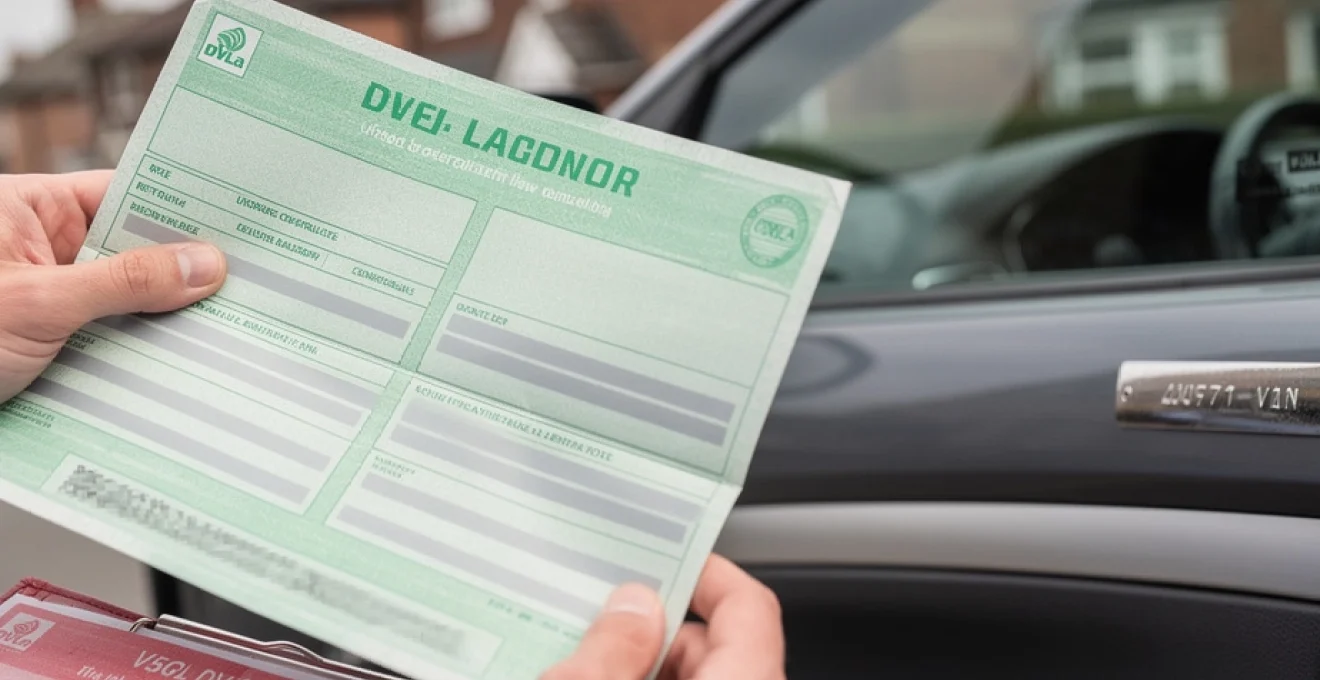
The Vehicle Identification Number, or VIN, is the single most important identifier for any car registered in the UK. When you buy a vehicle, especially second‑hand, the fastest way to confirm that what you are paying for is genuine is to match the VIN shown on the V5C logbook and the green V5C/2 new keeper slip with the number stamped and plated on the vehicle itself. If the numbers do not line up, the risks range from annoying paperwork problems to serious issues such as vehicle cloning and confiscation. Understanding exactly where the VIN appears on the V5C and how to read it correctly puts you firmly in control.
Understanding how the VIN is recorded on a DVLA V5C and new keeper slip
VIN definition, structure and format under UK and EU standards (ISO 3779)
A modern VIN is a standardised, 17‑character code defined by ISO 3779. Every car, van, bike or light commercial vehicle registered with the DVLA must carry a unique VIN, and that same code is printed on the V5C logbook and the new keeper slip. The VIN is made up of numbers and capital letters, excluding characters such as I, O and Q that can be confused with 1 or 0. Think of it as a car’s DNA sequence: one string that encodes where it was built, who built it, and which exact vehicle rolled off the line.
The structure is split into three main blocks. The first three characters are the World Manufacturer Identifier (WMI), which pinpoints the manufacturer and region, for example SAJ for Jaguar or WVW for Volkswagen passenger cars. Characters 4 to 9 form the Vehicle Descriptor Section, used by OEMs to define body style, restraint type, engine family and other configuration data. The final eight characters, 10 to 17, make up the Vehicle Identifier Section, often including model year and plant code plus a serial number that is unique to that manufacturer. On your V5C and V5C/2, the entire 17‑character sequence is printed in one field, even if it wraps onto two visual lines.
How the DVLA ingests manufacturer VIN data from OEMs like ford, BMW and volkswagen
Vehicle identity starts long before a number plate is fixed to the bumper. Manufacturers such as Ford, BMW and Volkswagen allocate a VIN at the production planning stage and stamp or laser‑etch it into the chassis or monocoque. That VIN, along with technical specification data, is then supplied electronically to the DVLA using secure batch files in a standardised ODX or similar data format. The DVLA matches this OEM VIN information against type approval records so that the V5C logbook accurately reflects the car’s engine size, fuel type, emissions class and body style.
When a dealer registers a brand‑new car, the VIN and keeper details are submitted via an online dealer portal. The DVLA’s system validates the 17‑character VIN against known WMIs and check‑digit algorithms to spot obvious errors. Once accepted, the VIN is written into the core vehicle record in the DVLA database. From that point, every document generated – full V5C, V5C/2 new keeper slip, tax reminders and MOT history records – is anchored to that VIN. If you later run an HPI report or other data check, those services query the same underlying VIN‑based record, which is why even a single typo on the V5C can cause big headaches.
Differences between VIN, chassis number and engine number on V5C logbooks
On older vehicles and in casual conversation, the terms VIN, chassis number and engine number are often used interchangeably, but they do not mean the same thing on a modern V5C. The VIN is the 17‑character identifier defined by ISO and is now treated as the official chassis number. It stays with the vehicle for life, even if the number plate changes, the engine is swapped or the car is exported and re‑imported. In the V5C, the DVLA labels this field as VIN/Chassis/Frame No. to reflect that combined role.
The engine number is a separate code applied to the engine block by the manufacturer. It is shown on the V5C in a distinct field and may be much shorter than the VIN. Engine numbers can legitimately change if a replacement engine is fitted, whereas altering a VIN outside DVLA processes is illegal. For older vehicles that pre‑date 17‑digit VINs, the original chassis or frame number is recorded instead and reused in the VIN field. When you cross‑check your paperwork, focus on the 17‑character VIN as the master identity and treat the engine number as secondary confirmation.
Front and rear pages of the V5C: where the VIN appears in sections 4, 5 and 10
The full red V5C registration certificate spreads vehicle and keeper details across several sections, and the VIN does not sit in only one place. On the main inside page, in what DVLA labels as Section 4: Vehicle Details, the VIN appears near the top under the VIN/Chassis/Frame No. field along with the registration mark, make, model, body type, and engine capacity. This is usually the clearest, most easily readable presentation of the VIN. Section 5: Previous Keeper(s) and Section 10: New Keeper’s Details do not repeat the full VIN, but they relate directly to the same DVLA record anchored to that identifier.
When the V5C is detached to create the green V5C/2 new keeper supplement, a portion of the data, including the VIN, is duplicated. If you unfold a complete V5C, the new keeper slip sits as a green panel, typically on the right‑hand side. The layout has changed slightly over the years, but the VIN remains close to the registration number and document reference code. If you are examining a V5C at a viewing, it is good practice to locate the VIN in Section 4 first, then confirm that the same characters appear on the V5C/2 tear‑off section.
Exact location of the VIN on a V5C new keeper slip (green slip V5C/2)
Where the VIN appears on the green V5C/2 new keeper supplement layout
The green V5C/2 new keeper slip is the temporary proof that a vehicle has been sold or transferred. It is also the quickest way for you to find the VIN without carrying the full logbook around. On current red‑style V5Cs, the V5C/2 is printed in green and labelled clearly at the top as “New keeper details”. Around halfway down the slip, usually beneath the registration number, the make and model, you will see a line marked VIN/Chassis/Frame No.. The 17‑digit VIN is printed directly alongside that label.
Because the V5C/2 is more compact than the main logbook, the DVLA compresses some fields. The VIN might be printed in a slightly smaller font than the bold registration mark above it. For imported vehicles or long VIN formats from some manufacturers, the number can take up almost the entire line. On genuine DVLA documents, the characters are evenly spaced, aligned and sharp. If spacing looks irregular, or part of the line appears to have been over‑typed, that is a strong reason to pause and investigate further.
Identifying the VIN label near the registration mark and document reference number
When quickly scanning a new keeper slip, it is easy to confuse the VIN with the document reference number, as both are long numeric strings. The layout, however, makes it possible to distinguish them at a glance. The document reference number on the V5C/2 is a 12‑digit code used for online transactions such as taxing the vehicle or updating keeper details. It is often grouped visually as nnnn nnn nnnn n and sits near the bottom of the green slip, usually with wording such as “Document reference number” or “Doc. Ref. No”.
The VIN field, in contrast, explicitly carries the printed label VIN/Chassis/Frame No. and contains 17 characters, most often in a mix of letters and numbers. If you count only 11 or 12 digits, you are almost certainly looking at the document reference rather than the VIN. Some older blue‑style V5Cs carried an 11‑digit reference on the new keeper section, which can create confusion when trying to tax a car online that now expects a 12‑digit format. In those cases, the VIN is still present as a separate, 17‑character string tied to the physical vehicle, not to the document.
Reading a long VIN correctly on multi-line or wrapped print on the slip
Long VINs with complex manufacturer descriptors sometimes push the DVLA layout to its limit, especially on older printers or when an owner’s details take extra space. On a V5C/2, the VIN field is designed as a single line, but on reprinted documents it can visually wrap into a second line without repeating the label. This can make reading and typing the VIN into online forms more error‑prone, particularly if a character lands right at the line break.
If the VIN on the new keeper slip appears to span two lines, treat it as one continuous sequence with no spaces. The DVLA database ignores spaces and line breaks, and most online services expect the VIN entered as a solid 17‑character string. A practical approach is to run a finger under the characters while reading them aloud or to copy the code into a note on a phone and count each character manually. Any VIN shorter or longer than 17 characters on a post‑1980 vehicle should immediately raise questions about document integrity or print quality.
Spotting OCR and print artefacts that can obscure characters on the V5C/2
V5C new keeper slips are laser‑printed on security paper, but smearing, toner dropout and folding can still obscure parts of the VIN. When a slip has been scanned or photographed, optical character recognition (OCR) artefacts can introduce misread digits, turning a 5 into an S or a 0 into an O. You may also encounter historical slips produced on earlier printing systems with slightly fuzzy type. For a VIN check or an HPI report, a single mis‑keyed character can completely change the result.
Take time to inspect ambiguous characters closely. Under good light, the difference between a stamped 3 and a 8 or between Z and 2 becomes clear. Comparing the VIN on the V5C/2 with the one on the metal plate or windscreen tag provides a reality check: if the same character looks different in both places, the issue is probably print quality rather than identity fraud. If you are unsure about one character and cannot resolve it from the vehicle itself, contacting the DVLA to confirm the VIN stored in the official record is a safer option than guessing.
Cross-checking the VIN on the new keeper slip against the vehicle itself
Locating stamped VINs in engine bay bulkheads, inner wings and chassis rails
A VIN printed on paper has limited value until it is matched against the number physically stamped into the vehicle’s structure. Manufacturers place the primary stamped VIN in a location designed to be hard to tamper with but still accessible for inspection. On many UK‑market vehicles, this stamped VIN can be found on the engine bay bulkhead, on the top of an inner wing, or along a chassis rail. It is usually stamped directly into the metal in a neat, consistent font, sometimes with a light layer of paint or lacquer over the top.
To cross‑check, open the bonnet and look for a straight line of characters around 10–20 cm long. Cleaning away light dirt or dust with a cloth often reveals the stamped VIN more clearly. On some modern cars, a small inspection flap in the plastic trim covers the stamping point for security reasons. The stamped VIN should match the 17‑character code on the V5C/2 exactly, including all letters and digits. If part of the number is missing due to rust or damage, compare the visible portion and consider seeking a professional inspection to verify the rest.
Finding VIN plates on door pillars, b‑posts and dashboard scuttles on UK models
In addition to the primary stamped VIN, most manufacturers also fit one or more VIN plates or labels. On UK vehicles, these often sit on the driver’s side B‑post (the door pillar you see when the door is open), on the slam panel at the front of the engine bay, or at the base of the windscreen on the dashboard scuttle. The windscreen VIN plate is particularly useful because it can be read from outside the vehicle, which is why it is widely used by police and enforcement agencies for quick roadside checks.
VIN plates can be metal plates riveted to the bodywork, hard plastic tags or adhesive labels with tamper‑evident features. The format may include extra information such as maximum permissible weights, paint code and model variant, but the 17‑character VIN stands out. When checking a newly purchased car, it is good practice to compare at least two different physical VIN locations with the V5C/2. If all three match, the risk of accidental mis‑stamping or minor body repairs causing confusion is greatly reduced.
Comparing VIN on V5C/2 with windscreen etching and OEM build plates
Beyond the obvious VIN locations, some vehicles also carry VIN‑related information on glass etchings and OEM build plates. Window etching is more commonly used for the registration number rather than the full VIN, but certain manufacturers or security packages incorporate partial VIN sequences into the etch for deterrence. Inside the engine bay, an OEM build plate or sticker may display the VIN alongside engine code, gearbox code and option codes. This is especially common on German makes such as BMW, Audi and Mercedes‑Benz.
By comparing the VIN on the V5C/2 new keeper slip with these secondary markers, you gain additional confidence that the car has not been built from parts of different vehicles. A mismatch between the V5C VIN and the build plate VIN should immediately be treated as a red flag. In some rare cases, legitimate shell replacements or heavy accident repairs can result in unusual combinations, but these should always be backed up by comprehensive documentation, insurance records and, ideally, DVLA correspondence confirming any approved identity changes.
Procedures when the physical VIN tag is missing, corroded or illegible
Rust, crash damage and poor repairs can sometimes destroy or obscure a VIN stamping or plate. If you find that the VIN on the chassis is partially illegible while the V5C/2 shows a clean 17‑digit code, the situation needs careful handling. Simply re‑stamping the VIN yourself, or allowing a bodyshop to improvise, can lead to serious legal issues. The DVLA takes VIN tampering extremely seriously because it is a common tool in vehicle cloning and ringing.
The correct procedure is to document the damage with clear photographs and contact the DVLA for guidance. In many cases, the agency will require an inspection, sometimes via a contractor such as the Driver and Vehicle Standards Agency (DVSA) or an approved engineer. If the vehicle’s identity can be reliably confirmed from other evidence – service history, previous MOTs, manufacturer records and any remaining partial VIN – the DVLA may authorise a replacement VIN to be stamped at an approved location. This is typically supported by an authorisation letter, and the event will be noted on the vehicle’s record, preserving transparency for future buyers.
Using GOV.UK, HPI check and MOT history services with the VIN from your V5C
Once you have located and confirmed the VIN on your new keeper slip, that information opens the door to several useful online checks and services. On GOV.UK, the official vehicle enquiry service allows you to verify core details such as make, colour, tax status and statutory off‑road notification (SORN) using the registration number, while cross‑checking with the VIN gives an extra layer of assurance that the correct record is being viewed. For a more detailed background, commercial providers offer HPI‑style checks that are keyed on both the registration and the VIN. These checks report on outstanding finance, recorded theft, insurance write‑offs and plate changes, all of which are critical when assessing a used car.
The government MOT history service lets you view every MOT test recorded for a vehicle since the system became digital, including mileage, advisory notes and failures. Matching the VIN from the V5C/2 with the VIN displayed on MOT certificates or the online MOT record confirms that the logged history genuinely belongs to that car, not to a donor vehicle with a similar plate. According to DVSA statistics, around 30–35% of vehicles fail their MOT at the first attempt each year, making a consistent, traceable history a powerful indicator of how well a car has been maintained.
Detecting VIN anomalies and potential vehicle cloning using the V5C new keeper slip
VIN anomalies are one of the clearest signals that a vehicle may have been cloned or subject to identity fraud. A cloned car typically carries the registration and VIN of a legitimate vehicle while itself being stolen or written off. When checking a car with the V5C/2 in hand, start by comparing the VIN on the slip with all physical VIN locations. If even one stamped or plated number differs by a character or two, consider whether the area shows signs of grinding, welding or repainting. Fresh paint or irregular welds around the VIN area can indicate tampering.
Next, run the VIN and registration through an HPI‑style check and the MOT history service. If the recorded mileage or colour is wildly different from what is in front of you, or MOT tests are logged in areas far away from where the car has supposedly lived, the identity may not be genuine. Industry reports suggest that vehicle cloning cases have increased in line with rising used‑car values and digital plate trading, so a careful VIN comparison is more important than ever. The cost of a thorough check is small compared to the risk of losing both the car and the money if police later seize a cloned vehicle.
What to do if the VIN is missing, incorrect or altered on your V5C new keeper slip
Discovering a problem with the VIN on the V5C/2 new keeper slip does not automatically mean that a car is illegal, but it does mean that you need to act methodically. If the VIN on the slip contains obvious printing errors – for example, a mis‑typed letter compared with multiple consistent VIN locations on the vehicle – gather evidence by taking clear photos of the car’s VIN stampings and plates and contact the DVLA. The agency can cross‑reference the data stored on its systems and, if appropriate, issue a corrected V5C. Driving a car with a minor clerical error in the VIN is unlikely to lead to enforcement action immediately, but fixing the record promptly avoids MOT and insurance complications later.
Where the V5C/2 VIN appears to be deliberately altered, or the vehicle’s physical VIN points have clearly been tampered with, the safest course is to walk away from any purchase that has not yet completed. If you already own the vehicle and only discover the issue afterwards, inform the police and the DVLA as soon as possible and provide all supporting documents such as receipts and prior adverts. Being proactive shows that you are a victim, not a participant, in any fraud. In more complex cases involving kit‑built cars, restorations or heavily modified vehicles, the DVLA may require an inspection to allocate a new identity number or a Q‑plate, particularly if the original VIN cannot be proven. Establishing a clean, consistent VIN across the car and the paperwork is the foundation for hassle‑free ownership, smooth resale and full protection under UK vehicle regulations.