
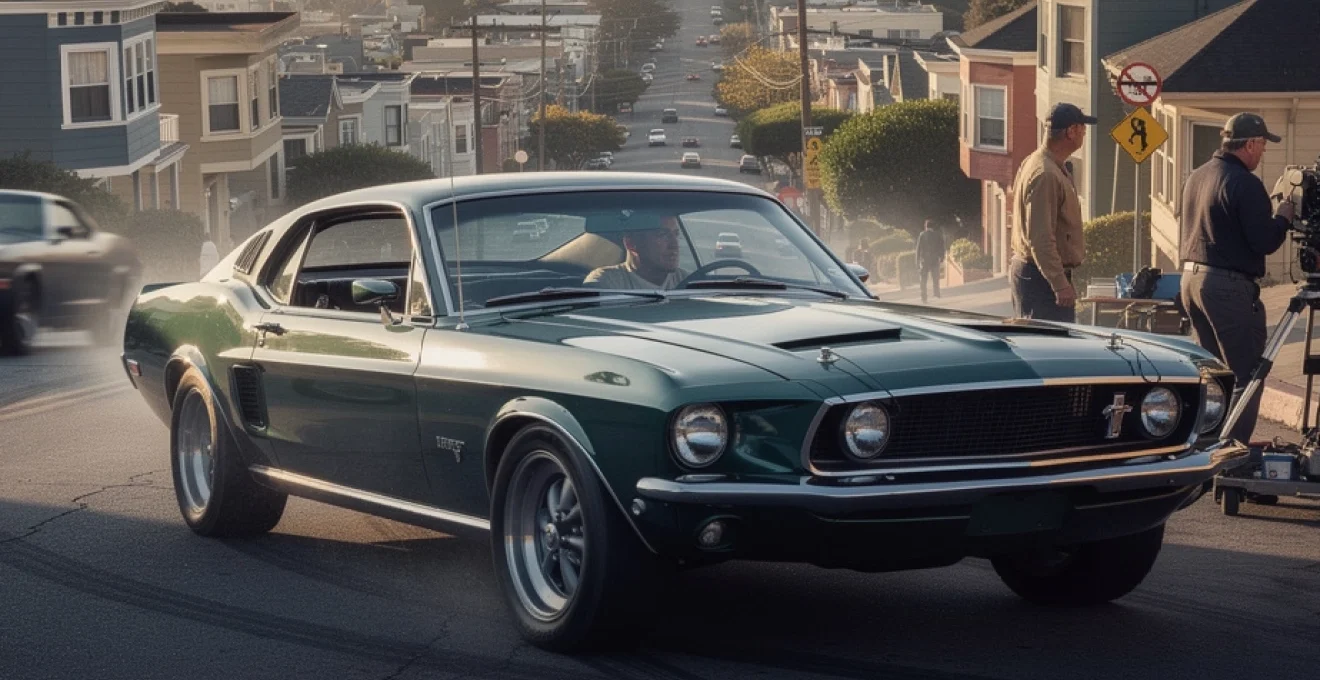
The Ford Mustang from Bullitt has become more than a film prop or a classic coupé. It is a rolling symbol of late‑1960s American muscle, pared-back police cool and a new way of shooting action on real city streets. More than fifty years after the 1968 movie debuted, the Highland Green fastback still shapes how you imagine a tough detective’s car, how directors design chase scenes and how modern performance Mustangs are specified. If you are considering a Bullitt-style build, looking at auction values or simply want to understand why this particular Mustang matters so much, the story behind the car blends engineering detail, stunt craft and cultural history in a way few vehicles can match.
Historical context of the ford mustang in bullitt and late-1960s american muscle culture
Positioning the 1968 ford mustang GT 390 within ford’s first-generation mustang lineage (1964½–1973)
By the time the 1968 Ford Mustang GT 390 appeared in Bullitt, the first-generation Mustang had already sold over one million units in less than two years. Launched in 1964½ as a “sports car for the masses”, the Mustang evolved rapidly, growing in size and weight to accommodate bigger V8 engines and more luxury equipment. The GT 390 sat near the top of this expanding range, above the small‑block 289 cars and below the exotic Shelby models. In 1968 the GT badge meant a performance‑oriented package that still felt usable enough for a cash‑strapped cop, which is precisely why the production chose it instead of something more overtly glamorous.
The Bullitt Mustang was ordered as a Fastback GT with the 390 cubic inch FE-series V8, four‑speed manual and front disc brakes. Within Ford’s first-generation Mustang catalogue, this combination balanced straight‑line pace with real-world affordability. For a driver like you in 1968, it offered muscle-car presence without the insurance and maintenance burden of a full race-bred Shelby GT500. That pragmatic, almost understated positioning helped it feel believable on screen, and it still makes sense if you are considering a period-correct Bullitt tribute today.
Comparison of the bullitt mustang to contemporary muscle icons: dodge charger R/T, pontiac GTO, chevrolet camaro SS
The chase in Bullitt deliberately paired the Mustang with a black Dodge Charger R/T 440, creating a visual duel between two of the era’s most potent muscle cars. On paper, the Charger’s 440 Magnum V8 had a power and torque advantage over the GT 390 Mustang, and its longer wheelbase gave it high‑speed stability. The Mustang, by contrast, was shorter, lighter and more agile, with a slightly more European flavour to its proportions. Against cars like the Pontiac GTO and Chevrolet Camaro SS, the Bullitt Mustang represented a middle ground: not the biggest engine, not the flashiest styling, but a compelling mix of performance and subtle menace.
For enthusiasts comparing muscle legends today, the Bullitt car’s appeal lies less in sheer numbers and more in character. Where a GTO might have flamboyant chrome and stripes, the Highland Green Mustang wears a debadged grille and muted paint. Where a Camaro SS often trades on overt aggression, the Bullitt specification whispers capability. If you are building or buying a classic muscle car and value understatement, that balance is still highly relevant in the modern collector market.
Influence of san francisco’s urban topography on the film’s car selection and stunt choreography
San Francisco’s unique topography—steep hills, abrupt intersections, narrow streets and rough tarmac—shaped both the choice of vehicles and the choreography of the Bullitt chase. The production needed cars with robust suspensions and simple, durable chassis layouts to survive repeated launches and landings over the city’s infamous crests. A unibody coupé like the Mustang Fastback, with a strong subframe and live rear axle, offered exactly that kind of punishment tolerance. The Charger, equally tough, provided a visual counterpoint while sharing the necessary mechanical ruggedness.
The city’s vertical layout also dictated camera positions and driving lines. Long downhill sections allowed the Mustang to build speed naturally, while uphill approaches to junctions produced the now legendary airborne shots. If you rewatch the scene with an engineer’s eye, the way the Mustang’s chassis compresses and rebounds tells a story about 1960s suspension design under real stress. For anyone designing stunts in urban environments today, San Francisco remains a template for blending geography, mechanical limits and cinematic drama.
How steve McQueen’s racing persona and motorsport background shaped the on-screen mustang character
Steve McQueen’s reputation as a genuine racing enthusiast, rather than just an actor, played a major role in how the Bullitt Mustang was presented. McQueen had experience in motorcycle and car competition, including events like the 12 Hours of Sebring, and pushed hard for authenticity. That racing persona drove key decisions: a manual gearbox rather than an automatic, minimal chrome, no wheel covers, and a “used” look that suggested the car had already seen hard miles. McQueen wanted a believable detective’s car that also felt like something an enthusiast would choose.
Behind the scenes, McQueen insisted on doing many of his own stunts, which required a car he could genuinely drive at the limit. The Mustang’s on‑screen character—slightly tail‑happy, loud, but controllable—mirrors the way a skilled amateur racer might handle a heavy, powerful coupé on closed streets. If you are interested in how driver personality can shape vehicle choice in film, Bullitt provides one of the clearest case studies: the car effectively becomes an extension of McQueen’s minimalist, no‑nonsense image.
Technical specification of the 1968 ford mustang GT 390 “bullitt” hero car
Factory powertrain configuration: 390 cu in FE V8, 4-speed manual, carburetion and drivetrain layout
The factory specification of the Bullitt hero car centred on Ford’s FE‑series 390 cu in V8, officially rated at around 325 bhp and over 427 lb ft of torque. Fed by a four‑barrel carburettor and backed by a four‑speed manual gearbox, the engine delivered ample low‑end shove typical of late‑1960s American muscle. Power went to the rear wheels through a conventional live axle with a limited-slip differential, making the car ideal for controllable oversteer and dramatic throttle‑steer exits from tight corners.
In a modern context, those figures may not sound extraordinary when hot hatchbacks offer similar power. Yet the way the torque arrives—thick, immediate and unfiltered—still feels special if you drive a correctly set‑up GT 390 today. For anyone restoring a Bullitt‑inspired Mustang, choosing a properly built FE V8 or a period‑style big block with similar characteristics is crucial to recreating the car’s muscular, slightly brutal power delivery.
Suspension and chassis setup: live rear axle, leaf springs, front disc brakes and handling limitations
Underneath the fastback bodywork, the 1968 Mustang relied on a simple but tough suspension package. Front wheels were located by unequal‑length control arms with coil springs and a front anti‑roll bar, while the rear used traditional leaf springs supporting the live axle. Front disc brakes were part of the GT package, with drums at the rear. On smooth roads this setup delivered a firm but acceptable ride; on San Francisco’s broken tarmac and violent crests, it was pushed to extremes.
From a handling perspective, the combination of a heavy iron big block and basic suspension geometry produced noticeable understeer at turn‑in and pronounced body roll. The live axle could skip sideways if unsettled mid‑corner, especially on the city’s rough surfaces. Yet for filming, those limitations turned into strengths, allowing the stunt team to create dramatic slides and jumps without sophisticated electronics getting in the way. If you are configuring a restomod, subtle upgrades to bushings, spring rates and dampers can retain that classic feel while improving safety and predictability.
Body style, fastback configuration and visual differences from standard 1968 mustang GT models
The decision to use a Fastback rather than a Notchback or Convertible was central to the Bullitt Mustang’s legend. The 2+2 Fastback silhouette, with its long roofline and sloping rear screen, created a dynamic profile even when parked. Visually, the Bullitt hero car differed from a standard 1968 Mustang GT in several deliberate ways: removal of the factory grille emblem, deletion of most exterior badging, blacked‑out grille treatment, and the understated Highland Green paint without stripes or contrasting roof.
These changes made the car look more like a sleeper—a performance car hiding in plain sight—than a showroom GT. The absence of chrome wheel covers and the use of simple Torq‑Thrust style wheels reinforced that subtle aggression. For enthusiasts replicating the Bullitt look, paying attention to these visual deletions is just as important as choosing the right body style, because the aura of the car comes as much from what is removed as from what is added.
Interior equipment: gauge cluster, steering wheel, seating and period-correct safety features
Inside, the Bullitt hero car retained a largely stock 1968 Mustang GT cabin, but the camera rarely lingered on luxury. A three‑spoke steering wheel, round‑dial gauge cluster with large speedometer and tachometer, and simple black vinyl seats created a functional environment appropriate for a lieutenant’s salary. Wood‑grain appliqués on the dash and door cards added a hint of upmarket feel without drifting into ostentation. There was no roll‑cage or racing harness on screen, even though some safety additions were made behind the scenes for stunt work.
Period‑correct safety equipment was basic by modern standards: lap belts, collapsible steering column, and padded dash areas. No airbags, no ABS, no traction control—just the driver’s skill and a sturdy structure. If you sit in a faithful Bullitt tribute today, the cabin feels surprisingly small and intimate compared with modern cars, which enhances the sense of speed at relatively modest velocities. That intimacy helps explain why the chase sequence still feels so visceral when viewed through the cabin shots.
Stunt preparation and mechanical modifications for the bullitt mustang chase sequence
Engine tuning, exhaust modifications and performance upgrades executed by max balchowsky
To make the Bullitt Mustangs perform convincingly on camera, the production turned to race mechanic Max Balchowsky. He modified the 390 V8s for reliability and response rather than sheer peak power, adjusting carburettor settings, ignition timing and cooling systems for long days of hard use. One of the most distinctive changes was to the exhaust system. Less restrictive, custom‑fabricated pipes created the raw, hard‑edged soundtrack that became almost as famous as the car itself.
From an enthusiast’s viewpoint, this approach mirrors a well‑sorted fast‑road build rather than a full race engine. Balchowsky focused on making throttle response crisp and torque delivery consistent across the rev range, ideal for on‑camera acceleration runs and repeated takes. If you are planning a Bullitt‑inspired engine build, prioritising reliability and sound quality over dyno bragging rights will yield a closer match to the film car’s real-world performance.
Reinforcement of chassis, suspension and subframe for high-impact jumps on san francisco streets
Repeated high‑speed jumps over San Francisco’s crests would quickly destroy a stock 1968 Mustang, so both hero and stunt cars received significant structural reinforcement. Welded seams, strengthened shock towers and bracing around the front subframe helped resist the enormous forces generated on landing. Suspension components were uprated or doubled‑up, with heavy‑duty dampers and revised bump stops designed to absorb impacts that production road cars were never meant to tolerate.
Those modifications turned the Mustang into a kind of low‑flying hammer, capable of punching into the road surface and surviving to drive away. If you watch closely, you can see panels distort and ride heights change over the course of the chase, tangible evidence of the punishment endured. For anyone tempted to recreate similar jumps, modern safety standards and classic car values make that approach highly inadvisable, but the principles of chassis reinforcement remain vital for historic rally builds or track‑focused restomods.
Tyre, wheel and braking system choices for high-speed filming and controlled slides
The film cars ran on period‑correct American Racing Torq‑Thrust wheels, which not only suited the aesthetic but also allowed easy tyre changes during the shoot. Tyres were chosen to provide a balance of grip and controllability; the stunt team needed predictable breakaway characteristics to stage long power‑slides and controlled drifts. Brakes were upgraded and carefully maintained, as repeated hard stops on steep streets could quickly induce fade in standard 1960s systems.
It is worth remembering that the cars in Bullitt operated without modern aids like ABS or electronic brake distribution. Stopping distances and pedal feel depended entirely on hardware and driver skill. For a contemporary enthusiast replicating the appearance but intending to drive regularly in traffic, sympathetic upgrades such as improved pad compounds, modern tyres with similar sidewall profiles and perhaps discreet brake cooling can significantly enhance safety while preserving the visual signature.
Removal of factory badging, grille trim and cosmetic elements to achieve the stripped “sleeper” aesthetic
One of the most distinctive aspects of the Bullitt Mustang is what is missing. The film team stripped away the pony emblem from the grille, much of the chrome brightwork and any overt GT badging. Side stripes and decorative elements were removed or toned down. The goal was a “working car” look—a detective’s tool rather than a dealer display piece. That de‑badged, almost anonymous aesthetic helped the Mustang stand apart from the more flamboyant muscle cars of the era.
This stripped approach has since influenced countless sleeper builds, where owners prioritise performance and stance over obvious branding. If you want to capture the Bullitt feel in your own project car, starting by subtracting visual clutter is often more effective than adding aftermarket body kits. A clean grille, subtle paint and the right stance can create an impression of restrained capability that neon graphics never achieve.
Sound design: capturing raw V8 audio from the mustang and charger for cinematic impact
The chase scene’s power comes not only from visuals but also from sound design. Unlike many contemporaneous films that relied heavily on music, Bullitt let the real audio of the Mustang and Charger dominate. Production teams mounted microphones close to exhaust outlets and under the bonnet to capture induction roar, valve‑train clatter and the distinctive bark of wide‑open throttles. Those raw recordings were then layered and edited to match on‑screen action, amplifying the sense of speed and danger.
The absence of a pop soundtrack, combined with authentic mechanical noise, created a level of immersion that changed how audiences expected car chases to sound.
For today’s content creators and YouTube channels dedicated to classic cars, that lesson remains powerful: honest mechanical sound often engages viewers more than overproduced music. If you are filming your own car, prioritising exhaust tuning and microphone placement can deliver material that resonates with enthusiasts in a way digital soundtracks rarely manage.
Filming the bullitt chase: stunt drivers, camera rigs and practical effects
Roles of steve McQueen, bud ekins and stunt coordinator carey loftin in the driving sequences
The Bullitt chase was a team effort combining McQueen’s star power with the expertise of professional stunt drivers. While McQueen performed many of the less extreme manoeuvres and interior shots, high‑risk sequences were handled by specialists such as Bud Ekins and stunt coordinator Carey Loftin. Their experience allowed the production to push the cars harder and stage complex near‑misses in live traffic conditions, something that would be tightly controlled under today’s safety regulations.
Loftin’s planning balanced spectacle with survivability, mapping out routes that showcased San Francisco while accounting for the cars’ limitations. Ekins, already famous for motorcycle work, applied his precise control to the Mustang in key moments. If you have ever wondered why the chase still feels risky and unsanitised compared to modern CGI‑heavy films, that blend of star involvement and stunt professionalism is a major factor.
In-car and exterior camera rigs: gyro-stabilised mounts, low-angle shots and bumper-mounted perspectives
To place viewers inside the chase, the crew used innovative camera mounts for the era. Gyro‑stabilised rigs and rigid brackets attached to the Mustang’s body captured low‑angle shots of the front suspension working, as well as over‑shoulder views of McQueen shifting gears. External cameras positioned near bumpers and wheel arches conveyed speed through rapidly passing kerbs and road markings. Those compositions turned the Mustang into both subject and camera platform.
Compared with later productions that leaned heavily on helicopter shots or studio rear‑projection, Bullitt’s in‑car footage feels intimately connected to the road. If you create automotive content today, that approach remains instructive: a well‑placed fixed camera at wheel height can communicate velocity and danger more effectively than a distant, stabilised aerial view. The technology has evolved, but the underlying principles of perspective and proximity still apply.
Continuity analysis: gear changes, wheel swaps, panel damage and reused streets in the final cut
For keen‑eyed viewers, the Bullitt chase offers a fascinating continuity puzzle. The Mustang sometimes appears to gain or lose hubcaps between shots, body damage appears and disappears, and certain San Francisco streets are used multiple times from different angles. There are also moments where gear changes on screen do not precisely match the car’s speed or engine note, as footage from various takes was intercut to build the most dynamic sequence.
Rather than undermining the scene, these quirks add to its charm. They also illustrate the practical constraints of analogue filmmaking with limited cars, finite time and no digital editing tools. Spotting these details can be an enjoyable exercise if you already appreciate the broader authenticity of the driving. The fact that enthusiasts still discuss such minutiae more than fifty years on underlines how deeply the Mustang’s on‑screen presence has embedded itself in popular culture.
Practical effects versus rear-projection: how bullitt redefined real-world car cinematography
Before Bullitt, many Hollywood car chases relied on rear‑projection—actors “driving” in front of pre‑filmed backgrounds. Bullitt rejected that approach almost entirely, opting for practical effects with real cars, real streets and genuine speed. The result was a sequence that felt dangerous and unpredictable compared with the polished but artificial style that preceded it. In 10 minutes and 53 seconds, the film redefined what audiences expected from cinematic driving.
By committing to genuine location shooting and physical stunts, Bullitt set a new benchmark for car cinematography that still influences directors more than half a century later.
Subsequent classics, from The French Connection to modern franchises, have borrowed heavily from that template: minimal music, practical stunts and camera positions that put the viewer in the driver’s seat. If you analyse contemporary chase scenes, the DNA of the Bullitt Mustang’s run through San Francisco remains clearly visible.
Identification, disappearance and rediscovery of the original bullitt mustangs
Distinguishing features between the “hero” car and the “stunt” car used in production
Two Highland Green 1968 Mustang GT Fastbacks were supplied for the production: a “hero” car for close‑ups and a “stunt” car for the most violent jumps and collisions. The hero car retained more of its interior trim and cosmetic finish, making it suitable for dialogue scenes and shots of McQueen driving. The stunt car was heavily modified structurally and often showed more visible panel damage, mismatched gaps and eventual mechanical fatigue.
Forensic study after the cars resurfaced confirmed subtle differences in welds, reinforcement plates and suspension components. Even the way certain holes were drilled in the chassis helped experts distinguish one from the other. If you want to understand provenance in high‑value film cars, the Bullitt Mustangs provide a textbook example of how production modifications can later serve as identification markers.
Tracing the post-production history: warner bros. sales, private ownership and the kiernan family story
After filming wrapped, the hero car left studio life and began a more ordinary existence. It was first sold to a Warner Bros. employee, then in 1970 passed to a New Jersey police detective. Four years later, in 1974, it was purchased by the Kiernan family for around $3,500—a figure that would become a historical footnote when the car later set auction records. The Kiernans used the Mustang as a regular driver before retiring it and resisting attempts, including one from McQueen himself, to re‑acquire the car.
The family kept the Mustang largely hidden for decades, creating a modern automotive legend: the “lost” Bullitt car. Its eventual re‑emergence for Bullitt’s 50th anniversary in 2018, after sympathetic recommissioning, connected the dots between the film era and today’s collector market. For enthusiasts, that uninterrupted private ownership story adds a layer of authenticity and romance that even the most meticulously restored replica cannot match.
The mexican scrapyard saga of the stunt car and subsequent authentication efforts
The stunt car’s fate was even more dramatic. Long rumoured destroyed after filming, it eventually resurfaced in a Mexican scrapyard, in heavily damaged condition. Enthusiasts and specialists recognised key structural modifications and VIN data that suggested it was the missing production car. What followed was a complex process of authentication, documentation and partial restoration, with the goal of preserving its identity and film history rather than returning it to perfect cosmetic condition.
The stunt car’s rediscovery in 2017 added another chapter to the Bullitt Mustang mythology. Seeing a battered, battle‑scarred chassis juxtaposed with the better‑preserved hero car highlighted the physical cost of those legendary jumps. For collectors and historians, it also demonstrated the importance of checking beyond surface appearance when assessing potential film vehicles with unusual modifications or paperwork gaps.
VIN verification, build sheets and forensic techniques used to confirm bullitt provenance
Confirming that a given 1968 Mustang is one of the Bullitt cars requires more than a paint colour and a Fastback roofline. Experts relied on VIN records, Ford build sheets, period photographs and forensic examination of welds, bracket positions and reinforcement plates. Even the pattern of holes drilled for camera mounts became evidence. Specialist reports, similar in spirit to Marti Reports for classic Fords, compiled this data into authoritative documentation.
For anyone considering a high‑value film car purchase, the Bullitt case underscores the need for deep due diligence. Matching hidden stampings, cross‑referencing production notes and using forensic techniques borrowed from accident investigation have become standard practice at the top end of the classic market. That methodology protects buyers while preserving the integrity of historically significant vehicles.
Market valuation and auction record of the bullitt mustang hero car
Mecum kissimmee 2020 sale: bidding dynamics and final hammer price analysis
When the Bullitt hero car crossed the block at Mecum’s Kissimmee auction in January 2020, it sparked international attention. Bidding opened at just $3,500—the same price it realised in its two previous private sales—but quickly escalated as multiple parties competed. For a period it appeared that $2.55 million would be the ceiling, before a late burst pushed the hammer price to $3.4 million. With buyer’s premium, the final figure reached approximately $3.74 million, establishing a new record for a Mustang at auction.
That sale illustrated how provenance and cultural impact can outweigh pure mechanical specification in the collector car market. Many faster, rarer or more technically advanced Mustangs exist, yet none carry the combined weight of McQueen’s association, cinematic history and a near‑mythic disappearance and rediscovery story. If you study classic car investment trends, the Bullitt sale reads almost like a case study in how narrative value compounds monetary value.
Comparative valuation against shelby GT500, boss 429 and other blue-chip collector mustangs
In purely technical terms, cars like the Shelby GT500, Boss 429 and early GT350s sit above a standard GT 390 Mustang. Limited production numbers, racing pedigrees and specialised engineering normally place them at the top of blue‑chip Ford valuations. Yet the Bullitt hero car comfortably eclipsed recent auction figures for even high‑quality Shelbys, highlighting how film provenance can re‑order traditional hierarchies. For example, while top Boss 429s may sell in the low seven‑figure range, the Bullitt Mustang’s result pushes into territory more commonly associated with rarer European exotics.
If you are building a collection, this dynamic raises strategic questions. Is it wiser to chase the most technically advanced homologation special, or to prioritise cars with deep cultural resonance? The Bullitt case suggests that when an automobile becomes an icon beyond the enthusiast world, its market behaves more like fine art than like a typical piece of engineering.
Impact of film provenance and celebrity association on classic car investment indices
Film provenance has long influenced classic car indices, but the Bullitt Mustang amplified that effect. Comparisons with other celebrity‑linked vehicles—such as Bond Aston Martins or screen‑used Ferraris—show that values can be several times higher than equivalent non‑film cars. Investment analysts tracking classic car indices have noted that media exposure around high‑profile auctions can temporarily lift interest across an entire model range, benefiting owners of non‑film Mustangs as well.
When a single car transcends its category, surrounding models often experience a halo effect in both values and cultural relevance.
For you as a potential investor, that means understanding not only a car’s specification but also its narrative context. Even without direct film provenance, a well‑executed Bullitt tribute or period‑correct GT 390 Fastback in Highland Green can benefit from the model’s elevated profile in the marketplace, especially when trends favour analogue, characterful performance cars over digital‑heavy modern machinery.
Factory and aftermarket bullitt mustang tributes: 2001, 2008–2009 and 2019 models
2001 mustang bullitt (new edge): 4.6L SOHC V8 upgrades, suspension tuning and aesthetic cues
Ford first officially revisited the Bullitt theme in 2001 with a special‑edition Mustang based on the “New Edge” platform. Powered by a 4.6‑litre SOHC V8 with revised intake, exhaust and ECU tuning, it produced a modest but meaningful power increase over the standard GT. Suspension upgrades—stiffer springs, revised dampers and lowered ride height—improved turn‑in and reduced body roll, echoing the film car’s taut stance without sacrificing daily usability.
Visually, the 2001 Bullitt embraced many of the cues that defined the original: Dark Highland Green paint (alongside limited alternative colours), debadged grille, unique five‑spoke wheels and minimal exterior brightwork. Inside, brushed aluminium accents and retro‑inspired gauges nodded to the 1968 cabin. If you are considering an affordable entry into the Bullitt story, these early factory tributes often represent strong value, combining modern reliability with clear thematic links to the film icon.
2008–2009 S197 bullitt: cold-air intake, exhaust calibration and FR3 handling package details
The second-generation factory Bullitt, launched for 2008–2009 on the S197 chassis, took the concept further. Its 4.6‑litre V8 received a cold‑air intake and bespoke ECU calibration, lifting power to roughly 315 bhp. The car featured a freer‑flowing exhaust tuned to emulate the original film soundtrack, delivering a distinctive bark under load. Ford’s FR3 handling package—uprated dampers, springs and thicker anti‑roll bars—sharpened responses, making the car genuinely rewarding on twisty roads.
Aesthetic treatment remained restrained: Dark Highland Green was the signature colour, with a blacked‑out grille, unique 18‑inch wheels reminiscent of Torq‑Thrust designs and almost no badges beyond subtle Bullitt scripts. As a daily‑drivable “analogue” muscle car with a manual gearbox and naturally aspirated V8, the S197 Bullitt has gained traction among enthusiasts who value the blend of retro styling and modern safety features.
2019–2020 S550 bullitt: 5.0L coyote V8, power increase, active exhaust and MagneRide options
To mark the film’s 50th anniversary, Ford introduced the S550‑based Bullitt for 2019–2020. This model used the 5.0‑litre Coyote V8, uprated to around 480 bhp—significantly more than the standard GT thanks to intake components borrowed from the Shelby GT350 and bespoke ECU mapping. An active valve exhaust system allowed drivers to tailor sound levels, from neighbourhood‑friendly to track‑ready roar, reinforcing the car’s dual personality as a usable GT and a weekend toy.
Optional MagneRide adaptive dampers offered a broad range of ride and handling characteristics at the touch of a button, while larger brakes and performance tyres ensured that chassis capability matched the engine’s output. Once again, Dark Highland Green paint, a debadged grille and simple black torque‑inspired wheels defined the look. For you as a modern driver, this iteration arguably delivers the purest fusion of Bullitt aesthetic with contemporary performance and comfort technology.
Colour, badging and trim philosophy: dark highland green, debadged grille and torque-thrust wheels
Across all official and aftermarket Bullitt tributes, certain design principles remain constant. Dark Highland Green paint, or a very close variant, is virtually non‑negotiable for an authentic homage. The grille is typically left free of large badges, emphasising the car’s shape rather than branding. Wheels tend to follow the torque‑thrust or simple multi‑spoke pattern, avoiding chrome excess. Interior trims favour dark colours with selective use of brushed metal or wood‑grain, reinforcing a purposeful, slightly understated atmosphere.
If you are planning your own Bullitt‑inspired build, focusing on these core elements—colour, grille, wheel choice, and restrained trim—will produce a more convincing result than simply adding Bullitt badges. The philosophy is about subtraction and subtlety, not about shouting. Think of it as the automotive equivalent of a tailored suit in dark cloth rather than a fashion‑driven outfit covered in logos.
Cultural legacy of the bullitt mustang in cinema, gaming and automotive design
Influence on later car films and TV series: the french connection, gone in 60 seconds and drive
Bullitt’s Mustang chase laid groundwork for later car‑centric films and TV shows. Productions such as The French Connection, the remake of Gone in 60 Seconds and more recent works like Drive all borrow the template of grounded, location‑based action and character‑defining vehicles. The notion that a car can communicate as much about a protagonist as clothing or dialogue owes much to McQueen’s Highland Green fastback weaving through San Francisco.
For directors and cinematographers, the film demonstrated that audiences respond strongly to real mechanical motion and authentic sound. For you as a viewer, even if not consciously aware of the lineage, modern chases that feel “real” rather than computer‑generated are standing on the Bullitt Mustang’s shoulders. The car effectively became a silent supporting actor whose performance still resonates.
Representation of the bullitt mustang in video games: forza, need for speed and gran turismo
The digital age extended the Bullitt Mustang’s reach into gaming. Titles in the Forza, Need for Speed and Gran Turismo franchises frequently include 1960s Mustang Fastbacks and Bullitt‑inspired variants, sometimes explicitly referencing the film car’s specification and colour. This exposure introduces new generations to the shape and sound of classic American muscle, even if players have never seen the original movie.
If you grew up tuning virtual Mustangs in a game, there is a strong chance that your mental image of a “cool muscle car” owes something to Bullitt. Developers often tune in‑game exhaust notes and handling models to evoke the analogue, tail‑happy character seen on screen. That feedback loop—film influencing car culture, then games re‑amplifying that influence—helps explain why demand for real‑world Bullitt tributes remains robust among younger enthusiasts.
Design references in modern ford performance models: mustang GT performance pack and mach 1
Modern Ford performance models such as the Mustang GT Performance Pack and Mach 1 incorporate subtle Bullitt influences even when not branded as such. Darker wheel finishes, simplified front grilles, and option packages that combine more focused suspensions with understated exterior treatments all echo the film car’s philosophy. Engineers and designers have openly acknowledged that the idea of a factory hot‑rod with restrained styling and enhanced dynamics owes much to the Bullitt template.
For you as a buyer comparing trim levels, recognising these design echoes can clarify why certain configurations feel more “authentic” or driver‑focused. A GT with a performance pack and minimal external flash often channels the Bullitt spirit more effectively than a louder, heavily striped variant, even if both share the same base engine.
Fan culture, replicas and restomod builds inspired by the bullitt specification worldwide
Perhaps the most tangible measure of the Bullitt Mustang’s legacy is the global community of fans, replica builders and restomod specialists dedicating time and resources to keeping the specification alive. From meticulously detailed 1968 GT 390 recreations with Marti‑documented provenance to modern Coyote‑swapped Fastbacks with Bullitt styling cues, the spectrum of homage is broad. Enthusiast forums, club meets and specialist auctions regularly feature cars finished in Highland Green with debadged grilles and torque‑style wheels, each offering a personal interpretation of the theme.
If you are considering joining that community, practical questions quickly arise: how close to film‑correct should a build be, how much modern technology should be integrated, and what balance between originality and usability suits your needs? Treat the original Bullitt Mustang less as a rigid blueprint and more as a guiding philosophy—functional, understated, mechanically honest—and you will find it easier to make choices that deliver both personal satisfaction and enduring appeal.