
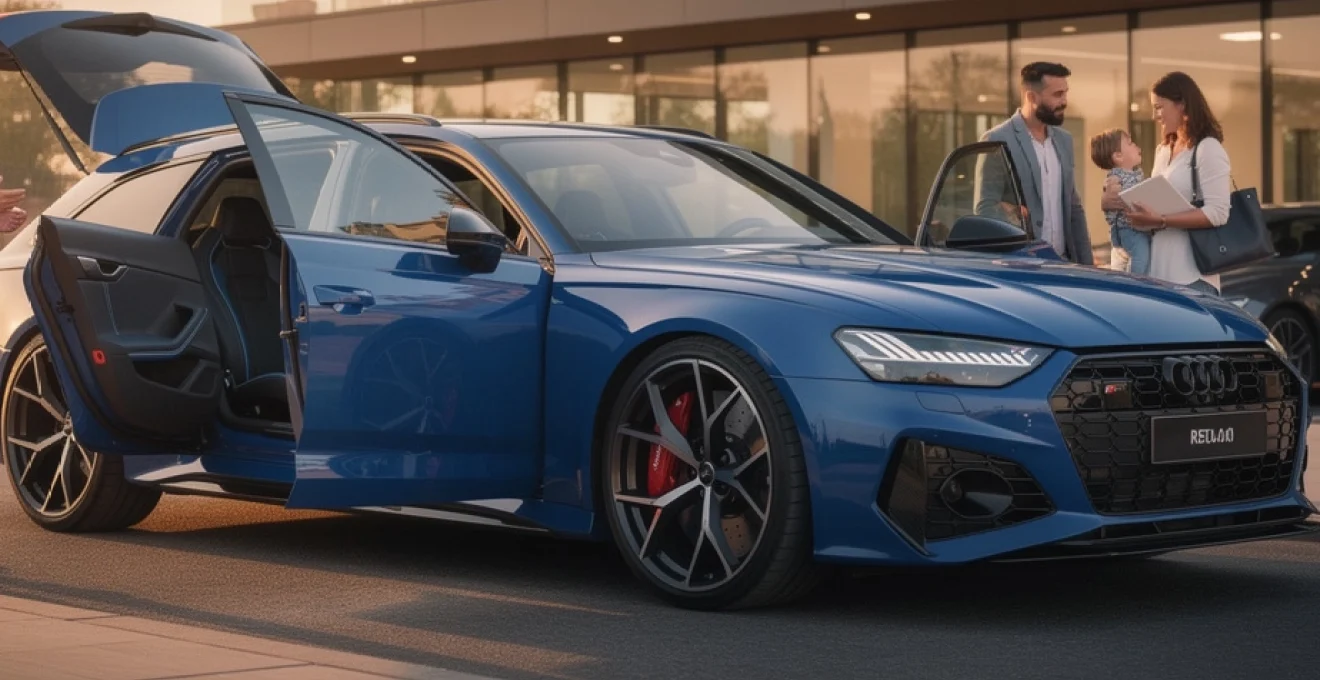
The blue Audi RS6 Avant occupies a rare niche: a family estate that behaves like a supercar yet copes effortlessly with daily life. In a market turning rapidly towards hybrids and full EVs, a 630 PS twin-turbo V8 wagon feels almost rebellious, especially when wrapped in a striking shade of blue that turns every reflection into a reminder of why you chose it. For drivers who need space for children, dogs or sports gear but still crave a car that feels special every time the start button is pressed, the RS6 Avant remains one of the most complete answers on sale in the UK.
Recent updates have made the RS6 Avant performance faster, more focused and better equipped, while UK production for new RS 6 Avant has now wound down, sharpening interest in used and nearly new examples. Against the backdrop of strict emissions rules and downsizing, this muscular estate stands out as a final flourish of petrol-powered theatre, combining brutal acceleration with limousine-grade comfort and a cabin that feels both futuristic and familiar.
Overview of the blue audi RS6 avant as a high-performance estate car
The blue Audi RS6 Avant is often described as the “supercar for families”, and the label fits. Beneath its practical estate body sits the hardware from Audi Sport’s most serious models: a 4.0 TFSI V8 biturbo engine, quattro all-wheel drive and chassis technology derived from the brand’s halo performance cars. Unlike an SUV, the RS6 Avant keeps a low, wide stance, giving you the feel of a high-performance saloon yet with the usability of a large estate. With 565 litres of boot space and generous rear legroom, it functions perfectly as a daily family car, yet it sprints from 0–62 mph in around 3.4 seconds.
For UK buyers, the RS6 Avant performance sits at the top of the A6 family tree. It shares only the roof, front doors and tailgate with the standard A6 Avant; almost every other body panel is unique. Widened arches flare by around 40 mm per side, accommodating huge 22-inch wheels and signalling intent even at a standstill. Recent model years have introduced advanced driver assistance packs, such as Tour Pack and City Assist, which support long-distance driving and urban manoeuvres without diluting the raw character that enthusiasts expect from a 600+ PS estate.
This dual personality is what makes a blue RS6 Avant so appealing on British roads. You can slip into Comfort mode and enjoy a quiet, refined motorway cruiser, then select an RS mode, unleash the V8’s thunder and keep pace with serious sports cars on a favourite B-road. For drivers who want a single vehicle that can commute, carry out family duties and deliver track-level pace, very few alternatives match this balance.
Powertrain and performance specs of the blue audi RS6 avant
4.0 TFSI V8 biturbo engine: output, torque curve and rev characteristics
At the heart of the blue Audi RS6 Avant sits the legendary 4.0 TFSI V8 biturbo. In RS 6 Avant performance form, it develops up to 630 PS and an enormous 850 Nm of torque. That torque plateau stretches broadly across the mid-range, typically from around 2,300 rpm to 4,500 rpm, so you feel effortless shove whenever you touch the throttle. The character of this engine is different from a peaky naturally aspirated V8; it behaves more like a tidal wave of torque that surges forward from low revs, rather than demanding that you explore the red line on every journey.
Rev characteristics are tuned for both responsiveness and refinement. Twin-scroll turbochargers mounted inside the V of the engine reduce lag, so the RS6 responds sharply to small throttle inputs in daily driving. Push harder and the engine will rev cleanly towards 7,000 rpm, accompanied by a deep, hard-edged soundtrack from the RS sports exhaust, especially in the more aggressive drive modes. Cylinder on demand technology can shut down four cylinders under light loads to improve fuel use, then re-engage them almost invisibly when you need full power. For a large estate with supercar-grade performance, the drivability of this long-tail keyword setup—4.0 TFSI V8 biturbo engine in the RS6 Avant—is as impressive as the raw numbers.
Quattro all-wheel drive, sports differential and torque vectoring calibration
Power is channelled to the road via Audi’s signature quattro all-wheel drive system, tuned specifically for the RS6 Avant. A mechanical centre differential usually sends 40% of torque to the front and 60% to the rear, but it can redirect up to 70% forwards or 85% backwards when slip is detected. This variable distribution is supported by a quattro sport differential on the rear axle, which actively shuffles torque between the rear wheels to help rotate the car into bends.
The calibration of the torque vectoring system is one of the RS6’s great strengths on tight UK roads. Rather than pushing into understeer like older fast Audis, the blue RS6 Avant feels keen to turn, especially in RS modes where software allows more yaw before stability systems intervene. On a wet B-road, the combination of quattro traction, sport differential and torque vectoring gives you remarkable confidence. Traction is so strong that you can deploy a large portion of the engine’s 850 Nm of torque even in less-than-ideal conditions, a key reason why the RS6 Avant is seen as an all-weather performance car.
0–62 mph, in-gear acceleration and top speed versus RS7 sportback and BMW M5 touring
Performance figures for the RS6 Avant performance are firmly in supercar territory. The sprint from 0–62 mph takes around 3.4 seconds, while 0–124 mph is dispatched in roughly 12 seconds, depending on exact specification and conditions. In-gear acceleration is just as startling: overtakes from 40–70 mph or 50–80 mph involve a brief downshift, a surge of torque and very little waiting around. This instant urge makes cross-country runs exceptionally rapid without needing to chase the red line.
Compared with an RS7 Sportback using the same engine, the RS6 Avant is effectively neck-and-neck, with tiny differences in drag and weight producing almost identical real-world pace. Against key rival estates and saloons such as a hypothetical current BMW M5 Touring or the Mercedes-AMG E 63 S Estate, the RS6 stands up extremely well. Top speed is electronically limited to 155 mph as standard, but RS Dynamic packages can raise this to around 174 mph or even higher, bringing the long-tail keyword advantage of a high-speed RS6 Avant performance estate into focus for regular Autobahn travellers.
Tiptronic 8-speed automatic gearbox mapping, launch control and shift logic
The RS6 Avant uses an 8-speed Tiptronic automatic gearbox rather than a dual-clutch unit. This choice is deliberate: the torque of the 4.0 TFSI V8 and the need for smooth low-speed behaviour make a conventional torque-converter automatic more suitable. In daily driving, shifts are near-seamless, easing the car through city traffic with little fuss. When you select Dynamic or an RS mode and use the paddles, the gearbox becomes far more assertive, snapping through ratios and holding gears longer for maximum response.
Launch control co-ordinates the engine, gearbox and quattro system to deliver consistent, repeatable starts. With the correct procedure—foot hard on the brake, throttle fully depressed, then a clean release—the RS6 will fire itself off the line with minimal wheelspin and stunning consistency. Shift logic is smart enough to anticipate when you are on a spirited back-road drive, pre-selecting lower gears under braking so the car is always in the power band. For mixed UK driving that includes town use, cross-country routes and motorways, this blend of smoothness and aggression is a major asset.
WLTP fuel consumption, CO₂ emissions and mild-hybrid (MHEV) 48V system integration
Official WLTP fuel consumption for the current RS6 Avant performance hovers around 23 mpg on the combined cycle, with CO₂ emissions approaching 288 g/km. Realistically, you are unlikely to match those numbers if you frequently explore the engine’s potential. Gentle motorway cruising and steady A-road driving can see mid-20s mpg, but enthusiastic B-road runs will drag the figure down into the high teens or lower. For a 630 PS estate car, that compromise is expected, but it does have tax implications: first-year VED is at the top rate, and the list price triggers the expensive car supplement from years two to six.
The RS6 Avant uses a 48V mild-hybrid (MHEV) system to trim fuel use and support refinement. A belt-driven starter-generator can recover energy under deceleration and feed it into a small lithium-ion battery, then use that energy to assist the engine during acceleration or allow coasting with the engine off for short periods. It will not drive the car on electric power alone, but it helps smooth stop–start events and lets the big V8 rest when conditions allow. For buyers intent on a long-tail keyword such as a high-performance estate with mild-hybrid V8, the RS6 strikes a balance between emotion and efficiency, though it is still far from an eco-car.
Chassis, suspension and braking technology on the RS6 avant
RS adaptive air suspension vs RS sport suspension with dynamic ride control (DRC)
Two main suspension setups define how your blue RS6 Avant feels on UK roads: RS adaptive air suspension and RS sport suspension with Dynamic Ride Control (DRC). Air suspension is standard on many UK-spec cars and offers excellent breadth of ability. In Comfort mode it delivers a genuinely supple ride for such a heavy, powerful estate, even on 22-inch wheels, while Dynamic mode firms things up and cuts body roll substantially. For long-distance commuters and drivers who face broken urban tarmac, air suspension is often the most sensible choice.
RS sport suspension with DRC replaces the air springs with steel coils and adds diagonally linked dampers to counteract pitch and roll. The result is a more tied-down feel on challenging roads, with sharper body control and less float at high speed. In simple terms, it makes the blue RS6 Avant feel closer to a track-biased super-saloon, tailored to the long-tail keyword audience seeking a more focused RS6 Avant driving experience. For frequent UK motorway and mixed-use driving, many owners prefer air suspension; enthusiastic drivers who visit track days or prioritise ultimate handling might favour DRC despite the firmer ride.
Dynamic steering, rear-axle steering and audi drive select driving modes
The RS6 Avant’s agility owes much to its dynamic steering and rear-axle steering. At low speeds, the rear wheels turn slightly opposite to the fronts, effectively shortening the wheelbase. This reduces the turning circle and makes tight car parks or narrow village lanes less intimidating. At higher speeds, the rears steer in the same direction as the fronts, improving stability during lane changes and long, fast curves.
All of this is integrated into Audi Drive Select, which tailors engine response, steering weight, suspension settings, exhaust sound and even the sport differential’s behaviour. Drivers can choose from modes such as Comfort, Auto, Dynamic and two customisable RS profiles. This means you can create a long-tail setup like a bespoke RS mode for UK B‑roads, combining a softer suspension setting for uneven surfaces with aggressive engine and gearbox mapping. The flexibility to tailor the car so precisely sets the RS6 apart from some rivals with less configurable drive modes.
Ceramic vs steel brakes, disc dimensions and high-speed braking performance
Given its pace, the blue Audi RS6 Avant needs serious stopping power. Standard steel brakes already offer huge discs with multi-piston calipers and strong fade resistance for spirited road driving. Disc diameters typically exceed 400 mm at the front, paired with large rear discs, giving ample mechanical leverage and heat capacity. For many UK owners who mainly use their car on the road, the standard steel setup with red or black calipers is entirely sufficient and more cost-effective to maintain.
Optional carbon-ceramic brakes elevate performance, particularly during repeated high-speed stops. Larger discs—again over 400 mm and often with six-piston calipers—reduce unsprung mass and cope better with sustained abuse, such as track work or Alpine descents. The trade-off is cost: carbon-ceramic brakes add a five-figure sum to the list price and replacement discs are very expensive. They can also be slightly grabby when cold, though modern systems are far more user-friendly than previous generations. For buyers investing in a long-tail keyword spec like a track-ready RS6 Avant with ceramic brakes, the upgrade makes sense; for typical UK road use, steel brakes remain a sensible default.
Tyre specifications, wheel sizes and recommended setups for UK roads
Most blue RS6 Avant performance models in the UK ride on 21‑inch or 22‑inch alloy wheels, often with Y‑spoke or rotor designs finished in silver, gloss black or satin black. Tyres are typically high-performance summer items with widths around 285 mm, providing vast grip but also generating some road noise on coarse surfaces. On UK motorways and A-roads, the standard tyre choices give confidence and stability even at high speeds.
For daily use on typically mixed British roads, a few practical tips help protect both comfort and wheels:
- Consider a high-quality all-season performance tyre if the car will be used year-round without winter wheels.
- Maintain correct pressures; under- or over-inflation harms both grip and ride quality on the RS6 Avant.
- Avoid cheap aftermarket tyres; the combination of 630 PS and quattro demands premium rubber for safety.
Drivers who frequently tackle poor rural surfaces may prefer 21-inch wheels with a slightly taller tyre sidewall, improving bump absorption and reducing the risk of pothole damage. For those chasing the visual drama of 22-inch wheels on a blue RS6 Avant, careful driving and regular pressure checks become even more important.
Exterior design of the blue audi RS6 avant: bodywork, aerodynamics and lighting
Exclusive blue paint options: nogaro blue, ascari blue and ultra blue metallic
Few colours flatter the RS6 Avant’s muscular shape as effectively as blue. Nogaro Blue pays homage to classic fast Audis of the 1990s, offering a rich, slightly retro hue that enthusiasts instantly recognise. Ascari Blue, available in metallic and matte finishes in recent model years, gives a more modern, motorsport-inspired appearance that pairs beautifully with carbon-fibre exterior trim and large wheels. Ultra Blue metallic sits somewhere in between, vivid in bright light yet subtle enough for a professional setting.
Choosing an exclusive blue paint can slightly increase lead times and cost, but it enhances both kerb appeal and potential resale value. On discontinued RS6 Avant performance models, rare paint and tasteful options often attract stronger interest on the used market. Combined with the long-tail keyword demand for a blue Audi RS6 Avant performance estate, colours like Nogaro and Ascari have become sought-after among collectors and enthusiasts.
Rs-specific body kit, widened arches and aerodynamic enhancements from audi sport
The blue RS6 Avant shares only its roof, front doors and tailgate with the regular A6 Avant; everything else is RS-specific. Wheel arches flared by about 40 mm per side give the car an aggressive stance and allow the fitment of 22-inch wheels. Deeper front and rear bumpers, a honeycomb Singleframe grille finished in gloss black and a sculpted bonnet with powerdome all reinforce the car’s performance credentials. Vertical air intakes, inspired in part by the Audi R8, stretch almost to the headlights and help feed cooling air to brakes and radiators.
Aerodynamic details are subtle yet effective. A roof-edge spoiler and carefully profiled rear diffuser manage airflow at high speed, while the oval RS exhaust outlets signal the car’s status to anyone following. Styling packages in matte aluminium, gloss black or carbon fibre allow owners to tailor the look: matte finishes can soften reflections on a dark blue RS6, while carbon details provide contrast on lighter blues such as Ascari or Ultra Blue.
Matrix LED, HD matrix LED and laser light headlamp technologies
Lighting technology is a major part of the RS6 Avant’s appeal. Standard Matrix LED headlights already offer adaptive beam control, selectively shading out portions of the light pattern to avoid dazzling other road users while maintaining full high-beam illumination elsewhere. This is particularly valuable on unlit rural roads where visibility and safety depend heavily on headlight reach.
Higher trims and option packs introduce HD Matrix LED and even Laser light technology. HD Matrix systems offer finer control over the beam pattern, improving clarity around roadside signs and lane markings. Laser light modules extend high-beam reach at higher speeds, activating above a certain threshold to project a focused cone of light further down the road. In practical UK terms, that means better visibility on motorways and fast A-roads during winter months. For owners using a long-tail feature like RS6 Avant Laser light for night driving, the upgrade genuinely benefits safety as well as aesthetics.
Black optic, carbon black and vorsprung exterior styling packages
UK buyers are frequently drawn to the RS6 Avant’s styling packages, which significantly influence the look of a blue car. Black optic packs typically replace chrome exterior trim with gloss black elements on the grille, window surrounds and roof rails. On a bright blue RS6 Avant, this contrast can look particularly aggressive. Carbon Black models build on this with extensive carbon-fibre detailing in the front splitter, rear diffuser and mirror caps.
Vorsprung versions sit at the top of the range, combining visual upgrades with a comprehensive list of technology and comfort features. Expect 22-inch wheels, black or carbon styling, a panoramic glass roof, HD Matrix LED headlights with Laser light, and virtually every driver assistance system rolled in. For buyers seeking a long-tail configuration like a fully loaded blue RS6 Avant Vorsprung, this trim offers a near-complete package straight from the showroom, albeit at a substantial price premium.
Interior design, ergonomics and technology in the blue RS6 avant
RS sport seats, upholstery choices and contrast stitching in blue-themed cabins
Inside, the RS6 Avant balances performance intent with everyday luxury. RS sport seats come as standard, offering strong lateral support, integrated headrests on upgraded versions and multiple electric adjustments. Upholstery is usually fine Valcona leather, with options for quilted patterns and perforations to enable seat ventilation. The RS Design packages—particularly RS Design Package Plus in Mercato Blue—layer in Alcantara, Dinamica and blue contrast stitching on the steering wheel, gear selector, knee pads and floor mats.
For a blue RS6 Avant, coordinating the exterior colour with interior accents creates a cohesive theme. Blue seat belts, blue RS logos and carbon twill inlays with blue accents give the cabin a bespoke, almost concept-car feel. Yet ergonomics remain straightforward: physical controls for crucial functions sit where you expect them, and driving position adjustability is generous, allowing a wide range of body types to get comfortable on long journeys.
Virtual cockpit, head-up display and RS-specific performance instrumentation
The digital heart of the cockpit is the Audi Virtual Cockpit, a 12.3-inch high-resolution display in place of traditional dials. It can show classic twin gauges, full-width navigation mapping or RS-specific performance views with central rev counter, G‑meter and lap timing data. RS graphics incorporate blue accents on some themes, subtly echoing the exterior paint of a blue RS6 Avant. The system is controlled via steering wheel buttons, so you can cycle through layouts without taking your hands away from the wheel.
An optional head-up display projects key information—speed, navigation arrows and driver-assistance alerts—onto the windscreen. In RS modes, it can also display shift indicators and performance-oriented data. For fast driving on unfamiliar roads, seeing turning instructions and speed limits in your line of sight reduces cognitive load. Enthusiasts chasing a long-tail feature like RS6 Avant head-up display with RS performance view will find it adds real-world usability as well as tech appeal.
MMI navigation plus, bang & olufsen audio and connected services in the UK
At the centre of the RS6’s infotainment setup are two stacked touchscreens. The upper unit handles MMI Navigation Plus, media and smartphone integration, while the lower screen controls climate and seat functions. Haptic feedback gives each touch a physical “click”, mimicking real buttons. Android Auto and Apple CarPlay come as standard, allowing you to run apps like Spotify or Waze on the main screen, although phone-based navigation cannot appear in the Virtual Cockpit in the same way as Audi’s native mapping.
Sound quality is another RS6 highlight. The optional Bang & Olufsen 3D Premium Sound System, standard on many Vorsprung cars, uses multiple speakers and advanced processing to generate a three-dimensional sound field. For long-tail keyword needs such as a luxury estate with Bang & Olufsen 3D audio, the RS6 Avant delivers a genuinely immersive listening experience. Over-the-air updates and UK-specific connected services keep mapping and traffic data current, supporting efficient route planning for both daily commutes and long European trips.
Practicality, boot capacity and family usability compared with audi A6 avant
Despite its performance focus, the blue Audi RS6 Avant remains highly practical. Boot capacity stands at roughly 565 litres with the rear seats up, only slightly down on the standard A6 Avant because of the more complex rear suspension and exhaust layout. The boot shape is square, and the opening is wide, making it easy to load pushchairs, dogs or a couple of large suitcases plus soft bags. Split-folding rear seats increase carrying capacity further when required.
Rear passenger space is generous, with excellent kneeroom and headroom even for taller adults. Three passengers can sit in the back, though the central seat is slightly raised and the transmission tunnel intrudes on foot space. Isofix mounting points and wide-opening rear doors simplify installation of child seats, turning the RS6 into a legitimately family-friendly vehicle. Compared with a standard A6 Avant, you lose a small amount of marginal practicality, but you gain a vast amount of performance and character, which for many owners is a worthwhile exchange.
Price, trim levels and option packs for the blue audi RS6 avant in the UK
Base price, on-the-road costs and standard equipment for UK-spec RS6 avant
UK pricing for the Audi RS6 Avant performance typically starts around £120,000 RRP, with transaction prices sometimes a little lower depending on dealer offers and stock. Earlier in the lifecycle, cars could be found from roughly £111,000 when paying cash through competitive brokers, while used RS6 Avant examples currently begin near £43,000 for older models with higher mileage. On-the-road costs include first-year VED at the highest emissions band and the expensive car supplement for five years due to the list price exceeding £40,000.
Standard equipment is generous: Matrix LED headlights, RS adaptive air suspension, RS sport seats in Valcona leather, Audi Virtual Cockpit, MMI Navigation Plus, front and rear parking sensors, reversing camera and a high level of active safety systems. Even so, many of the most desirable features—panoramic glass roof, Bang & Olufsen audio, head-up display, advanced driver-assistance packs—are bundled into higher trims or option packs, which can significantly increase the real cost of a blue RS6 Avant fitted to an enthusiast’s ideal specification.
Cost breakdown of carbon black, performance and vorsprung models
The UK RS6 Avant range is typically structured around main trims such as RS6 Avant performance, Carbon Black and Vorsprung. Base performance models offer the full 630 PS powertrain and core RS features without all the cosmetic and tech upgrades. Carbon Black versions add extensive black styling elements, carbon-fibre trim and usually larger wheels, pushing the price upwards by several thousand pounds. For many enthusiasts, Carbon Black provides the sweet spot between equipment and cost.
Vorsprung sits at the top, adding almost every available feature: 22-inch wheels, HD Matrix LED headlights with Laser light, Night Vision Assistant, panoramic glass roof, Bang & Olufsen 3D sound, advanced driver assistance packs, 360° cameras and powered soft-close doors. The price can easily climb to £135,000–£140,000 once paint and a few bespoke options are included. For UK buyers looking for a long-tail specification like a top-spec RS6 Avant Vorsprung in blue, budgeting for this level of spend is essential.
Pricing impact of exclusive blue paints, carbon-ceramic brakes and RS dynamic packages
Exclusive paints such as Ascari Blue metallic or matte finishes carry a surcharge over standard colours, typically running into four figures. While this adds to the initial cost, a desirable blue on an RS6 Avant can improve resale value and make the car easier to sell in a crowded premium used market. From a financial perspective, strong colours often recoup some or all of their option cost at resale, particularly when combined with tasteful packages like Black optic or Carbon Black.
Carbon-ceramic brakes and RS Dynamic packages are among the most expensive individual options. Ceramics can add well over £8,000–£10,000, while RS Dynamic Plus (including raised top speed and additional chassis enhancements) also comes at a premium. These options are most justified for drivers who make regular use of Autobahns, track days or Alpine roads, where the extended capabilities can be exploited. For typical UK usage involving urban traffic, motorways and occasional spirited drives, a standard RS6 Avant performance with steel brakes and RS Dynamic may represent better value.
Finance, PCP and leasing examples for UK buyers considering the RS6 avant
Given list prices north of £120,000, many UK buyers fund a blue RS6 Avant using PCP, lease or other structured finance products. A representative PCP deal on a nearly new RS6 Avant might involve a deposit of 10–20%, followed by monthly payments in the region of £1,500–£2,000 over 36–48 months, depending on mileage and final balloon figure. Leasing can sometimes reduce monthly outlay at the expense of ownership; for company car users, the high BIK rate due to emissions makes salary sacrifice schemes less attractive than with EVs.
To make a large-performance estate such as the RS6 Avant sustainable, a few finance tips are worth considering:
- Negotiate on in-stock cars, where dealers may offer stronger discounts than on factory orders.
- Balance high-cost options like ceramics and matte paint against potential impact on monthly payments.
- Consider nearly new or pre-registered cars, which can save tens of thousands versus list price.
Careful structuring of finance, combined with a sensible choice of options, ensures that a blue RS6 Avant aligns with both driving expectations and financial realities over the ownership period.
Buying advice, rivals and resale value of a blue audi RS6 avant
Choosing a blue Audi RS6 Avant means understanding both its strengths and its running costs. Insurance sits in the highest groups, tyres and brakes are expensive to replace, and fuel consumption reflects the presence of a thirsty V8. Yet reliability has generally been solid, helped by the use of proven Volkswagen Group components. Regular servicing in line with Audi’s schedule and meticulous care of high-performance consumables keep the car operating at its best. Many owners also invest in specialist detailing and ceramic coatings, not only enhancing the appearance of blue paint but also supporting long-term residuals.
Key rivals include the Mercedes-AMG E 63 S Estate, which offers a larger boot and a slightly wilder character, and the BMW M5 saloon, which trades estate practicality for a lower, more compact body. There is also the emerging competition from EV hyper-estates and SUVs, but for those wanting a traditional V8 soundtrack, the RS6 Avant has a unique appeal. Used values reflect that: even as new prices have risen by around £20,000 since launch, strong demand keeps residuals healthy, especially for well-specified blue cars with desirable options such as Bang & Olufsen audio, panoramic roof and RS Design packs. For the enthusiast who wants a long-tail proposition like a collectible blue Audi RS6 Avant performance estate, focusing on specification, colour and documented maintenance history will pay dividends when it is time to move the car on.