
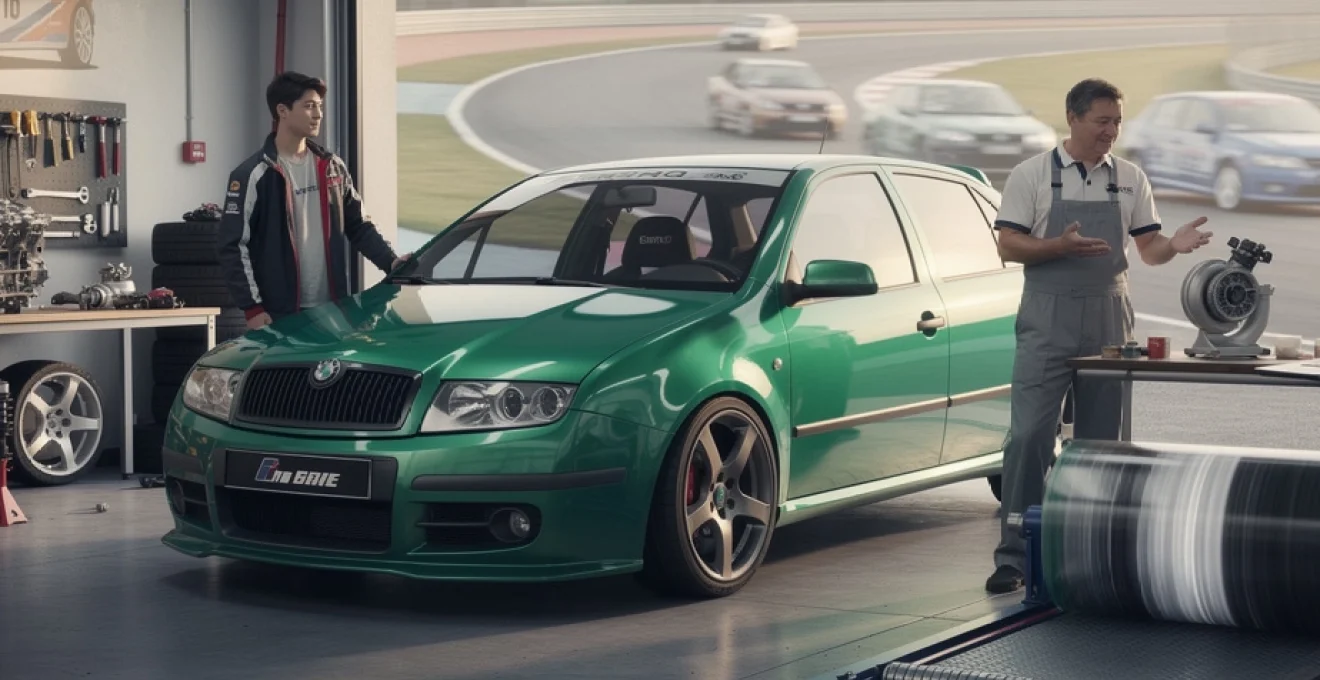
The Skoda Fabia vRS Mk1 is one of those rare hot hatchbacks that makes you do a double take. On paper it is a supermini with a taxi engine; on the road it feels like a compact torque monster that can embarrass far more expensive machinery. Two decades on, the diesel vRS has become a cult classic, prized for its blend of performance, economy and everyday usability. If you are looking at affordable performance cars that still make sense as a daily driver, the first-generation Fabia vRS deserves serious attention, both as an enthusiast’s toy and as a future classic worth preserving.
Skoda fabia vRS mk1 in context: origins, platform sharing and VAG hot hatch strategy
PQ24 platform fundamentals: shared architecture with VW polo 9N, SEAT ibiza 6L and audi A2
The Fabia vRS Mk1 is based on the Volkswagen Group PQ24 platform, shared with the VW Polo 9N, SEAT Ibiza 6L and Audi A2. That shared architecture gives the Skoda a solid structural foundation, modern crash protection for its era and parts commonality that still pays off in 2025. You benefit from a wide aftermarket, plentiful used components and easy access to service items that are identical across several VAG small cars. Compared with many early-2000s superminis, the PQ24 chassis feels robust and well damped, more like a shrunken family hatch than a budget runabout.
Dimensions play in the Fabia’s favour too. It is among the longest cars in its class, which translates into decent cabin space, a usable rear bench and a 260-litre boot that works for real-world family duties. From a dynamics point of view, the Skoda’s relatively high kerbweight of around 1,315kg gives a more mature, planted feel on the motorway than lighter rivals, even if that extra mass slightly blunts ultimate agility on a tight B-road.
From skoda motorsport to vRS badge: WRC heritage and brand positioning in early 2000s
In the early 2000s, Skoda was still shaking off lingering “cheap and nasty” stereotypes in the UK. Motorsport and clever branding were key tools. The brand’s presence in the World Rally Championship with the Fabia WRC, combined with the success of the Octavia in touring car and rally series, laid the groundwork for the performance sub-brand. The vRS badge (simply RS in mainland Europe) arrived on the Octavia in 2001 and quickly became shorthand for value-packed, understated performance.
The Fabia vRS, launched in 2003, took that motorsport halo and wrapped it around something unusual: a diesel-only hot hatch with five doors. That decision looked bold when most rivals pushed high-revving petrol engines and three-door “boy racer” styling. Yet the combination of torque-rich performance, low fuel consumption and subtle looks proved exactly what many buyers wanted: a car that could commute all week, then surprise hot hatch royalty on a Sunday blast.
Instead of building a showy hot hatch, Skoda created a stealthy diesel sprinter that appealed to drivers who cared more about real-world pace than pub bragging rights.
Model timeline 2003–2007: pre-facelift, facelift and key production changes
Production of the Fabia vRS Mk1 ran from 2003 to 2007, aligning with the later years of the first-generation Fabia. Early cars featured the original front-end styling and EU3-compliant engine calibration. From late 2005, the diesel became EU4-compliant, nudging official combined economy up from 52.3mpg to around 53.3mpg and slightly refining emissions. Cosmetic tweaks mirrored the broader Fabia facelift: grille, lights and interior trim updates that modernised the ambience without altering the core mechanical package.
The run-out highlight was the limited “Special Edition” in 2007, often referred to simply as the vRS SE. Around 1000 Race Blue metallic cars were produced, adding leather seats with blue piping, red brake calipers, cruise control and privacy glass. Enthusiasts now hunt these late SE cars for their spec and relative rarity, especially when combined with low mileage and full dealer history.
Market positioning versus VW polo GTI, SEAT ibiza FR TDI and ford fiesta ST150
When new, the Fabia vRS undercut its VAG cousins and many petrol hot hatches. In 2005, a Fabia vRS cost about £12,380, compared with roughly £14,425 for a mechanically similar Volkswagen Polo GT TDI. It sat alongside the SEAT Ibiza FR TDI and Cupra as another torque-heavy diesel option but carried a distinctly value-led, practical image. Against a Ford Fiesta ST150 or Renaultsport Clio 182, the Skoda lacked the last degree of throttle adjustability and steering feedback, yet it fought back with superior mid-range shove, lower running costs and a more grown-up five-door body.
For buyers prioritising in-gear acceleration, motorway refinement and fuel economy, the Fabia vRS made compelling sense. The car’s real rival was less one specific model and more the “warm diesel hatch” segment as a whole, which has since all but disappeared under emissions pressure and shifting consumer demand.
1.9 TDI PD130 powertrain: engine code ASZ, unit injector system and tuning headroom
Pumpe-düse injection technology: injector design, fuel pressure and ECU mapping (bosch EDC15P)
At the heart of the Fabia vRS sits the legendary 1.9 TDI PD130 engine, internal code ASZ. The “PD” stands for Pumpe-Düse, or unit injector, a system where each cylinder has its own integrated injector and high-pressure pump driven directly by the camshaft. This layout allows injection pressures exceeding 2,000 bar without the need for a traditional common-rail rail, giving fine control of fuelling events and excellent thermal efficiency.
The BOSCH EDC15P ECU manages these injectors with detailed mapping for boost, fuelling, smoke and torque limits. For you as an owner or tuner, that means substantial headroom: a simple remap can often lift power from the factory 130bhp to 160–170bhp while keeping conservative exhaust gas temperatures and acceptable smoke levels. The technology may predate current Euro 6 diesels, but in the early 2000s it was cutting-edge, even winning endurance races and powering high-mileage taxi fleets across Europe.
ASZ vs ARL vs PD100 engines: internal differences, turbocharger sizes and torque curves
Understanding how the Fabia’s ASZ engine compares with siblings helps if you plan to modify or swap parts. The ASZ (130bhp) sits between the milder PD100 units and the more aggressive 150bhp ARL found in some Golf and Ibiza models. Internally, the ASZ uses stronger pistons and rods than the PD100, plus uprated injectors with higher flow potential. The ARL takes that further with different injector nozzles and often a larger turbo, allowing stock torque outputs of around 236lb ft versus the Fabia’s quoted 229lb ft.
In practice, the ASZ delivers a broad, flat torque curve from about 1,900rpm to 3,500rpm, ideal for real-world overtakes. The PD100 feels softer, requiring more throttle to achieve similar pace, while the ARL builds torque even more aggressively but can be fussier about fuel quality and maintenance if pushed hard. For everyday fast-road use, the ASZ offers arguably the best compromise between strength, reliability and tuning flexibility.
Turbocharger setup: garrett GT1749VA variable geometry turbo, boost control and common failure modes
The Fabia vRS uses a Garrett GT1749VA variable geometry turbocharger (VNT). Instead of a fixed turbine housing, adjustable vanes alter exhaust gas flow to spool the turbo quickly at low revs while preventing overspeed at the top end. This is why the car feels so responsive from 2,000rpm despite modest displacement. Boost control relies on vacuum-actuated vane movement, governed by the ECU through a boost control solenoid and feedback from the MAP sensor.
Ageing examples can suffer from sticking VNT vanes due to soot build-up, especially if driven gently for long periods. Symptoms include overboost limp mode, erratic boost and flat spots. Gentle “Italian tune-up” runs and periodic checks of actuator movement help, but severe cases need turbo removal and cleaning or replacement. Boost leaks from cracked intercoolers or split hoses can also mimic turbo issues, so a smoke test is advisable before committing to major work.
OEM drivetrain: 6-speed manual (02J/02M family), clutch, dual-mass flywheel and limited-slip options
Power is transmitted through a six-speed manual gearbox from the 02J/02M family, chosen for its torque capacity and pleasant shift quality. Ratios are relatively long, enabling relaxed motorway cruising at around 2,000rpm in sixth, which you notice in impressive real-world diesel economy. The stock clutch and dual-mass flywheel (DMF) cope well with factory torque, but remapped cars running 300lb ft or more can push these components beyond design limits, especially under repeated hard launches.
For hard-driven or tuned cars, many owners opt for uprated clutches and sometimes a single-mass flywheel conversion, trading a little refinement for durability. Enthusiasts wanting more traction on wet or bumpy roads often add a mechanical limited-slip differential from brands such as Quaife or Wavetrac. This transforms the Fabia’s ability to put torque down cleanly out of tight bends, though it does add cost and requires proper setup.
Chassis dynamics: suspension geometry, brakes and handling traits of the fabia vRS mk1
Front MacPherson strut and torsion beam rear: stock geometry, roll stiffness and understeer behaviour
The Fabia vRS uses a straightforward suspension layout: MacPherson struts at the front and a torsion beam at the rear. Geometry prioritises stability over razor-sharp turn-in, which suits a diesel hot hatch designed as a daily. Out of the box, the chassis offers secure, predictable handling with moderate body roll and a tendency towards safe understeer when pushed. For most drivers, that translates into confidence, especially in poor weather.
The downside, if you are chasing cornering thrills, is a certain numbness at the limit. The front-heavy weight distribution, with a strong iron-block diesel over the nose, inevitably encourages the tyres to wash wide if you carry too much speed into tight bends. Learning to exploit the engine’s fat torque band and drive off the corner rather than charging in too hard yields the most satisfying results.
OEM suspension components: springs, dampers, anti-roll bars and typical upgrade paths (bilstein B12, eibach Pro-Kit)
Standard Fabia vRS suspension uses slightly lowered, firmer springs and model-specific dampers versus regular Fabia variants. Anti-roll bars are modest in size, again tuned for comfort and stability rather than outright track performance. After 15–20 years, many original dampers are tired, which can make the car feel floaty and imprecise. Refreshing the suspension is one of the best investments you can make in an ageing vRS.
Popular upgrade paths include Bilstein B12 kits (B8 dampers with Eibach Pro-Kit springs) for a road-focused package that sharpens responses without ruining ride quality. Other owners choose matched spring and damper combinations from Koni, or go further with height-adjustable coilovers. A mild drop of 25–30mm, combined with quality dampers, can transform the car’s balance without compromising ground clearance on British roads.
Steering and weight distribution: hydraulic rack characteristics, front axle load and torque steer management
The Fabia vRS uses a hydraulic power-assisted steering rack, offering decent weight but limited feel compared with the best hydraulic setups of the era. Many owners find the steering slightly inert around the straight-ahead, though it weights up convincingly once loaded in a bend. The relatively heavy engine over the front axle, combined with strong low-down torque, could have produced unruly torque steer, but Skoda’s calibration and conservative tyre sizes keep things mostly in check.
On remapped or high-boost cars, torque steer becomes more noticeable, especially on poor surfaces and in lower gears. Choosing high-quality tyres and ensuring correct alignment with a touch of additional front camber can help. For fast-road setups, aiming for a balanced weight distribution via sensible ride height and avoiding excessive nose-down rake gives a more neutral, confidence-inspiring front end.
Braking system: 288 mm front discs, caliper specification and big brake kit swaps (octavia vRS, porsche brembo)
Braking hardware on the Fabia vRS is stronger than on cooking models. Front discs measure 288mm and are clamped by sliding calipers that are shared across numerous VW Group models. The rear uses solid discs, adequate for the car’s weight and intended use. In standard form, braking performance is perfectly acceptable for road driving, though spirited use on track will quickly expose limitations in pad material and fluid.
Upgrades range from quality performance pads and braided lines to full big brake kits. A common route uses 312mm front discs and calipers from the Octavia vRS or Golf GTI 1.8T, which bolt up with minimal modification. More extreme builds adopt four-piston Brembo setups from Porsche donor cars, combined with suitable carriers and discs. For most enthusiasts, however, a pad and fluid upgrade is enough to support a tuned PD130 on fast road work.
Real-world performance: dyno figures, acceleration data and fuel economy metrics
Factory performance vs tested results: 0–60 mph, in-gear acceleration and dyno-verified power outputs
Officially, Skoda quoted 0–62mph in 9.5 seconds and a top speed of around 128mph. Contemporary road tests and owner timing, however, often recorded significantly better figures. Many lightly run-in cars hit 0–60mph in the low 8s, thanks to strong torque and relatively short lower gears. Where the Fabia vRS truly shines is in-gear acceleration: third and fourth gear pull from 40–70mph feels far stronger than the numbers suggest.
Dyno runs on healthy stock cars frequently show 135–140bhp and torque closer to 240lb ft, suggesting Skoda’s official figures were conservative. This aligns with anecdotal comparisons where a Fabia vRS kept pace with, or even pulled on, more powerful petrol cars in rolling sprints. Owners often report that the car feels quicker in the real world than many 150–170bhp hot hatches, particularly on the motorway.
PD130 torque delivery: mid-range pull, turbo lag and motorway overtaking characteristics
The character of the PD130 engine defines how the Fabia vRS drives. Below 1,700rpm, response is modest; once the VNT turbo spools around 1,900rpm, there is a strong, sustained shove that makes overtakes feel effortless. You do not chase a high redline here – the party is over by about 4,200–4,500rpm – but between 2,000 and 4,000rpm the engine pulls strongly and consistently.
On the motorway, this means you can leave the car in sixth and surf the torque wave, dropping a gear only for very rapid overtakes or steep gradients. Many owners remark that from 50–70mph, the vRS feels at least as quick as larger petrol saloons. The mid-range punch turns the car into an easy long-distance companion that still feels eager when an interesting stretch of road appears.
Fuel consumption in daily use: motorway cruising, urban driving and mixed-cycle mpg
One of the Fabia vRS’s biggest attractions is its diesel economy. Official combined figures hover around 52–53mpg depending on model year, and many drivers still achieve similar results in mixed use. On a gentle motorway run at legal speeds, 55mpg or more is realistic, making the car cheaper to run than many modern turbo petrol superminis. In urban driving, expect mid-40s mpg if you are smooth with the throttle and keep the engine in its torque band.
Even when driven briskly on B-roads, it is surprisingly difficult to drop below the low 40s. For you as a potential buyer, this means a rare combination of hot hatch pace and low fuel spend. In an era where diesel is under pressure in city centres, that long-distance fuel efficiency still makes the Fabia vRS an appealing commuter or high-mileage daily outside ULEZ zones.
Comparison with contemporary hot hatches: clio 182, MINI cooper S R53 and golf GT TDI 150
Compared with a Renaultsport Clio 182 or MINI Cooper S R53, the Fabia vRS lacks the sharp throttle response, screaming top end and pointy front end that define classic petrol hot hatches. The Clio 182, in particular, remains a benchmark for steering feel and chassis playfulness. Yet the Skoda counters with torque and versatility. On a twisty road, a well-driven vRS can keep a surprisingly close watch on those icons, especially when the route includes fast, flowing sections favouring mid-range grunt.
Against a Golf GT TDI 150 or Ibiza FR TDI, the Fabia delivers similar straight-line performance while often costing less to buy and insure. The five-door body, relatively low purchase prices and cult following mean you get a practical yet entertaining package. If you prioritise outright track-day heroics, the petrol rivals win; if you need a multi-role daily driver that still makes you grin, the diesel Skoda remains a strong contender.
Common issues and reliability patterns in ageing skoda fabia vRS mk1 models
PD injector wiring loom, tandem pump and EGR valve faults: diagnosis and preventative maintenance
Age and mileage inevitably bring weaknesses to the surface, even on a robust PD130. The injector wiring loom inside the cylinder head can degrade, causing misfires, poor starting or intermittent running faults. Replacement is relatively straightforward and inexpensive, and many owners pre-emptively swap the loom on high-mileage cars. The tandem pump, which combines vacuum and low-pressure fuel duties, can leak diesel externally or cause hard starting; early diagnosis avoids further issues.
EGR valves and associated intake plumbing are prone to soot build-up, especially on cars driven mainly in town. Symptoms include sluggish throttle response and increased smoke. Regular intake cleaning, sensible use of quality fuel and periodic full-throttle runs help keep the system cleaner. Some owners opt for EGR delete solutions where regulations allow, but this needs to be balanced against emissions compliance and MOT rules.
DMF and clutch wear on remapped cars: symptoms, lifespan and solid flywheel conversion options
The dual-mass flywheel and clutch are consumables, particularly on tuned Fabia vRS examples. A remapped PD130 can produce torque far beyond the factory rating, accelerating wear. Warning signs include judder when taking up drive, rattling at idle, slipping under full boost and difficulty engaging gears. On a stock or mildly tuned car, 120–150k miles from the original clutch and DMF is not unusual; aggressive driving or higher torque levels reduce that significantly.
When replacement time comes, you can choose an OEM-style DMF and clutch for refinement, or a single-mass flywheel conversion for durability. A solid flywheel introduces more vibration and some gearbox chatter at idle but copes better with repeated hard launches and track use. For a primarily road-driven car at modest torque levels, a fresh DMF remains the most civilised option.
Boost and intake issues: intercooler leaks, MAP sensor contamination and VNT vane sticking
Boost-related problems are common on older cars but relatively simple to trace with methodical checks. The front-mounted intercooler can suffer from stone damage and corrosion, leading to small leaks that sap performance. Likewise, rubber boost hoses and clips fatigue over time, especially near the turbo outlet. A pressure or smoke test is valuable when buying or troubleshooting a vRS, as it will quickly highlight leaks.
The MAP sensor, mounted in the intercooler outlet, can become contaminated with oil mist and soot, giving inaccurate boost readings and prompting limp mode. Gentle cleaning with appropriate electronics cleaner often restores function. As mentioned earlier, sticking VNT vanes can cause overboost and limp mode under load. Log data from the ECU and vacuum checks on the actuator help differentiate between mechanical and control-related causes.
Chassis and body longevity: front subframe corrosion, rear axle bushes and door seal water ingress
Structurally, the Fabia vRS tends to age well, but certain areas deserve close inspection. Front subframes and suspension mounting points can show corrosion on cars that have seen a lot of winter road salt. Rear axle bushes soften and split with mileage, leading to vague handling and increased tyre wear. Replacing them with quality rubber or poly bushes restores precision.
Water ingress is another known issue. Blocked windscreen scuttles can send water through the pollen filter housing into front footwells, while weak door membrane seals can allow water to track into rear footwells. Damp carpets, steamed-up windows or a musty smell warrant investigation. Electrical systems are generally reliable, though blower resistors can fail, leaving only the highest fan speed operational.
Tuning and modification pathways: from stage 1 remap to track-ready fabia vRS builds
ECU remapping stages: stage 1, stage 2 and hybrid turbo setups with typical bhp/torque targets
One reason enthusiasts flock to the Fabia vRS is its tuning potential. A well-calibrated Stage 1 remap on the stock hardware typically yields 160–170bhp and 280–300lb ft, transforming in-gear performance while still returning excellent economy. Stage 2 packages add supporting hardware such as freer-flowing exhausts and upgraded intercoolers, targeting 180–190bhp within safe limits for the standard internals.
For those chasing bigger numbers, hybrid turbochargers based on the GT1749VA core, or full-frame conversions, can push output past 200bhp and 330lb ft. At that point, clutch, flywheel and often differential upgrades become mandatory, and careful mapping is essential to keep EGTs and smoke manageable. For road use, many specialists regard around 190bhp as the sweet spot for reliability and driveability.
Intake, exhaust and intercooler upgrades: panel filters, decat/downpipe and front-mount conversions
Supporting hardware helps the PD130 breathe more freely. A high-flow panel filter in the standard airbox, combined with a smoothed intake path, avoids the heat-soak issues sometimes seen with open cone filters. Exhaust-wise, a larger bore downpipe and high-flow or decat system reduce back pressure, helping the turbo spool faster and lowering EGTs. Noise increases but remains civil if you choose sensible silencers.
The stock intercooler is adequate for mild tuning, but sustained high-boost use benefits from an uprated front-mount intercooler (FMIC). Cooler charge temperatures improve power consistency and reduce knock and thermal stress. A well-packaged FMIC kit that retains good airflow to the radiator and does not hang too low is ideal for a dual-use road and track Fabia vRS.
Handling upgrades: coilovers (AP, KW, BC racing), polybush kits and uprated anti-roll bars
Chassis tuning brings the Fabia closer to modern hot hatch standards. Quality coilovers from AP, KW or BC Racing allow height and often damping adjustment, so you can tailor ride height for both aesthetics and function. Paired with uprated anti-roll bars, this reduces body roll and improves turn-in without making the car unlivable on poor surfaces.
Polyurethane bush kits for the front wishbones, rear beam and steering rack improve precision and feedback, though they do transmit more noise and vibration. For fast-road use, a hybrid approach – poly bushes in key locations, quality rubber elsewhere – often gives the best compromise. A proper alignment with a touch more negative camber and slightly reduced toe-in completes the package.
Track and fast-road builds: brake cooling, bucket seats, harnesses and geometry setup
If you intend to track a Fabia vRS, thinking holistically about the package matters. Brake cooling ducts to the front discs, high-temperature fluid and performance pads are essential to avoid fade in longer sessions. Fixed-back bucket seats and harnesses keep you securely located, making it easier to feel what the chassis is doing and react precisely.
Geometry is one of the most powerful tools at your disposal. More front camber, a touch of rear toe-out and a slightly stiffer rear roll stiffness bias can help the car rotate more willingly into corners, mitigating inherent understeer. Approach changes incrementally and, if possible, work with a specialist familiar with VAG track setups to avoid a nervous or snappy balance.
Wheel and tyre packages: 16-inch vs 17-inch fitment, tyre profiles and popular models (michelin PS4, goodyear eagle F1)
The Fabia vRS was supplied with 16-inch alloys as standard, a sensible choice for UK roads. Many owners move to 17-inch wheels for aesthetics and sharper response, but that inevitably sacrifices some ride comfort and adds unsprung weight if you choose heavy rims. For fast-road driving, a lightweight 16-inch wheel with a quality 205/45 or 205/50 tyre often offers the best balance of grip and compliance.
Modern performance tyres such as Michelin Pilot Sport 4 or Goodyear Eagle F1 Asymmetric transform the car’s grip levels compared with early-2000s rubber. In the wet, tyre quality makes a particularly big difference, helping the front axle cope with strong diesel torque. Keeping pressures checked and aligned to your chosen suspension setup rewards you with consistent behaviour and even wear.
Buying guide: how to source, inspect and value a skoda fabia vRS mk1 in today’s market
Pre-purchase inspection checklist: engine, gearbox, suspension and electrical system
When inspecting a Fabia vRS Mk1, start with the essentials. A warm engine should idle smoothly with minimal smoke; excessive clatter, misfires or blue smoke suggest injector, camshaft or turbo issues. Look for oil or diesel leaks around the tandem pump and cam cover. On a test drive, boost should build cleanly from around 1,800rpm without flat spots or limp mode. The gearbox should shift cleanly in all gears, with no crunching or whining.
Suspension-wise, listen for knocks over bumps, pointing to worn top mounts, drop links or bushes. Check for uneven tyre wear that might indicate alignment, bush or accident damage. Inside, test all electrical functions, especially the blower fan speeds, central locking and window mechanisms. Damp carpets hint at water ingress; walk away from cars with obvious rust in structural areas unless priced as a significant project.
Verifying tuning history: remaps, hardware changes and supporting documentation
Because the Fabia vRS responds so well to tuning, many examples have been remapped or modified. Tuning in itself is not a red flag, but you need to know what has been done and by whom. Ask for invoices from recognised tuners, dyno sheets and details of supporting hardware such as upgraded clutches or intercoolers. A vague “remapped mate” story without paperwork should trigger caution.
Look closely at engine bay and under-car work quality. Neat wiring, properly mounted intercoolers and correctly routed hoses indicate a careful build; bodged brackets, cable ties as permanent fixtures and poorly sealed joins suggest corner cutting. If in doubt, budget for a professional inspection or rolling-road health check before committing.
Mileage, service records and timing belt intervals: realistic expectations for high-mile PD diesels
High mileage on a PD diesel is not inherently worrying if the car has been maintained correctly. Engines regularly surpass 200,000 miles, and there are documented examples running near 400,000 miles in taxi and fleet use. What matters is evidence of regular oil changes with the correct VW-spec oil, timely fuel and air filter replacements, and adherence to timing belt and water pump intervals (typically every four years or 80,000 miles).
A thick history folder with stamped service books, receipts and MOT records is worth paying for. Conversely, a low-mileage car with patchy history may be more risky than a higher-mile car with meticulous records. As a buyer, aim for a balance: reasonable mileage for the age, regular maintenance and a seller who can talk confidently about how the car has been looked after.
Price bands in the UK: project cars, useable daily drivers and collector-grade low-mile examples
| Condition | Typical mileage | Indicative price range (UK) |
|---|---|---|
| Project/high-mile & scruffy | 150k–200k+ | £1,000–£1,500 |
| Useable daily driver | 100k–150k | £2,000–£3,000 |
| Clean, well-kept example | 70k–110k | £3,000–£4,000 |
| Collector-grade / SE limited edition | <80k | £4,000–£6,000+ |
Values have firmed in recent years as supply shrinks and enthusiasm grows. Sub-£1,500 cars often need substantial work: tired suspension, worn clutches and cosmetic issues. Around £2,500–£3,000 typically buys a solid, well-maintained car that can serve as a daily. Truly exceptional low-mileage cars, especially 2007 SE models in Race Blue, now attract premium prices and increasing interest from collectors looking for usable modern classics.
Future classic status: collectability, enthusiast community and long-term ownership prospects
Production numbers, rare colours and option packs: identifying desirable specifications
Exact global production figures for the Fabia vRS Mk1 are not widely published, but UK supply was modest and demand strong when new. Limited colour palettes mean stand-out shades – such as bright Lemon Yellow or the later Race Blue SE – are now especially sought after. Cars with original paint, unmodified bodywork and factory wheels in good condition naturally sit higher in the desirability rankings.
Option-wise, cruise control (standard on SE), climate control, side airbags and original audio equipment can add interest, particularly to collectors chasing OEM-correct examples. Unmolested interiors in the distinctive off-white cloth are increasingly rare, as many cars have suffered from wear or aftermarket changes over time. If you are thinking long-term value, a tidy, largely standard car with tasteful, reversible upgrades is a smart compromise.
Community support: briskoda, UK skoda owners club and specialist independent garages
Long-term ownership of a Skoda Fabia vRS is made far easier by a strong community and specialist ecosystem. Online forums such as Briskoda host extensive build threads, how-to guides and troubleshooting discussions built up over two decades. The UK Skoda Owners Club and local meets connect you with other owners, often leading to shared parts sourcing and workshop recommendations.
Enthusiast communities have effectively become living workshops for the Fabia vRS, pooling thousands of hours of collective problem-solving and modification experience.
Independent VAG specialists across the UK know the PD130 platform inside out, from injector coding to suspension refresh strategies. For you as an owner, that means cost-effective servicing, access to used parts and honest advice about which upgrades genuinely improve the car and which are marketing hype. As the model ages, that network becomes increasingly valuable.
Insurance, tax and ULEZ considerations for UK-based fabia vRS mk1 owners
Insurance for the Fabia vRS remains reasonable compared with many petrol hot hatches, especially if you are over 25 with a clean record. Declaring modifications is essential; many specialist insurers understand tuned PD diesels and can offer sensible premiums. Road tax bands reflect the early-2000s diesel CO2 levels – far from today’s ultra-efficient standards but still manageable for most budgets.
The main modern headache is urban emissions regulation. The Fabia vRS Mk1 does not typically meet Euro 4 petrol/Euro 6 diesel equivalence used by schemes such as London’s ULEZ, so daily use inside those zones can quickly become uneconomical. For drivers outside major low-emission zones, however, the combination of low fuel consumption and modest insurance keeps overall running costs lower than many newer, more complex turbo petrols.
Long-term parts availability: OEM, aftermarket and breaker-yard sourcing strategies
Thanks to platform sharing with Polo, Ibiza and other VAG models, core service and wear parts for the Fabia vRS remain widely available from both OEM and aftermarket suppliers. Items like belts, filters, brakes and suspension components are unlikely to become scarce any time soon. Specialist diesel injection parts, clutch kits and DMFs are also still in healthy supply because the PD130 engine family continues to power many cars on the road.
For body and trim components, breaker yards and enthusiast forums are invaluable. As more standard Fabias and high-mile vRS cars are scrapped, a supply of used panels, interiors and niche plastics emerges. Combining new mechanical parts with carefully sourced used trim allows you to keep a Fabia vRS Mk1 looking and driving well for many years, turning it into a characterful, economical classic that can still take you across the country on a single tank of fuel.