
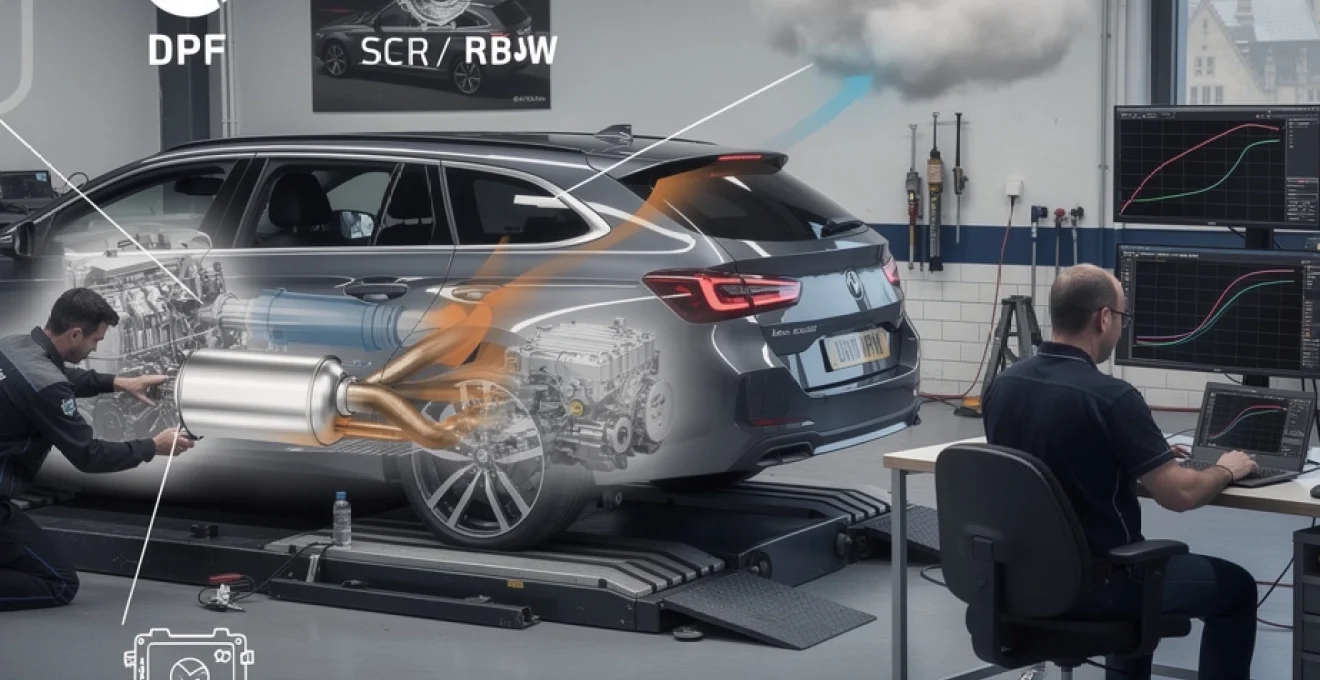
Removing a diesel particulate filter (DPF) and remapping the ECU can transform how a modern diesel engine feels to drive. Faster spool, more torque and fewer warning lights sound tempting, especially if you are dealing with a constantly clogging filter. Yet on Euro 5 and Euro 6 cars, DPF delete and remap sit at the crossroads of complex engine management, strict emissions laws and potentially expensive MOT issues. Understanding what actually happens inside the exhaust, what the ECU is trying to do, and what the law in the UK and EU allows puts you in a much stronger position before any irreversible cuts or software changes are made.
For many owners, DPF problems start with a simple dashboard light and end in limp mode, big bills and talk of “just gutting the filter”. Before reaching for a grinder or a tuning file, it helps to see the DPF not as an obstacle but as a carefully integrated part of the engine’s emissions system. Once removed, the ECU must be convinced the DPF is still there, or fully re‑calibrated to run without it. That is where things become technical, legal and sometimes risky if handled casually.
How diesel DPF systems work on modern euro 5 and euro 6 engines
Modern Euro 5 and Euro 6 diesel engines rely on the DPF to capture and burn off soot particles that would otherwise leave the tailpipe. On many PSA HDi, VW TDI and Ford EcoBlue units, the DPF sits close to the turbocharger so exhaust gas temperatures are high enough for regeneration. Under normal driving, the DPF fills with soot, then at set load and temperature points the ECU uses post‑injection events to raise exhaust gas temperature (EGT) above 550–600°C, burning soot into fine ash. That ash stays in the filter, slowly increasing backpressure over tens of thousands of miles.
In everyday use, especially on short journeys, regeneration may be interrupted or never start. The ECU monitors several parameters – exhaust temperature, backpressure, mileage since last regeneration and driving pattern – to decide when to trigger an active regen. If you mainly do stop‑start urban driving, the conditions may never stay stable long enough, so soot loading rises and you see messages like “DPF full – drive to clean”. Ignoring those early warnings often leads to forced regeneration at a garage or, in severe cases, a fully blocked filter that cannot be recovered by software alone.
Closed vs open DPF architecture on PSA HDi, VW TDI and ford EcoBlue engines
Two main DPF architectures are used on modern diesel cars: open (wall‑flow without additives) and closed systems that rely on fuel‑borne catalysts like Eolys or similar. PSA HDi engines are a classic example of the latter. A small additive tank doses the fuel so soot burns at a lower temperature, allowing regeneration at around 450–500°C. VW TDI and many Ford EcoBlue engines use an open DPF with no additive, relying purely on high EGTs achieved through late post‑injection and sometimes intake throttling.
When considering DPF delete and remap, that architecture difference matters. Closed systems involve extra fault paths: low additive level, additive pump failure or incorrect tank reset after refilling. Open systems are simpler mechanically but still integrate with multiple sensors. Removing the filter on an additive‑equipped engine without correctly disabling additive dosing in the ECU can quickly contaminate the exhaust, damage the SCR catalyst and cause ongoing fault codes. In practice, open‑type VW and Ford systems are usually more straightforward to map for off‑road use than complex additive‑based PSA setups.
Passive vs active regeneration cycles and ECU control strategies
DPF regeneration happens in two basic ways. Passive regeneration occurs naturally when sustained high‑load driving raises EGTs enough for soot to burn without extra fuel. Long motorway trips at constant speed often achieve this. Active regeneration is controlled directly by the ECU. When calculated soot loading crosses a threshold, the ECU schedules additional late injection pulses, closes the EGR valve and may increase idle speed to heat the DPF.
On many Bosch EDC16 and EDC17 systems, active regen cycles aim to last 10–20 minutes and repeat roughly every 300–600 miles depending on driving style. If you repeatedly stop the engine mid‑regen, unburnt diesel can dilute the oil. That is why owners of city‑driven diesels often see rising oil levels and warnings. From a tuning point of view, any DPF removal map must fully disable these active regen strategies; leaving them active when no filter is present leads to excessive EGTs, poor fuel economy and sometimes visible smoke as post‑injected fuel is not properly utilised.
Backpressure thresholds, differential pressure sensors and limp mode triggers
The ECU does not directly “see” soot; it infers DPF loading by comparing the pressure before and after the filter using a differential pressure sensor. At given flow rates (usually estimated from MAF and engine speed), the ECU expects a certain pressure drop. As soot builds up, this pressure difference rises. Once a lower threshold is hit, the ECU schedules a regeneration. If pressure continues to climb and exceeds a higher limit, it triggers limp mode and a DPF warning.
Typical thresholds vary by manufacturer, but a sustained high differential pressure at moderate engine speed is interpreted as “DPF overloaded” on most Euro 5/6 cars. At that point, fault codes are stored, torque is reduced and turbo boost is limited to protect the engine. Running a vehicle with artificially modified or disconnected pressure sensors without appropriate remap work is risky. The ECU may assume low soot loading and skip necessary regenerations, leading to rapid, unseen accumulation until a complete blockage or thermal event occurs.
Interaction between DPF, EGR valve and SCR/AdBlue systems
On many Euro 6 diesels, the DPF is just one piece of a broader emissions chain that includes EGR (exhaust gas recirculation) and SCR (selective catalytic reduction) with AdBlue. EGR reduces NOx by recirculating a portion of exhaust back into the intake, lowering combustion temperature. That recirculated exhaust, however, carries soot and oil vapour that can accelerate DPF loading and intake clogging. As a result, EGR duty cycles and DPF strategies are tightly related in the ECU calibration.
SCR uses AdBlue injection into the exhaust to convert NOx into nitrogen and water over a catalyst. In many Euro 6 applications, the SCR catalyst sits downstream of the DPF, so any uncontrolled soot or ash from a gutted DPF can quickly poison the SCR substrate. When considering DPF removal, disabling or altering EGR and SCR logic becomes highly technical. Poorly executed deletes often trigger complex chains of NOx sensor errors, AdBlue countdowns and restricted‑start conditions that are harder to resolve than the original DPF issue.
Typical DPF fault codes (P2002, P2458, P242F) and what they indicate
DPF‑related diagnostic trouble codes (DTCs) give a strong clue about the underlying problem. Code P2002 (“DPF efficiency below threshold”) usually indicates that the ECU detects unexpected low backpressure, either because the filter is cracked, has been tampered with or soot loading calculations are out of sync. Code P2458 points to “DPF regeneration duration”, suggesting that regens are taking too long or being repeatedly interrupted.
Code P242F refers to “DPF ash accumulation”. This is especially common on higher‑mileage cars where the filter has successfully regenerated soot many times but is now physically full of incombustible ash. At that point, more forced regenerations will not fix the restriction. Professional DPF cleaning or replacement is usually the only sustainable solution. Ignoring these codes and simply clearing them without checking differential pressure or soot load values on a diagnostic tool tends to result in the same warnings returning within a few hundred miles.
What “DPF removal” actually means: software delete vs physical gutting
DPF removal is often spoken about as if it is a single action, but in reality it has two distinct elements: software delete and physical modification of the exhaust. Purely physical gutting of the filter without updating the ECU is a recipe for constant fault codes, limp mode and uncontrolled post‑injection. Conversely, software‑only DPF delete without removing a severely blocked filter leaves a major restriction in the exhaust, often producing higher EGTs and poor turbo response.
Professional tuners treat DPF removal as a process, not a product. That process includes a full diagnostic session, checking live values such as soot loading, differential pressure and regeneration status. If the filter is only moderately loaded, a proper forced regeneration or off‑car cleaning may return it to near‑new flow and extend its life significantly. Where the substrate is physically damaged or ash‑packed, removal and replacement or cleaning become more logical options than ongoing forced regens that stress the turbo and cylinder head.
Physical DPF gutting, straight‑pipe fabrication and visual MOT inspection risks
Physical DPF removal usually involves taking the exhaust section containing the filter off the car, cutting open the canister, removing the honeycomb substrate and welding the shell back together. Some garages replace the entire section with a new straight‑pipe, sometimes adding a dummy canister to mimic the appearance of a functioning DPF. Care must be taken not to damage temperature sensors or pressure take‑offs housed in or near the DPF section, as those will still be monitored by the ECU on many platforms.
From an MOT perspective in the UK, testers are required to fail a vehicle if a DPF that was fitted as standard appears to be missing or obviously modified. Visual inspection focuses on the presence of the canister, weld marks and obvious straight‑pipe sections where a filter should be. Even if the vehicle passes a basic smoke opacity test, a clearly gutted DPF can result in an MOT failure. Many owners only discover this requirement after an enthusiastic but poorly concealed delete, forcing an expensive reversal with a new filter and software reversion.
ECU remap to disable DPF logic on bosch EDC16, EDC17 and delphi systems
The software side of DPF delete involves editing the engine control unit maps so that DPF‑related logic is deactivated. On Bosch EDC16 and EDC17 systems, as well as Delphi units used on some Vauxhall and Ford diesels, the tuner identifies all relevant “switches” and maps related to soot loading calculation, regeneration requests, differential pressure plausibility checks and DPF temperature monitoring. Simply turning off a few DTCs is not adequate and often leaves hidden regen strategies active.
A thorough DPF off remap sets appropriate flags so the ECU no longer attempts post‑injection for regen, does not reduce torque for high inferred soot loading and ignores missing or low DPF backpressure as long as other conditions are healthy. Many tuners combine this with a Stage 1 remap for modest power and torque gains. However, those torque increases must stay within sensible limits for the gearbox and turbocharger, especially on early Euro 5 engines with weaker clutches and known timing chain issues.
Sensor emulation and wiring modifications for DPF pressure and temperature probes
Some DPF delete jobs also involve sensor emulation. If the ECU continues to expect signals from DPF‑related pressure or temperature sensors, tuners may fit resistors, dummy sensors or small electronic modules that output a believable signal. For example, a differential pressure sensor may be left physically connected but with its hoses re‑routed so it sees near‑zero pressure difference, while the map is adjusted to interpret that as normal.
In a better‑executed setup, the ECU is calibrated so it no longer relies on those sensors for protection logic. That reduces the need for crude wiring changes, which are often the first place a sharp MOT tester or dealer technician will look when investigating emissions faults. Poor soldering, moisture ingress and chafing on modified harnesses create future reliability problems that can cost more in troubleshooting than the original DPF problem ever did.
Before‑and‑after diagnostics with VCDS, FORScan, autel and snap‑on scanners
Good practice around DPF removal includes comprehensive diagnostics before and after the work. Tools such as VCDS for VW/Audi, FORScan for Ford, and multi‑brand scanners from Autel or Snap‑on allow you to read not just fault codes, but also live values that show how the DPF is behaving. Checking parameters like “calculated soot mass”, “measured differential pressure” and “distance since last regeneration” gives a baseline of the system’s health.
After a DPF delete and remap, the same tools help verify that regeneration is no longer being requested, post‑injection is disabled and no new DPF‑related codes are present. A short road test with live data logging is invaluable. If you still see DPF or regen requests in the data stream, the map is incomplete. That is one of the reasons generic, file‑service maps without any datalogging are risky, particularly on more complex Euro 6 engines with tight thermal limits.
Performance impact of DPF removal and remapping on torque, turbo and fuel economy
From a pure performance perspective, removing a heavily loaded DPF and optimising the ECU calibration can bring noticeable gains. On many 2.0 TDI, 1.6 HDi or 2.2 CDTi engines, a freer‑flowing exhaust reduces backpressure on the turbine, allowing the turbo to spool slightly earlier and maintain boost with less effort. That often translates into stronger low‑rpm torque and a more responsive throttle feel, even before additional fuel and boost are added through remapping.
Dyno figures vary by engine and state of the original DPF, but increases of 10–20 bhp and 20–40 Nm from a sensitive Stage 1 remap combined with DPF removal are common on popular units. Fuel economy improvements are more variable. If you use the extra performance, average consumption may stay similar or worsen. Driven gently, some owners report 3–5% better economy due to reduced pumping losses and fewer active regeneration cycles. However, poor mapping, excessive fuelling and uncontrolled smoke often erase any potential efficiency benefits and raise EGTs to levels that shorten turbo and piston life.
Legal and MOT implications of DPF delete in the UK and EU regulations
On‑road DPF removal on Euro 5 and Euro 6 cars sits firmly in a legal grey area that is actually not very grey once the regulations are read closely. In the UK, it is an offence to use a vehicle on a public road if it has been modified so that it no longer meets the emissions standards it was designed to meet. Government guidance makes clear that removing or tampering with a DPF fitted as standard is illegal for road use, regardless of whether the car can still pass a basic smoke test. Similar provisions exist in much of the EU, linked to type‑approval rules.
In practice, enforcement has been tightening. The DVSA has carried out roadside checks and targeted inspections of garages suspected of advertising illegal DPF removal. Several high‑profile cases over the last few years have highlighted fines for both businesses and drivers where evidence of DPF tampering was found. While some older or off‑road vehicles may sit outside these rules, most Euro 5 and Euro 6 daily drivers used in cities are squarely covered, so any decision to delete the filter must be taken with full awareness of those legal risks.
UK MOT rules on visible DPF removal and emissions opacity testing
Since 2014, the UK MOT inspection manual has required testers to check visually for the presence of a DPF on diesel vehicles that were fitted with one when new. If the tester can see that a DPF has been removed or obviously modified, the vehicle should receive a major defect and fail the test, even if it passes the smoke opacity check. That visual check focuses on missing canisters, crude welds or non‑standard pipework in the section of exhaust where the DPF should be located.
The smoke opacity test itself is not a reliable indicator of DPF function. A well‑mapped car with a gutted filter can pass comfortably, while a car with an intact but partially blocked DPF can fail due to poor combustion and injector issues. Some owners assume that passing a smoke test makes a DPF delete “legal enough”; MOT rules do not support that view. For anyone considering removal, the potential cost of refitting a new OEM or pattern DPF and reversing the map after a failed MOT can run into four figures on modern diesels.
DVSA enforcement, fines and insurance invalidation risks
The Driver and Vehicle Standards Agency (DVSA) has the authority to investigate garages offering illegal DPF removal for road vehicles. Where evidence is found, penalties can include fines and removal of testing licences. Drivers caught using vehicles with tampered emissions systems can also face fines and prohibition notices. In some cases, vehicles have been ordered off the road until returned to compliant condition. The financial impact of rectifying such issues often dwarfs the original cost of the delete.
Insurance is another angle many owners overlook. Most policies require disclosure of significant modifications, particularly those affecting performance or emissions. Undeclared DPF removal and remap work can be grounds for refusing a claim after an accident. Even if the other party’s insurer pays out, your own insurer may decline to cover damage to your vehicle. From a risk‑management perspective, any performance remap or exhaust modification should be declared, and written confirmation requested from the insurer that cover remains valid.
EU emissions legislation (euro 5/6) and type‑approval considerations
Across the EU, modern diesel cars receive type‑approval based on compliance with Euro 5 or Euro 6 emissions limits in both lab and, for newer approvals, real‑world (RDE) tests. The DPF is a core part of the emissions control system required to meet the particle number (PN) and particulate mass (PM) limits. Removing or disabling it means the car no longer conforms to its original type‑approval. While day‑to‑day enforcement still varies by country, the legal position is clear: the vehicle, as modified, does not meet the approval it was sold under.
Recent moves towards stricter roadside emissions testing and remote sensing in several EU member states underline the direction of travel. As low‑emission zones expand and Euro 7 regulations loom, pressure is likely to increase rather than decrease. For business fleets, taxis and private hire vehicles, running a DPF‑deleted diesel in this environment risks not only individual fines but also regulatory action against operating licences where systematic non‑compliance is found.
Implications for ULEZ, CAZ and low‑emission zone access in london, birmingham and other cities
Urban areas such as London and Birmingham have introduced Ultra Low Emission Zones (ULEZ) and Clean Air Zones (CAZ) to target NOx and particulate emissions from older and non‑compliant vehicles. Entry charges and penalties are based on the original Euro standard and official emissions data, not the current hardware state of the vehicle. A Euro 6 diesel with its DPF removed still appears as Euro 6 in the database, so it may gain entry, but its real‑world emissions are far higher than allowed by the scheme’s intent.
There is growing discussion about more advanced roadside monitoring using particle counters and remote sensors that can detect gross emitters regardless of registration data. If such systems are rolled out more widely, DPF‑deleted diesels could become easy targets for enforcement in city centres. For drivers who rely on access to ULEZ or CAZ zones for commuting or business, preserving full emissions compliance, or switching to genuinely cleaner powertrains, will likely prove more sustainable than chasing short‑term performance gains through DPF removal.
ECU remapping after DPF removal: tuning strategies and safety limits
Any DPF delete that includes a performance remap introduces another layer of considerations around engine and drivetrain safety. A “Stage 1” map on a healthy, stock car with DPF intact is generally conservative, staying within comfortable limits for turbo speed, EGTs and gearbox torque capacity. Once the filter is removed, tuners often feel tempted to push further, especially when exhaust backpressure drops and the turbo responds better. That is where clear strategies and data‑driven limits become essential.
Professional calibrators treat each popular engine family – such as VW 2.0 TDI, BMW N47 or Vauxhall CDTi – as a known case study with defined weak points. For example, some early N47 units have timing chain issues, while certain VW DSG gearboxes have strict input torque caps. A good DPF‑off Stage 2 map respects those realities by shaping torque delivery rather than simply raising peak boost and fuelling. The aim is strong, flat, mid‑range torque without sudden spikes that shock the drivetrain or push combustion pressures towards unsafe levels.
Stage 1 vs stage 2 remaps on popular engines (VW 2.0 TDI, BMW N47, vauxhall CDTi)
On a VW 2.0 TDI, a typical Stage 1 remap with DPF intact might raise output from around 150 bhp to 185 bhp and torque from 340 Nm to roughly 400 Nm. With the DPF removed and a less restrictive exhaust, a Stage 2 calibration can often reach 200–210 bhp and 430–450 Nm without hardware changes beyond a good intercooler. Similar proportional gains exist on BMW N47 and Vauxhall CDTi engines, but each platform has its own safe limits informed by extensive logging and field experience.
The key difference between Stage 1 and Stage 2 after DPF delete is not only peak numbers but also how aggressively torque is delivered at low rpm. Stage 2 files may bring boost in earlier and target richer mixtures to keep EGTs in check, which can visibly increase smoke if not carefully balanced. For daily‑driven cars, especially those used for towing or frequent short trips, a mild DPF‑off Stage 1 often offers the best compromise between drivability, smoke control and mechanical sympathy.
Boost pressure, AFR and EGT management to protect turbochargers and pistons
Managing boost pressure, air‑fuel ratio (AFR) and exhaust gas temperature is central to safe diesel tuning post‑DPF removal. A freer exhaust allows faster turbo acceleration, but if requested boost and fuelling are raised without restraint, turbine speed and compressor outlet temperatures can climb beyond their design envelope. Sustained EGTs above 800–850°C risk damaging turbine blades, cracking manifolds and overheating pistons, particularly on engines with modest intercooling.
Well‑developed maps use closed‑loop boost control and EGT modelling to cap extreme conditions. AFR is kept lean enough under sustained load to avoid heavy smoke, yet rich enough at transient points to maintain response. On some platforms, tuners limit maximum boost at low rpm and high gear to keep cylinder pressures under control, even if the hardware could momentarily deliver more. That balance is part science, part experience; generic maps that ignore it often show strong dyno numbers but reduced longevity in real‑world towing or high‑load motorway use.
Rolling‑road (dyno) tuning vs generic “file service” maps
Dyno‑based tuning offers the advantage of controlled, repeatable measurements of power, torque and EGTs. When a DPF is removed and a custom map is built live on the rolling road, the tuner can observe how small changes in timing, boost or rail pressure affect not just output, but also smoke levels and thermal behaviour. That level of feedback is difficult to replicate with a generic file downloaded from a “file service” and flashed on the driveway.
File‑service maps are typically built from a combination of previous calibrations and broad assumptions about hardware condition. They may work acceptably on some cars, but they cannot account for worn injectors, slightly restricted intercoolers or marginal turbos. When combined with DPF delete, those unknowns become more critical. A vehicle with an already tired turbo may survive on a conservative stock DPF map but fail quickly under a more aggressive generic file that regularly presses it into the upper end of its operating range.
Smoke control, injection timing and rail pressure adjustment
Visible diesel smoke is not only an MOT and roadside enforcement problem; it is also wasted fuel and unburnt soot loading up the turbo and exhaust. After DPF removal, smoke becomes immediately visible rather than trapped, so map quality shows itself clearly. Key levers here are injection timing, duration and common‑rail pressure. Advancing main injection slightly at higher loads can improve combustion efficiency and reduce smoke, but excessive advance raises cylinder pressure and knock risk.
Increasing rail pressure allows more fuel to be delivered in a shorter injection window, helping keep combustion within the optimal crank angle range. However, injector and pump durability set a firm limit. To control smoke responsibly, tuners often shape torque limiters against airflow so that requested torque never exceeds what current mass air flow can support with a clean burn. From a driver’s seat perspective, that yields a car that pulls strongly under load without leaving a visible trail of soot every time you accelerate hard.
Data‑logging key parameters with tools like HP tuners, KESS, KT‑Flash
Reliable data‑logging is the backbone of safe remapping, especially once emissions hardware like the DPF is altered. Tools such as HP Tuners, KESS or KT‑Flash, combined with appropriate logging software, allow capture of vital parameters: boost pressure, MAF, fuel rail pressure, injection duration, EGT (where sensor‑equipped), lambda and knock sensors on some platforms. Analysing this data over varied road conditions shows whether the engine is operating within safe margins.
For example, repeated high EGTs during motorway climbs or towing suggest the need to trim fuelling or boost in those zones, even if peak power numbers look impressive. Similarly, rail pressure oscillations or noisy injector corrections may hint at hardware issues to address before pushing power further. For anyone serious about DPF delete and remap as a long‑term solution rather than a short‑term thrill, access to thorough data‑logging and someone experienced enough to interpret it is worth as much as the tuning file itself.
Alternatives to DPF removal: professional cleaning, forced regeneration and OEM updates
For many owners, the urge to remove the DPF comes from repeated warnings, limp mode episodes and expensive dealer quotes for replacement. Yet full removal is not the only path. Professional off‑car cleaning services can restore a heavily loaded but structurally sound filter to near‑new flow by removing accumulated ash as well as soot. Techniques include ultrasonic baths, thermal cleaning ovens and specialised flushing rigs, typically costing less than half the price of a new OEM DPF and extending usable life by another 15,000–25,000 miles depending on driving patterns.
Where soot loading is high but ash is not excessive, a properly managed forced regeneration using dealer‑level diagnostics can also help. Unlike repeated, short active regens triggered during urban driving, a workshop‑initiated regen is monitored for EGT, backpressure and duration, giving a clearer picture of the filter’s true condition. Addressing underlying causes such as failed temperature sensors, split differential‑pressure hoses, low additive levels on PSA systems or outdated ECU software is equally important. Many manufacturers have released updated calibrations that refine regeneration strategies and reduce premature clogging, so checking for OEM software updates before condemning the DPF can pay dividends.
Preventative measures also make a real difference. Regular motorway runs long enough to complete a full passive or active regen, using high‑quality diesel and maintaining healthy injectors limit soot output at the source. Periodic engine oil changes are critical, because repeated interrupted regens dilute oil with diesel and accelerate wear. For drivers whose use is almost entirely short, stop‑start city trips, switching to a petrol, hybrid or fully electric vehicle often makes more economic sense over the life of the car than fighting a losing battle with a DPF‑equipped diesel in an unsuitable duty cycle.