
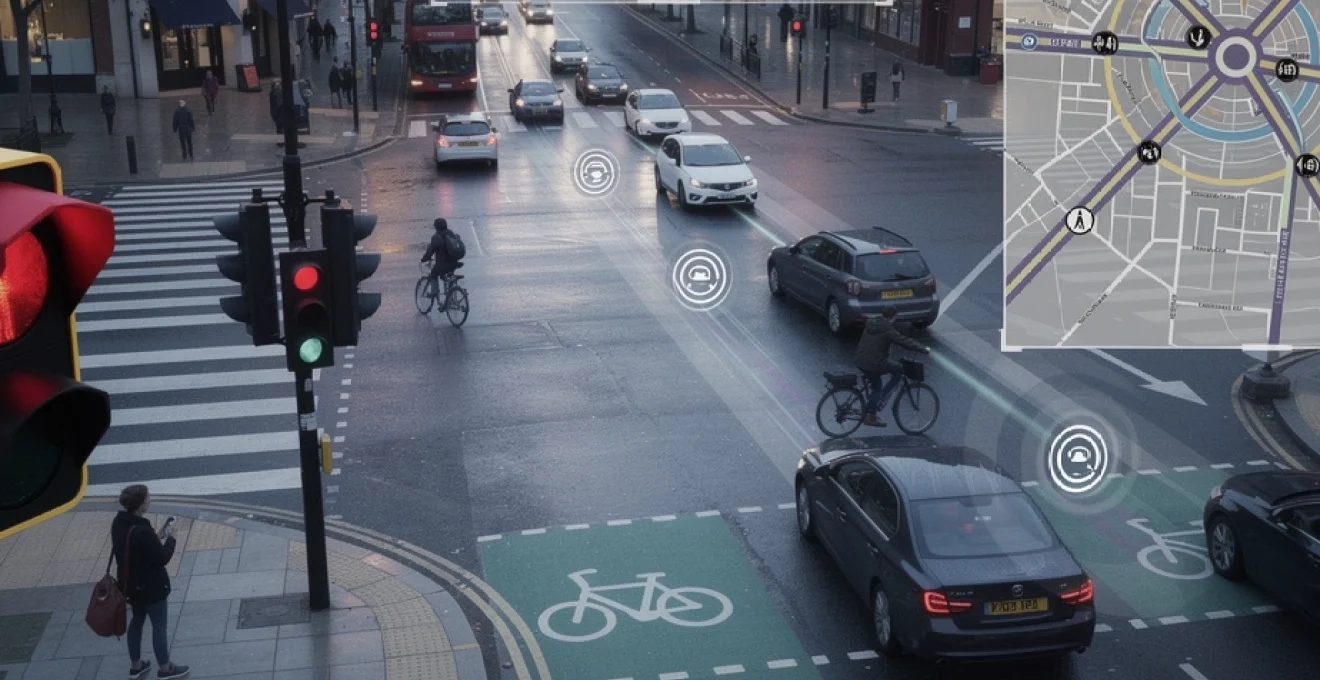
Red light cameras in Nottingham shape how you drive through some of the city’s busiest junctions. With hundreds of traffic signal installations and a smaller network of enforcement sites, understanding where cameras operate – and how they work – can make every journey safer and less stressful. If you know how the technology triggers, how Notice of Intended Prosecution (NIP) timelines work and which routes are most heavily monitored, you are far better placed to avoid fines, points and unnecessary risk. For drivers using major routes such as the A52, A60 and A610 daily, red signal enforcement is not just a legal issue; it directly affects journey planning, braking choices and how you read a set of changing lights in real time.
How red light cameras operate in nottingham under UK traffic enforcement law
Red light camera enforcement in Nottingham sits under the same UK traffic law framework that covers fixed speed cameras. Devices must be Home Office type‑approved, calibrated against strict standards and used in line with guidance that aims to improve safety rather than generate revenue. In Nottinghamshire there are 471 traffic signal installations and around 17 fixed red light camera sites, so only a small proportion of lights are actively enforced at any one time. Many junctions also have other technology, such as ANPR cameras or bus lane enforcement, which can cause confusion about what actually triggers an offence. Understanding the enforcement chain – from sensor in the road to letter through your door – helps you judge how cameras will respond to your driving decisions at amber and red.
Home office type-approval, DVSA calibration standards and nottinghamshire police enforcement workflow
Every fixed red light camera used by Nottinghamshire Police must carry Home Office type-approval. That approval confirms that, when installed and maintained correctly, the device is accurate enough for prosecution. Calibration is typically aligned with DVSA‑recognised metrology standards and is checked at regular intervals, often annually or after any engineering work. If calibration records are not up to date, evidence from the device can be challenged. Once a potential offence is captured, the image set enters an enforcement workflow where trained staff manually review each case. They assess the time into red, vehicle position and plate clarity before authorising a NIP. Automation plays a big role, but human review is still the final filter before your case moves into the legal system.
Inductive loop sensors, radar triggering and photographic evidence capture at signalised junctions
Most Nottingham red light cameras rely on inductive loop sensors cut into the tarmac just beyond the stop line. Think of them as metal detectors for vehicles: when your car passes over a live loop during the red phase, the system knows a potential violation has occurred. Some newer installations combine loops with radar or laser detection to improve reliability in poor weather. The camera then records at least two time‑stamped images, often 0.5 seconds apart. Those photos need to show the illuminated red aspect, your vehicle crossing the stop line and, ideally, its position further into the junction. This sequence forms the core of the evidence bundle and is what you later see if you request photographs to identify the driver or assess the circumstances.
Integration with ANPR (automatic number plate recognition) and DVLA keeper data for NIP issuing
Modern enforcement systems in Nottingham usually integrate red light cameras with ANPR software. Once the camera captures an offence, ANPR reads your number plate automatically. That registration is then cross‑referenced with DVLA keeper data to identify the person or company recorded as responsible for the vehicle. The back‑office system generates a NIP, which must normally be sent so it arrives within 14 days of the alleged offence for UK‑registered vehicles. Any error in plate reading – for example due to dirt, damage or a non‑standard font – can affect the process, although the combination of high‑resolution images and ANPR algorithms means misreads are relatively rare. If the plate is unreadable, enforcement staff may manually interpret it or, in some cases, discard the offence entirely.
Amber phase timings, red phase grace periods and enforcement thresholds under TSRGD
Amber and red timings at Nottingham junctions follow the national framework in the TSRGD (Traffic Signs Regulations and General Directions). Amber usually lasts about 3 seconds on 30 mph roads, slightly longer on higher‑speed approaches, giving you a defined window to stop if it is safe. Many systems also include a very short grace period – often 0.5 seconds – after the light turns red before the enforcement circuitry arms. In practice, cameras are aimed at those who clearly enter on red, not drivers caught in an unavoidable borderline moment. However, the law is strict: once the signal is red, any entry beyond the stop line can technically count as an offence, even if you feel the decision was safer than braking harshly on a wet or icy surface.
Key red light camera locations in nottingham city centre and inner ring road corridors
Nottingham’s inner ring road and central corridors combine heavy commuter traffic, bus priority lanes and complex junction layouts. Those conditions have historically generated higher collision rates, particularly at sites where multi‑lane approaches merge with pedestrian crossings. Cameras in these areas aim to manage that risk by discouraging late running through signals. For example, the Huntingdon Street and Mansfield Road corridors see a constant flow of buses, taxis and private vehicles converging near the city core. If you regularly drive between the city centre and suburbs such as Arnold, Radford or Lenton, understanding where enforcement is most likely helps you read each approach more cautiously and gives you the confidence to brake earlier rather than “chancing it” on a late amber.
A60 mansfield road and woodborough road junction camera placements
The A60 Mansfield Road corridor includes several high‑risk intersections where red signal running has been a problem, particularly near the junction with Ribblesdale Road in Arnold and around Woodborough Road closer to the city centre. Historic listings show a red light camera at the A60 Mansfield Road – Ribblesdale Road junction northbound, monitoring traffic heading out towards Arnold and Daybrook. On the city side, the A60 Huntingdon Street – Woodborough Road junction has had enforcement equipment covering south‑east bound movements into the inner ring. When you approach either junction, the safest strategy is to treat the onset of amber as a firm instruction to slow, especially if you are at or above the posted limit. Long tailbacks and frequent bus movements make sudden lane changes a particular collision risk here.
A610 nuthall road and western boulevard signal-controlled intersection enforcement
The A610 Nuthall Road corridor is one of Nottingham’s most intensively monitored enforcement zones. Multiple camera heads have historically been installed around the Nuthall Island complex, including inbound and outbound approaches and the segment sweeping into the A6514 Western Boulevard. The junction of A6514 Western Boulevard with A610 Nuthall Road on the ring road has been listed with enforcement coverage westbound, aiming at drivers accelerating away from the island or trying to “beat” a late signal. Traffic volumes here are substantial, especially in peak hours when queues from the M1 direction build quickly. If you use this route daily, building a mental model of phase sequences and likely congestion patterns helps you anticipate when staying in gear and rolling gently to a halt is safer than last‑second braking.
A52 derby road, ilkeston road and middleton boulevard junction camera coverage
The A52 corridor through Nottingham splits into several busy spurs, including Derby Road, Ilkeston Road and the Middleton Boulevard section of the ring road. Previous enforcement lists highlight red light cameras at sites such as A52 Derby Road – Wollaton Road and A609 Ilkeston Road – Radford Boulevard, with additional coverage where the ring road meets the A610. These signalised junctions manage not just radial flows but also major university and hospital traffic, making pedestrian and cyclist protection a priority. You often see staggered pedestrian crossings and advance stop lines for cycles near camera sites, which can complicate how you judge the stop line. Entering the box while focusing on pedestrians instead of the light is a common cause of inadvertent red phase encroachment.
A6005 castle boulevard, wilford street and queens drive red signal enforcement sites
Although not always explicitly labelled as combined red light and speed enforcement, parts of the A6005 corridor – covering Castle Boulevard, Wilford Street and Queens Drive – have seen various camera deployments over recent years. Historic references mention cameras at A6005 Nottingham Road / Swiney Way, Chilwell and A6005 Queens Road – Station Road, Beeston westbound, which lie just beyond the city boundary but serve many Nottingham commuters. Castle Boulevard and its connection to Maid Marian Way have also used enforcement to control late running into the city core. The mixture of 30 mph and 40 mph sections, frequent bus lanes and short signal cycles means you benefit from planning lane position earlier than usual, avoiding rushed decisions at the last few metres before the stop line.
Lenton, radford and forest fields high‑risk junction cameras around the inner ring road
Lenton and Radford host several of Nottingham’s most complex junctions, with high student populations, heavy cycling and late‑night traffic around the A6005, A609 and A6130 corridors. Sites such as Ilkeston Road – Radford Boulevard, Radford Boulevard – Hartley Road and nearby inner ring road junctions have historically been associated with red signal offences. In Forest Fields and Hyson Green, enforcement around radial approaches to Gregory Boulevard and Hucknall Road further shapes driving behaviour. Why does this matter for you? Because mixed traffic – taxis pulling over, cyclists filtering, pedestrians crossing late – can tempt drivers to “clear the junction” during late amber, only to be caught by an already‑armed camera. A more defensive driving style, with slightly lower approach speeds, dramatically reduces that temptation.
Red light camera hotspots on nottingham’s radial routes and suburban corridors
Outside the city centre, several radial roads linking Nottingham to the M1 and surrounding towns carry red light enforcement at strategic points. Statistics from local authorities show that around 17 of the 471 signalised junctions in Nottinghamshire have red light cameras, a relatively small but impactful network. These devices often appear where high‑speed suburban approaches meet built‑up areas, or where serious collisions have occurred at right‑turn filters. For daily commuters from Clifton, Colwick, Arnold or Hucknall, learning these hotspots is a matter of both legal protection and safety. It encourages earlier speed reduction as you transition from dual carriageway sections into 30 mph and 40 mph zones dotted with pedestrian refuges, cycle lanes and access roads.
A453 clifton boulevard and remembrance way junction cameras approaching M1 junction 24
The A453 provides a fast route between Nottingham, the M1 Junction 24 and East Midlands Airport. As the dual carriageway narrows and speed limits step down near Clifton and the urban fringe, several signalised junctions manage local access and park‑and‑ride connections. While published lists focus more on speed cameras and average speed systems along Remembrance Way, red light enforcement has also been used around key intersections on Clifton Boulevard, particularly near large roundabouts with signal‑controlled entries. The combination of high approach speeds and complex lane markings can create last‑second lane‑change manoeuvres that coincide with amber onset. Allowing more time to merge into the correct lane and treating every amber on this corridor as an early braking cue is one of the most effective ways to avoid both collisions and tickets.
A52 clifton bridge, gamston lings bar road and ring road interface camera locations
The junctions where the A52 crosses the River Trent at Clifton Bridge and then links to Gamston Lings Bar Road and the southern ring road form one of the region’s most sensitive traffic nodes. While some enforcement here focuses on speed and lane discipline, red signal cameras support pedestrian and cycle safety at key crossings and filter phases. Congestion is common at peak times, and signal cycles can feel relatively short, increasing the temptation to push through amber to avoid another red. However, given that enforcement typically targets entries more than 0.5 seconds into red, easing off the throttle earlier is usually the lower‑stress option. It also helps maintain smoother flow, as abrupt last‑second braking on the bridge sections can trigger rear‑end shunts.
A612 colwick loop road and colwick park corridor signal enforcement
The A612 Colwick Loop Road is a focal point for red light enforcement discussions, not least because public listings and third‑party camera maps sometimes disagree. Official sources have identified red light cameras at A612 Colwick Loop Road – Private Road No 1 (south‑west bound) and A612 Daleside Road / Vale Road, Colwick. At the same time, crowd‑sourced services sometimes mark additional camera icons near Mile End Road and First Avenue, often tagging them as combined red light and speed cameras. The discrepancy illustrates an important point: no unofficial map should be treated as definitive. Treat every major signalised junction along the Colwick Loop and Daleside Road corridor as if enforcement is active. That mindset naturally supports smoother approaches and reduces the risk of braking late to avoid cameras seen at the last moment.
A60 hucknall road, arnold and daybrook junction cameras in northern suburbs
Hucknall Road and Mansfield Road handle large flows between the city centre and northern suburbs such as Sherwood, Arnold, Daybrook and Hucknall. Official lists reference red light enforcement on A611 Hucknall Road – Haydn Road (northbound), A611 Hucknall Road (south‑bound) within the city, and A60 Mansfield Road – Ribblesdale Road (northbound) in Arnold. These corridors combine bus priority measures, cycle lanes and numerous side streets, making them fertile ground for spur‑of‑the‑moment overtakes or amber gambles. If you know that cameras could be present at multiple points, you are less likely to accelerate toward a changing signal to “stay with the flow”. Instead, planning to lift off the accelerator as soon as cross‑traffic illumination becomes visible in your peripheral vision tends to keep you clear of red phase encroachment.
Mapping and verifying nottingham red light camera locations using open data and navigation tools
Finding an accurate, up‑to‑date map of Nottingham red light cameras can be surprisingly difficult. Official bodies such as Nottinghamshire County Council increasingly rely on Freedom of Information exemptions when asked to publish full enforcement lists, citing Section 31(1) of the Freedom of Information Act and concerns that drivers might deliberately route around cameras. At the same time, third‑party websites offer detailed maps that mix fixed speed cameras, red light enforcement, bus lane cameras and ANPR points, sometimes with duplicated or outdated entries. For a responsible driver, the aim is not to game the system, but to understand how camera deployment relates to collision history and road design. Combining open data, navigation apps and collision statistics gives you a more nuanced picture than any single source can provide.
Using nottingham city council and nottinghamshire county council transport datasets
Nottinghamshire County Council confirms that there are 471 traffic signal installations across the authority, but only around 17 have fixed red light cameras. The council supplies detailed locations for signals in spreadsheet form, yet explicitly withholds which specific sites host enforcement under FOI Section 31(1), arguing that disclosure might prejudice crime prevention and public safety. That stance has become more common among UK authorities in recent years as camera networks have diversified. For practical purposes, you can still download signal location data, load it into mapping software and then compare it against observed camera housings on street‑level imagery. Treat the council datasets as a base layer that reveals where signalised junctions exist, then mentally overlay the risk factors – high speeds, complex turning movements, heavy pedestrian activity – that often correlate with camera deployment.
Cross‑checking camera sites with google maps, waze and TomTom speed cameras services
Navigation tools provide another lens on Nottingham red light enforcement, but each has limitations. Google Maps offers satellite and Street View imagery that lets you visually confirm camera housings on poles or gantries, though it will not explicitly flag red light cameras. Waze uses user reports to warn about police locations and some fixed cameras, but icons may represent mobile traps, temporary roadworks or even outdated information. Dedicated services such as TomTom Speed Cameras aggregate crowdsourced reports with some official data, yet still display disclaimers that locations are guides only, not definitive references. If you rely heavily on these services, it is easy to treat a lack of icon as “permission” to hurry through a changing amber. A more robust approach sees app alerts as a backup to disciplined observation, not the primary safety system.
Leveraging crashmap.co.uk collision data to understand camera placement rationale
Collision data fills an important gap that camera maps alone cannot address. Tools such as crashmap‑style interfaces show police‑recorded injury collisions at UK junctions over multiple years, often colour‑coded by severity. When you overlay this information on Nottingham’s inner ring road, radial routes and suburban corridors, a pattern usually emerges: camera‑equipped junctions tend to coincide with clusters of right‑angle or turning collisions. Using this type of dataset, you can answer questions like, “Why has a camera been installed here and not at the next set of lights?” In many cases, red light enforcement is a direct response to a documented safety problem, not a random or purely revenue‑driven decision. For drivers, that knowledge encourages respect for the signal timings even if you have never personally seen an accident at that location.
Red light camera penalties, NIPs and contesting procedures in nottingham
Understanding what happens after a red light violation in Nottingham helps you make informed choices from the moment a NIP lands on your doormat. The legal process is standardised across England and Wales but is administered locally by Nottinghamshire Police and the courts serving Nottingham and the surrounding boroughs. If the evidence stack shows that your vehicle crossed the stop line during red, you can usually expect either a fixed penalty offer or, in some circumstances, an invitation to attend an educational course instead of prosecution. However, the first and most important legal obligation rests with the registered keeper, who must respond to the NIP and associated Section 172 notice within the set deadline. Failing to do so can create a worse outcome than the original alleged offence.
Notice of intended prosecution (NIP) timelines and section 172 keeper obligations
After a camera detects a suspected offence, Nottinghamshire Police issue a Notice of Intended Prosecution to the registered keeper. For UK‑registered vehicles, this NIP must normally be served so it arrives within 14 days of the alleged violation. The envelope includes a Section 172 notice requiring the keeper to identify the driver at the time. You have 28 days to complete and return the form, providing accurate details; ignoring, failing to sign or otherwise not supplying driver information is a separate offence. As Nottinghamshire Police emphasise, that offence can attract six penalty points and a fine up to £1,000. In other words, failing to respond can lead to a heavier penalty than the red light incident itself, particularly if the original offence would likely have qualified for a course.
Fixed penalty points, speed awareness and red light education course eligibility
For a straightforward red light camera offence in Nottingham, the usual fixed penalty is three points on your licence and a £100 fine, assuming there are no aggravating factors such as a collision, very late entry into the red phase or evidence of dangerous driving. In many cases, drivers are instead offered the chance to attend a red light or speed awareness course as an alternative to prosecution. Nottinghamshire Police state that, if you complete such a course successfully, you will not incur points or further fines in relation to that offence. Course offers are typically discretionary and often depend on the severity of the incident and whether you have attended a similar course in the previous three years. Accepting a course means paying a fee and giving up half a day, but it keeps your licence cleaner.
Requesting photographic evidence and assessing amber timing or obscured signal defences
If you are unsure who was driving or want to understand what happened, you can usually request photographic images from Nottinghamshire Police. These photos are primarily provided to help identify the driver, not for a full technical audit of the device, but they often show the vehicle position relative to the stop line and sometimes the time into red. Possible technical defences include arguments about unusually short amber phases, defective signals, obscured lights due to foliage or construction, and defective cameras. However, such defences rarely succeed without expert evidence and clear documentation, because signals and enforcement devices are designed with significant tolerance. In practice, most drivers in Nottingham who receive a single, marginal offence find that a course or fixed penalty is the most pragmatic route unless there is a very clear and provable error.
Driving strategies to avoid red light violations at camera‑monitored nottingham junctions
Safe driving strategies around camera‑monitored junctions do more than protect you from penalties; they reduce collision risk across the entire network. Nottingham’s mix of arterial routes, tram lines, bus lanes and dense pedestrian areas means that a simple habit such as easing off the throttle earlier can have outsized benefits. Instead of viewing cameras as isolated hazards to dodge, it is more effective to treat them as reminders to refine how you judge distance, speed and signal timing. By reading phase patterns, managing following distances and respecting vulnerable road users such as cyclists and pedestrians, you lower the chance of being caught in an impossible dilemma when the light changes from green to amber at the worst possible moment.
Reading signal phase patterns on A52, A60 and A610 corridors to anticipate changes
Many major Nottingham corridors – particularly the A52, A60 and A610 – use coordinated signal systems to manage flow. That means phases at one junction are often timed relative to the next, creating a pattern that regular drivers can learn. For example, if you know that, on the A610 Nuthall Road inbound, a certain pedestrian crossing usually turns red shortly after the previous junction releases cross‑traffic, you can anticipate a likely phase change rather than being surprised. Watching side‑street and pedestrian signals can also give clues: flashing green men or amber pedestrian indicators often precede your own signal turning amber. Treat each corridor as a rhythm you can “read”, much like anticipating the beat in a piece of music, and you are less likely to be caught approaching at an inappropriate speed when the phase switches.
Safe deceleration profiles, following distances and wet‑weather braking at camera sites
One of the most common reasons drivers run red lights, intentionally or not, is mis‑judged braking distance. On Nottingham’s urban 30 mph routes, a typical dry stopping distance is around 23 metres, but that can roughly double on wet or icy surfaces. If you routinely follow too closely, any unexpected amber at a camera‑equipped junction can feel like a no‑win choice between harsh braking and crossing the line. Keeping a generous two‑second gap – or more in the rain – allows you to adopt a smoother deceleration profile when signals change. Think of it as stretching out the decision window: the earlier you can start gently coming off the accelerator, the less likely you are to panic‑brake or accelerate to “make the light”, both of which increase risk and enforcement exposure.
HGV blind spots, cyclist ASLs (advanced stop lines) and pedestrian crossing interactions
Camera‑equipped junctions in Nottingham often coincide with complex layouts featuring Advanced Stop Lines for cyclists, pedestrian refuges and multiple turning lanes. Heavy goods vehicles and buses have significant blind spots that can hide cyclists waiting in ASLs or pedestrians stepping off kerbs late in the green phase. If you drive an HGV or large van, approaching these junctions slightly below the posted limit and scanning mirrors early reduces the chance of a last‑second surprise forcing you into a red light decision. As a car driver, stopping behind the first line of an ASL, not within the cyclist box, keeps vulnerable users visible and avoids creeping into the enforcement zone before the light fully changes. Recognising that cameras are there to protect these interactions – not just to penalise – encourages a calmer, more cooperative approach to every signal.