
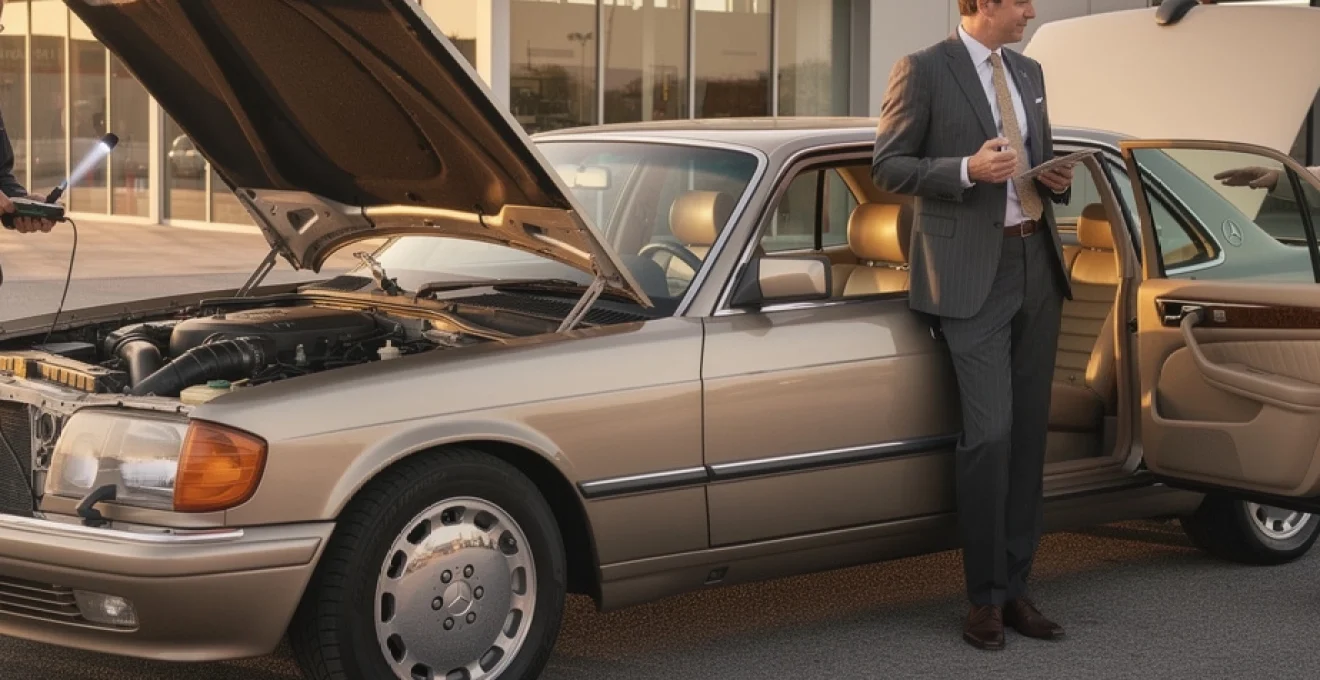
The Mercedes-Benz 560 SEL sits at a crossroads of engineering rigour, discreet luxury and period status. It was the flagship of the W126 S-Class range, aimed squarely at buyers who wanted a limousine that could cruise the autobahn at 150 mph yet feel as relaxed as a modern executive saloon. For anyone considering a classic luxury car that still makes sense on today’s roads, the long-wheelbase 560 SEL remains one of the most compelling propositions. Values of good cars are rising steadily, but thoughtful buyers can still find examples that balance originality, usability and long-term collectability.
Spend some time with a cared‑for 560 SEL and the appeal becomes obvious. The doors close with a muted “thunk”, the V8 idles almost silently and the suspension irons out bumps in a way many contemporary SUVs struggle to match. Underneath that calm surface sits serious engineering: a torquey M117 V8, thoroughly developed chassis and a body designed around safety and durability rather than fashion. For enthusiasts used to more fragile classics, the car can feel like over‑engineering made tangible.
W126 chassis heritage: positioning the Mercedes-Benz SEL 560 in the S-Class lineage
The W126 S-Class, introduced at the 1979 Frankfurt Motor Show, was conceived as a lighter, safer and more aerodynamic evolution of the earlier W116. Development spanned roughly six years, with extensive wind tunnel work and crash testing at a time when fuel economy and safety were becoming central concerns. Compared with its predecessor, the W126 shed up to 280 kg depending on model, thanks to greater use of high-strength steel and careful optimisation of the structure. The 560 SEL, launched for the 1986 model year in most markets, represented the ultimate expression of this platform.
Positioned at the top of the S-Class hierarchy, the 560 SEL featured the longest wheelbase configuration (SEL – Lang) and the most powerful engine offered in a regular W126 saloon. Production ran until 1991/92 depending on market, and period press often referred to it as “the best car in the world”. Around 75,000 examples of the 560 SEL were sold globally, yet the majority were left-hand drive, making right-hand drive cars relatively rare today. For buyers looking for a usable classic luxury saloon, that combination of volume production and flagship status keeps parts accessible while preserving a sense of exclusivity.
In historical terms, the 560 SEL bridges the gap between the more analogue W116 and the fully electronic W140 that followed in the 1990s. It retains solid mechanical controls, a largely cable‑driven cabin and a conventional hydraulic power steering system, yet introduces technologies such as ABS, SRS airbags and advanced seatbelt pre‑tensioners. Many classic specialists consider the W126 to be the sweet spot in the S-Class timeline, where durability, comfort and simplicity meet.
M117 5.6-litre V8 powertrain: technical specifications, performance figures and tuning potential
At the heart of the 560 SEL lies the M117.968 5.6‑litre V8, an all‑alloy, single‑overhead‑camshaft engine with two valves per cylinder. In European non‑catalyst form, it produced around 296 bhp and 430 Nm (approx. 336 lb ft) of torque, with slightly lower figures for catalyst‑equipped and US‑spec engines. Power was delivered through a robust four‑speed automatic gearbox, tuned for smoothness rather than aggressive kickdowns, yet still capable of brisk acceleration. Period factory data quoted 0–62 mph in 6.9 seconds and an electronically limited top speed of about 155 mph on some versions.
For a luxury saloon weighing roughly 1,700–1,800 kg, those numbers are still respectable in current traffic. What matters more in daily use is the torque curve: the engine delivers substantial pulling power from barely above idle, allowing lazy progress with minimal throttle input. This character makes the 560 SEL an ideal high‑speed cruiser, whether on open motorways or long‑distance touring. For owners interested in classic Mercedes performance tuning, the M117 platform also offers plenty of scope for subtle modifications that preserve reliability.
Bore, stroke and compression ratio of the M117.968 engine in the 560 SEL
The M117.968 displaces 5,547 cc, with an 88.0 mm bore and 94.8 mm stroke, giving it a distinctly “undersquare” layout compared with many modern engines. This long‑stroke configuration contributes to the engine’s generous low‑ and mid‑range torque, which is one of the defining characteristics of the 560 SEL driving experience. Compression ratio varies by market: European non‑catalyst engines typically run around 10.0:1, while catalyst and US‑market versions use slightly lower compression to accommodate emissions equipment and fuel quality.
From an engineering perspective, the combination of relatively modest revs and robust internals has proved durable. Many 560 SELs have covered well over 200,000 miles with only routine servicing and occasional top‑end work. For buyers assessing a car today, a recorded mileage of 130,000–150,000 miles is not inherently a concern if backed by detailed maintenance history and regular fluid changes.
Bosch KE-Jetronic fuel injection, ignition mapping and emissions control on late W126 models
Late W126 560 SELs use Bosch KE-Jetronic, a mechanically‑controlled fuel injection system with electronic fine‑tuning. In simple terms, it combines the robustness of traditional K‑Jetronic with digital control of mixture via an electro‑hydraulic actuator and ECU. Ignition on these engines is controlled by a separate module that manages advance curves and interfaces with knock sensors and emissions hardware. Compared with earlier purely mechanical systems, KE‑Jetronic offers better cold starting, cleaner emissions and slightly improved fuel economy.
This injection setup does, however, demand correct maintenance. Vacuum leaks, tired fuel pumps or ageing ignition components can lead to rough running, poor hot starts or flat spots under load. Buyers should budget for a thorough service if there is no recent evidence of work on fuel lines, filters, cap and rotor, ignition leads and sensors. Once refreshed, KE‑Jetronic tends to be stable for many years, making the 560 SEL a very usable classic daily driver for those prepared to stay on top of preventative maintenance.
Factory performance data: 0–62 mph, top speed and torque curve compared with 500 SEL and 420 SEL
To understand how the 560 SEL sits within the W126 range, a direct comparison with the 500 SEL and 420 SEL is useful. Factory figures from the period show clear advantages in both acceleration and flexibility. The gap is most noticeable above motorway speeds, where the larger engine maintains higher velocities with less effort. The following table summarises typical European‑spec numbers:
| Model | Power (bhp) | Torque (Nm) | 0–62 mph | Top speed |
|---|---|---|---|---|
| 420 SEL | 218 | 330 | ~9.0 s | ~140 mph |
| 500 SEL | 245–252 | 390 | ~7.5 s | ~149 mph |
| 560 SEL | 272–296 | 430 | ~6.9 s | ~155 mph (limited) |
On paper, the differences may look modest, but on the road the 560 SEL’s stronger torque curve translates into easier overtakes and fewer downshifts. If you plan to use a W126 regularly on motorways or in hilly regions, that extra capacity makes the car feel effortlessly brisk rather than merely adequate. For some buyers, the 500 SEL represents a sweeter compromise between cost and performance, but in pure long‑distance comfort the 560 SEL remains the reference point.
Common engine wear points: timing chain, valve stem seals, guides and head gasket longevity
Despite its reputation for durability, the M117 engine has predictable wear areas that any prospective owner should understand. The duplex timing chain, guides and tensioner are prime examples. On neglected cars, brittle plastic guides can fail, risking serious internal damage. Evidence of timing chain replacement around 100,000–150,000 miles, ideally with upgraded parts, is a strong positive sign in the history file. A quiet cold start with no rattling from the front of the engine is another useful indicator.
Oil consumption and blue smoke on overrun often point to tired valve stem seals or, less commonly, worn guides. Replacing seals alone is a manageable job for a specialist and can transform the car’s manners. Head gaskets on these engines generally last well if coolant changes have been performed regularly, but any signs of overheating, coolant loss or oil contamination should be taken seriously. A pre‑purchase inspection by a Mercedes‑experienced workshop pays for itself quickly when assessing a 560 SEL.
Period-correct performance upgrades: AMG camshafts, free-flow exhausts and ECU recalibration
Enthusiasts seeking more performance while maintaining period correctness often look to AMG’s period modifications as inspiration. In the late 1980s, AMG offered hotter camshafts, reprofiled cylinder heads and freer‑flowing exhaust systems for the M117. These changes typically lifted power towards the 320–340 bhp region, depending on specification. Modern tuners can replicate similar results while keeping the car visually stock and fully road‑legal.
For most owners, sensible upgrades include a high‑quality stainless exhaust system, careful ignition optimisation and ensuring the KE-Jetronic system is set up correctly on a rolling road. Expect modest gains in peak power but more noticeable improvements in throttle response and mid‑range pull. Any tuning work should be reversible and documented, as originality remains a key factor in long‑term collector value for a 560 SEL.
Long-wheelbase comfort engineering: SEL 560 ride quality, NVH isolation and chassis dynamics
The long-wheelbase W126 platform was designed from the outset as a high-speed luxury saloon capable of sustained autobahn running. The 560 SEL benefits from revised spring and damper rates, thicker anti‑roll bars and more sophisticated geometry than earlier Mercedes models. At city speeds, the suspension soaks up potholes and broken tarmac with a suppleness that surprises drivers familiar only with modern low‑profile tyres. At higher speeds, the body remains calm and composed, with little pitch or float.
Noise, vibration and harshness (NVH) levels are particularly impressive for a 1980s design. Extensive use of double door seals, sound‑deadening materials and aerodynamic refinement keeps wind and road noise low, even after several decades. Much of this refinement stems from lessons learned in motorsport and long‑distance durability testing. For you as a driver today, the result is a classic that feels genuinely relaxing over long distances, rather than something to be endured.
Hydropneumatic rear self-levelling suspension (SLS) versus standard coil spring setup
Many 560 SELs were equipped with hydropneumatic rear self‑levelling suspension, often abbreviated to SLS. This system uses hydraulic struts and nitrogen spheres in place of conventional rear dampers, maintaining a constant ride height regardless of load. For owners who plan to use the car for chauffeuring, family trips or towing, SLS provides outstanding stability and comfort. When everything is in good order, the system is almost invisible in day‑to‑day use, quietly compensating for luggage and passengers.
Like any hydraulic system, SLS requires periodic attention: spheres lose pressure over time, hoses can age and the hydraulic pump must be kept leak‑free. Replacement spheres and hoses are still widely available, and independent specialists are familiar with the setup. Cars that have been converted to conventional coil springs should be inspected carefully; the conversion may indicate past neglect rather than a considered upgrade. For collectors seeking originality, a functioning SLS system is a strong selling point.
Anti-dive front geometry, anti-squat rear design and high-speed autobahn stability
The 560 SEL’s suspension geometry was designed around long‑distance, high‑speed stability. The front uses anti‑dive geometry to limit nose‑down movement under braking, while the rear incorporates anti‑squat characteristics under acceleration. Combined with the long wheelbase, these features give the car a planted, reassuring feel on fast roads. Even sudden lane changes at motorway speeds are handled with calm body control, something that impressed period testers and still feels impressive today.
The analogy often used by experienced owners is that of a high‑speed train: the car gathers pace smoothly, tracks dead straight and shrugs off crosswinds with minimal steering correction. Tyre choice plays a significant role here. Sticking to quality, period‑correct sizes and avoiding excessively wide or low‑profile tyres preserves the carefully tuned balance between comfort and grip that Mercedes engineers intended.
Steering feel, turning radius and recirculating ball system refinement on W126 LWB models
The W126 uses a power‑assisted recirculating ball steering box rather than the rack‑and‑pinion layout more common today. Early examples could feel a little vague on centre, but later 560 SELs benefited from incremental improvements to box design and bushing materials. When properly adjusted, the steering offers a pleasing blend of light low‑speed effort and reassuring weight at higher speeds, albeit with less road feel than a sports saloon.
For city driving, the turning circle is commendably tight for a car of this size, aiding parking and manoeuvring in tight spaces. Worn steering couplings, tired suspension bushes or incorrect alignment can make the car feel imprecise, so a crisp, confident steering response is a good indicator of recent chassis refreshment. Many owners report that renewing front wishbone bushes, track‑rod ends and the steering damper dramatically improves precision.
Brake system architecture: ABS, ventilated discs and fade resistance in real-world driving
Braking on the 560 SEL is handled by large ventilated discs at the front and solid or ventilated discs at the rear, depending on specification, with ABS fitted as standard on later cars. For a 1980s luxury saloon, stopping power is reassuring, with good modulation and resistance to fade under repeated hard use. The ABS system was among the more advanced of its time, and most surviving cars still operate with only routine maintenance of sensors and wiring.
In real‑world driving, the car’s mass means that high‑speed stops still demand respect. Owners who plan spirited use often fit modern high‑friction pads and fresh brake hoses, which improve pedal feel and consistency. For classic touring, ensuring that the brake fluid is changed every two years and that calipers are free‑moving usually suffices to keep the system reliable.
Ride comfort comparison: mercedes SEL 560 vs BMW E32 750il and jaguar XJ40 sovereign
Contemporary rivals to the 560 SEL included the BMW E32 750iL and Jaguar XJ40 Sovereign. Each approached luxury in a slightly different way. The BMW offered a more overtly sporting character, with firmer damping and a V12 engine that encouraged higher revs. The Jaguar prioritised plushness and styling flair but sometimes lagged behind in build consistency. Against that backdrop, the Mercedes delivered a uniquely calm, balanced ride.
From a modern perspective, the 560 SEL feels less isolated than the BMW 750iL, with more mechanical character, yet more robust and less fragile than many XJ40s. In long‑haul comfort, the Mercedes tends to age more gracefully; squeaks, rattles and trim issues are relatively rare, even on higher‑mileage cars, thanks to outstanding build quality and conservative engineering choices.
Interior craftsmanship and luxury options: leather, wood veneer and period-correct tech
Open the door of a well‑preserved 560 SEL, and the cabin makes a strong first impression. Thick carpets, substantial door cards and carefully matched wood veneers create an atmosphere closer to a private jet than a typical saloon. The design is understated, with clear instrumentation and logically placed controls rather than flashy ornamentation. For many enthusiasts, this restraint is part of the appeal: luxury here is expressed through material quality and longevity rather than gadgets alone.
From a usability standpoint, the interior still works remarkably well in daily driving. All major controls fall easily to hand, sightlines are excellent and there is a sense of airy space enhanced by large glass areas. Many examples were specified with upgraded leather, electric rear seats and sophisticated climate control systems, turning the rear compartment into a genuine working environment for executives or diplomats. For you as a potential owner, interior condition is one of the best guides to how carefully a particular car has been treated.
Seat design, orthopaedic support and rear legroom in the long-wheelbase 560 SEL cabin
The seats in the 560 SEL are a case study in long‑distance ergonomics. Deep cushions, generous bolstering and carefully profiled backrests provide support without the hardness sometimes found in modern sports‑oriented designs. Many cars feature orthopaedic driver’s seats with adjustable lumbar support, allowing fine‑tuning for different body shapes. Even after several hours behind the wheel, fatigue is noticeably reduced compared with many period and even some current cars.
Rear passengers benefit most from the long‑wheelbase layout. Legroom rivals that of many modern long‑wheelbase limousines, and the seat base angle encourages a relaxed posture. Cars optioned with electric rear bench adjustment and rear footrests feel particularly special, mirroring features seen in contemporary chauffeur‑driven vehicles. If you plan to use the car for formal events or executive transport, prioritising these options can transform the ownership experience.
High-grade materials: zebrano wood, burr walnut, leather codes and interior colour combinations
The W126 interior showcases high‑grade materials, including Zebrano wood or burr walnut veneers, depending on market and trim. These real wood inlays are carefully lacquered and matched, and even today, original dashboards often show minimal cracking or fading if protected from harsh sunlight. Leather quality is another strong point. Mercedes used thick, naturally grained hides that develop a pleasing patina rather than premature wear when conditioned properly.
Interior colour combinations ranged from conservative blacks and dark blues to lighter creams and palomino tones. Some 560 SELs left the factory with velour upholstery, particularly in earlier years, which offers surprising durability and a distinctively period look. When viewing a car, consistent ageing of leather, wood and plastics usually indicates an honest, original interior rather than a piecemeal restoration.
Climate control, becker and blaupunkt audio systems, power accessories and rear amenities
The 560 SEL was generously equipped with comfort and convenience features. Automatic climate control, often with separate temperature dials, maintains cabin conditions effectively, provided that vacuum pods, sensors and the blower motor are in good health. Original Becker or Blaupunkt head units, sometimes paired with factory amplifiers, deliver surprisingly rich sound for their era and contribute to a period‑correct atmosphere.
Power accessories include electric windows, mirrors, sunroof, and often electrically adjustable front and rear seats. Many cars were also specified with rear reading lights, illuminated vanity mirrors and rear sunblinds. When inspecting a potential purchase, taking the time to test every switch and function helps identify minor faults before they become annoyances, especially as some control modules and motors can be costly to source.
Optional equipment and rare factory codes: electric rear bench, heated seats and sunblind
Certain factory options are particularly desirable among collectors and enthusiasts. The electric rear bench, sometimes combined with heated rear seats, turns the 560 SEL into a genuine chauffeured limousine. A rear electric sunblind adds both privacy and sun protection, while memory functions on front seats enhance everyday usability for multi‑driver households. These options are often recorded in the car’s data card or service book, allowing verification of originality.
Other rare codes include upgraded audio, orthopaedic seats, limited‑slip differentials and specific market packages. From a value perspective, a car with an extensive but tasteful options list generally commands a premium, especially where these features remain functional. For you as a buyer, balancing equipment, condition and provenance is more important than chasing every rare option at any cost.
Build quality benchmarks: panel fit, switchgear durability and cabin NVH over high mileage
One of the reasons the 560 SEL has earned a reputation as a “hewn from granite” luxury car lies in its build quality. Panel gaps are tight and consistent, door alignment remains correct even after decades and paint quality often still looks deep after a light machine polish. Inside, switches and stalks retain their tactile “click”, and many original headliners remain firmly attached, unlike in some contemporaries where sagging is common.
Many specialists consider the W126 S-Class, and especially the 560 SEL, a reference point for late‑20th‑century automotive build quality.
Noise suppression is equally impressive over high mileage. A well‑maintained car with 130,000 miles can feel quieter and more solid than newer vehicles that have led harder lives. When evaluating a 560 SEL, listen for wind rustle around the doors, creaks from the dashboard and vibrations over rough roads; their absence is usually a sign that the structure and trim remain as tight as the day the car left Sindelfingen.
Safety innovation on the Mercedes-Benz 560 SEL: ABS, SRS airbag systems and structural integrity
Safety has long been central to the S‑Class identity, and the 560 SEL embodies this philosophy. It was among the earliest luxury saloons to combine ABS braking, SRS airbags and advanced seatbelt pre‑tensioners in a single package. Many cars feature a driver’s airbag as standard, with a passenger airbag available as an option in later years. Side‑impact protection beams in the doors, carefully engineered crumple zones and a rigid passenger cell contribute to crash performance that still compares favourably with many younger vehicles.
From a structural perspective, the W126 benefitted from extensive crash testing, including offset and side‑impact scenarios that were still evolving in regulatory frameworks at the time. Engineers focused on controlled deformation paths, protecting the integrity of the occupant cell. For owners using a 560 SEL in regular traffic, this depth of safety engineering adds considerable peace of mind, particularly when carrying family or clients. As with any car of this age, ensuring that seatbelts, airbags and structural areas such as sills and chassis rails are free from corrosion is essential to preserve that original safety performance.
Market variants and special editions: european, US-spec and AMG 560 SEL configurations
The 560 SEL was sold in several distinct market configurations. European‑spec cars typically enjoyed higher compression ratios, fewer emissions restrictions and, consequently, more power than their US counterparts. US‑market examples received larger bumpers, sealed‑beam or composite headlamps and different gearing to suit local regulations and driving conditions. Australian, Japanese and Middle Eastern markets added further variations in equipment and emissions setups, making the 560 SEL a genuinely global flagship.
Special interest surrounds AMG‑modified 560 SELs from the period before AMG became fully integrated into Mercedes‑Benz. These cars, often built to individual order, could feature uprated engines, revised suspension, aggressive body kits and bespoke interiors. Original documentation, such as build sheets and invoices, is critical for authenticating such cars, as many replicas were created later using aftermarket parts. For you as a buyer, deciding between a standard and an AMG‑enhanced 560 SEL involves balancing driving character, running costs and the rarity premium that genuine AMG cars attract.
Documented AMG 560 SELs sit at the top of the value hierarchy, but a well‑preserved standard car often offers a more relaxed, timeless ownership experience.
Some markets also saw limited‑run editions with specific paint and trim combinations, commemorating events or partnerships. While these special editions can be attractive, condition and maintenance history remain more important than any cosmetic distinction. Enthusiasts often note that a straight, rust‑free, mechanically sound “ordinary” 560 SEL is a far wiser purchase than a cosmetically unusual but neglected special edition.
Buying, maintenance and restoration: common rust areas, parts availability and collector values
Anyone contemplating a 560 SEL purchase benefits from approaching the process methodically. Rust is a primary concern, even on cars that appear sound at first glance. Key areas include the front wings around the wheelarches, the jacking points, the base of the rear screen (where trapped moisture can cause hidden corrosion), the boot floor and the chassis rails near suspension mounting points. A car with bubbling paint in these zones often hides more extensive issues beneath the surface, so a detailed inspection on a lift is strongly recommended.
Mechanical parts availability remains good, with many items still supplied by Mercedes and a healthy aftermarket for service components. Suspension arms, bushes, steering parts and braking hardware are all accessible through specialists, and used parts from donor cars can help with rarer trim pieces. However, certain interior plastics, specific wood trims and some electronic modules are becoming harder to source in perfect condition. Prospective owners should budget both time and funds for tracking down the best‑quality components during a restoration.
From a maintenance standpoint, the 560 SEL rewards preventative care. Regular fluid changes (engine oil, gearbox, coolant, brake fluid and SLS hydraulic fluid where fitted), along with periodic replacement of rubber components, keep the car feeling tight and reliable. Three practical tips for long‑term enjoyment include:
- Scheduling a full baseline service with a Mercedes specialist immediately after purchase, addressing ignition, fuel and cooling systems.
- Protecting the underside and cavities with a quality rust inhibitor or wax treatment once any corrosion has been rectified.
- Storing the car in a dry, ventilated garage and using it regularly to avoid issues associated with long periods of inactivity.
Collector values for the 560 SEL have risen notably over the last five years, with the best examples commanding strong prices at auction. Restored cars with comprehensive history, low mileage and desirable options, such as electric rear seats and high‑spec interiors, are increasingly sought after. Higher‑mileage but mechanically sound cars remain relatively attainable, offering an accessible route into classic S‑Class ownership. If you prioritise structural originality and careful upkeep over odometer readings alone, a 560 SEL can deliver the kind of enduring, refined driving experience that modern luxury cars often only approximate with complex electronics and adjustable modes.