
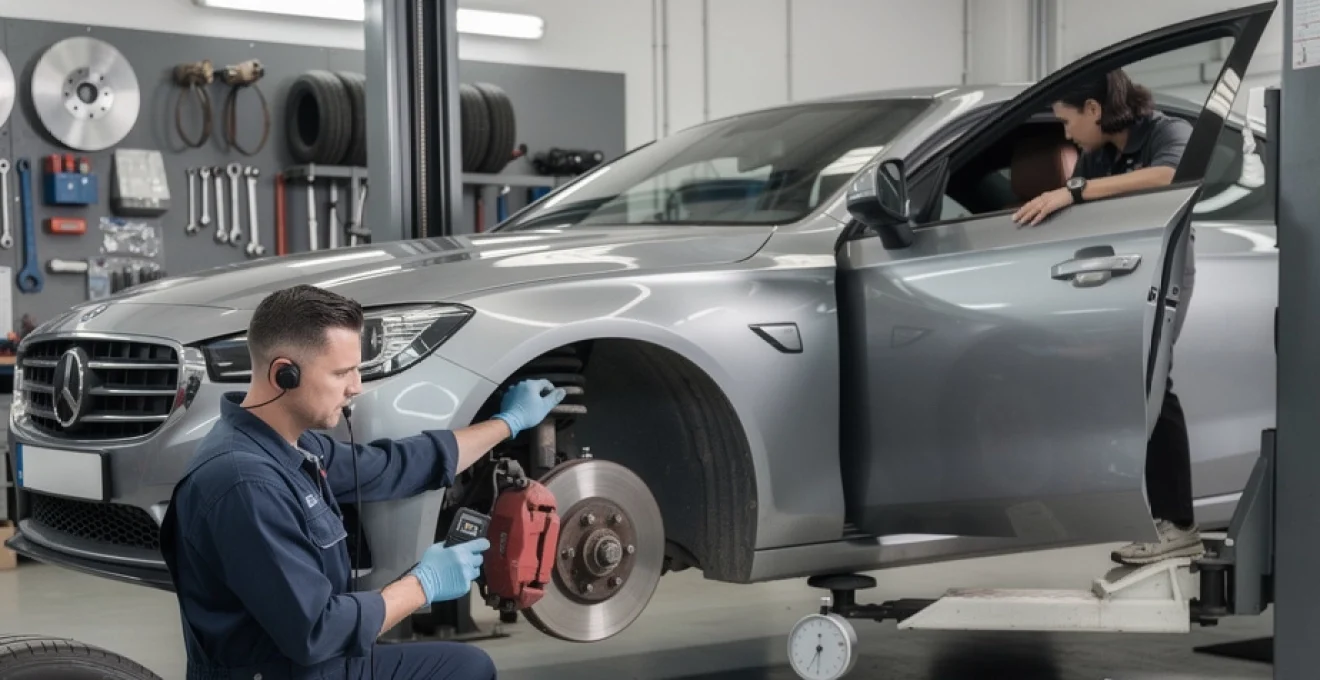
A knocking sound when braking can turn every journey into a guessing game. Is it unsafe to drive? Will the brakes fail? Is the problem in the brakes at all, or somewhere else in the chassis? Modern cars use complex brake, suspension and steering systems that all react together when you press the pedal, so a single knock can have several possible sources. Understanding how to diagnose the noise methodically saves time, money and, most importantly, keeps you safer on the road. With a clear workflow and a few simple tools, you can narrow down the cause of brake knocking and decide whether a careful DIY fix is realistic or whether a professional inspection is the smartest move.
How to diagnose a knocking sound when braking: step‑by‑step inspection workflow
Replicating brake knocking on‑road and on‑lift: low‑speed vs high‑speed test procedures
Accurate diagnosis always starts with replicating the knocking sound under controlled conditions. Ideally you want to find a quiet, straight road where you can brake repeatedly from different speeds. Begin with low‑speed tests (10–20 mph) and gently apply the brake pedal to see if the knock happens once per stop, several times per wheel revolution, or only when you brake over bumps. Then repeat at 30–40 mph with medium pressure, paying attention to whether the noise is louder, faster, or now accompanied by vibration through the steering wheel.
Once you can reproduce the issue consistently, a workshop or MOT bay can perform similar checks with the car on a lift. The technician will often spin the wheels by hand or using a running gear rig, then lightly apply the brakes to simulate road load. This is especially useful if the knock is linked to disc run‑out or pad movement, because a cyclic click or clunk every revolution becomes obvious when background road noise is eliminated. Think of it as isolating each component in a quiet room rather than trying to diagnose in a crowd.
Using chassis ears, NVH apps and mechanic’s stethoscopes to pinpoint brake knock sources
If the knock is subtle or seems to move around the car, electronic tools can make a big difference. Chassis ears are clamp‑on microphones fixed to key points such as the caliper carrier, lower control arm, subframe and hub. The signals feed into a receiver so you can compare noise intensity between locations while driving or on a rolling road. Many modern NVH (noise, vibration and harshness) diagnostic apps, often used in dealer environments and at specialist centres, apply similar logic using accelerometers and audio analysis.
A mechanic’s stethoscope is a low‑tech but very effective option. With the car safely lifted, a technician can rotate the wheel while lightly applying the brake, then place the stethoscope on the caliper body, carrier, hub and suspension arms. A sharp, metallic knock heard loudest at the caliper suggests pad or slide pin issues, while a duller thud near the arm bushings points to suspension wear. Used properly, these tools turn an elusive knock into a traceable signal rather than guesswork.
Visual checks: calipers, pads, discs and hub components under dynamic load
Once you have a rough location, visual inspection under light load is the next step. With the wheel removed, ask an assistant to press the brake pedal lightly while you observe the caliper, carrier and pads. Any visible rocking, jumping or excessive clearance in the pads usually indicates worn or missing anti‑rattle clips, incorrect pads for the carrier, or mis‑seated shims. A floating caliper that moves too freely on its pins, or one that binds and then releases with a knock, is a strong suspect for brake‑timed clunks.
The disc and hub face also need careful attention. Rust scale or debris between disc and hub can create a small tilt, which then produces cyclic knocking as the high spot hits the pads with each rotation. Look for shiny patches, radial grooves, or blue hot spots on the disc surface. These are classic indicators of uneven contact, disc thickness variation or localised overheating, all of which can cause the kind of rhythmic knock you hear only when braking at certain speeds.
Interpreting pedal feel, steering feedback and noise timing to distinguish brake‑related knocks
Pedal feel and steering feedback contain valuable clues if you know what to look for. A knock that coincides exactly with the first moment of pedal application, with no vibration and no change in braking force, often comes from pad movement or a loose caliper. By contrast, a knock that repeats rapidly and is felt as a pulsing pedal or shimmy in the steering wheel suggests disc run‑out or hub issues. If you feel a dull thud through the floor or seat rather than the pedal, the culprit may be suspension bushes or subframe mounts reacting to deceleration.
Timing is crucial: does the noise appear only once when you initially brake, or does it continue as you roll to a stop? A single knock per stop tends to indicate something “taking up slack”, such as worn control arm bushes or a shifting pad. Multiple knocks per wheel revolution are more often linked to rotating components like discs, wheels or tyres. Analysing these patterns logically helps you avoid replacing good parts and instead focus on the true cause of the knocking sound when braking.
Common brake system faults that cause knocking noises under braking
Loose or worn brake pads rattling in the carrier: anti‑rattle clips, shims and pad backing plates
Loose brake pads are one of the most common and overlooked causes of a brake knocking noise, especially after recent pad and disc replacement. Many modern systems rely on stainless steel anti‑rattle clips, shims and correctly sized backing plates to keep pads snug in the carrier. If those clips are missing, bent, or not properly seated, the pad can move back and forth slightly until braking force slams it against the carrier, creating a metallic knock or click.
Budget pads that copy OEM shapes poorly can be a problem here. A few tenths of a millimetre of extra clearance may not sound like much, but under deceleration the pad can slap around with noticeable noise. If you can physically rattle a pad by hand when the caliper is off, the fit is too loose. Correcting this may be as simple as installing new genuine‑quality clips and shims, or as involved as changing to higher‑quality pads with accurately machined backing plates.
Floating caliper slide pin wear and seizure causing lateral knock and uneven pad contact
On vehicles with a single‑piston floating caliper, the caliper body must slide smoothly on its guide pins to centre itself over the disc. When those slide pins wear oval, corrode, or seize from lack of lubrication, the caliper can tilt or stick. As you apply the brakes, it may suddenly free up and snap sideways, causing a distinct knock. You might also notice uneven pad wear, with one pad almost down to metal while the other looks relatively fresh.
In some cases, worn slide pin bores in the carrier allow minor but audible lateral play even with new pins. This can make the caliper bang against the limits of its travel on rough roads or when you quickly change pedal pressure. Servicing the pins with high‑temperature silicone grease and replacing damaged rubber boots often eliminates this, but once the carrier itself is worn, replacement is usually the only lasting cure.
Disc (rotor) run‑out, thickness variation and hot spots generating cyclic knock when slowing
Disc run‑out and disc thickness variation (DTV) are well‑known for causing steering shake and brake judder, but they can also create a rhythmic knocking sound when braking. If the disc does not run perfectly true, it will push the pads in and out slightly with each rotation. Combined with pad clearance or a sticky caliper, that movement can translate into a repeating knock that speeds up with road speed and fades away as you come to a halt.
Hot spots and uneven transfer layers on the disc surface, often caused by holding the brakes hard at a standstill after heavy braking, can exaggerate the effect. These spots engage more aggressively with the pad and then release, producing noise and vibration. Regular surveys suggest that up to 70% of “warped disc” complaints are actually caused by DTV and pad deposition rather than true warping, so measuring run‑out and thickness properly is essential before ordering new discs.
Warped, cracked or incorrectly torqued brake discs transmitting knocks through the hub
Genuinely warped or cracked discs are less common than many assume, but when present they can definitely cause knocking under braking. Excessive heat from repeated heavy stops, towing, track use or seized calipers can over‑stress the disc. Micro‑cracks may start as faint clicking or light knocking that gradually worsens. Improper torqueing of wheel nuts or disc retaining screws can also distort the disc, especially on thinner economy rotors.
If the disc is clamped unevenly to the hub, the high spots will strike the pads harder at specific points of the rotation. You will often feel this as both a knock and a pulsing pedal, particularly at motorway speeds when braking from 60–70 mph. A dial indicator gauge check at the disc edge is the only reliable way to confirm run‑out and distinguish between minor surface issues and significant structural distortion.
Budget pattern brake components vs OEM (e.g. ATE, brembo, TRW) and knock‑related fit issues
Using cheap pattern brake parts may save money up front but can easily introduce knocking noises due to sloppy tolerances. In professional experience, a disproportionate number of post‑service knocks and clunks trace back to off‑brand pads and discs with inconsistent dimensions. Pad ears that are slightly undersized, discs with hub bores a fraction too big, or low‑grade anti‑rattle clips all encourage unwanted movement under braking torque.
By contrast, premium or OEM‑equivalent brands such as ATE, Brembo or TRW are engineered to extremely tight tolerances and tested across multiple vehicle platforms. Industry data from large independent brake suppliers often shows a lower comeback rate and fewer NVH (noise, vibration, harshness) complaints when such components are used. For a stubborn brake knock that resists other fixes, upgrading to top‑tier hardware can be a surprisingly effective final step.
Suspension and steering components that mimic a brake knocking sound
Worn lower ball joints and track rod ends knocking under deceleration load transfer
A knocking sound when braking does not always originate from the brakes. As the vehicle’s weight shifts forwards, worn suspension and steering joints experience a sharp change in load that can create a distinct clunk. Lower ball joints that have developed play often knock as the wheel tries to move backwards slightly under braking. Track rod ends with internal wear may also click or knock, sometimes more noticeable when braking while turning into a junction or roundabout.
These noises can be deceptive because they roughly coincide with pedal application, leading many drivers to blame the brake system. A technician will usually check for free play using a lever bar with the wheel lifted, watching for any relative movement between control arm, hub carrier and steering arm. If you hear knocking both when braking and when driving over small sharp bumps, ball joints and rod ends move high up the suspect list.
Anti‑roll bar (sway bar) link and bush wear producing clunks during braking and turn‑in
The anti‑roll bar (ARB) links and bushes are another common source of “fake” brake knocks. As you brake and the nose of the car dips, the ARB twists to resist roll, loading up its drop‑links and chassis bushes. Worn links can clack or rattle, especially at low speeds and over rough surfaces. If you also hear similar clunks when going over speed humps or entering driveways at an angle, ARB issues are a strong candidate.
In many popular models, including various Volkswagen, Ford and Vauxhall platforms, ARB drop‑links are relatively light components that see heavy use on UK roads full of potholes. Replacing a pair of worn links is a comparatively inexpensive job that can eliminate an annoying knock that only appears when braking lightly or turning under braking.
Strut top mounts, shock absorbers and coil springs knocking when weight shifts forward
Strut top mounts and dampers are heavily loaded whenever weight transfers forwards. A collapsed or partially seized top mount can cause a dull knock or groan each time the suspension compresses under braking. Some designs also rotate with the steering, so a top mount fault may produce a knock when turning and braking simultaneously, such as manoeuvring in a car park.
Shock absorbers with worn internal valves sometimes emit a faint tapping or knocking over fine ripples in the road that becomes more noticeable as you brake gently. In more severe cases, a broken coil spring can jump slightly in its seat when the suspension compresses or extends, producing a sharp metallic clonk. Visual inspection of the spring ends, damper bodies and top mounts under a torch is essential whenever brake‑timed knocks are reported.
Loose subframe bolts, engine mounts and steering racks transmitting knocks on pedal application
Although less common, structural and mounting issues must not be ignored. Loose subframe bolts can allow the entire front suspension cradle to shift a few millimetres under braking, causing a heavy, unsettling knock that you will feel through the floor and steering. Similarly, deteriorated engine or gearbox mounts may let the drivetrain rock forward when you brake, striking limit stops or other components with an audible thunk.
Steering racks with worn mounts or internal play can also clunk when the direction of load changes suddenly as the weight moves forwards. These problems are serious from a safety perspective: any suspicion of subframe, rack or mount movement justifies immediate professional assessment, especially if combined with vague steering or pronounced changes in alignment while driving.
Axle, hub and wheel issues that produce knocks when braking
Loose wheel nuts, elongated bolt holes and incorrect wheel fitment under braking torque
Loose wheel nuts are an obvious but critical check whenever there is a knocking sound when braking. A wheel that is not securely clamped to the hub can shift slightly each time you apply braking torque, producing a loud, alarming knock or click that may feel like it comes from the brakes. In severe cases you may also notice steering wobble or a sensation that the car is wandering under braking.
Aftermarket alloy wheels introduce an extra variable: if the centre bore is larger than the hub and no hub‑centric rings are fitted, the wheel is centred only by the bolts. Under braking, the wheel can move minutely on the studs, gradually elongating the bolt holes and increasing the knock. Any suspicion of incorrect wheel fitment or missing centre rings should be addressed immediately, as continued driving risks both brake performance and wheel security.
Wheel bearing play, hub wear and CV joint backlash as sources of brake‑timed knocking
Wheel bearings with excessive play often cause humming or growling, but they can also knock when lateral forces change. Under braking, the bearing can shift from one side of its worn race to the other, creating a dull knock or click. If you combine braking with cornering, such as slowing while changing lanes, the sound may become more pronounced. Jacking the car and rocking the wheel at 12 and 6 o’clock is the standard check for play.
Backlash in CV joints and driveshafts can behave in a similar way. As you lift off the throttle and then brake, the torque direction in the drivetrain reverses, causing worn joints to take up slack with an audible knock. Differentiating this from brake knocks relies on observation: drivetrain or CV noises often occur when transitioning between acceleration and braking, even without much pedal pressure, whereas pure brake knocks track the pedal application more directly.
Debris, stones or rust scale trapped between disc, backing plate and hub face
Occasionally the cause of a brake knock is as simple as a small stone or chunk of rust lodged where it should not be. A pebble trapped between the disc and the backing plate can strike once per revolution, creating a rhythmic tick or knock that may become louder under braking as the disc deflects very slightly. Similarly, rust build‑up on the hub face can prevent the disc from sitting flat, turning into a physical high spot once the disc is clamped down.
Removing the disc and cleaning the hub face thoroughly with a wire brush, then refitting and torqueing evenly, is crucial during any brake service. Industry surveys suggest that improper hub preparation is responsible for up to 30% of post‑replacement judder and knock complaints. Taking an extra five minutes with a brush and a straight‑edge often prevents hours of troubleshooting later on.
Alloy wheel damage, buckled rims and flat‑spotted tyres causing rhythmic knocks when slowing
Damaged wheels and tyres can also mimic brake faults. A buckled rim or severely flat‑spotted tyre (for example after an emergency stop without ABS on older vehicles) may generate a thud or knock once per rotation, more obvious at low speeds when slowing to a stop. Under braking, the suspension has less opportunity to absorb the irregularity, so the knock can sound as if it is coming from the caliper area.
Spinning the wheel on a balancer or while the car is on a lift, and sighting the inner and outer rim edges for wobble, helps identify buckles. Any tyre with visible flat spots, exposed cords or severe out‑of‑round must be replaced for safety reasons. Correcting these issues not only removes the noise but also restores smoother braking and steering behaviour.
Model‑specific brake knock patterns: BMW, VW, ford, toyota and other common platforms
BMW 3 series (E90, F30) floating caliper pad slap and front control arm bush knock under braking
BMW 3 Series models such as the E90 and F30 platforms frequently exhibit brake‑timed knocks linked to front suspension bushings and floating caliper design. The front tension strut (often called the brake reaction arm) uses a large fluid‑filled bush that can deteriorate around 60–90k miles. Under braking, the wheel hub moves rearwards slightly, and a worn bush can allow a pronounced clunk that many drivers mistake for a brake problem even when discs and pads are new.
At the same time, the OEM floating caliper and pad arrangement on some variants allows a small amount of pad movement. If anti‑rattle hardware is tired or aftermarket pads with looser tolerances are fitted, an audible pad slap can occur at the first touch of the pedal. Replacing the reaction arm bushes with high‑quality components and ensuring the pad hardware is fresh typically resolves both symptoms.
Volkswagen golf and audi A3 front pad carrier and ARB drop‑link clunks on light braking
On many Volkswagen Golf and Audi A3 generations, a light clunk on gentle braking over rough surfaces is often traced to a combination of pad carrier wear and ARB drop‑link play. The pad carriers can build up corrosion under the stainless slides, squeezing the pad slightly and then allowing it to stick and release with a knock. Cleaning this corrosion and fitting new clips is an essential step whenever chasing Golf or A3 brake noises.
The drop‑links on these cars are also infamous for developing play, producing small but sharp knocks over imperfections. Because these are loaded differently under braking, the knock can appear only when you ease onto the pedal or when turning into side streets while slowing down. Upgraded links and fasteners, installed with correct torque, generally restore the solid feel expected from these platforms.
Ford focus and fiesta rear drum brake shoe knock and radius arm bush issues
Many Ford Focus and Fiesta models use rear drum brakes on lower‑powered variants, and these can generate their own distinctive knocking sounds. If the shoe retaining springs or adjusters wear or corrode, the shoes can move more than intended and slap against the drum when you first apply the brakes. The noise tends to be a single knock per stop at low speed, particularly noticeable when reversing or manoeuvring.
In addition, rear radius arm or trailing arm bushes on these cars often soften with age, allowing the whole axle to shift slightly under braking. This produces a deeper thud that you might feel from the rear floor area. Combining a rear brake inspection with a check of rear suspension bushes is therefore standard practice when dealing with Focus or Fiesta brake knocks.
Toyota corolla and yaris front strut top mount and caliper slide pin noise characteristics
Toyota Corolla and Yaris models are generally reliable, but certain generations do show patterns of brake‑timed knocking linked to front strut top mounts and caliper slide pins. When top mounts dry out or fail, they can emit a creak or knock exactly as you come to a stop, sometimes accompanied by a slight “memory steer” sensation where the wheel does not return smoothly to centre. This is often more pronounced in cold weather or after the car has sat overnight.
Caliper slide pins on these models can also suffer from insufficient lubrication or damaged rubber boots. Once moisture gets in, the pins corrode and the caliper may snap into position with a click or knock under light braking. Periodic cleaning and lubrication with the correct high‑temperature silicone grease, rather than general‑purpose lubricants, significantly reduces this problem and preserves Toyota’s typically refined brake feel.
DIY fixes for knocking when braking: adjustment, lubrication and component replacement
Correctly refitting pads with new shims, grease (e.g. copper‑free ceramic) and anti‑rattle hardware
If you are confident with basic maintenance, refitting brake pads correctly is one of the most effective DIY fixes for knocking when braking. Start by removing the caliper and pads, then thoroughly cleaning the carrier, especially the pad contact areas. Any rust or dirt left here will interfere with how the pads sit and move. Fit new stainless anti‑rattle clips and any shim hardware supplied with quality pads, avoiding the temptation to reuse badly corroded originals.
Apply a very thin film of copper‑free ceramic brake grease to the pad ears, backing plates and contact points, rubbing it in so there are no blobs that could contaminate the friction material. The aim is to allow smooth sliding without free play. Once refitted, the pads should move in the carrier with light finger pressure but with no rattling. A simple road test with a series of medium stops from 30–40 mph will then confirm whether the knock has disappeared.
Servicing caliper slide pins: cleaning, high‑temperature silicone grease and boot replacement
Properly serviced slide pins are essential for quiet, consistent braking. Remove the caliper and carefully withdraw each pin, noting which position has a rubber damping sleeve if fitted. Clean the pins with brake cleaner and a lint‑free cloth, removing all old grease and any surface corrosion. Inspect the bores in the carrier for rust, pitting or oval wear; light corrosion can be cleaned out, but heavily worn carriers usually require replacement.
Replace any torn or hardened rubber boots, as these allow water ingress that leads to future seizure. Apply a small amount of high‑temperature silicone‑based brake grease to each pin and work it into the bore, ensuring full travel without binding. Once reassembled, the caliper should slide smoothly by hand. Many stubborn brake knocks vanish immediately once the caliper is able to centre itself correctly under braking load.
Checking disc run‑out with a dial gauge and reseating or replacing warped brake discs
To confirm or rule out disc‑related causes of knocking, a dial indicator gauge is invaluable. With the disc secured to the hub using at least two wheel nuts tightened to normal torque, position the gauge tip near the outer edge of the braking surface and zero the dial. Slowly rotate the disc and observe the total indicated run‑out. Figures above manufacturer limits, often around 0.05–0.1 mm, are likely to cause judder and potentially cyclic knocking.
If run‑out is marginally high, first remove the disc, clean the hub face thoroughly and reseat the disc in a different position, then recheck. Occasionally a simple reseat within tolerances can cure the issue. If the reading remains excessive or you see clear signs of hot spots, cracks or scoring, replacing the discs as a matched axle set with quality components is the only sensible option for both safety and noise reduction.
Torque procedures for wheel nuts, caliper bolts and carrier bolts using a calibrated torque wrench
Incorrect torque is a surprisingly frequent root cause of brake knocking and associated issues. Over‑tightened wheel nuts can distort discs and hubs, while under‑tightened caliper or carrier bolts may allow critical components to shift under braking. Using a calibrated torque wrench and following the manufacturer’s specified values is therefore not optional – it is essential. Always tighten wheel nuts in a star pattern to ensure even clamping of the disc and hub.
Caliper and carrier bolts often have specific torque plus angle settings or require thread‑locking compound. Ignoring these details can lead to loosening over time, with the first symptom sometimes being a sharp knock each time you hit the brakes. For anyone performing DIY brake work, investing in a decent torque wrench and checking it against a known standard every couple of years is a small cost compared with the risk of brake component movement.
When to escalate to a professional brake specialist or MOT test centre for further diagnosis
There is a clear point at which further home diagnosis is no longer wise. If you experience a loud, persistent knock under braking accompanied by steering pull, severe vibration, or any sensation that the car is unstable, professional assessment should be arranged as soon as possible. The same applies if initial DIY work does not eliminate the noise, or if you discover issues with subframe mounts, steering racks or structural suspension components.
Brake and suspension faults directly affect stopping distance and vehicle control, and industry statistics indicate that defective brakes contribute to thousands of MOT failures and a significant number of avoidable accidents each year. A qualified technician or brake specialist has access to workshop lifts, advanced NVH tools and manufacturer data that go beyond home resources. Treat any unresolved knocking sound when braking as a safety‑critical symptom that justifies expert investigation rather than an annoyance to be lived with.