
Rusted wheel arches can quietly turn a solid, dependable car into an MOT headache and a financial drain. Road salt, grit and trapped mud attack the metal from both sides, and by the time bubbles appear in the paint, the corrosion is often much further advanced than it looks. Whether you drive a ten-year-old Ford Focus or a cherished BMW 3 Series, arch rust is one of the most common reasons otherwise sound cars are scrapped early. Understanding how to diagnose, repair and prevent wheel arch corrosion puts you back in control of the car’s future and helps you decide whether a quick cosmetic repair, a proper welded fix or simple monitoring is the best option for your budget and skill level.
Diagnosing rust damage on wheel arches: surface corrosion vs structural rot
Identifying perforation, delamination and flaking on inner and outer wheel arch lips
Correctly diagnosing rust on wheel arches starts with distinguishing light surface corrosion from structural rot. Surface rust usually shows as small brown stains, scabs or bubbles in the paint on the outer arch lip. When you run a fingernail across, the metal still feels solid and there are no holes. This type of wheel arch rust can often be treated with mechanical cleaning, rust converter and primer before it becomes serious.
Structural rot is different. Look for perforation (actual holes), sharp flaky edges and areas where the metal has delaminated into layers. Tap along the arch lip and inner return with a small pick hammer or even the handle of a screwdriver. A dull, crunching sound usually means the steel is separating and has lost strength. If gentle pressure causes the metal to crumble, the arch is no longer sound and will eventually require cutting out and replacement rather than simple sanding and filling.
Locating hidden rust traps in wheel arch liners, pinch welds and rear quarter panels
Wheel arch corrosion rarely starts in the obvious place you can see from outside. On most modern cars the inner arch is lined with plastic liners and felt-type splash guards that trap mud, leaf debris and salt. These act like a sponge, holding moisture against the steel for months at a time. To diagnose rust properly you need to remove these liners and inspect behind them, especially where the arch meets the sill and rear quarter panel.
Pay particular attention to the pinch welds and seams around the arch tub. Any seam where two panels overlap is a classic rust trap, especially if the original seam sealer has cracked. On hatchbacks and saloons the lower rear quarter panel behind the arch is another hotspot. The outer skin may look reasonable, but rust may already be creeping along the seam where inner and outer arches join, working its way outwards until it finally bubbles through the paint.
Assessing MOT safety and structural integrity on common UK models (ford focus, VW golf, BMW 3 series)
For UK drivers, one of the biggest questions is whether rusty arches threaten the next MOT. MOT regulations focus on structure and safety, especially anywhere within 30 cm of a suspension, steering or seatbelt mounting point. Rear wheel arches sit close to suspension turrets, spring seats and rear axle mounts, so serious rot here is more than cosmetic. MOT testers will ignore light surface rust but will fail sharp edges, perforation or heavy corrosion that affects strength near key mounting points.
On cars like the Mk1–Mk3 Ford Focus, Mk4–Mk6 VW Golf and E46/E90 BMW 3 Series, arch corrosion is common by 10–15 years of age, especially in areas with heavy salt use. Industry surveys from several UK rust-proofing specialists suggest that over 40% of family cars over 12 years old show moderate to severe wheel arch corrosion. Yet many still pass the MOT because the rot is confined to the outer skin. Once rust reaches the inner arch, inner sill or rear chassis rail, a patch weld becomes essential for a legal pass.
Using pick hammers, inspection mirrors and borescopes to probe rusted arch cavities
Because so much of the arch structure is hidden, simple visual inspection is rarely enough. Basic diagnostic tools make a huge difference. A pick hammer helps reveal weak, delaminated metal. Gentle, systematic taps around the arch lip, inner tub and seam lines will quickly show where steel has thinned. An inspection mirror on a telescopic handle lets you see behind the lip into the return, where rust frequently eats from inside to out.
For a more in-depth assessment, a low-cost USB or Wi-Fi borescope is extremely useful. Feed it into drain holes, behind liners or through small gaps at the bottom of the quarter panel to inspect arch cavities and hidden seams. If the borescope shows heavy scale, flaking rust or damp sludge inside, any cosmetic repair to the visible panel is only a short-term fix. At that point, a long-term strategy combining cavity treatment and, eventually, welded repair sections becomes essential if the car is to be kept for several more years.
Preparing the vehicle and work area for wheel arch rust repair
Safe jacking and axle stand placement at sill jacking points near corroded arches
Safe preparation is the foundation of a successful wheel arch rust repair. Whenever you work on arches, the car must be jacked securely, with the wheel removed to give full access. Use the manufacturer’s recommended jacking points on the sill, but inspect them first; if rust extends into these areas, move the axle stand slightly inboard under a sound chassis rail or subframe mount instead. Many hobbyists underestimate how quickly a car can shift when sanding or grinding vigorously on a raised corner.
Once the car is supported, give the wheel arch area a thorough wash to remove mud, salt and loose debris. Degreasing solutions, snow foam and even a basic pressure washer help reduce airborne dust later. A clean work area is not just about comfort: fewer contaminants means better adhesion for rust converters, epoxy primers and fillers, significantly extending the life of the repair.
Removing plastic wheel arch liners, mud flaps and trim clips without damage
Arch liners and mud flaps must come off if you want to reach all offending corrosion. Many cars use fragile plastic push clips or torx screws that snap easily. A trim removal kit with wedge tools and clip pliers makes a big difference here and costs far less than replacing a handful of broken clips at a dealer. Gently work around the arch, prising clips out rather than levering directly against the bodywork.
Label any unusual fixings, especially where mud flaps share mounting points with liners. Photographing the liner before removal can also save frustration during refitting. With the liner removed, rinse and scrub the inner arch again. Years of baked-on road grime often conceal early rust, so a clean surface makes diagnosis and later sealing more accurate.
Masking and protecting tyres, brake components and suspension during grinding and sanding
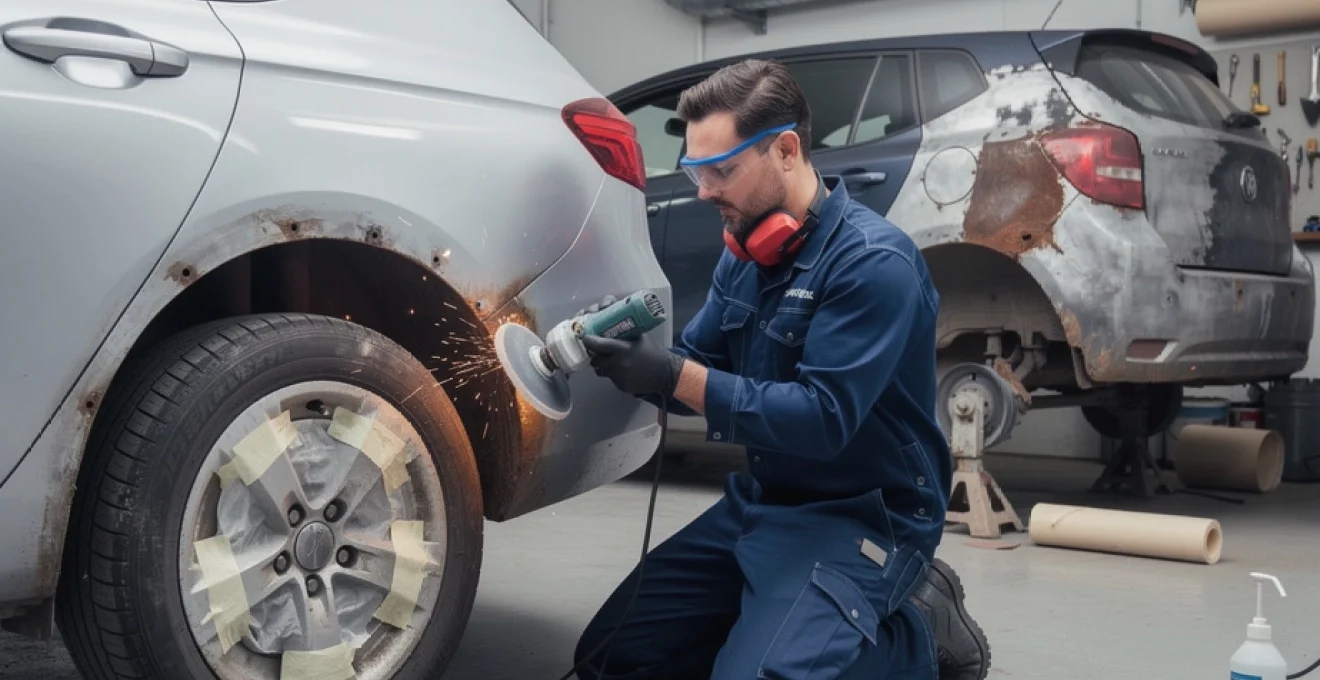
Grinding, sanding and spraying create abrasive dust and overspray that you absolutely do not want on tyres, brake discs, pads or suspension joints. Masking the area thoroughly is worth the extra 20 minutes. Use plastic sheeting or heavy masking paper to cover the brake assembly and strut. Mask the tyre completely if it remains on the car, or store it well away from the work area.
Edge the repair zone with quality automotive masking tape that can tolerate solvents and gentle heat. Good masking not only protects components but also keeps a crisp edge for primer and paint, reducing the amount of polishing and blending required later. A simple investment in careful preparation reduces the risk of squeaky brakes, contaminated rubbers and messy overspray.
Planning ventilation, dust extraction and PPE for rust, paint and filler work
Working on rusted wheel arches generates three main hazards: metal dust, filler dust and solvent fumes. Each needs proper control. At a minimum, use a P2 or P3-rated respirator for grinding and sanding, and a mask rated for organic vapours when spraying primers, basecoat or 2K clear. Safety glasses or a full face shield protect against flying wire brush strands and grinding sparks.
Ventilation is just as important. If the job is done in a garage, crack the main door and use a fan to draw dusty air away from you. A simple domestic vacuum connected near the grinding area can capture a surprising amount of dust. Think of rust repair as similar to woodworking: chips, dust and fumes spread everywhere unless managed, and effective PPE and extraction make the entire process safer and more pleasant.
Mechanical rust removal on wheel arches using grinders, flap discs and wire wheels
Selecting angle grinder attachments: 3M roloc discs, poly-abrasive strip wheels and cup brushes
Mechanical rust removal is where the real transformation begins. The goal is to strip back all loose rust to clean, sound metal without excessively thinning panels. A small 115 mm angle grinder or a drill with suitable attachments is usually enough for DIY work. For outer arches, poly-abrasive strip wheels or 3M Roloc-style clean and strip discs work very well, cutting through paint and rust while being forgiving to the steel underneath.
Wire cup brushes are useful on thicker sections and inner arches but can gouge thinner body panels if used carelessly. Flap discs in the 80–120 grit range are excellent for feathering and profiling, though they remove metal quickly and generate more heat. On curved arch lips, smaller diameter wheels and Roloc discs mounted on a die grinder or drill offer greater control, reducing the risk of flat spots in the body line.
Grinding back to clean metal while controlling heat and avoiding panel warping
Controlling heat build-up is critical when grinding wheel arches. Thin outer skins can warp or ripple surprisingly quickly if the metal becomes too hot. Work in short bursts, frequently moving the grinder and allowing the panel to cool between passes. If the surface becomes uncomfortable to touch for more than a second, pause and let it cool down before continuing.
Remove all visible corrosion until only bright metal remains. If pitting is present, decide whether to grind slightly deeper or switch to chemical rust conversion. Over-grinding weakens the panel, so erring on the side of leaving shallow pits for a quality converter is often wiser than chasing every black speck with an aggressive disc.
Feathering OEM paint and clear coat around the repair area for a smooth transition
Once rust and loose paint have been removed, the border between bare steel and factory paint must be feathered for a smooth, invisible repair. Use 180–240 grit paper initially to blend the step between layers, then refine with 320–400 grit. Feather far enough into the surrounding paint to avoid a hard edge after priming and painting; typically 50–70 mm beyond the rust zone is adequate on an arch.
This feathered area gives high-build primer and filler a smooth runway to blend into the original finish. Think of the transition like a shallow ramp rather than a cliff edge. A sharp ridge in the paint stack will almost always show through after colour and clear coat, especially under harsh sunlight or workshop lighting.
Vacuuming and degreasing bare steel with panel wipe before chemical rust treatment
After grinding and feathering, the wheel arch will be covered in dust, media and microscopic metal particles. Thorough cleaning now significantly improves adhesion for the chemical stages. Vacuum the area carefully, paying close attention to seams, lips and inside the arch lip where dust tends to collect. Follow up with a lint-free cloth and a suitable panel wipe or degreaser to remove any remaining contaminants and oily residues.
If you plan to use a rust converter on pitted areas, avoid touching the bare metal with bare hands; skin oils can interfere with the reaction. Gloves, clean cloths and fresh degreaser give the converter and primers the best possible surface to bond with, which translates directly into longer-lasting rust protection for the repaired wheel arch.
Chemical rust conversion and corrosion protection primers for wheel arches
Using rust converters such as bilt hamber hydrate 80 and kurust on pitted steel
Even after thorough grinding, small rust pits and microscopic oxides often remain, especially on older wheel arches. Rust converters are designed to stabilise this remaining corrosion rather than relying solely on mechanical removal. Products like Bilt Hamber Hydrate 80 and Kurust penetrate into the pores of the steel, reacting with iron oxide to form a more stable, paintable surface.
Apply converters sparingly to pitted areas with a brush, working the liquid into the pores and slightly beyond the visibly affected zone. Most manufacturers recommend one or two coats with specific drying times. Once the treated areas turn the recommended dark colour and cure fully, lightly abrade the surface with fine paper (e.g. 400 grit) to remove any high spots, then clean again with panel wipe before priming.
Applying zinc-rich epoxy primers (e.g. upol #182, rustbuster epoxy mastic) on bare arches
For long-term arch rust protection, an epoxy or zinc-rich primer is a major upgrade over basic aerosol primer. Products like Upol #182, Rustbuster Epoxy Mastic or Custom 421 epoxy systems provide both excellent adhesion and a moisture-resistant barrier, crucial in such a harsh environment. On bare metal, an epoxy primer effectively seals the steel and reduces the risk of moisture penetrating back to the substrate.
Apply epoxy primer according to the manufacturer’s instructions, usually 1–2 medium coats with appropriate flash-off times. Because these primers are less porous than conventional cellulose primers, they also give body filler and subsequent paint layers a more stable base. On particularly vulnerable arches, some professional restorers even use epoxy on both sides of the panel before top coating and waxing the inner cavities.
Seam sealing wheel arch joints, pinch welds and lap seams to block moisture ingress
Many wheel arch rust problems originate in poorly sealed seams rather than in open metal. Once epoxy primer has cured, re-sealing critical joints is essential. Use brushable or caulk-type seam sealer along the inner arch lip, pinch welds and lap seams around the rear quarter and sill joining areas. The aim is to create a flexible, continuous barrier against water and salt.
Seam sealer should be applied in a smooth bead and tooled out to avoid trapping air pockets. Avoid thick, lumpy applications that can hold grit and moisture. Modern OEM-style seam sealers also help to restore the factory appearance on visible inner arches, especially when later over-coated with stone chip or underbody coatings.
Priming inner arch cavities with cavity waxes like dinitrol 3125 and waxoyl
Once the visible surfaces are treated, attention must turn to the hidden cavities that caused the rust in the first place. Cavity waxes such as Dinitrol 3125 or Waxoyl are designed to creep into seams and box sections, displacing moisture and forming a flexible, self-healing wax layer. On wheel arches, this means injecting wax through existing drain holes, grommets or drilled access points into the inner arch, sill ends and lower rear quarter panels.
Warm the wax before application for better atomisation and penetration. Use a dedicated cavity lance to reach the full length of the arch and adjoining sections. Regular reapplication every couple of years, especially in harsh UK climates with heavy winter salting, dramatically slows future corrosion and protects the repair investment.
Body filler, fibreglass and welded patch repairs for rusted wheel arch lips
When to choose fibreglass matting vs polyester body filler for non-structural arch repairs
Choosing the right material for rebuilding a rusted arch lip depends on how much metal remains and whether the area is structural. For non-structural, cosmetic outer lips where small sections have rusted away but the underlying inner arch is still sound, fibreglass matting backed with resin can bridge small gaps and provide a strong but lightweight base for final shaping with polyester body filler.
Where the metal is largely intact and only shallow pitting exists, straight polyester filler (e.g. P38 or Upol Easy Sand) over epoxy primer or converted steel is usually sufficient. However, if pressing on the area causes movement, or the inner and outer arches have separated, cosmetic fillers alone are not appropriate; a welded steel repair is the only responsible solution for a long-lasting, MOT-safe result.
Mixing and applying body filler (P38, upol easy sand) for rebuilding arch contours
Body filler is often misunderstood. Used correctly, it is a finishing and contouring product, not a structural material. Mix small quantities of filler like P38 or Upol Easy Sand exactly to the manufacturer’s hardener ratio, spreading it thinly over the prepared surface. Several thin applications are better than one thick lump, both for strength and sandability.
Shape the wheel arch contour with 80–120 grit once the filler reaches a cheese-like stage, then refine with 180–240 and finally 320–400 grit on a small sanding block. Blocking is crucial: always use a rigid or semi-rigid block rather than fingers to maintain the natural curvature of the arch and avoid creating waves or flat spots that become obvious when the sun hits the paint.
Cutting out rot and fabricating steel patch panels for outer arches and rear quarters
For serious rot, the only reliable solution is cutting out the corrosion and welding in fresh steel. Mark the affected area on the outer arch and rear quarter, staying at least 10–15 mm into solid metal. Use a cutting disc to remove the rotten section in a simple shape that will be easy to replicate in new steel, such as a rectangle or gentle curve following the wheel arch line.
Fabricate a patch panel from 0.8–1.0 mm automotive-grade steel. Shrinking hammers, dollies and simple bending tools help replicate the original arch profile. Ideally, patches should be butt-welded rather than simply laid over existing metal, as overlap joints can create new moisture traps. However, for older daily drivers, a carefully welded overlap joint sealed properly can still provide many more years of service.
MIG welding thin automotive steel around arches while preventing distortion and blow-through
MIG welding is the standard method for patching thin car bodywork. Thin steel around arches is prone to distortion and blow-through, so technique and settings are critical. Use 0.6 mm wire with a low power setting to begin, performing a series of short, spaced tack welds rather than a continuous bead. Allow the panel to cool between tacks and move around the repair to distribute heat.
Once the patch is fully tacked, gradually join the tacks together with quick trigger pulses, keeping the weld pool small. After cooling, grind the welds back carefully with a flap disc, avoiding gouging the surrounding metal. A correctly welded and dressed patch should be almost flush with the original panel, needing only a thin skim of filler to restore the OEM profile.
Metal finishing, skim filling and block sanding to restore OEM wheel arch profiles
After welding and initial grinding, minor imperfections are inevitable. Metal finishing with hammers and dollies can gently level high spots and reduce the amount of filler needed. Aim for a repair that requires only a light skim of filler, not a deep rebuild. Apply filler over epoxy or etch primer as specified by the product, then block sand progressively finer until the original arch line flows smoothly into the repaired area.
Use a guide coat (a light dusting of contrasting paint or dedicated powder) to highlight low and high spots as you sand. The goal is to make the repair visually vanish when viewed along the panel’s length. Good metal finishing and blocking here are the difference between a repair that always catches the eye and one that even a trained observer has to search for.
Painting and blending repaired wheel arches with aerosol and spray gun techniques
Colour matching factory paint codes and using blending techniques on rear quarter panels
Once the arch is structurally sound and smooth, paintwork brings the job to life. Start by locating the factory paint code, usually on a door jamb or under the bonnet, and have paint mixed by an automotive supplier. Even with the correct code, ageing and sun fade mean a perfect match is rare, so blending into adjacent panels is often necessary, especially on metallic and pearlescent colours.
On rear quarter panels, blend the basecoat further up the panel and sometimes into the rear door rather than limiting it to a tight area around the arch. This softens any slight colour variation and avoids a visible “edge” in different light conditions. Even with aerosols, careful blending and subsequent polishing can produce very respectable results on daily drivers.
Applying etch primer, high-build primer and guide coat before final sanding
Before colour, the repair needs a robust primer system. On bare metal, an etch primer or epoxy primer provides adhesion and corrosion resistance. Over this, apply high-build primer to fill fine sanding marks and minor imperfections. Build primer in several light coats, allowing each to flash off according to the data sheet.
Once cured, apply a guide coat and wet sand with 600–800 grit to achieve a perfectly smooth surface. Any remaining pinholes or scratches should be spot filled or reprimed at this stage. Skipping this step often leads to obvious texture differences around the arches once the glossy clear coat is applied, so patience here pays dividends.
Spraying basecoat and 2K clear coat around wheel arches using HVLP guns or aerosols
Basecoat should be applied in thin, even passes, extending slightly beyond the repaired area with each coat to aid blending. Metallics require consistent gun speed and distance to avoid patchiness. With aerosols, warming the can in hot water improves atomisation and finish. Once coverage and colour are satisfactory, allow appropriate flash-off time before clear coat.
2K clear coat, whether applied via HVLP gun or 2K aerosol, provides durability and gloss that single-pack lacquers cannot match. Apply 2–3 coats, each slightly wetter than the last, avoiding runs while achieving a uniform gloss over the blended area. The final clear should extend beyond the basecoat blend, ideally to a logical panel edge where possible.
Polishing, compounding and refining orange peel on freshly painted arch areas
Even with excellent spraying technique, some orange peel or minor dust nibs are likely. After the clear coat has fully cured, wet sand problem areas with 1500–2000 grit, keeping the paper very well lubricated and using light pressure. Follow up with cutting compound on a machine polisher or by hand, then refine with a finishing polish.
This process levels the clear and restores gloss, helping the new paint match the surrounding factory finish. On wheel arches in particular, a slightly higher texture is acceptable, as these areas are exposed to road rash and rarely scrutinised from a few centimetres away, but a careful polish still makes the repair look far more professional.
Long-term rust prevention for wheel arches in UK climates
Underbody sealing and undercoating wheel arches with rubberised or polyurethane coatings
Once a wheel arch has been repaired and painted, protection against future damage becomes the priority. Underbody sealers and stone chip coatings create a tough, impact-resistant layer on inner arches and lower panels. Modern polyurethane or rubberised coatings adhere well to epoxy primer and seam sealer, absorbing the impact of gravel and grit that would otherwise chip the paint and expose bare steel.
Apply these products in even coats, focusing on the inner arch tub, lower quarter panel and sill ends. Avoid heavy, featureless layers that can trap moisture underneath; the aim is a textured but coherent film that follows the metal’s shape. Regular visual checks, especially after winter, help to spot any breaches or damage before rust gains a foothold again.
Flushing wheel arches after winter road salt using pressure washers and snow foam
In UK conditions, road salt is the single biggest accelerant of wheel arch rust. Simple washing habits make a measurable difference. During winter and early spring, take advantage of pressure washers at home or at local washes to thoroughly flush arch liners, lips and inner tubs. A pre-wash snow foam helps loosen caked-on grime, allowing the rinse to reach seams and ledges more effectively.
Angle the lance carefully into the arch, but avoid blasting directly into fresh seam sealer or delicate areas at point-blank range. Think of the rinse as simulating heavy rain but with enough force to dislodge the gritty paste that sits in the lip and along pinch welds. Consistent post-salt flushing is one of the cheapest and most effective long-term arch preservation strategies.
Periodic reapplication of cavity wax and seam sealer in high-risk arch areas
Cavity waxes and seam sealers are not fit-and-forget. Over years of thermal cycling, vibration and stone impact, they can shrink, crack or wash away. Inspect arches annually, ideally before winter, for any signs of cracking in seam sealer or dry, thinned wax in cavities. Reapply wax where necessary, focusing on arch lips, inner seams and the junctions between arch, sill and rear quarter.
Data from corrosion specialists indicates that cars treated internally with cavity wax every 3–4 years can show up to 60% less structural corrosion after 15 years compared to untreated vehicles of the same model. For any driver intending to keep a car beyond finance cycles, this simple maintenance is one of the best long-term investments in structural longevity.
Fitting mud flaps and arch liners to reduce stone chipping and paint damage
Finally, small hardware changes can significantly lower the rate of new damage. Quality mud flaps reduce the amount of stones and grit blasted directly into the arch lip and rear quarter, particularly on motorway or rural driving. Where cars left the factory without full arch liners, retrofitting OEM or aftermarket liners can shield exposed lip returns and pinch welds from direct spray.
Check that liners have adequate drainage and do not themselves trap water; small drain holes or slots may be necessary in some designs. Combined with sound paint, regular cleaning and periodic internal waxing, these physical barriers help ensure that the rusted wheel arch repair you carry out today remains solid and tidy many winters into the future.