
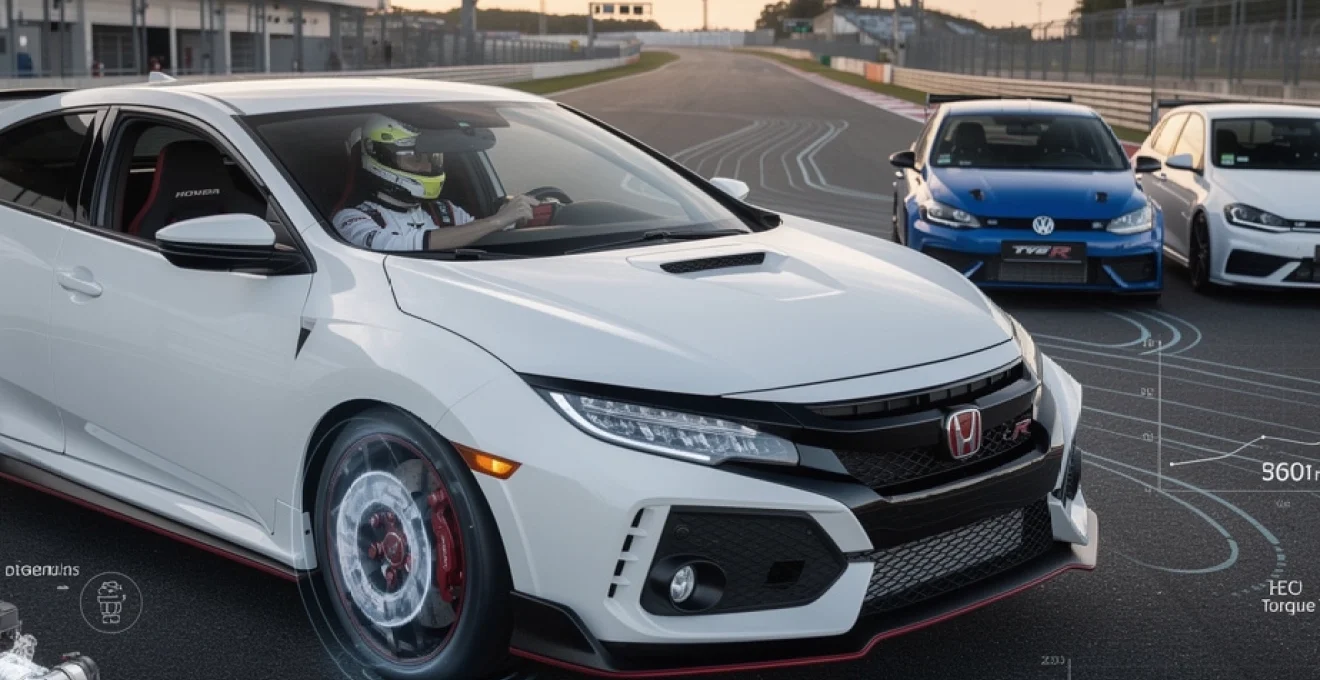
The FK2 Honda Civic Type R arrived in 2015 with a simple aim: reclaim the hot-hatch crown using front-wheel drive, a manual gearbox and a brand-new turbocharged VTEC engine. In a world drifting towards all-wheel drive and dual‑clutch gearboxes, the FK2 felt like a defiant engineering statement. You felt that defiance the first time the rev lights flared red and the milled alloy knob snapped into the next ratio. It is a car that demands a little tolerance from you in daily use, but rewards that compromise with an intensity that modern, more polished rivals often struggle to match.
For drivers who value connection more than lap-time bragging rights alone, the FK2 Civic Type R remains a fascinating used proposition. Strong performance, robust engineering and a surprisingly practical cabin sit alongside a chassis that can feel almost race-car stiff in the right (or wrong) conditions. Understanding where the FK2 excels, where it asks for patience and where it benefits from smart upgrades will help you decide if this hardcore Civic fits your style of fast driving.
Honda FK2 civic type R overview: chassis code, production years and UK market positioning
The FK2 Civic Type R uses the FK2 chassis code and was built from 2015 to 2017, based on the ninth-generation Civic hatch. It arrived late in that model’s life cycle, which is why production lasted barely two years before the FK8 replaced it. That short run, combined with strong demand from enthusiasts, means UK cars have held their value better than many rivals; good examples typically sit in the £15,000–£20,000 band despite being close to a decade old.
When new, the FK2 Type R launched at £29,995 in standard form, with the better-equipped GT pack pushing the price just over £32,000. That placed it directly against the Ford Focus ST and, crucially, the all-wheel-drive Mk7 Golf R and Focus RS. Honda’s angle was clear: keep things front-driven and manual, but deliver power and track pace to worry more expensive machinery. The car’s sharply styled body, big rear wing and 19‑inch wheels made it impossible to mistake for a regular Civic on UK roads, yet the five-door shell and 498‑litre boot kept it viable as a daily driver for those who can live with firm suspension.
The FK2’s UK market positioning was also about brand rehabilitation. After the softer FN2, many enthusiasts questioned whether the Civic Type R legend had dulled. The FK2’s aggressively tuned chassis, 306 bhp output and Nürburgring lap record attempt were designed to show that Honda still took the Type R badge extremely seriously. On today’s used market, that extreme approach makes the FK2 particularly attractive if you want a truly focused hot hatch rather than a fast all-rounder.
K20C1 turbocharged powertrain analysis: torque delivery, VTEC implementation and real-world performance
Boost characteristics and turbo response: low-end torque vs high-rpm power in the FK2 type R
Under the bonnet sits the K20C1 2.0‑litre turbocharged four-cylinder, the first forced‑induction engine ever fitted to a Civic Type R. It produces 306 bhp at 6500 rpm and 295 lb ft of torque from 2500–4500 rpm, a dramatic step up from the old FN2’s 198 bhp and 142 lb ft. The compression ratio of 9.8:1 is relatively high for a turbo motor, contributing to crisp throttle response. A mono‑scroll turbocharger, direct injection, forged conrods and a lightweight crankshaft round out a robust specification.
Turbo response is strong for a single-scroll unit. Below 2000 rpm you can sense the engine gathering itself, but from roughly 2500 rpm the FK2 Type R pulls with a broad, muscular surge that makes everyday driving easier than in older naturally aspirated VTEC units. Yet the character remains distinctly Honda once past 5000 rpm: the engine seems to harden its note and urge, charging to the 7000 rpm limiter with real enthusiasm. For a turbo hot hatch, the blend of low‑end shove and high‑rev eagerness is unusually engaging.
In-gear acceleration metrics: 30–70 mph, 50–70 mph and motorway overtakes compared with golf R and focus RS
On paper the FK2 Type R covers 0–62 mph in 5.7 seconds and runs on to 167 mph. Those figures already put it ahead of many front-drive rivals from the same era. In real use, in-gear acceleration is where the car feels particularly potent. A well-driven FK2 typically needs around 4.5–5.0 seconds for a 30–70 mph pull in third gear, and about 3.0 seconds for 50–70 mph in fourth. That makes swift motorway overtakes feel almost casual if you are in the correct gear.
Compared with a Mk7 Golf R DSG, the Honda’s front‑drive traction means it loses ground from a standing start, but once rolling, the manual Civic claws back speed quickly. Against a Focus RS, the FK2 again lags off the line due to the Ford’s rear‑biased all-wheel drive, yet on a warm, dry road the Honda can stay extremely close in 30–100 mph runs. The key difference is how the FK2 delivers its pace: you interact more, think about gear choice and accept a little wheelspin, yet the sense of reward every time you nail an overtake is correspondingly higher.
Track performance data: lap times at nürburgring nordschleife, silverstone and anglesey coastal
Honda used the FK2 Type R to hunt front‑wheel‑drive lap records, and the numbers still impress. In period the car recorded a 7:50.6 lap of the Nürburgring Nordschleife, beating the then‑benchmark hot hatches and only being eclipsed later by ultra‑focused specials such as the Golf GTI Clubsport S. That 7:50.6 was achieved on road‑legal tyres and with only modest changes from showroom specification, underlining how serious the base package already was.
On UK circuits the FK2 has proved equally capable. Independent tests on the Anglesey Coastal circuit saw it lap within a second of all‑wheel‑drive rivals when fitted with aggressive track tyres. One long-term car, shod with Michelin Pilot Sport Cup 2s, matched a Focus RS on the same rubber around a tight test track despite the Ford’s extra 39 bhp and four‑wheel drive traction. At Silverstone, club-level drivers consistently report that the Civic’s composure on turn‑in and exit makes it easy to extract lap time, provided you respect the front tyres and avoid overdriving corner entry.
Engine reliability patterns: ringland integrity, cooling efficiency and known K20C1 weak points
The K20C1 has built a reputation for durability in standard tune, especially when serviced correctly at 12,500‑mile or annual intervals. On stock boost, ringland failures are rare; the pistons use cast alloy, but Honda’s conservative fuelling and knock strategy help safeguard them. Engine oil consumption is usually modest if the car has not lived its life bouncing off the limiter from cold. Regular oil changes using the correct 0W‑30 or 0W‑20 synthetic are crucial to maintaining bearing and turbo health.
Cooling performance is generally adequate for fast-road use, but repeated track sessions in hot weather can push coolant and intake temperatures higher than ideal. Occasional reports of overheating usually trace back to blocked radiators, failing thermostats or modified cars running increased boost without upgraded cooling. Engine mounts can soften over time, leading to additional drivetrain movement and harshness, especially on launches. These are consumable parts rather than inherent weaknesses, but worth checking on any test drive.
ECU mapping behaviour: factory boost control, knock strategy and effects of stage 1 remaps
The FK2’s ECU tightly manages boost via an electronically controlled wastegate and a conservative knock strategy. On 99 RON fuel, the car will generally target around 1.3–1.4 bar of peak boost, tapering towards the redline. If knock is detected, ignition timing is quickly pulled and on‑throttle response softens; you may feel this as a slight flat spot when using lower octane fuel. The factory calibration aims for reliability first, which explains why stock cars feel consistent lap after lap if kept within reasonable temperature limits.
Stage 1 remaps commonly lift power into the 340–360 bhp range and torque to around 360–380 lb ft on UK pump fuel. That extra mid-range shove transforms straight-line performance but also increases thermal load, cylinder pressure and clutch stress. For a road‑biased FK2, a mild map that focuses on smoothing torque delivery rather than chasing headline numbers is usually the most enjoyable option. Any tuned car should be backed up by upgraded intercooling, meticulous servicing and the assumption that consumables such as clutches and front tyres will wear faster.
Front-wheel-drive dynamics: torsion beam rear axle, limited-slip differential and cornering behaviour
Helical LSD calibration: torque vectoring feel on b-roads and circuit hairpins
The FK2 Civic Type R pairs its powerful engine with a mechanical helical limited‑slip differential on the front axle. Rather than using brake‑based torque vectoring, the LSD physically routes more drive to the wheel with greater grip, helping the car pull itself out of corners. On a typical British B‑road you feel this as a distinct sense of the nose being dragged towards the apex if you commit to the throttle early, a sensation that can initially surprise drivers stepping out of open‑diff hot hatches.
On circuit hairpins the calibration allows just enough inside wheelspin at turn‑in to help rotate the car before the diff locks harder as you unwind the steering and apply power. In the dry, that combination makes the FK2 remarkably effective at clawing out of slow bends, even compared with some all‑wheel‑drive rivals. In the wet, you will notice more wheelspin and occasional tugging at the wheel if the surface is bumpy, but torque steer is impressively contained for a 300+ bhp front‑driver.
Steering feedback and geometry: camber settings, toe characteristics and mid-corner stability
Steering in the FK2 is very direct just off centre, which can feel almost hyperactive during the first few miles. The rack ratio and assistance have been tuned to give quick responses without artificial weight. Factory geometry uses modest negative camber at the front and a neutral toe setting, aiming for predictable responses and strong mid‑corner bite. The Dual Axis Strut front suspension separates steering and strut axes, reducing torque steer and camber change compared with a conventional MacPherson layout.
Once acclimatised, you can guide the FK2 with small, measured inputs, particularly at higher speed where the car feels superbly stable in a straight line and through fast sweepers. Mid‑corner bumps are managed well in the standard driving mode, though +R stiffness can cause the chassis to skip if the surface is broken. Enthusiast owners often add a little extra front camber using adjustable top mounts for more even tyre wear on track, but for fast-road driving the stock geometry gives a good compromise between response and stability.
Brake system performance: brembo front calipers, fade resistance and track pad upgrades
Braking is handled by Brembo four‑piston calipers clamping 350 mm front discs, with solid single‑piston calipers at the rear. On the road, pedal feel is firm and reassuring, and fade resistance is excellent in standard use. On track, the FK2 can work its front brakes extremely hard, particularly on heavy-braking circuits. Long‑term test data shows some cars needing front pads and discs at around 11,000 miles when regularly driven quickly, so budgeting for consumables is sensible.
If you plan frequent track days, higher-friction pads and high‑temperature fluid are worthwhile investments. A quality aftermarket pad can improve initial bite and high‑temperature stability without ruining manners on the road. For most drivers, the stock setup is more than adequate, but any squealing, judder or long pedal travel on a test drive warrants investigation; the FK2 is sensitive to pad quality and correct bleeding.
Tyre selection impact: OEM continental SportContact vs michelin pilot sport 4S and cup 2
Tyres transform the FK2 Type R more than many owners expect. From the factory, UK cars commonly wore 235/35 R19 Continental SportContact 6 rubber. Grip levels are high, particularly in the dry, but some drivers describe the Contis as feeling a little edgy at the limit. Switching to Michelin Pilot Sport 4S usually brings a softer breakaway, stronger wet‑weather performance and slightly improved ride quality, making the car less tiring on typical British roads.
For maximum track performance, Michelin Pilot Sport Cup 2 or similar semi‑slick tyres can unlock another layer of precision and speed. One long‑term FK2 fitted with Cup 2s managed to match a Focus RS on the same tyres around a reference circuit, despite the Ford’s power and traction advantage. The trade‑off is straightforward: more noise, less wet‑grip margin and faster wear. If you want a fast road car rather than a track toy, the PS4S or equivalent is usually the best all‑round choice.
Transmission and gearing: six-speed manual, rev-matching techniques and driveline refinement
The FK2’s six‑speed manual gearbox is central to its appeal. Honda engineered the shift with a 40 mm throw, identical to that of the revered 2002 NSX‑R, and the result is one of the most precise, mechanical-feeling linkages fitted to any modern performance car. The milled alloy gear knob sits close to the steering wheel, inviting quick shifts, and the gate is well defined enough that even aggressive three‑to‑two downshifts feel natural after a little practice. For many enthusiasts, this gearbox alone justifies choosing an FK2 over dual‑clutch rivals.
Gear ratios are stacked closely, keeping the engine in its strong 3500–7000 rpm band. At UK motorway speeds the engine sits a little higher in the rev range than some rivals, contributing to a noticeable but acceptable level of cabin drone. If you enjoy rev-matching heel‑and‑toe downshifts, the pedal layout demands a deliberate ankle roll but rewards with a smooth, satisfying blip every time. There is no automatic rev-match feature on the FK2, which means every well‑timed downshift feels like a small victory rather than software doing the work.
The clutch is light by performance‑car standards but can show wear if subjected to repeated drag‑style launches or heavy track use on tuned cars. When assessing a used FK2, any sign of clutch slip under full boost in higher gears should be treated as a negotiation point. Driveline refinement is otherwise strong: there is some low‑speed transmission shunt if you try to crawl in too high a gear, but once above walking pace the powertrain feels tight and cohesive rather than loose or rattly.
Cabin ergonomics and driving position: bucket seats, pedal spacing and daily usability
Open the door and you are greeted by deep, bewinged bucket seats trimmed in red and black cloth. They look dramatic but deliver genuine long‑journey comfort for average‑build drivers, blending firm bolstering with enough cushioning to prevent fatigue. Taller or broader‑shouldered occupants may find entry slightly awkward because of the pronounced side bolsters, yet once seated the driving position is excellent: low, legs outstretched and arms comfortably bent, more like a sports coupé than a family hatchback.
The dashboard layout, with its split‑level analogue and digital instruments, divides opinion. Some drivers enjoy the futuristic feel and quick-glance digital speed read‑out, while others find the scattering of information across multiple planes distracting, particularly when warning messages appear simultaneously in several locations. The infotainment system is an obvious weak point by current standards: the touchscreen can be laggy and the menu structure feels more like an aftermarket double‑DIN unit than a modern integrated system. Using smartphone mirroring where available is often the easiest approach.
Pedal spacing is the main ergonomic quirk. The brake and throttle are set quite far apart, which makes subtle heel‑and‑toe work harder than in some rivals; you must exaggerate ankle movement rather than relying on a slight roll of the foot. Some owners address this with an aftermarket throttle pedal extension. Practicality, by contrast, is a strong suit. The vast 498‑litre boot, split‑fold rear seats and generous rear legroom make the Civic Type R entirely capable of family duty. If you can accept a firm ride and bold styling, the FK2 can absolutely serve as a single do‑it‑all car.
FK2 type R vs FK8 and FL5: comparative performance, chassis evolution and tuning potential
Successor models FK8 and FL5 build on the FK2 formula rather than rejecting it, but each changes the character in important ways. The FK8, launched in 2017, uses a development of the same K20C1 engine with 316 bhp in European trim, multi‑link rear suspension instead of a torsion beam, and a more compliant chassis tune. The current FL5 evolves that package again, with 324 bhp, further chassis stiffening and more subtle exterior styling. On paper, both are quicker than the FK2, with quoted 0–62 mph times of 5.8 s (FK8) and 5.4 s (FL5), plus higher Nürburgring lap records.
On the road, the FK8 and FL5 feel more mature and less raw. Ride quality is notably better, especially in their comfort or default modes, and cabin refinement has improved step by step. If you spend a lot of time on broken urban tarmac, those changes are significant. Yet many seasoned drivers still describe the FK2 as having more “edge” and drama. Turbo noise, vibration through the controls and the hyperactive +R mode make it feel closer to a race‑car for the road, for better and occasionally for worse.
From a tuning perspective, all three generations respond well to careful upgrades, but the FK2’s lighter kerb weight (around 1378 kg) and simpler rear suspension make it attractive for track builds. Stage 1 and 2 engine packages can comfortably push an FK2 past 360 bhp, provided cooling and fuelling are addressed. Chassis modifications such as upgraded dampers, additional camber and more serious tyres turn it into a formidable club‑level track tool without sacrificing the inherent strength of the base shell. For drivers who prioritise raw involvement and are willing to accept some compromises in comfort and refinement, the FK2 remains an unusually intense and rewarding hot hatch choice in the modern era.