
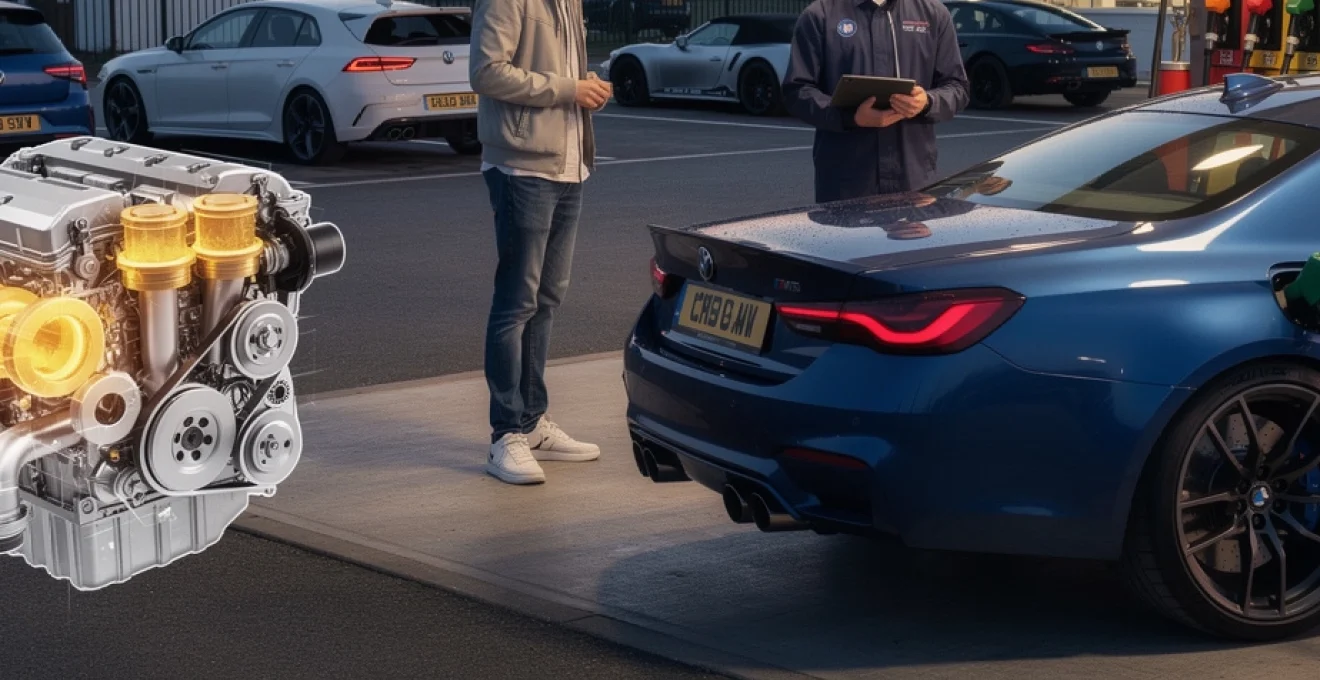
Pulling up at a UK forecourt in 2025 can feel more like scrolling a spec sheet than buying petrol. Labels such as E10, E5, 95, 97, 98, 99 RON and a wall of brand names all promise performance, protection and efficiency. If you care about engine health, turbo reliability or simply getting the best from a performance car, understanding the highest octane fuel in the UK stops being trivia and becomes a real money decision. Knowing when 99 RON super unleaded genuinely helps – and when 95 RON is perfectly fine – lets you fuel confidently instead of guessing at the pump.
What counts as the highest octane petrol in the UK today? E5 super unleaded, 97–99+ RON and branded premium fuels explained
On UK roads, the phrase “highest octane fuel” usually means super unleaded petrol with an octane rating of 97, 98 or 99 RON. Standard petrol is now E10 95 RON; anything above that sits in the “high-octane” camp. Almost all major brands sell an E5 super unleaded grade, which contains up to 5% ethanol and carries the higher octane rating. These fuels are still fully road legal, can be used in any compatible petrol engine and are available at a large proportion of UK filling stations, though rural coverage can be patchy.
In practice, the highest octane fuel widely available to everyday drivers is 99 RON E5 super unleaded, sold under names like Shell V‑Power or Tesco Momentum 99. Some forecourts still offer 98 RON instead of 99 RON, and a few have stuck with 97 RON. For most high-performance road engines, the difference between 98 and 99 RON is marginal, but stepping up from 95 RON to 98/99 RON can change how aggressively the engine’s control systems allow it to run, especially under high load or boost.
RON, MON and AKI: how octane rating is measured on UK and international petrol pumps
Octane rating is often treated like a scorecard for petrol, but there are several ways to measure it. In the UK and across Europe, the number printed on the pump is the RON – the Research Octane Number. It is measured under relatively gentle test conditions and reflects how resistant the fuel is to knock during low to medium engine loads. There is also MON – the Motor Octane Number – measured at higher temperatures and more severe loads, which is often lower than RON for the same fuel.
In North America and a few other markets, the pump number is the average of RON and MON, written as (R+M)/2 or AKI (Anti‑Knock Index). That is why US “91 octane” roughly corresponds to 95 RON in UK terms, and US “93” is close to 98 RON. If you are importing a car or reading an overseas manual, this difference matters. A handbook specifying 91 AKI is broadly asking for what UK forecourts sell as 95 RON E10; a manual calling for 93 AKI is aiming for 98/99 RON super unleaded.
Super unleaded vs standard E10: comparing 95 RON to 97, 98 and 99 RON grades on UK forecourts
Standard unleaded in the UK is E10 95 RON, which contains up to 10% ethanol. It powers around 95% of petrol cars on the road and has been the default grade in Great Britain since September 2021. For everyday family cars, crossovers and small hatchbacks, 95 RON E10 delivers the performance and efficiency expected by manufacturers. Many modern engines are calibrated specifically with 95 RON in mind, and for those vehicles super unleaded gives little more than a lighter wallet.
Super unleaded, on the other hand, is E5 97–99 RON. Its key advantage is higher resistance to knock – uncontrolled combustion that can damage engines. In high-compression, turbocharged or performance engines, this extra headroom allows more aggressive ignition timing, higher boost pressures and, in some cases, slightly better fuel economy under load. Independent tests have found that for regular cars tuned for 95 RON, the improvement in miles per gallon from super unleaded is typically within the margin of error, but for certain high-output engines the difference in drivability and consistency can be significant, especially during spirited driving.
Branded high-octane fuels in the UK: shell V-Power, BP ultimate, esso synergy supreme+ and tesco momentum 99
Several brands offer their own take on high-octane fuel, each with slightly different specs and additive packages. Shell V‑Power is perhaps the highest profile, marketed heavily on its 99 RON rating and detergent-rich formulation. Many drivers of performance cars report smoother running and cleaner spark plugs after long-term use, though hard, independent data is rarer. Esso Synergy Supreme+ and Tesco Momentum 99 also carry a 99 RON rating at many sites, with Tesco’s Momentum often undercutting the oil majors on price.
BP Ultimate is generally a 97 RON fuel in the UK, so it sits slightly below the very top octane offerings, but still well above standard 95 RON E10. It too includes a robust detergent package aimed at cleaning injectors and intake valves. A common question is whether supermarket premium fuel is inferior. All UK fuels must meet the same British Standard, and base petrol often comes from the same refineries; the main differences lie in the brand-specific additive packages. For most engines, consistent use of any reputable super unleaded is far more important than the logo on the pump.
“100 RON” and race fuels: specialist high-octane blends from sunoco, VP racing fuels and gulf racing fuels
Beyond the public forecourt, there are specialist fuels designed for motorsport and high-end tuning. Brands such as Sunoco, VP Racing Fuels and Gulf Racing Fuels supply blends rated at 100 RON and above, sometimes combined with high MON values for stability under extreme load. These products are typically sold in drums or at race circuits rather than normal petrol stations, and some are not road legal in the UK because of their composition or additive content.
Race fuels often feature tightly controlled volatility, oxygenated components and very consistent knock resistance, making them ideal for engines running high boost pressures, aggressive ignition maps or elevated compression ratios. Tuning an ECU for 102 RON race fuel, for example, allows dramatically more ignition advance than would be safe on 95 RON. However, the cost per litre is several times higher than even 99 RON forecourt fuel, and running race fuel in a road car that is not mapped for it rarely delivers benefits beyond an impressive spec sheet.
How high-octane petrol works inside the engine: combustion chemistry, knock resistance and ECU calibration
High-octane petrol does not contain “more energy” in the simple sense. Instead, it is chemically engineered to be more resistant to self-ignition under pressure and heat. In a spark-ignition engine, the goal is to control exactly when the air–fuel mixture ignites using the spark plug. If the mixture auto-ignites too early, multiple flame fronts collide, generating pressure spikes known as knock. Over time, severe knock can damage pistons, bearings and cylinder heads.
Because 97–99 RON petrol is more resistant to knock than 95 RON, engineers can design or calibrate engines to run higher compression ratios, higher turbo boost or more advanced ignition timing when high-octane fuel is present. Think of octane as the “headroom” above which more aggressive settings remain safe. The chemistry is complex – involving molecular structure, evaporation behaviour and additive packages – but for a driver the effect is simple: in the right engine, high-octane fuel can unlock performance and efficiency that the control system would otherwise hold back. This is especially relevant as manufacturers push downsized, turbocharged engines to meet emissions targets without sacrificing power.
Detonation and pre-ignition: how octane rating reduces engine knock in turbocharged and high-compression engines
Detonation and pre‑ignition are often lumped together as “knock”, but they describe different failure modes. Detonation occurs when the end-gas – the last part of the mixture to burn – auto-ignites after the spark has fired, sending shockwaves through the cylinder. Pre‑ignition happens when the mixture ignites before the spark, often triggered by a hot spot such as a glowing carbon deposit. Both create abnormal pressure spikes that high-octane fuel is specifically formulated to resist.
Turbocharged and high-compression engines are more knock-prone because they squeeze and heat the mixture more before ignition. When you ask a turbo engine for full throttle at low revs, cylinder pressures can be very high. With 95 RON fuel, the engine’s knock sensors may detect incipient detonation and force the ECU to retard ignition timing or cut boost. With 99 RON fuel, the mixture tolerates more pressure and temperature before knocking, so the ECU can hold a more advanced, efficient ignition angle, especially under sustained load such as track driving, towing or climbing long motorway gradients.
Ignition timing advance and knock sensors: how modern ECUs optimise performance on 99 RON fuel
Modern ECUs constantly adjust ignition timing based on knock feedback. Knock sensors act like sensitive microphones bolted to the engine block, “listening” for the characteristic frequencies of detonation. If knock is detected, the ECU gradually retards timing for that cylinder bank until the knock disappears, then slowly advances again to find the safe limit. This closed-loop approach allows one engine calibration to adapt to different fuel qualities, ambient temperatures and altitudes.
When you run a car that is capable of benefitting from 99 RON petrol, the ECU effectively finds a new, more aggressive sweet spot. Under identical conditions, it can run a few degrees more ignition advance before knock occurs. That might translate to a handful of extra horsepower, better torque at mid-range revs and slightly lower exhaust gas temperatures. The benefit is most obvious in engines that are right on the edge of knock on 95 RON, such as many turbocharged performance models. For an engine that is already knock-limited by design at 95 RON, however, the ECU may have nothing extra to give even if 99 RON is supplied.
Forced induction applications: turbocharged engines from BMW M, Mercedes-AMG, VW TSI and ford EcoBoost on high-octane fuel
Many of the most popular performance engines in the UK are turbocharged four- and six-cylinder units that respond notably well to high-octane petrol. BMW’s M division, Mercedes‑AMG, Volkswagen’s TSI engines and Ford’s EcoBoost range often specify 98 RON as “recommended” for full power output, with 95 RON permitted but derating performance. Owners frequently report that 99 RON super unleaded delivers more consistent acceleration and reduces the “soft” feeling that can appear on hot days or after repeated hard runs.
Turbocharged engines are like air pumps being pushed harder and harder. With higher RON fuel, the ECU can sustain target boost for longer without pull-back and can maintain more aggressive ignition timing in the mid-range where knock risk is greatest. A well-known example is the VW Golf R; independent dyno tests have shown power differences of 5–10 bhp between 95 and 99 RON fuels on otherwise stock cars, with even larger gaps on remapped engines running higher boost.
High-compression naturally aspirated engines: honda VTEC, mazda Skyactiv-G and performance motorcycle engines on super unleaded
Not all engines that appreciate high octane have turbos. High-compression naturally aspirated units, such as certain Honda VTEC engines, Mazda’s Skyactiv‑G petrols and many performance motorcycle engines, also benefit. Some of these designs use compression ratios of 13:1 or higher, which would be marginal on 95 RON without careful combustion chamber shaping and precise injection timing. Feeding them 98/99 RON gives extra safety margin, especially when worked hard near the redline.
Owners of high-revving bikes and sports saloons sometimes notice crisper throttle response and cleaner high-rpm operation on E5 super unleaded compared with E10 95 RON. The differences are subtle in day‑to‑day commuting but become more apparent on track days or Alpine road trips where engines spend prolonged periods at high load. While many of these engines are officially compatible with 95 RON, long-term use of the highest octane fuel can be a form of inexpensive insurance against borderline knock when conditions are less than ideal.
Which UK cars actually need the highest octane fuel? manufacturer specifications and real-world examples
For most UK drivers, the key question is simple: does the car need the highest octane fuel, or is it just “nice to have”? The most reliable source is the owner’s handbook and the sticker inside the fuel filler flap. Manufacturers are obliged to state the minimum fuel grade required for safe operation, and many also specify a higher “recommended” grade for optimum output. If you are driving a leased vehicle or a business car, following that guidance also keeps you safely inside warranty and finance conditions.
High-octane petrol only becomes essential when the manufacturer explicitly states a minimum of 98 or 99 RON for full power, or when an aftermarket tune has been calibrated on that grade.
Performance‑oriented models are more likely to demand 98+ RON, while mainstream hatchbacks, SUVs and city cars are generally calibrated around 95 RON E10. Classic imports, modified turbo cars and high-compression motorcycles are special cases where professional advice or rolling‑road testing can reveal the real-world impact of fuel choice, particularly if the original documentation refers to overseas octane standards.
Owner’s manual requirements: differentiating “recommended” vs “required” 98/99 RON for warranty compliance
Wording in the owner’s manual matters. Some manufacturers write that 95 RON is the minimum, with 98 RON or higher “recommended” for maximum performance. Others state that 98 RON is required, and 95 RON may be used only temporarily, with reduced output and potentially higher consumption. For warranty purposes, using less than the stated minimum can give a manufacturer grounds to challenge engine-related claims if there is evidence of sustained knock damage.
If your handbook says “97/98 RON recommended; 95 RON permitted”, then you have genuine flexibility. You might reasonably use 95 RON for everyday commuting and super unleaded before longer, spirited drives. If, instead, the manual says “98 RON required”, treating 99 RON E5 as the default fuel is the safest option. For imported cars referencing 91 or 93 AKI, remember the conversion to RON when interpreting those recommendations so that you do not under‑fuel a high-performance engine by accident.
Performance and sports cars calibrated for 98+ RON: BMW M3/M4, audi RS models, nissan GT-R, porsche 911 and GR yaris
Many halo models on UK roads are explicitly developed around 98 RON petrol. The BMW M3/M4, Audi RS range, Nissan GT‑R, most Porsche 911 variants and Toyota’s GR Yaris all fall into this camp. Their compression ratios, turbo boost strategies and ignition maps assume high-octane fuel; while their ECUs can usually adapt to 95 RON in an emergency, doing so long-term undermines the engineering effort that went into them.
On these cars, choosing the highest octane fuel in the UK is not just about shaving tenths off a 0–62 mph time. It also supports consistent lap‑after‑lap behaviour on track, preserves exhaust components by keeping temperatures lower and reduces the likelihood of harmful knock events during hot weather or heavy use. Drivers who habitually use 99 RON often report that the car feels “happier” and more linear, particularly on dual carriageway overtakes or tight B‑road climbs where the engine lives in the mid‑range.
Hot hatches and tuned turbo cars: VW golf R, ford focus ST/RS, hyundai i30 N and remapped 1.8/2.0 TSI engines
Hot hatches and tuned turbo cars sit in a grey area between everyday transport and full‑fat sports cars. Factory‑tuned models such as the VW Golf R, Ford Focus ST/RS, Hyundai i30 N and similar tend to list 95 RON as acceptable, with 98 RON often recommended for best performance. In standard form, these engines can run safely on either grade, but super unleaded unlocks more of their potential when driven hard.
Once a turbo petrol is remapped, the fuel question becomes more critical. Many popular 1.8 and 2.0 TSI remaps are explicitly written for 98/99 RON, using the knock resistance to support higher boost and more ignition advance. Running such a tune on 95 RON may cause the ECU to pull back timing constantly, erasing much of the gain and potentially stressing components. If you have paid for a high-octane map, budgeting for 99 RON fuel is simply part of running the car responsibly.
Classic, imported and high-compression engines: JDM turbo cars, older subaru impreza WRX/STI and performance motorbikes
Classic and imported performance cars introduce extra complexity because many were designed in markets with different octane scales. Japanese Domestic Market (JDM) turbo cars, older Subaru Impreza WRX/STI models and a variety of performance motorbikes often originate from environments where 100 RON is widely available. When these vehicles arrive in the UK, owners or tuners typically recalibrate ECUs for 97–99 RON fuel as a compromise.
Using the highest octane fuel available is particularly sensible for these engines, not only for performance but also for mechanical sympathy. Many run relatively high boost levels by modern standards, may have accumulated carbon deposits over time and can be more sensitive to small changes in fuel quality. In some cases, specialist additives or occasional use of oxygenated race fuel is combined with careful mapping for track use, although this is a niche approach best handled by experienced tuners with access to dyno facilities.
E5 vs E10 at the highest octane: ethanol content, material compatibility and energy density
One subtlety of the UK’s highest octane fuels is ethanol content. Standard 95 RON petrol is now E10, meaning up to 10% ethanol by volume. Most super unleaded 97–99 RON fuels remain E5, limited to up to 5% ethanol. Ethanol has a higher octane rating than pure petrol but a lower energy density, so while it helps prevent knock, it slightly reduces the energy per litre. That is why some drivers notice a 1–3% drop in fuel economy when switching from E5 to E10, even if the octane rating remains the same.
Material compatibility is another factor. Ethanol is hygroscopic and can be more corrosive to certain rubbers, plastics and older fuel system components. Vehicles built since 2011 are generally E10‑compatible, but an estimated 8% of UK petrol cars – particularly classics, some early‑2000s models and many carburetted bikes – are not officially approved. For those vehicles, E5 super unleaded is often the only safe mainstream option. If a classic engine also benefits from higher octane, using E5 97/98/99 RON becomes the logical choice, even at a higher price per litre.
Fuel additives, detergents and deposit control in UK premium petrol formulations
Octane rating is only part of the story. Premium petrol grades also differ in their additive packages – the detergents, corrosion inhibitors and friction modifiers blended into the base fuel. By law, all UK petrol must contain a minimum level of cleaning agents to prevent gross injector fouling and deposit build‑up. However, branded premium fuels often contain several times that minimum, targeted at keeping intake valves, injectors and combustion chambers cleaner over long mileages.
Heavy deposit formation can increase an engine’s effective compression ratio, create hot spots that promote pre‑ignition and disrupt spray patterns from injectors. Over tens of thousands of miles, that can mean rougher idle, lost performance and higher emissions. Using a high-detergent super unleaded from time to time – or consistently, if the budget allows – can help reduce this tendency, especially in direct‑injection petrol engines that are more prone to intake valve deposits. While no fuel can fully reverse long‑term neglect, premium formulations are a helpful preventative tool in keeping the combustion system closer to its as‑designed state.
Cost–performance analysis: when paying for 97–99 RON super unleaded in the UK actually makes sense
Premium petrol typically costs around 8–12 pence per litre more than standard E10, though this premium can vary by region and brand. On a 50‑litre fill, that is an extra £4–£6. Over 10,000 miles a year in a car averaging 40 mpg, the difference in annual fuel spend could easily reach £120–£150 if you use super unleaded exclusively. For a typical commuter hatchback tuned around 95 RON, multiple independent tests have concluded that any small efficiency gains from higher octane fuel rarely offset that additional cost.
For certain cars and driving patterns, however, the equation changes. If your manufacturer explicitly recommends or requires 98/99 RON for full performance, or if you run a tuned turbo engine calibrated for high-octane fuel, using the cheapest 95 RON option is a false economy. The small savings at the pump are outweighed by reduced performance, potential knock‑related wear and the risk of issues under sustained load. Even if you split usage – 95 RON for gentle local trips, 99 RON before long motorway journeys or track days – the cumulative cost remains modest compared with tyres, servicing and depreciation.
Using the highest octane fuel strategically – when the engine will be worked hard, in hot weather or on long climbs – often delivers most of the benefits without committing to it for every tank.
A practical approach for many UK drivers is to follow three simple steps. First, read the owner’s manual carefully and treat the minimum RON as non‑negotiable. Second, if 98/99 RON is merely recommended, experiment with a few tanks of super unleaded during the type of driving you care about most – such as motorway runs or spirited weekend drives – and monitor fuel consumption and response. Third, consider the age and type of your engine; for older, high‑compression or direct‑injection units, the detergent and E5 ethanol advantages of premium fuel can be as valuable as the octane itself, especially over the lifetime of the vehicle.