
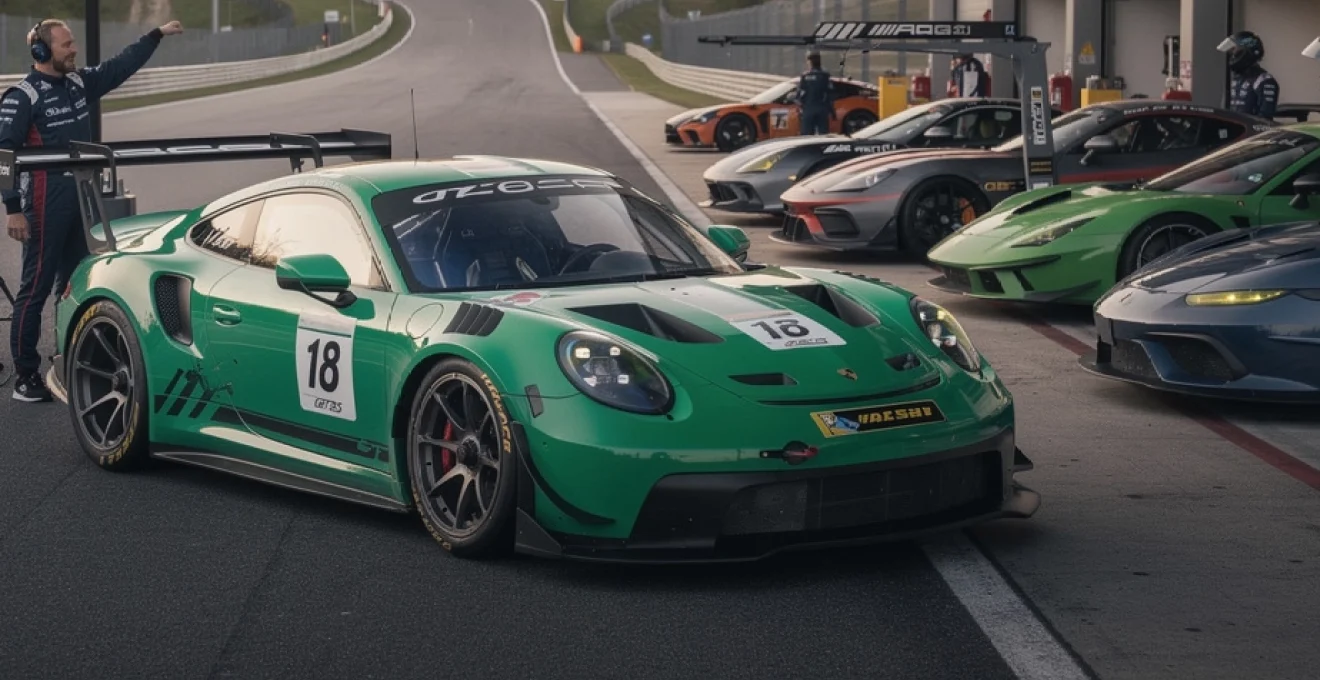
The Nürburgring Nordschleife has become a second home for the 911 GT3 RS. Every generation is judged as much by its lap time on the 20.832 km “Green Hell” as by its power figure or price tag. For you as an enthusiast, engineer or buyer, that single number – the official GT3 RS Nürburgring lap time – is shorthand for chassis genius, aero efficiency and mechanical reliability under extreme load. Digging beneath the headline reveals how delicately Porsche balances downforce, gearing, tyres and temperature to extract a sub‑seven‑minute lap from a naturally aspirated, road‑legal car that still has to pass emissions and TÜV.
Understanding how that lap is achieved, verified and compared to rivals from AMG, Lamborghini and BMW gives you a far more accurate view than a simple leaderboard screenshot. Factors like 20.6 km versus 20.832 km configuration, tyre compound, fuel load and even where the timing beacon sits on the T13 straight can swing the stopwatch by several seconds. The latest GT3 RS does not sit at the very top of the Nürburgring production car table, but its time shows how much performance can be unlocked from a high‑revving atmo flat‑six when the surrounding hardware is optimised for downforce and consistency rather than brute horsepower alone.
Official porsche 911 GT3 RS nürburgring nordschleife lap time: figures, conditions and verification
Declared GT3 RS lap time on the 20.8 km nürburgring nordschleife configuration and sector breakdown
The current 992‑generation Porsche 911 GT3 RS holds an official Nürburgring Nordschleife lap time of 6:49.328 for the full 20.832 km configuration. Porsche also quotes an “adjusted” reference of 6:44.848 aligned with the historical 20.6 km measurement used before 2019. Both numbers matter if you want to compare the GT3 RS against older records logged before the Nürburgring standardised its timing protocol.
While Porsche does not publish a full sector‑by‑sector breakdown to the public, the onboard footage shows a clear performance pattern. The GT3 RS tends to claw back time in medium‑ and high‑speed aero sections such as Flugplatz, Schwedenkreuz and Kesselchen, while giving away a little on very long flat‑out stretches where turbocharged rivals can continue to pull beyond 270 km/h. The average speed across the lap sits at roughly 185 km/h (115 mph), underlining just how aggressively the car is driven over the 73‑plus corners and 300 m of elevation change.
Compared to the 992 GT3’s already impressive 6:55‑range lap, the GT3 RS finds roughly 10–11 seconds around the full 20.832 km loop. Most of that gain does not come from extra peak power, but from increased downforce, stickier tyres and the ability to brake later and carry more mid‑corner speed.
Weather, track temperature and tyre compound (michelin pilot sport cup 2 R / cup 2) during the record lap
Fast Nürburgring laps live or die on conditions, and the GT3 RS record run is a textbook example. Air temperature hovered around the mid‑teens Celsius, with a dry track and no major wind gusts – close to the ideal envelope for a high‑downforce road car. At this temperature range, both engine and tyres sit in a sweet spot: the 4.0‑litre flat‑six can deliver maximum power without overheating, and the Michelin compound reaches peak grip without “greasing up”.
The record car ran on Michelin Pilot Sport Cup 2 R N0 tyres, the most aggressive road‑legal option available for the 992 GT3 RS. This semi‑slick offers a softer compound and more track‑focused construction than the regular Cup 2. For you as a trackday driver, that translates into higher ultimate grip but a narrower operating window and faster wear. Porsche and Michelin generally recommend starting pressures slightly below 2.0 bar cold, allowing the tyres to climb to around 2.3–2.5 bar hot through Hatzenbach and Hocheichen. The record onboard clearly shows no damp patches, which is critical for a tyre that can quickly lose confidence if forced to deal with standing water or very low surface temperatures.
Driver, timing method (transponder, GPS, video) and FIA-style verification used by porsche
The 992 GT3 RS Nürburgring lap was driven by Porsche brand ambassador and long‑time development driver Jörg Bergmeister, a racer with deep Nordschleife experience. Choosing a driver who was involved in the GT3 RS development makes sense: you get someone who instinctively trusts the car at 3g of lateral load and knows exactly how the aero and suspension react to kerbs and compressions.
Since 2019, Nürburgring record attempts for road‑going cars are conducted under an officially controlled protocol. The GT3 RS run used a calibrated transponder‑based timing system at the T13 start/finish line, backed up by GPS logging and full‑length onboard video. A notary supervised the attempt, while a neutral technical organisation documented the car’s road‑legal configuration. This FIA‑style verification is not as strict as a race scrutineering process, but it does lock down key parameters such as tyre model, roll cage specification and absence of non‑homologated performance parts.
“On the Nordschleife, transparency over distance, timing and car specification matters as much for credibility as the raw lap time itself.”
Comparison between 20.6 km “bridge‑to‑gantry” laps and the official 20.832 km manufacturer reference
If you spend time on Nürburgring forums or videos, you will constantly see references to 20.6 km and bridge‑to‑gantry (BTG) laps. The differences can be confusing if you are comparing a GT3 RS Nürburgring time against older or unofficial runs, so a quick clarification helps.
The current manufacturer standard uses the full 20.832 km loop measured “start‑to‑start” at T13. Before this, many factory times were quoted on a 20.6 km distance that skipped the short straight past the old start line, typically making laps look around 4–4.5 seconds faster. Tourist‑day BTG laps are shorter still (roughly 19.1 km), because you join and leave the track via the main straight.
When you see the 992 GT3 RS quoted at 6:44.848, that is effectively a 20.6 km‑equivalent reference time adjusted from the real 6:49.328 lap. For meaningful comparisons with the latest AMG, Lamborghini or BMW efforts, always use the 20.832 km figure. If you have your own BTG reference time in a GT3 or similar car, adding 20–25 seconds gives a rough approximation of the full‑loop potential.
Aerodynamics and chassis engineering enabling the GT3 RS nürburgring performance
Active aero, DRS rear wing and front splitter design derived from 911 GT3 R and GT3 cup
The 992 GT3 RS is arguably the most aerodynamically advanced road‑legal 911 to date, and that is the main reason why its Nürburgring pace is so close to much more powerful cars. The car borrows heavily from Porsche’s 911 GT3 R and GT3 Cup race programmes, then adds active elements that race series regulations would never allow.
The twin‑plane rear wing sits higher than the roofline and incorporates a proper drag reduction system (DRS). Under heavy braking the flap pops up into a high‑downforce position; on straights like Döttinger Höhe the driver can flatten it to cut drag. Up front, a deep adjustable splitter works with underbody aero and a reshaped front bumper to balance the giant rear wing. Even the front wishbones are profiled to act as small wings, contributing around 40 kg of downforce on their own – a detail that underlines just how far Porsche is prepared to go to find aero gains.
Downforce figures, balance front to rear and influence on high‑speed sections like flugplatz and schwedenkreuz
Porsche quotes headline downforce of up to 860 kg at 285 km/h for the GT3 RS on its most aggressive track setting, roughly three times the level of a 992 GT3. That number transforms the car’s behaviour through fast sections of the Nordschleife that can unsettle even experienced drivers in more conventional road cars.
At Flugplatz and Schwedenkreuz – both approached in fifth or sixth gear – the GT3 RS sits noticeably calmer than a standard GT3 or Turbo S. The front‑to‑rear aero balance is tuned so that the car resists the tendency to pitch and float over crests, allowing you to stay on partial throttle where others would need a confidence‑sapping lift. This balance also lets the ABS and rear‑axle steering work more consistently, because tyre load is managed more progressively as the car rides compressions like Fuchsröhre and the climb past Kesselchen.
Weissach package, magnesium wheels and unsprung mass reduction through PCCB brakes
For the Nürburgring record, Porsche could have chosen either a “standard” GT3 RS or the optional Weissach Package. The latter focuses on reducing mass and stiffening key areas, rather than adding power. It includes extensive carbon‑fibre body components, a carbon roll cage (instead of steel in many markets) and, crucially, ultra‑light magnesium wheels.
Those wheels, combined with the optional Porsche Ceramic Composite Brakes (PCCB), significantly reduce unsprung mass at each corner. For you, that means the dampers and springs have an easier job controlling wheel movement over bumps and kerbs, which is vital on the notoriously bumpy Nordschleife. Less unsprung mass also improves tyre contact patch stability under heavy multi‑axis loads – such as braking uphill while turning into the first part of the Karussell. The result is more consistent grip, better pedal feel and slightly quicker response over rapid direction changes.
Suspension kinematics, adjustable dampers and rear‑axle steering tuning for corners such as hatzenbach and karussell
The GT3 RS suspension carries over the basic layout from the 992 GT3 – double‑wishbone front and multi‑link rear – but almost every setting is more extreme. The car sits lower, with more negative camber, stiffer springs and specific damper valving. Crucially for track use, compression and rebound can be adjusted independently on the PASM dampers, giving engineers and experienced owners fine control over body control and tyre support.
Through the quick changes of direction at Hatzenbach, the RS shows how much support those settings provide. The steering remains calm even with aggressive kerb use, and the rear‑axle steering effectively shortens the wheelbase to rotate the car into apexes. At the Karussell, the damper tune allows the car to “drop in” to the concrete bowl without oscillation, keeping the aero platform stable and allowing early throttle on exit. If you track a GT3 RS yourself, experimenting methodically with damper clicks, alignment and tyre pressures can easily yield several seconds around a long circuit.
“Think of the GT3 RS suspension as a race‑car toolkit disguised as a road car: the geometry is aggressive, but the adjustability lets you tailor the chassis precisely to the Nordschleife’s demands.”
Powertrain, gearing and tyre strategy of the 992 GT3 RS on the nordschleife
4.0‑litre naturally aspirated flat‑six characteristics, rev range and power delivery on uphill segments like kesselchen
On paper, the 992 GT3 RS powertrain looks modest compared to hybrid hypercars and twin‑turbo V8s: a 4.0‑litre naturally aspirated flat‑six with around 525 PS. The magic is in how this engine delivers that power. Peak output arrives close to the 9,000 rpm redline, and the engine is happy to sit above 7,000 rpm for long periods – ideal for a track that strings together medium‑ and high‑speed sections.
On the climb through Kesselchen and up to Klostertal, the engine’s linear torque curve and razor‑sharp throttle response make it easier to modulate grip than in a turbocharged car that might surge as boost builds. If you are used to turbo torque, the GT3 RS can feel a little flat below 5,000 rpm, but the Nürburgring record lap demonstrates how rarely the engine is allowed to drop that low. Treat it like a superbike engine: keep it spinning and it rewards you with relentless, predictable thrust.
PDK gear ratios, shift logic and speed profile on döttinger höhe straight
The 992 GT3 RS uses a track‑focused PDK dual‑clutch gearbox with shorter ratios than the regular GT3. The gearing keeps the engine in its sweet spot between 7,000 and 9,000 rpm more of the time, especially out of slower corners such as Aremberg or the exit of Bergwerk. For a driver chasing lap time, that shorter gearing is worth more than an extra 20–30 PS at the top end.
On the long Döttinger Höhe straight, the combination of aggressive aero and short ratios means the GT3 RS typically tops out around 280–285 km/h before the timing line, depending on wind and DRS use. That is noticeably lower than lower‑drag cars like the 911 Turbo S or AMG One, which can clear 300 km/h. However, the RS has already clawed back significant time earlier in the lap, and the shorter gearing helps it explode out of Galgenkopf onto the straight, reducing the penalty of its extra drag.
Tyre choice between michelin pilot sport cup 2 R N0 and cup 2: pressures, warm‑up and degradation over a hot lap
Tyre strategy plays a huge role in any GT3 RS Nürburgring attack. The more extreme Michelin Pilot Sport Cup 2 R N0 tyres offer roughly several seconds per lap over the standard Cup 2 on a lap as long as the Nordschleife, provided you drive hard enough to keep them in their operating window.
For a single hot lap, the Cup 2 R warms quickly and holds peak grip for the six‑to‑seven‑minute window required. Porsche typically starts the lap with the tyres just under their ideal pressure, knowing that by Kesselchen they will have reached full temperature. Degradation over a single lap is modest, but you will feel a slight drop in bite under very heavy repeated braking if you push on for multiple flying laps. For trackday use, alternating between Cup 2 R for qualifying‑style runs and regular Cup 2 for longer stints is a pragmatic approach that balances speed and longevity.
Braking system performance, fade resistance and ABS calibration at braking zones such as aremberg and tiergarten
A Nürburgring lap hammers the brakes like few other circuits, and the GT3 RS braking system is designed with this abuse in mind. The optional PCCB ceramics offer lower unsprung weight and excellent resistance to fade. The calipers and pads are sized for repeated stand‑on‑the‑pedal stops from 270 km/h‑plus without any significant change in pedal feel.
At zones such as Aremberg, Mutkurve and the terrifying approach to Tiergarten, the ABS calibration becomes critical. The GT3 RS uses a motorsport‑inspired ABS map that allows a small amount of slip before intervening, giving you strong deceleration without the chattering sensation of a heavily intrusive system. On the record lap, careful trail‑braking combined with the aero‑assisted stability lets the driver brake later and carry more speed into turn‑in, especially downhill where many road cars become nervous. For your own driving, gradually building up braking reference points and watching telemetry (if available) is one of the safest ways to chip away at lap time.
GT3 RS nürburgring lap time versus rival track specials from AMG, lamborghini and BMW
Comparison with Mercedes‑AMG GT black series and AMG one nordschleife records
Contextualising the GT3 RS means placing it against some of the most extreme machinery to have lapped the Nordschleife recently. The Mercedes‑AMG GT Black Series set a 6:48.047 time on the full 20.832 km loop, making it marginally quicker than the GT3 RS despite being front‑engined and twin‑turbocharged with 730 PS. Its giant fixed aero package and relatively low ride height show just how far AMG pushed what is still nominally a road car.
Above both sits the extraordinary Mercedes‑AMG One, which holds the current road‑legal production car record at 6:29.09 (20.832 km) and 6:24.03 on the 20.6 km measurement. With a Formula 1‑derived hybrid powertrain delivering over 1,000 PS and advanced active aero, it operates in a different performance universe. Yet the margin of around 20 seconds over a lap that long underlines how effectively Porsche has turned a naturally aspirated 525 PS 911 into something that can still sit in the same conversation.
Head‑to‑head with lamborghini huracán performante, aventador SVJ and huracán STO lap times
Lamborghini has used Nürburgring lap times aggressively in marketing, particularly with the Huracán and Aventador track specials. The Huracán Performante famously broke the seven‑minute barrier with a (20.6 km) time in the 6:52 region, while the more extreme Aventador SVJ recorded around 6:44.97 on the same shorter distance. Translated to 20.832 km, these sit roughly in the same broad band as the GT3 RS’s adjusted 6:44.848 reference.
The later Huracán STO focuses even more heavily on aerodynamics and track driving, and although its official lap time sits slightly behind the peak Performante and Aventador figures, it reinforces a clear pattern: lightweight, high‑downforce V10 Lamborghinis are closer to the GT3 RS than to the heavier V12 flagships in repeatable lap pace. If you are choosing between a Huracán STO and GT3 RS for trackdays, factors like running costs, tyre life and brake wear will matter almost as much as the raw Nürburgring comparison.
Benchmarking against BMW M4 CSL, audi R8 GT and nissan GT‑R nismo nürburgring editions
In the broader “track special” segment, several cars sit a rung below the GT3 RS and GT2 RS MR in outright time, but still offer serious Nordschleife pace. The BMW M4 CSL hovers around the low‑7‑minute mark on the full loop, helped by reduced weight and semi‑slick tyres. Audi R8 GT editions historically lap a little slower still, limited by a more road‑oriented chassis tune despite charismatic V10 power.
Nissan’s various GT‑R Nismo Nürburgring editions are some of the most controversial entries in any lap table, with questions raised over tyre compounds and suspension setups used during official runs. Even taking the most optimistic time at face value, the GT‑R Nismo generally sits a handful of seconds behind the 992 GT3 RS over a full lap, despite its all‑wheel drive traction and turbocharged power. This underlines a key point: sophisticated aero and a cohesive chassis matter more around the Nordschleife than headline horsepower once you pass a certain threshold.
Gap analysis to other porsche models: 992 GT3, 911 turbo S and 911 GT2 RS MR
Looking inside the Porsche family gives perhaps the clearest sense of where the 992 GT3 RS sits. Recent official and independent data points form a useful mini‑leaderboard:
| Model | Configuration | Lap time (20.832 km) |
|---|---|---|
| 911 GT2 RS MR (991.2) | Modified road car | ≈ 6:40.33 (adjusted 6:38.835) |
| 911 GT3 RS (992) | Production | 6:49.328 (adjusted 6:44.848) |
| 911 GT3 (992) | Production | ≈ 6:59.927 (adjusted 6:55.34) |
| 911 Turbo S (992) | Production, independent | ≈ 7:17–7:18 (20.6 km) |
The GT3 RS carves roughly 10–11 seconds from the 992 GT3 despite a small power increase, illustrating how valuable the extra aero and Cup 2 R tyres are. Compared to the ballistic 991.2 GT2 RS MR, the gap is only around 9 seconds, even though the latter combines 700 PS with Manthey Racing’s full chassis and aero toolkit. The 911 Turbo S, meanwhile, remains devastating in a straight line but cannot match the GT3 RS for consistent cornering and braking over a full lap. If you care most about Nürburgring lapping, the GT3 and GT3 RS hierarchy is very clear.
Influence of nürburgring configuration, balance of performance and regulations on lap records
Manufacturer record categories: road‑legal production car, track‑focused road car and modified/aftermarket classes
Since 2019, Nürburgring lap records are grouped into clear categories based on the German KBA (Federal Motor Transport Authority) definitions. This is vital if you want to understand where the GT3 RS Nürburgring time fits in the bigger picture. Broadly speaking, three clusters matter for enthusiasts:
- Series production road cars – fully road‑legal, no aftermarket performance parts, OE tyres only.
- Track‑focused road cars – still road‑legal, but with more extreme aero, cages and optional track packs.
- Modified or aftermarket prepared cars – like the 911 GT2 RS MR, using kits from partners such as Manthey Racing.
The 992 GT3 RS sits at the extreme end of the second group, while the AMG One defines the current peak for category one. Once a model receives a Manthey kit or similar upgrade, it typically moves into the third bracket. For you as a buyer, this means a GT3 RS equipped later with an MR kit can statistically leapfrog many rivals, but its time will be classified differently from the “pure” production car record.
Fuel load, ride height and alignment settings in relation to TÜV road‑legal requirements in germany
Manufacturers walk a fine line when preparing cars for a record lap. To remain road‑legal under German TÜV rules, the car must comply with certified ride heights, emissions hardware, noise limits and safety equipment. At the same time, engineers will naturally choose the most aggressive settings permitted within that envelope.
For the GT3 RS, that typically means:
- Running a near‑minimum fuel load sufficient for one or two flying laps.
- Setting ride height and alignment to the most track‑focused options available in the owner’s manual.
- Using road‑approved tyres at the lower end of recommended pressure, assuming a significant temperature rise.
As a result, a Nürburgring‑spec GT3 RS may feel noticeably harsher and more nervous on public roads than the default showroom setup. If you use your car primarily on the street with occasional trackdays, a small compromise – slightly less negative camber, a few clicks softer damping – often gives a more usable and confidence‑inspiring package, without adding more than a couple of seconds to an eight‑minute Nordschleife reference lap.
Role of nürburgring officials, timing providers and onboard data logging in validating lap records
Modern Nürburgring lap records rely on more than just a stopwatch and a press release. The circuit’s management mandates that official runs use calibrated timing equipment, typically a transponder loop at T13 linked to professional timing providers. A notary or similar legal representative must be present to witness the lap and verify that conditions meet the agreed standards.
Onboard video and data logging have become equally important. For any GT3 RS or AMG record run, you can expect:
- A full‑length onboard camera feed, often with speed, gear and GPS overlays.
- High‑resolution data logs of throttle, brake pressure, steering angle and yaw rate.
- Independent verification that the driven distance matches 20.832 km.
For you, this transparency is invaluable. It allows independent analysts to spot anomalies – for example, a suspiciously short straight‑line section or an implausibly high corner entry speed. As tyre and aero technology push lap times towards the physical limits of a road‑legal car, this kind of scrutiny ensures the GT3 RS Nürburgring benchmark retains its credibility.
Future GT3 RS development and prospects for faster nürburgring lap times
Potential for GT3 RS evo or manthey racing (MR) kit upgrades on the nordschleife
Given Manthey Racing’s close relationship with Porsche – the company is majority‑owned by Porsche AG – it is reasonable to expect a GT3 RS MR package at some point in the 992 lifecycle. Previous MR kits for the GT3 and GT2 RS have delivered 5–10 seconds of improvement around the Nordschleife via refined aero, bespoke suspension tuning and tailored Cup 2 R tyre specs.
If a similar evolution arrives for the 992 GT3 RS, an official lap in the low‑6:40s on the full 20.832 km configuration looks plausible, especially as tyre compounds and damper technology continue to advance. For you as a serious track customer, such a kit offers factory‑backed, TÜV‑approved upgrades that keep the car road‑legal while moving it a step closer to the performance of a GT3 R customer race car.
Impact of future 911 hybridisation and emissions regulations on nürburgring performance targets
Regulatory pressure and electrification will inevitably shape the next generations of GT3 and GT3 RS. Future 911 models are widely expected to adopt some form of hybrid assistance, particularly on turbocharged variants. For a purist GT3 RS, the challenge will be integrating electric support without diluting the high‑revving character that defines the car today.
From a Nürburgring perspective, a mild hybrid system could actually help. Strategic electric boost out of slower corners would improve acceleration, while regenerative braking could take some load off the friction brakes over long stints. The main constraints will be weight and thermal management. Adding batteries and power electronics risks pushing kerb weight upwards, which would demand even more downforce and tyre capability to maintain or improve on the current 6:49.328 benchmark.
Trend analysis of 911 GT3 and GT3 RS nordschleife times from 997, 991 to 992 generations
Looking back over the past three generations of GT3 and GT3 RS reveals an impressive rate of progress, especially considering that peak power has not risen dramatically. Early 997‑era GT3 RS models hovered around the 7:25–7:33 mark on the shorter 20.6 km configuration. The 991 generation pushed those figures down into the 6:56–7:00 range, particularly once Manthey kits and Cup 2 tyres entered the equation.
The 992 step has been another clear jump. A standard 992 GT3 now records an adjusted 6:55.34, already quicker than many earlier RS cars, while the 992 GT3 RS’s 6:49.328 full‑loop time would have seemed almost unthinkable for a naturally aspirated 911 a decade ago. The pattern is clear: incremental improvements in aero, suspension kinematics, tyre technology and electronic control have combined to carve roughly 30–35 seconds from GT3‑family Nürburgring laps across three generations. If you project that curve forward, a future hybrid‑assisted GT3 RS with even more sophisticated active aero could, in the right conditions, flirt with the 6:40 barrier for a fully road‑legal, naturally aspirated‑feeling 911, keeping the Nordschleife at the heart of the car’s development story.