
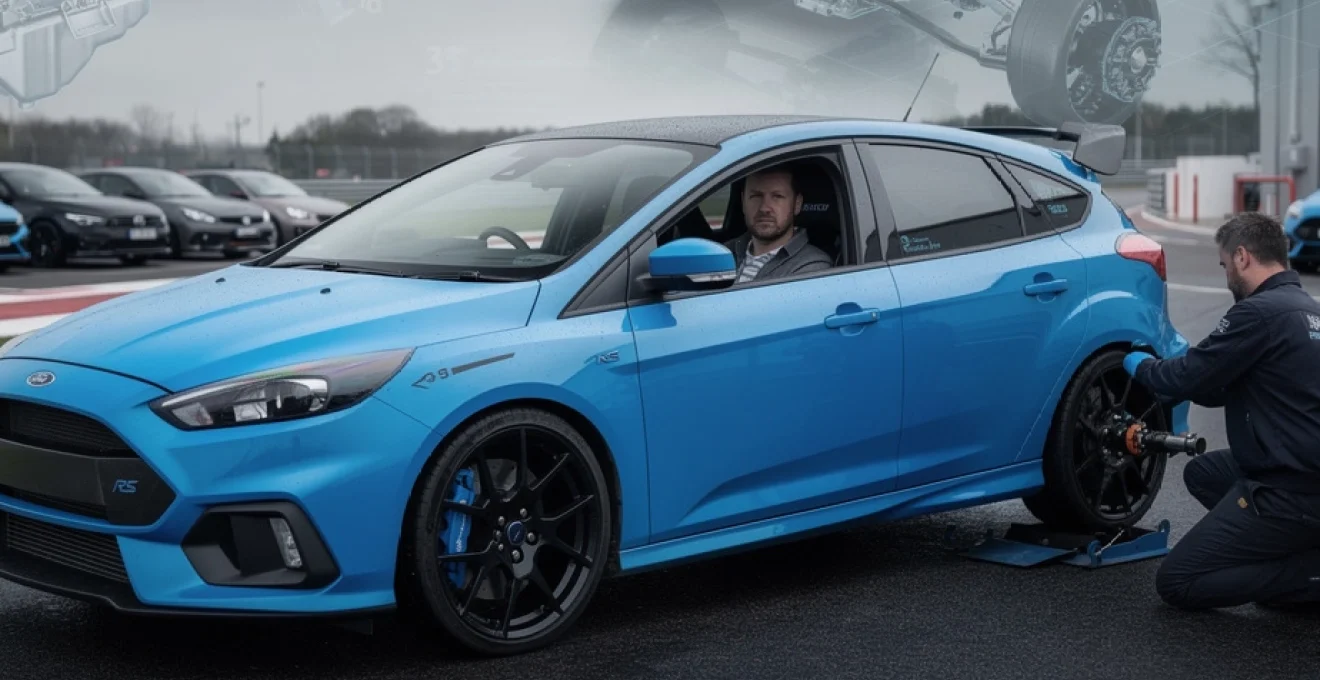
The Ford Focus RS Edition sits in a fascinating sweet spot between hardcore rally refugee and everyday hot hatch. It brings together the already wild Mk3 Focus RS recipe with a handful of focused upgrades that sharpen the chassis, tweak the styling and, crucially, add a mechanical limited-slip diff at the front. For anyone who loves driving, this is the version that many engineers would quietly choose. As the RS badge has now been retired and modern performance cars move ever closer to hybridised, dual-clutch anonymity, the Focus RS Edition feels more relevant than ever if you want a manual, turbocharged all‑wheel‑drive hatch that still talks to you. Treat it right and it can be both a brutal track toy and a surprisingly usable four‑season daily.
Ford focus RS edition overview: production years, UK allocation and how it differs from the standard focus RS mk3
Limited-run focus RS edition vs heritage edition vs standard mk3: chassis, colour and equipment distinctions
The Focus RS Edition arrived towards the end of Mk3 RS production, with UK cars landing from late 2017 into 2018. It was conceived as a limited‑run, more focused derivative rather than a power‑boosted flagship. Exact global production figures were never heavily publicised, but UK allocation is generally accepted to be in the low thousands, making the Edition significantly rarer than the regular Mk3 RS yet more attainable than the ultra‑exclusive Heritage Edition.
Mechanically, the big differentiator is the front‑axle Quaife mechanical limited‑slip differential. Where the standard RS relied on brake‑based torque vectoring at the front, the Edition uses the Quaife unit to apportion torque across the front wheels proactively. Visually, the Edition adds a gloss black roof, black mirror caps and a black rear spoiler, plus unique wheel centre caps and subtle RS Edition badging. Inside, the Edition bundles together some desirable options: Recaro shell‑backed seats, carbonfibre‑effect trim pieces and blue detailing that lifts what is otherwise a fairly utilitarian Focus cabin.
Above it sits the Focus RS Heritage Edition, limited to just 50 UK cars in Tief Orange. That model combines the Quaife diff with a factory‑approved Mountune FPM375 package and extra interior trim upgrades, pushing power to around 370–375 bhp. The Edition shares the chassis hardware – notably the diff – but retains the standard 345 bhp tune unless a dealer or owner has added Mountune or similar upgrades later.
Key markets and UK-specific specification pack: nitrous blue, stealth grey and frozen white configurations
Being the final evolution of a “world car” RS, the Edition was sold in a handful of key markets including the UK, mainland Europe and North America (where an RS with a similar specification arrived for the 2018 model year). UK‑spec cars were the ones that nailed the visual drama thanks to the signature Nitrous Blue paint paired with the gloss black roof and spoilers. Unlike the standard RS, where Stealth Grey was the only free colour, the Edition leaned into the RS halo image with Nitrous Blue as the default hue.
Some markets also saw cars in Stealth Grey and Frozen White with Edition equipment, but these are rarer in the UK and often command additional interest from collectors who want something a little more discreet. All Editions retained the five‑door bodyshell used across the Mk3 Focus range. That means there is no three‑door “homologation special” here, but for daily usability you gain easier rear‑seat access and better practicality than many rivals.
Typical used prices, mileage brackets and resale trends for the focus RS edition in the UK market
As of late 2024, used Focus RS Edition prices in the UK typically sit a tier above standard Mk3 RS values. Expect asking prices in the region of £32,000–£38,000 for Edition cars, depending on mileage, condition and provenance. Earlier 2017 Editions with 40,000–60,000 miles tend to start in the low £30k bracket, while low‑mileage examples under 20,000 miles can comfortably push towards the high £30k mark, particularly with a full Ford or recognised specialist history.
Price resilience has been impressive. After an initial post‑Covid dip, values have stabilised, helped by Ford’s confirmation that there will be no Mk4 Focus RS. Look at the trajectory of Mk1 and Mk2 Focus RS prices over the last five years and a similar pattern emerges: depreciation flattens, then clean cars begin to appreciate. The Edition’s limited numbers, Quaife diff and “last of the line” status make it particularly appealing if you want a car that delivers daily thrills without haemorrhaging value.
Rivals to benchmark against: honda civic type R FK8, VW golf R, audi RS3 and Mercedes-AMG A45
When shortlisting alternatives, you will probably be weighing the Focus RS Edition against four big hitters: the Honda Civic Type R FK8, Volkswagen Golf R, Audi RS3 and Mercedes‑AMG A45. The FK8 Civic Type R, launched in 2017, is widely regarded as the sharpest front‑wheel‑drive driver’s car of its era, with 316 bhp and a 0–62 mph time of 5.7 seconds. It offers sublime steering and damping, but lacks all‑wheel drive, which is a consideration if you commute year‑round in the UK.
The Mk7.5 Golf R, with its 306 bhp EA888 engine and Haldex all‑wheel drive, is more subtle and refined than the Ford. In real‑world conditions, a DSG‑equipped Golf R feels every bit as rapid, but it is much more clinical and less emotive to hustle. Step up to an Audi RS3 or Mercedes‑AMG A45 and you enter a different price and image bracket: the RS3 brings a glorious five‑cylinder soundtrack and strong straight‑line pace, while the A45 offers 376 bhp (in period) and ruthless traction. Yet both remain more inert and nose‑heavy than the Focus when pushed hard on a tight B‑road.
Engine, turbocharging and drivetrain: ford focus RS edition EcoBoost powertrain in detail
2.3‑litre EcoBoost four‑cylinder: block, internals, compression ratio and cooling upgrades
Under the bonnet, the Focus RS Edition uses the same 2.3‑litre EcoBoost inline‑four as the standard Mk3 RS. Derived from the Mustang unit, it is heavily reworked with a focus on durability at high specific outputs. The aluminium block uses high‑tensile cast‑iron liners, while the cylinder head is made from an upgraded alloy to handle increased combustion temperatures. Compression ratio sits at around 9.37:1, relatively modest for a modern direct‑injection turbo engine, allowing higher boost without catastrophic knock.
Outputs are quoted at 345 bhp (257 kW) at 6,000 rpm and 347 lb ft (470 Nm) between 2,000 and 4,500 rpm, with a transient overboost function lifting torque to approximately 369 lb ft (500 Nm) for short bursts. To manage this, the RS gains a significantly larger front‑mounted radiator and more efficient charge‑air cooling than a standard Focus. In spirited road use this translates to consistent performance with minimal power fade, even after repeated full‑throttle pulls, provided high‑quality 97 RON or higher fuel is used.
Borgwarner turbocharger, intercooler system and boost pressure characteristics in the focus RS edition
The Focus RS turbocharger, supplied by BorgWarner, is a twin‑scroll design. That means exhaust gas pulses from each pair of cylinders are kept separate until they reach the turbine wheel. The effect for you is crisper low‑end response and less turbo lag than with a conventional single‑scroll unit of similar size. Boost pressure peaks in the region of 1.6–1.7 bar absolute under overboost, although exact values depend on ambient conditions and software calibration.
A large front‑mounted intercooler drops intake charge temperatures significantly compared with the Mustang. In back‑to‑back testing, intake temps on an RS can be 15–20°C lower under load than on less aggressively cooled 2.3 EcoBoost applications. This not only protects the engine but also allows the ECU to maintain higher ignition advance for better mid‑range punch. The exhaust system uses a relatively free‑flowing layout with an electronically controlled valve, giving the car its distinctive pops and crackles in Sport and Race modes without being obnoxious on a motorway cruise.
AWD system with dynamic torque vectoring: GKN twin-clutch rear drive unit, torque split and calibration
The heart of the Focus RS Edition’s drivetrain is the GKN “Twinster” rear drive unit. Unlike conventional Haldex systems that use a single clutch to engage or disengage the rear axle, the RS employs a pair of independent clutch packs, one per rear driveshaft. Up to 70% of available torque can be sent rearwards, and within that, up to 100% of rear torque can be pushed to a single wheel. This allows some very rear‑biased behaviour in certain modes and scenarios.
Interestingly, the rear axle is geared about 2% faster than the front. In simple terms, the back wheels want to turn slightly quicker than the fronts; the clutch packs then regulate how much of that extra speed is actually delivered. Under power in a tight bend, more torque is sent to the outside rear wheel, effectively “pushing” the car into the corner and helping to rotate the chassis. The result, once you are familiar with it, is a hot hatch that can feel uncannily like a compact rally car rather than a nose‑led front‑drive machine.
Drive modes (normal, sport, track, drift): throttle mapping, exhaust valve control and ESC thresholds
The RS Edition retains the four‑mode drive system: Normal, Sport, Track and Drift. These modes adjust parameters for throttle response, steering assistance, all‑wheel‑drive behaviour, damper stiffness, exhaust valve position and ESC thresholds. Normal keeps things relatively restrained, with lazier throttle mapping, softened dampers and a more conservative torque split that prioritises stability and efficiency.
Sport quickens the throttle, adds weight to the steering, slackens ESC intervention and opens the exhaust valve more of the time, making the RS feel more alert without becoming unruly. Track is the most aggressive “serious” mode, with the stiffest damper setting, very rear‑biased torque distribution and reduced safety nets. Drift mode goes a step further, actively encouraging yaw by sending pronounced torque to the outside rear wheel and raising slip thresholds. On a wet circuit or large skidpan it can turn the Focus into a surprisingly approachable oversteer machine, though on the road it still demands respect.
Official performance figures vs real‑world data: 0–62 mph, in‑gear acceleration and top speed testing
Officially, the Focus RS Edition shares the same straight‑line performance numbers as the standard Mk3 RS: 0–62 mph in 4.7 seconds and a limited top speed of 165–166 mph. Independent tests on UK soil have repeatedly corroborated those figures, with magazine timing gear regularly recording 4.6–4.8 seconds to 62 mph on a dry surface. On a roll, the RS is equally impressive: 30–70 mph in third and fourth gears often lands in the mid‑4‑second range.
Real‑world pace depends heavily on surface and driver. Launch control, activated via the touchscreen and steering‑wheel buttons, delivers consistent, repeatable starts if you are prepared to work the clutch hard. From a 40 mph roll in second, the car’s mid‑range torque and short gearing make overtakes feel almost instantaneous. Compared with a DSG Golf R, the RS Edition is marginally slower off the line due to manual shifting, but once rolling the difference is negligible and the Ford feels more frenetic and alive.
Chassis, suspension and braking: how the focus RS edition drives on road and track
Quaife mechanical limited-slip differential: launch traction, corner exit grip and torque steer management
The Edition’s standout chassis upgrade is the Quaife automatic torque‑biasing diff at the front. In simple terms, this mechanical device routes more torque to the wheel with greater grip, instead of relying on the ABS to brake a spinning wheel. During a standing start, it helps both front tyres share the burden of transmitting power before the rear axle is fully engaged, marginally improving traction and smoothing out the launch.
On corner exits, especially out of tight hairpins or roundabouts in the wet, the Quaife diff noticeably tightens the line. You can lean on the throttle earlier without inducing the scrabbling understeer that can occasionally appear in the open‑diff standard car. Because the diff is torque‑biasing rather than a crude locking unit, torque steer is well controlled; there is more tug at the wheel than in a Golf R but significantly less than in older, front‑drive‑only hyper‑hatches such as the Mk2 Focus RS or early Mitsubishi Evos.
Suspension hardware: springs, anti‑roll bars, dual‑mode dampers and geometry vs standard focus RS
Suspension hardware for the Focus RS Edition mirrors that of the regular Mk3 RS. Up front there are MacPherson struts with bespoke springs, dampers and anti‑roll bar tuning; at the rear, a multi‑link “Control Blade” setup manages wheel control. Ride height is lower and spring rates are significantly stiffer than a normal Focus, contributing to the RS’s famously firm low‑speed ride.
Dual‑mode dampers, controlled via the left‑hand column stalk or drive‑mode selection, switch between Normal and “Sport/Race” settings. The firmer setting increases compression and rebound by roughly 40%, an amount that is very noticeable on scarred urban tarmac. Geometry is set up with more negative camber and toe tweaks to sharpen turn‑in. On smooth circuits, the firmer mode brings huge body control; on broken B‑roads, most drivers will cover more ground – and preserve spinal discs – by leaving the dampers in their softer calibration.
Steering feel and front‑end response: rack ratio, EPAS tuning and tyre choice (michelin pilot super sport, cup 2)
Steering is handled by a fixed‑ratio EPAS rack, quicker than the variable‑ratio item in the Focus ST. Rack speed is around 2.0 turns lock‑to‑lock, which gives the RS Edition an eager front end and makes even modest inputs feel immediate. Assistance levels vary by mode, with Sport and Track adding weight without drastically improving feedback. Compared with a Civic Type R, the RS has slightly less granular steering feel but still provides a clear sense of front‑end grip.
Tyre choice plays a huge role in how the Focus RS Edition talks to you. Most UK cars left the factory on 235/35 R19 Michelin Pilot Super Sports, which offer a good balance of wet grip, progression and ride. Optional Michelin Pilot Sport Cup 2s transform dry‑cornering ability, bringing lap‑time gains of over a second on short circuits, but they do introduce more road roar and a more abrupt breakaway in heavy rain. For mainly road use in the UK climate, a modern ultra‑high‑performance tyre such as the Pilot Sport 4S is often the sweet spot.
Braking system: brembo front calipers, disc dimensions, fade resistance and track‑day pad options
Braking hardware on the Focus RS Edition is robust straight from the box. Up front sit 350 mm ventilated discs clamped by four‑piston Brembo aluminium calipers; the rear uses 302 mm solid discs with single‑piston calipers. On the road, stopping performance is strong, with a firm, reassuring pedal and excellent initial bite. Instrumented testing has seen 60–0 mph stopping distances consistently around the 34–35 metre mark on warm tyres, which is competitive with segment rivals.
On track, the stock pads and fluid are adequate for 10–15 minute sessions, but heavy drivers will eventually experience some softening of the pedal. Many owners fit track‑oriented pad compounds from reputable brands and upgrade to high‑temperature brake fluid. For you, that means far better fade resistance on long circuits without sacrificing road usability. Some dedicated track builds add brake‑cooling ducts and two‑piece discs to reduce heat soak during repeated hard use.
Handling character on UK b‑roads vs circuit use: understeer, lift‑off oversteer and stability at high speed
On a typical British B‑road, the Focus RS Edition feels hyperactive in the best way. The chassis is keen to change direction, the rear axle pushes the car into corners and the front Quaife diff claws it out. Driven neatly, the car will run neutral with only mild understeer at very high entry speeds. Back off the throttle mid‑corner and the rear gently tucks in; with more commitment and in looser ESC settings, there is a tangible hint of lift‑off oversteer that makes the car feel adjustable rather than edgy.
On circuit, the story evolves. With warm tyres and the dampers in their firmer mode, the RS Edition becomes astonishingly stable at high speed. Fast, committed corners see the car sit flat and composed, with the all‑wheel‑drive system shuffling torque seamlessly. In Track mode, the balance is neutral to mildly oversteery on corner exit if you are greedy with the throttle. Drift mode remains best kept for low‑grip surfaces; on a dry circuit it can simply overheat the rear tyres too quickly for meaningful lap‑time work.
Interior, ergonomics and infotainment: recaro seats, SYNC 3 and daily usability
Recaro shell seats, driving position and rear accommodation compared with regular focus variants
The Focus RS Edition’s interior is dominated by its optional Recaro shell‑backed seats, which become standard equipment on the Edition package. These fixed‑back chairs offer excellent lateral support and look suitably motorsport‑inspired, with high bolsters and integrated headrests. The downside for you as a driver is a higher-than-ideal hip point and the loss of height adjustment; taller owners in particular should check driving position carefully on a test drive.
Compared with a regular Focus, the RS driving position still feels slightly perched, although the thick‑rimmed, flat‑bottomed steering wheel and aluminium pedals help set the right tone. In the rear, space is unchanged from the standard hatch, so two adults can be carried reasonably comfortably on shorter journeys. Three across the bench remains a squeeze, but children will be fine. Headroom is adequate unless very tall passengers sit directly behind very tall front occupants.
Cabin materials, RS‑specific trim details and noise, vibration and harshness (NVH) assessment
Material quality in the Focus RS Edition reflects its Ford Focus origins more than its performance price tag. Upper dash plastics are soft‑touch and pleasant enough, but lower trim, door cards and the centre console still employ hard, scratchy materials. RS‑specific touches, such as blue stitching, carbonfibre‑effect fascia inserts and an additional trio of gauges for oil temperature, oil pressure and boost, do at least give the cabin a more bespoke feel.
NVH levels are acceptable rather than plush. At 70 mph, you will notice more road roar from the 19‑inch tyres than in a Golf R, and the engine’s gravelly note is ever‑present. That said, many enthusiasts view this as part of the car’s character. Exhaust resonance is well controlled, and the engine settles to a low‑ish 2,500 rpm in sixth at motorway speeds, keeping long‑distance fatigue manageable. If you value pin‑drop refinement above all else, a premium German rival will suit you better.
Ford SYNC 3 infotainment, navigation and smartphone integration (apple CarPlay, android auto)
The Edition-era cars benefit from Ford’s SYNC 3 infotainment system, which represented a noticeable step forward from earlier SYNC 2 setups. An 8‑inch touchscreen sits high on the centre console, with large icons and reasonably responsive touch inputs. Factory navigation is clear, although mapping graphics look a generation behind the latest systems from premium brands. Thankfully, full Apple CarPlay and Android Auto support allow you to mirror preferred navigation apps from your phone.
Audio is handled by a 10‑speaker Sony system, sufficient for most ears, though not in the league of premium branded systems in some rivals. Physical shortcut buttons for volume and key functions mean you do not have to prod the screen constantly on bumpy roads. Once set up, Bluetooth pairing is automatic and reliable, making the Focus RS Edition straightforward to integrate into a modern, connected lifestyle.
Practicality metrics: boot space, rear legroom and child‑seat compatibility for family use
Practicality is where the Focus RS Edition quietly scores well compared with more extreme performance machinery. Boot space is quoted at around 260 litres with the rear seats in place, a little down on a regular Focus due to the all‑wheel‑drive hardware and subwoofer installation. Fold the 60/40 split rear bench and capacity expands beyond 1,000 litres, enough for bikes, flat‑pack furniture or a full track‑day toolkit and extra wheels.
Rear legroom is competitive within the C‑segment hatch class. Isofix mounting points on the outer rear seats make child‑seat installation straightforward, and the five‑door layout removes much of the contortion seen in three‑door hot hatches. If you want a single car that handles nursery runs, weekly shops and a few track days a year, the Focus RS Edition is more accommodating than its aggressive image might suggest.
Reliability, head gasket concerns and maintenance for the focus RS edition
Head gasket and cylinder liner issues on early mk3 focus RS: recall status and edition‑specific implications
Much has been written about head‑gasket failures on early Mk3 Focus RS models. The root cause was a batch of engines assembled with an incorrect gasket design intended for the Mustang, leading to coolant leakage, misfires and, in worst‑case scenarios, cylinder liner damage. Ford addressed the issue via a field service action, replacing gaskets – and in some cases complete cylinder heads – under warranty. The relevant campaign reference is often recorded as FSA17832 in service paperwork.
By the time the Focus RS Edition arrived, production had moved to the corrected gasket and head specification. Even so, when shopping you should look for documentation showing that any recall work has been completed or confirming that the car falls outside the affected VIN range. Regular oil changes with the correct Ford‑approved 0W‑40 or 5W‑30 fully synthetic oil, plus proper warm‑up and cool‑down routines, remain essential for long‑term reliability if you intend to use the full performance regularly.
Common wear points: clutch, AWD coupling, driveshafts and suspension components on high‑mileage cars
Like any high‑output, manual performance car, the Focus RS Edition has a few known wear points, especially once mileage creeps above 50,000. The clutch and dual‑mass flywheel can suffer if subjected to repeated hard launches or abusive driving. Symptoms include a high biting point, judder or slip under full boost in higher gears. Budget around £1,000–£1,300 at a specialist for clutch and flywheel replacement using quality parts.
The GKN rear drive unit and associated couplings are generally robust, but cars that have spent substantial time on track may develop whining noises, shudder under load or fluid leaks. Regular fluid changes at or before the recommended intervals help. Front driveshafts can exhibit clicking on full lock when worn, and bushings for control arms and anti‑roll bars may develop play, leading to knocks over bumps. None of these are catastrophic, but they are useful bargaining chips when assessing a potential purchase.
Service schedule, oil specification and recommended maintenance intervals for spirited or track use
Ford’s official service schedule for the Mk3 Focus RS lists a major service every 37,500 miles or three years, with annual or 12,500‑mile oil‑change intervals under normal use. For an RS Edition that sees frequent spirited driving or occasional track work, a more conservative regime is wise. Many specialists recommend an oil and filter change every 6,000–8,000 miles or annually, whichever comes sooner, using a high‑quality fully synthetic that meets Ford WSS‑M2C931‑C or later specifications.
Brake fluid should be refreshed at least every two years, and more frequently if used on circuit with high‑temperature pads. Rear diff and PTU (power transfer unit) oils are worth changing every 30,000–40,000 miles instead of waiting for symptoms to appear. Regular alignment checks – ideally by a performance‐focused workshop – help maintain the razor‑sharp handling that defines the RS Edition.
Warranty considerations, ford main dealer vs specialist RS tuner servicing in the UK
Most Focus RS Editions are now long out of factory warranty, although a handful may still carry dealer‑supplied extended cover. When considering servicing options, you face a choice between Ford main dealers and independent specialists with RS experience. Main dealers offer convenience and digital service records, which some future buyers appreciate. However, labour rates can be high and technician familiarity with a relatively rare RS Edition may vary by location.
Respected independent outfits – often the same names behind well‑known tuning packages – bring deep product knowledge and a more sympathetic approach to performance use. They understand common failure modes, suitable fluids and realistic maintenance needs for track work. For you as an enthusiast owner, a thick folder of invoices from a recognised RS specialist can be just as reassuring to the next buyer as a stamped main‑dealer booklet, provided intervals and quality are documented clearly.
Tuning potential, modifications and long‑term ownership prospects
Stage 1–3 remaps from mountune, revo and DreamScience: power, torque and drivability changes
The 2.3 EcoBoost and GKN AWD hardware make the Focus RS Edition highly receptive to tuning. Stage 1 software from reputable names typically lifts output to around 370–380 bhp and 380–400 lb ft while retaining stock hardware. This level of tune, equivalent to the official Mountune FPM375 kit, dramatically fattens the mid‑range without sacrificing driveability or reliability when correctly mapped and maintained. Many owners report 0–62 mph times dropping into the low‑4‑second bracket on a warm surface.
Stage 2 and Stage 3 packages add upgraded intercoolers, induction kits and high‑flow downpipes, with power figures around 400–450 bhp. At this point, careful consideration of clutch capacity, cooling and fuelling becomes vital. Think of it as turning a sprinter into a decathlete: outright pace increases, but the supporting systems must evolve too. For road‑biased owners, a well‑calibrated Stage 1 is often the best “fast road” compromise, preserving the Edition’s balance while unlocking its latent potential.
Intake, downpipe and exhaust upgrades: sound, backpressure and MOT compliance in the UK
Intake and exhaust modifications are among the most popular Focus RS Edition upgrades. A high‑flow panel filter or full induction kit can sharpen throttle response and add more turbo noise without significant downsides. Downpipe and cat upgrades, however, must be approached carefully if you want to remain MOT‑compliant. A quality sports cat maintains emissions legality while reducing backpressure; decat pipes are cheaper and flow extremely well but will usually fail an MOT and may trigger warning lights.
Aftermarket cat‑back exhaust systems can significantly alter the RS’s soundtrack, from subtle deepening to full “WRC‑replica” volume. When selecting a system, consider cold‑start noise, motorway drone and neighbour relations as much as outright drama. Many owners find that a resonated cat‑back paired with the factory electronic valve gives the best balance between daily usability and weekend character.
Track‑oriented upgrades: coilovers, camber kits, brake cooling and semi‑slick tyre setups
If you see track days as a core part of ownership, the Edition’s capable stock setup can be transformed into something truly formidable with focused upgrades. Height‑ and damping‑adjustable coilover kits from reputable brands allow corner‑weighting, fine‑tuning of rebound/compression and improved bump control. Paired with additional negative camber via adjustable top mounts or camber bolts, front‑end grip and tyre wear patterns improve markedly.
Brake‑cooling ducts directed at the front discs help control temperatures during long sessions, extending pad and fluid life. Semi‑slick or track‑day oriented tyres such as Michelin Cup 2s or similar compounds can drop lap times by multiple seconds, but must be used with care in the wet and at low temperatures. For a dual‑use car, a dedicated track wheel and tyre set is often the most practical solution, leaving the OE 19‑inch wheels on more all‑weather‑friendly rubber for road use.
Collector appeal and long‑term value outlook for the focus RS edition vs other modern fast fords
From a collector’s perspective, the Focus RS Edition occupies a compelling niche. It is rarer and more technically interesting than a standard Mk3 RS, thanks to the Quaife diff and limited‑run specification, yet not as stratospherically priced as the 50‑off Heritage Edition. Looking at the evolution of values for Mk1 and Mk2 Focus RS models, plus halo fast Fords like the Sierra and Escort Cosworth, suggests that special variants with clear engineering distinctions tend to enjoy the most robust long‑term demand.
For you as a long‑term owner, the Edition offers a rare combination: an engaging, manual, all‑wheel‑drive turbo hatch that can still be serviced by mainstream garages and independents, with parts support likely to remain healthy for many years. Maintain it meticulously, resist the temptation for extreme modifications and keep mileage sensible, and the Focus RS Edition has every chance of becoming one of the standout modern fast Fords to own, drive and quietly watch appreciate.