
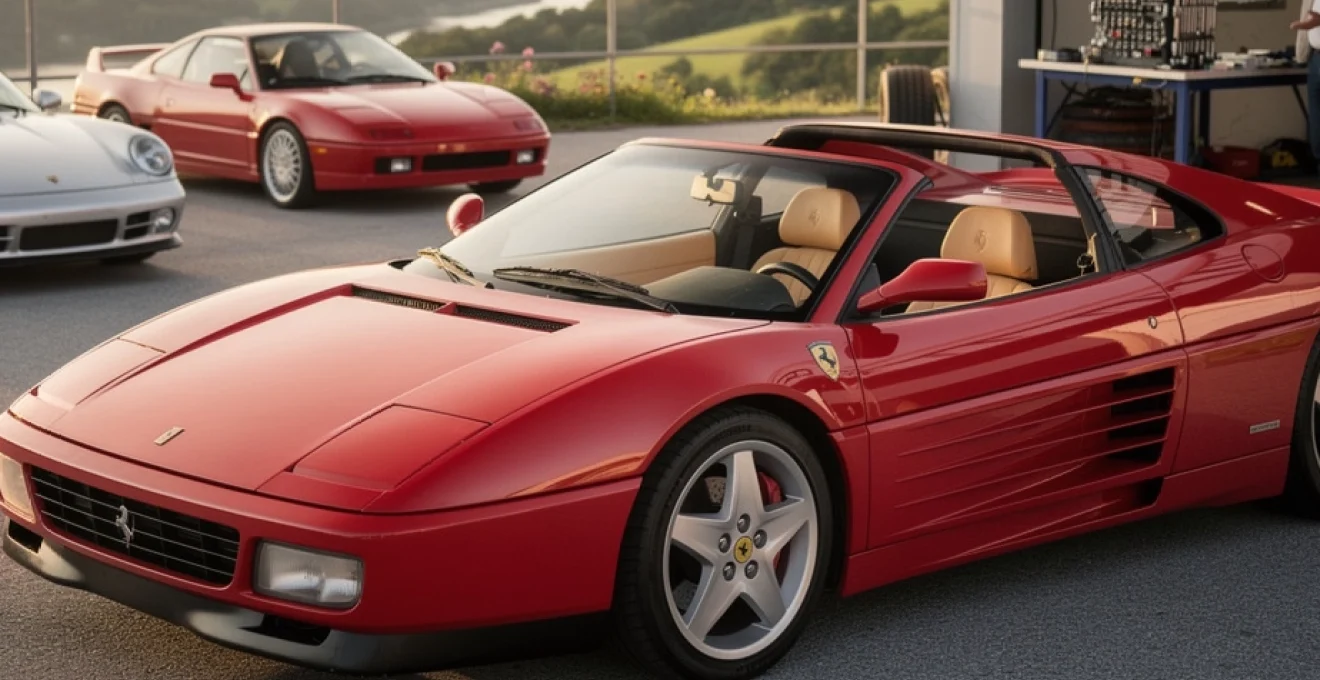
Slip into a Ferrari 348 TS and you step straight back into a world of gated shifters, flat-plane crank theatrics and unapologetically analogue controls. The 348 sits at a fascinating crossroads in Maranello’s history, bridging the old-school 308/328 era and the more polished, electronically assisted F355 generation. Values have risen strongly over the last decade, yet the 348 TS still offers one of the most authentic classic Ferrari driving experiences you can buy today. If you are looking for a usable, mid‑engined V8 with a removable roof and genuine motorsport DNA, the targa‑topped 348 TS deserves far more attention than it received when new.
Ferrari 348 TS targa overview: model history, market positioning and rivals 911 carrera 2 and honda NSX
From mondial and 328 to 348 TS: evolution of ferrari’s mid-engined V8 lineage (1989–1993)
Launched at the 1989 Frankfurt Motor Show, the Ferrari 348 arrived as the successor to the 328 and the contemporary Mondial, reshaping Ferrari’s mid‑engined V8 architecture. The engine was rotated 90 degrees to a longitudinal layout, driving a transversely mounted gearbox – hence the T in 348 TB/TS. Compared with the 328, capacity grew to 3,405 cc and power jumped by around 30 bhp, with official figures of 296–300 bhp depending on market. This was enough for a claimed 0–62 mph time of around 5.4–5.6 seconds and a top speed near 171 mph, firmly into serious supercar territory in period.
The 348 TS variant added a removable targa roof panel, giving open‑air thrills without moving to the more complex full Spider. Built from 1989 to 1993 before being renamed 348 GTS after a major update, the TS combined Testarossa‑inspired styling with more modern aerodynamics and underbody management. Despite early criticism from the press, continuous running changes to suspension, engine management and build quality gradually transformed the car into a far sharper and more reliable package by the early 1990s.
The Ferrari 348 TS represents the crucial transition from classic analogue V8s to the more sophisticated era of the F355, making it one of the most interesting Ferraris to experience today.
TS versus TB and serie speciale: body style, chassis and market differences
The core 348 range comprised the 348 TB (coupé) and 348 TS (targa). Mechanically, the TB and TS shared the same steel spaceframe chassis, rear‑mid‑mounted V8 and transaxle, but the TS introduced extra reinforcement around the sills and roof aperture to compensate for the removable panel. In practice, the TS weighs slightly more than the coupé but offers a far more evocative experience on a sunny B‑road, with engine and induction noise filling the cabin.
Above the standard cars sat the 348 Serie Speciale, a limited‑run US‑market model produced in 1992–1993. Only 100 were built (65 TS, 35 TB), featuring revised suspension, wider tyres, a modest 12 bhp power bump and subtle body tweaks including different tail light treatment and a Serie Speciale badge. Power output rose to about 312 bhp and 238 lb ft, sharpening mid‑range response and elevating the car’s desirability. Period reviewers criticised the price premium, but today the 348 TS Serie Speciale sits firmly in collector‑grade territory thanks to its rarity and focused setup.
Rivals in period: porsche 964 carrera 2, honda NSX and lotus esprit SE comparative context
In the early 1990s, the Ferrari 348 TS faced formidable rivals. The Porsche 964 Carrera 2 coupled 250 bhp with everyday usability and superb build quality, making it the sensible enthusiast’s choice. The Honda NSX, launched in 1990, famously rattled Ferrari with its aluminium chassis, 270 bhp VTEC V6 and extraordinary reliability. Many contemporary journo tests found the NSX dynamically superior, with friendlier handling and tighter assembly.
The Lotus Esprit SE added another dimension: up to 264 bhp from a turbocharged four‑cylinder, razor‑sharp steering and even edgier handling than the Ferrari. Against this backdrop, the 348’s nervous limit behaviour and occasional build issues attracted criticism. Yet drive these cars today and the narrative changes. The 348 TS offers a uniquely intoxicating blend of gated shift feel, flat‑plane V8 character and Pininfarina styling that neither Stuttgart nor Japan could quite replicate, especially with the roof panel stowed.
UK and EU-market 348 TS production numbers, year-by-year updates and recalls
Exact UK‑market Ferrari 348 TS production numbers are not officially published, but of the approximately 8,844 348s produced worldwide between 1989 and 1995, a significant proportion were TS models, with a strong showing in right‑hand‑drive markets such as the UK. Many UK cars have since been exported to Australia and continental Europe, shrinking local supply. This reduced pool has contributed to firming UK prices over the past five to seven years, particularly for late‑model GTS‑badged cars.
Crucially, the 348 evolved almost continuously. Early cars (1989–1991) gained improvements to chain tensioners, alternators and engine management. In 1993, power increased to around 316–320 bhp, the chassis and gearbox were revised, and the nomenclature changed to GTB/GTS alongside the new Spider. Buyers should ensure that any UK or EU 348 TS has received all factory upgrades and recall work; a car without documented updates is significantly less desirable than a later, fully updated example.
Engine and performance analysis: 3.4-litre tipo F119D V8, drivetrain and real-world figures
Technical breakdown of the 3.4-litre DOHC 32-valve flat-plane crank V8 and bosch motronic injection
At the heart of the Ferrari 348 TS sits the Tipo F119D V8, a 3,405 cc unit with double overhead camshafts per bank and 32 valves. Like Ferrari’s racing engines, it uses a flat‑plane crankshaft, giving that distinctive hard‑edged bark as the revs climb towards the 7,500 rpm red line. Bore and stroke are 85 mm by 75 mm, a relatively oversquare configuration that favours rev‑happiness and rapid throttle response over low‑down torque.
Fuel and ignition are handled by Bosch Motronic, initially Motronic 2.5 on early cars and later 2.7, integrating fuel injection and ignition timing into a single ECU package. Compared with carburetted or early injection Ferraris, this system offers smoother cold starts, more consistent fuelling and improved emissions. It is sophisticated but not unserviceable; a good specialist can diagnose most issues quickly, and parts supply remains strong through Ferrari and aftermarket sources.
Power, torque and gearing: 0–60 mph, in-gear acceleration and top speed versus factory claims
Factory figures for the 348 TS quote around 296–300 bhp at 7,200 rpm and 239 lb ft at 4,200 rpm. Independent dyno tests typically show 260–280 bhp at the wheels for healthy examples, broadly supporting the official claims once drivetrain losses are factored in. In period, road tests recorded 0–60 mph times between 5.4 and 5.8 seconds and 0–100 mph in the low 13‑second range, placing the car at the sharp end of early‑1990s performance.
Long gearing and a 7,500 rpm red line give the Ferrari 348 TS a theoretical top speed of 171–174 mph, depending on version. On modern roads, what matters more is in‑gear thrust. Third and fourth gears deliver strong, linear acceleration from 3,500 rpm to the limiter, ideal for fast A‑road overtakes. If you are used to modern turbocharged torque monsters, the 348 can initially feel soft low down, but once driven like the classic sports car it is – revs kept above 4,000 rpm – the engine comes alive with race‑bred urgency.
Manual 5-speed gated transmission, clutch characteristics and final-drive ratios
The 348 TS uses a five‑speed manual transaxle mounted transversely, linked to the longitudinal engine – a layout shared with the Mondial T. The famous open gated shifter defines the driving experience; throws are short but require deliberate, accurate movement, particularly when cold. Second gear is known to be reluctant until the oil warms up, a trait inherited from earlier Ferraris rather than a fault. Owners often recommend starting in first, shifting to third and only using second once the gearbox is properly up to temperature.
Clutch life depends heavily on use. Some cars see 10,000–15,000‑mile clutch lives, while more sympathetically driven examples can stretch beyond 30,000 miles. Later multi‑plate clutches are more expensive to replace than earlier single‑plate units. Final‑drive ratios give around 25 mph per 1,000 rpm in fifth, so at 70 mph the engine sits comfortably in the 3,000 rpm range, refined enough for longer GT journeys while still ready to respond. For many enthusiasts, the combination of manual gearbox, mechanical clutch and precise gate is the single biggest reason to choose a 348 over newer paddle‑shift Ferraris.
Cooling, lubrication and common engine issues: cambelt service, oil leaks and heat-soak
The Ferrari 348 TS uses dry‑sump lubrication, designated by many as F119D/G in technical documents, helping maintain oil pressure during sustained high‑g cornering. Cooling is via twin side‑mounted radiators fed by the distinctive straked intakes. When properly maintained, the system copes well even in warm climates, although heat‑soak after a hard run can reveal weak fans, relays or aging coolant hoses, so a thorough cooling system inspection is essential during a pre‑purchase check.
The most critical maintenance point is the cambelt. Early guidance recommended belt changes every two years, later relaxed to three years or 24,000 miles. Many specialists still advise a strict three‑year interval, as a snapped belt can mean extensive valve and piston damage. Other known issues include early cars suffering cam‑drive chain tensioner wear and jack‑shaft bearing problems – both addressed by factory updates – as well as occasional oil leaks from cam covers and crank seals. A documented history of belt changes and engine‑out servicing is a strong sign you are looking at a carefully maintained 348 TS.
Chassis, handling and ride: steel spaceframe, suspension geometry and steering feel
Rear-mid engine layout and weight distribution versus 328 and F355
The 348 TS is built around a steel spaceframe chassis with a rear‑mid‑mounted V8, giving near‑ideal weight distribution and a low polar moment of inertia. Compared with the 328, the engine sits lower and further forward relative to the rear axle, improving stability and high‑speed balance. The structure anticipates many aspects of the later F355, though without that car’s power steering or electronic damping. Kerb weight for the TS sits around 1,390 kg, slightly more than the TB but still lean by modern standards.
This layout rewards smooth, experienced drivers. Quick inputs mid‑corner can provoke the classic rear‑engined Ferrari lift‑off oversteer response, whereas measured steering and progressive throttle application allow the chassis to flow beautifully. Compared with the F355, the 348 feels more physical and less forgiving, but also more communicative, making it an appealing choice if you value raw feedback over outright speed.
Double-wishbone suspension, koni dampers and anti-roll bar tuning for road and track
All 348 variants use double‑wishbone suspension at all four corners, with coil springs and Koni dampers. Anti‑roll bars front and rear help control body roll without resorting to excessive spring rates, so the car retains compliance over typical UK B‑road surfaces. Ferrari made multiple revisions to geometry, spring and damper rates during production, targeting the early reputation for nervous handling at the limit.
On a properly set‑up Ferrari 348 TS, the ride is firm but not punishing. The chassis breathes with the road rather than skipping over it, and the car responds well to smooth steering and throttle inputs. Occasional track use is entirely realistic; fade‑resistant brakes and the neutral balance at higher speeds make it a surprisingly capable track‑day partner as long as you respect weight transfer and keep on top of tyre and suspension condition.
Steering rack, tyre sizes (front 215/50 ZR17, rear 255/45 ZR17) and alignment settings
The steering rack on the 348 TS is unassisted, a rarity in modern performance cars. At parking speeds, the weighting can feel heavy, but once rolling there is exquisite feedback through the rim, allowing you to sense front‑end grip and surface texture. Factory tyre sizes are 215/50 ZR17 at the front and 255/45 ZR17 at the rear, on distinctive five‑spoke alloys that suit the car’s proportions perfectly.
Correct alignment is critical. Worn bushes, tired dampers or incorrect geometry can transform a crisp, engaging car into something nervous and imprecise. A specialist will typically use factory‑spec camber and toe settings as a baseline, sometimes adding a touch more negative camber for fast‑road use. If you plan regular track days, investing in fresh suspension components and a bespoke four‑wheel alignment is one of the most cost‑effective upgrades you can make to a 348 TS.
High-speed stability, lift-off oversteer behaviour and road surface sensitivity
Much of the early criticism of the Ferrari 348’s handling focused on its behaviour near the limit. With the engine behind the driver and minimal electronic intervention, abrupt lift‑off mid‑corner can cause the rear to step out quickly. This trait is not unique to the 348, but it is more pronounced than in a Porsche 964 Carrera 2 or Honda NSX. On the other hand, once you adapt driving style – braking in a straight line, maintaining gentle throttle through the apex – the car feels stable and predictable.
High‑speed stability is generally excellent. The undertray smooths airflow beneath the car, while the rear buttresses and integrated spoiler manage wake cleanly. At Autobahn speeds, a well‑maintained 348 TS tracks straight and feels secure, provided the tyres are fresh and correctly inflated. On poor UK roads, the car can tramline slightly due to its relatively wide front tyres; good alignment and quality tyres reduce this tendency significantly.
Targa roof design and bodywork: TS-specific structure, aerodynamics and usability
Targa panel mechanism, roof storage, sealing and wind-noise characteristics
The defining feature of the 348 TS is its removable targa roof. The painted panel unlatches from the windscreen header and B‑pillar mounts, then stows in the rear bay behind the seats. The mechanism is entirely manual, with simple locating pegs and clamps that are robust when properly adjusted. Removing the roof turns the TS into a quasi‑Spider, flooding the cabin with engine noise and fresh air while maintaining the underlying coupé silhouette.
As with any older targa, sealing and wind noise depend on condition. Fresh rubber seals and careful alignment reduce whistling at motorway speeds, while older, shrunken seals can let in wind and occasional water. If you test‑drive a car, spend time driving at 60–70 mph with and without the panel in place. Any rattles or leaks are usually fixable but should be factored into negotiation. For many owners, the additional sensory connection more than compensates for modest refinement sacrifices.
Body rigidity and scuttle shake: TS versus TB structural comparison
Removing a section of roof inevitably reduces torsional rigidity compared with the closed TB. Ferrari compensated by reinforcing sills and key load paths, yet the TS still exhibits slightly more scuttle shake over broken surfaces. In day‑to‑day use this manifests as minor vibration through the steering column and windscreen frame on very rough roads rather than anything alarming.
For most UK road driving, the difference between TB and TS stiffness is less critical than suspension condition and tyre choice. If you are chasing lap times, the TB or later GTB is marginally preferable, but if you want that open‑top Ferrari experience, the TS hits a sweet spot. Structurally sound examples with no signs of accident repair or corrosion rarely exhibit serious flex.
Pininfarina styling cues: side strakes, buttresses and testarossa design influence
Stylistically, the Ferrari 348 TS is pure late‑1980s Pininfarina. The horizontal side strakes echo the Testarossa, while the rear buttresses and black slatted grille over the tail lights lend the car a distinctive wedge stance. Some critics felt the look was dated even at launch, but time has been kind; today the angular lines and pop‑up headlights give the 348 an unmistakable retro exotic character.
Later models, especially the 348 GTB/GTS and Serie Speciale, toned down some of the Testarossa references with painted sills and revised rear treatments. Many owners consider Rosso Corsa with cream or black leather the archetypal specification, but darker colours such as Nero or Blu Chiaro emphasise the car’s sculpted flanks beautifully. If you value classic supercar drama, few shapes deliver it as effectively as a 348 TS with the roof off and the V8 idling behind you.
Paint, corrosion hotspots and underbody protection in UK and coastal climates
The 348 body shell is largely steel with galvanised protection, so serious corrosion is less common than on earlier Ferraris. Nonetheless, UK and coastal cars can suffer rust in specific hotspots. Check wheelarches, door bottoms, sill ends and around the windscreen frame, as well as under the rubber seals of the targa panel. Any bubbling suggests a need for professional attention, particularly if it is already broken through the paint.
Underbody trays help protect the structure and manage airflow, but they must be present and intact. Missing or damaged trays not only compromise aerodynamics but also expose crucial components to spray and salt. During an inspection, insist on seeing the car on a lift to assess floorpans, subframe mounts and the condition of the exhaust and suspension hardware. In the long term, regular washing of the underside – especially after winter use – significantly reduces corrosion risk.
Braking, electronics and safety: ABS, bosch systems and early-’90s ferrari hardware
Brembo braking system, disc dimensions, pad compounds and fade resistance
Braking on the Ferrari 348 TS is handled by ventilated discs all round with Brembo calipers. While exact disc dimensions vary slightly by model year, they are generously sized for a 1,390 kg car, contributing to strong stopping power and decent fade resistance. In period tests, repeated high‑speed stops showed stable performance, provided the system was in good condition and fitted with quality pads and fresh fluid.
Today, many owners choose modern pad compounds that offer improved bite and temperature stability without excessive dust or noise. On spirited road drives and occasional track days, a correctly maintained system feels reassuring, with good pedal progression and enough modulation to avoid locking the wheels before the ABS intervenes. If you notice pulling under braking, vibration or a long pedal, budget for discs, pads and possibly caliper overhaul.
Bosch ABS calibration, brake bias and pedal feel on b-roads and track days
The 348 TS was one of the early Ferraris to benefit from Bosch anti‑lock braking. The system is relatively simple by modern standards but well tuned for the car’s weight distribution and tyre sizes. Brake bias favours the front, as expected, but there is enough rear contribution to keep the car stable under heavy deceleration, even on damp surfaces. On B‑roads, the ABS cuts in progressively rather than abruptly, allowing confident late braking into tight corners.
On track, you will find that the system can be triggered more easily by mid‑corner bumps or kerb strikes, but it remains predictable. Regular fluid changes and inspection of sensors and wiring are vital to retain proper function. If you enjoy heel‑and‑toe downshifts, the firm, ideally placed pedal makes it easy to blend braking and throttle, enhancing the sense of connection between you, the 348 TS and the road.
Electrical architecture, fusebox fragility, alternator failures and common diagnostic checks
Electrics on early‑’90s Ferraris have a reputation for occasional eccentricity, and the 348 TS is no exception. The fusebox and associated connectors can suffer from heat‑related degradation over time, leading to intermittent faults with fans, lights or ancillary systems. Alternators on early cars were also known weak points, with later upgrades improving reliability. When viewing a car, ensure that all electrical items function correctly, from windows and mirrors to lights, horn and heater blower.
The electronic climate control, governed by its own ECU, is another area to check. Dry solder joints or degraded components can cause erratic operation; while replacement units are scarce, specialist reconditioning is usually possible. A healthy electrical system is about more than convenience: reliable fans and pumps are essential to safe running, especially in traffic. A pre‑purchase inspection by a marque expert will typically include voltage checks, load testing and a review of the condition of key relays and earth points.
Cabin, ergonomics and driving environment: seating position, controls and GT usability
Connolly leather, bucket seat design and pedal offset for taller UK drivers
Open the low, frameless door and the 348 TS cabin immediately feels special. Connolly leather covers the seats, dashboard and door panels, with most UK cars finished in black or a two‑tone black and tan combination. The seats are more touring‑oriented than hardcore buckets, offering good bolstering and decent long‑distance comfort. Adjustment is manual but sufficient for most drivers up to around six feet; taller drivers may find headroom tight with the roof panel in place, though removing it solves this instantly.
The pedal box is slightly offset towards the centreline, a typical Ferrari quirk of the era. If you are coming from modern ergonomically perfect cabins, this can feel unusual at first but soon becomes second nature. The relatively small steering wheel, free of buttons and airbags, sits at a good distance, and visibility of the main instruments is excellent once the seat is correctly positioned.
Instrument cluster readability, switchgear reliability and climate control performance
The instrument cluster follows a classic Ferrari layout: large central tachometer flanked by speedometer and auxiliary gauges. Dials are clear and legible, even in bright sunlight. At night, the orange backlighting suits the period character. Switchgear along the centre console controls climate settings, hazard lights and other ancillaries; the rubberised coating on some switches can become sticky with age but can be refinished or carefully stripped back to a clean surface.
Climate control performance is adequate rather than exceptional. Air‑conditioning systems on well‑maintained cars cope with typical UK summers, especially with the roof in place, but you should not expect modern levels of ice‑cold blast. Heater output in winter is strong, and demisting is generally effective. Ensuring the system is correctly gassed, with a healthy compressor and leak‑free pipework, transforms cabin comfort and makes the car far more usable as a genuine grand tourer.
Visibility, parking manoeuvres and everyday drivability in city and motorway use
For a low, mid‑engined supercar, the Ferrari 348 TS offers surprisingly good visibility. The view forward over the low bonnet is excellent, and the slim A‑pillars help when placing the car on narrow roads. Rear three‑quarter visibility is slightly compromised by the flying buttresses, but large door mirrors compensate well. In urban traffic, the heavy steering at very low speeds and the clutch action demand some effort, yet with practice the car becomes perfectly manageable.
On the motorway, the 348 TS settles into a relaxed cruise at legal speeds, with the V8 spinning comfortably in the mid‑range. Wind noise with the roof in place is acceptable for a 30‑plus‑year‑old design; with the panel removed, the cabin remains livable up to typical UK limits, although conversation will naturally be dominated by that glorious engine note. If you plan to use a 348 TS regularly, choosing routes that avoid stop‑start congestion allows the car to shine as a charismatic daily‑drivable classic.
Ownership, maintenance and buying guide: costs, specialists and 348 TS market trends
Service schedules, cambelt intervals and typical annual maintenance budgets in the UK
Running a Ferrari 348 TS in the UK is not cheap, but it is more manageable than many imagine if approached sensibly. The big ticket is the cambelt service, recommended every three years or 24,000 miles. This typically involves engine‑out work and replacement of belts, tensioners and associated seals, often combined with a major service. Costs at reputable independents can range from £2,000 to £3,500 depending on scope and parts chosen.
Annual servicing between belt changes is much lighter, often around £600–£1,000 for fluids, filters and inspections. Budget additionally for tyres (a quality set of 17‑inch performance tyres can cost £800–£1,000), brake components and occasional suspension refresh work. Realistically, an enthusiast driving 3,000–5,000 miles per year might expect an average annual maintenance spend of £1,500–£2,000 over a five‑year ownership horizon, excluding unexpected repairs.
Pre-purchase inspection checklist: chassis, engine compression and targa roof alignment
If you are considering a Ferrari 348 TS, a professional pre‑purchase inspection is essential. A thorough check should include:
- Full engine health assessment, including compression and leak‑down tests on all eight cylinders
- Verification of cambelt service history, tensioner updates and evidence of recent major work
- Chassis and suspension inspection for corrosion, cracked spring platforms and worn bushes
- Targa roof condition, alignment, seal integrity and correct storage mechanism operation
- Electrical system testing, including climate control ECU, fans, lights and charging system
During a road test, listen for gearbox whine, check that all gears engage cleanly once warm and pay attention to any clutch slip under hard acceleration in higher gears. A 348 TS that feels tight, tracks straight and stops confidently is far better value than a cheaper but tired example. Spending extra on the best available car almost always saves money in the medium term.
Recommended UK ferrari specialists and independent garages for 348 TS servicing
The UK benefits from a mature ecosystem of Ferrari specialists familiar with the 348 platform. When choosing a garage, prioritise those with documented experience of engine‑out belt services, electrical diagnostics and chassis setup on this model. Many independent workshops employ technicians who previously worked at main dealers during the 348’s original sales period, bringing invaluable hands‑on knowledge.
Ask prospective specialists about typical 348 TS jobs they undertake, from climate ECU repairs to suspension refreshes. Request sample invoices to understand labour rates and parts markup. A good relationship with a trusted independent not only reduces costs versus main dealer servicing but also provides access to nuanced advice on preventative maintenance – the kind of guidance that keeps you enjoying classic Ferrari ownership rather than reacting to avoidable failures.
Current UK and EU market values, appreciation trends and collectors’ options codes to seek
Market perception of the Ferrari 348 has shifted significantly. Once sitting in a “no man’s land” between the 328 and F355, the 348 TS is now recognised as an underappreciated modern classic. In the UK, usable cars tend to start around £30,000, with stronger, well‑maintained examples commonly in the £40,000–£55,000 bracket. The very best low‑mileage, late‑production or exceptionally documented cars can command more, especially in desirable colours and with factory options.
Across Europe, prices broadly mirror UK trends once exchange rates and taxes are accounted for. Limited‑run models such as the 348 Serie Speciale sit in a much higher tier, often exceeding $70,000–$90,000 in the US and occasionally clearing six figures for pristine, ultra‑low‑mileage cars. For a regular TS, seek cars with desirable options such as factory air‑conditioning, the original gated manual gear lever in unmodified condition and period‑correct wheels and exhaust. As scrutiny at major events like Auto e Moto d’Epoca in Bologna and rising interest in analogue supercars continue to intensify, a carefully chosen 348 TS Targa increasingly looks like both an emotional and financially sensible way to experience classic Ferrari thrills.