
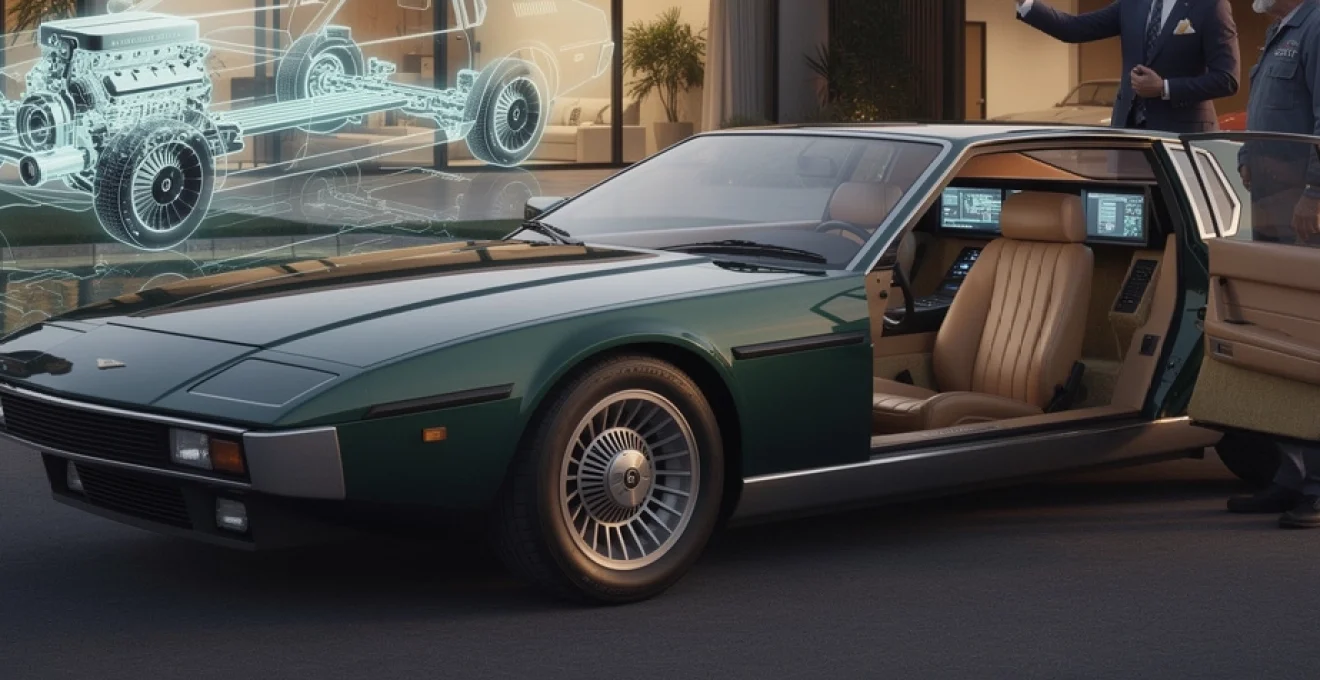
The Aston Martin Lagonda occupies a unique place in automotive history. Part rolling sculpture, part experimental technology lab, it challenged every convention about what a luxury saloon should be. Launched in the mid‑1970s and developed through to 1990, the Lagonda fused avant‑garde design, a muscular V8 powertrain and radical digital instrumentation long before such ideas became mainstream. For anyone interested in classic luxury cars, automotive design or the evolution of high‑end British engineering, understanding the Lagonda means understanding how a small marque dared to out‑innovate far larger rivals and help define what modern luxury mobility could become.
Today the Lagonda name is again associated with zero‑emission concepts and ultra‑luxury electric mobility, but the original wedge‑shaped saloon still sets the tone for bold thinking. Whether you are considering buying a classic Lagonda, researching its engineering or simply fascinated by its combination of drama and detail, the car rewards close study. Beneath the theatrical styling lies a meticulously hand‑built machine that reflects more than a century of Aston Martin and Lagonda heritage, and foreshadows many of the ideas currently reshaping the premium automotive sector.
Design DNA of the aston martin lagonda: wedge profiles, gandini lines and 1970s avant‑garde luxury
Exterior architecture of the lagonda series 2–4: folded-paper surfacing, pop-up headlamps and ultra-low bonnet
The design language of the Aston Martin Lagonda Series 2–4 is often described as folded paper or origami on wheels. Designer William Towns pushed the wedge profile to an extreme, creating a four‑door luxury saloon that looked closer to a concept car than a production vehicle. The bonnet sits improbably low over the 5.3‑litre V8 thanks to a very flat engine installation, while the scuttle and beltline run almost arrow‑straight from nose to tail. Pop‑up headlamps preserve the clean front fascia, emphasising the sheer, almost architectural surfaces.
The Lagonda’s styling divided opinion from day one, but that divisiveness is precisely what made it an instant icon on launch and keeps it visually fresh decades later.
If you study side profiles of the Lagonda, you see echoes of Marcello Gandini’s work on cars like the Lamborghini Espada and Maserati Khamsin: long overhangs, razor‑sharp edges, and a cab pushed slightly rearwards to lengthen the bonnet visually. Yet the Lagonda goes further, with minimal radii on leading edges and a bluff tail that prioritises aerodynamic stability over decorative curves. For you as an enthusiast, this means the car reads differently from every angle; it is a machine you interpret as much as you admire.
Cabin architecture and packaging: long-wheelbase proportions, limousine rear quarters and visibility trade‑offs
Under the dramatic skin lies a surprisingly rational cabin package. The Lagonda sits on a long wheelbase evolved from the Aston Martin V8 platform, allowing generous rear legroom that rivals contemporary limousines. The rear quarters were designed with chauffeur‑driven use in mind, especially for Middle Eastern and royal clients, so the shoulder line and glasshouse balance privacy with light. You get a true lounge‑like rear environment, enhanced by deep cushions and thick Wilton carpeting.
That said, the radical styling imposes compromises. The ultra‑low scuttle and steeply raked windscreen improve high‑speed aerodynamics but create reflections and limit forward visibility for shorter drivers. The high tail and narrow rear screen also reduce rearward vision compared to more conventional saloons. From a modern perspective, these trade‑offs resemble those seen on current super‑saloons and high‑style SUVs: form is optimised for drama and aero, leaving you to rely more on mirrors and driver judgement than on expansive glazing.
Material choices and coachwork: hand-formed aluminium panels, steel substructures and corrosion protection
The Lagonda coachwork is traditional in construction even when the styling appears futuristic. Hand‑formed aluminium panels are mounted over a steel platform and substructure, reflecting classic British coachbuilding practice. The mix of materials keeps overall mass lower than a fully steel‑bodied car of similar size, helping the 2‑tonne saloon achieve credible performance and ride quality. For anyone contemplating restoration, this hybrid structure has specific implications.
Where steel meets aluminium, galvanic corrosion can occur if moisture and salts are allowed to accumulate. Factory rust protection of the late 1970s and early 1980s was respectable but not at modern levels, so today you will often find corrosion at sills, lower door skins and the interfaces around the bulkhead. Professional restorers typically strip the body to bare metal, treat seams with modern epoxy primers and apply cavity wax extensively. If you value long‑term preservation, specifying upgraded corrosion protection during any repaint is as important as visual finish.
Aerodynamic considerations: drag coefficient, front-end lift management and high‑speed stability at 150+ mph
The Lagonda’s shape was not just styling theatre; it was also a serious attempt to optimise high‑speed touring. Period data suggest a drag coefficient around the 0.38–0.40 mark, quite competitive for a large, square‑shouldered luxury saloon of its era. The razor‑sharp nose and low bonnet reduce frontal area, while the flat underbody sections help smooth airflow beneath the car. For you as a driver, the benefit is reduced wind noise and improved fuel economy at motorway speeds compared with more upright luxury cars of the 1970s.
Front‑end lift management was a particular engineering focus because the car was capable of near‑150 mph in carburetted V8 form. The wedge profile naturally generates some nose‑down effect, but the team also tuned the front air dam and under‑bonnet airflow to prevent pressure build‑up. Owners often comment that a well‑sorted Lagonda feels impressively stable at high speed, comparable to contemporary GTs. The analogy is akin to a low‑flying private jet: once settled into its cruise, the car slices through the air with a calm that belies its bulk.
Powertrain engineering: V8 performance, fuel-injection evolution and driveline of the aston martin lagonda
5.3-litre tadek marek V8: block architecture, DOHC valvetrain and compression ratios across series 1–4
At the heart of the classic Aston Martin Lagonda sits the 5.3‑litre Tadek Marek‑designed V8, shared with the Aston Martin V8 and later derivatives. This all‑alloy unit uses a robust block with wet liners and a DOHC valvetrain per bank, driving two valves per cylinder. Early engines in the mid‑1970s used higher compression ratios, typically in the 9:1 region, enabling outputs in excess of 280 bhp in Lagonda tune, with torque well over 300 lb ft. As emissions regulations tightened, compression was reduced and cam timing softened, but the engine’s character remained muscular and smooth.
For you as an owner or buyer, understanding engine specification by year is crucial. Series 2 cars with Weber carburettors deliver the most traditional V8 feel and soundtrack, while later Series 3 and 4 cars with fuel injection prioritise drivability and emissions compliance. Despite the Lagonda’s weight, 0–60 mph times in the 8–8.5 second range and top speeds approaching 148 mph placed it firmly in the performance saloon category, especially when compared with contemporary Rolls‑Royce and Bentley rivals.
Carburettor vs fuel injection: weber carb setups, Weber-Marelli EFI and calibration for emissions and drivability
Engine breathing on the Lagonda evolved significantly over its production run. Early cars used four twin‑choke Weber carburettors, a complex but highly tunable set‑up delivering instant throttle response and a rich, classic soundtrack. Correct synchronisation is vital; if you own a carburetted Lagonda, investing in a specialist with experience balancing multiple Webers will pay dividends in smooth idle and crisp pickup. Fuel consumption is predictably high, typically in the low‑teens mpg in mixed use.
Later Series 3 and 4 cars adopted Weber‑Marelli EFI, an early electronic fuel‑injection system designed to satisfy emissions standards in the US and Europe. Calibration sought a compromise between cold‑start behaviour, part‑throttle economy and full‑throttle power. While this system is simpler to live with once correctly set up, age can affect sensors and wiring. Modern EFI specialists increasingly retrofit discreet control units, preserving originality visually while improving reliability. For a long‑term owner, this blend of period hardware and contemporary electronics often offers the best of both worlds.
Transmission options: chrysler TorqueFlite automatic vs manual gearboxes and final-drive ratio selection
Most Aston Martin Lagondas were delivered with the three‑speed Chrysler TorqueFlite automatic transmission, chosen for its smoothness and durability. Its torque converter characteristics suit the V8’s broad torque curve, allowing relaxed, low‑rpm cruising at motorway speed. Final‑drive ratios were selected to emphasise effortless acceleration between 30 and 100 mph rather than outright top speed, reflecting the car’s grand touring brief. If you are evaluating a car today, crisp, positive shifts and clean fluid are key health indicators.
A very small number of cars were produced with manual gearboxes, largely for enthusiasts favouring driver engagement over refinement. These rare examples command a premium value in the current market. However, the automatic transmission better suits chauffeur‑driven use and urban luxury driving, especially in markets like the Middle East where many Lagondas spent their early lives. When budgeting for ownership, plan periodic gearbox servicing; fresh filters and fluid significantly extend the life of these classic units.
Cooling, lubrication and exhaust systems: managing heat soak, oil pressure and V8 soundtrack refinement
Packaging a 5.3‑litre V8 under such a low bonnet required careful attention to cooling and lubrication. A generous radiator, belt‑driven fan and, on later cars, electric auxiliary fans help manage heat soak in hot climates. Oil coolers were often fitted, particularly on cars delivered to desert regions, maintaining stable oil pressure during extended high‑speed runs. For you, that means a well‑maintained cooling system is the difference between a reliable tourer and an overheating classic.
The exhaust system shapes both performance and the signature V8 soundtrack. Factory systems balance back‑pressure and silencing to produce a refined but distinctive note, more of a cultured growl than an outright roar. Many owners are tempted by freer‑flowing aftermarket exhausts, but overly loud systems can undermine the car’s luxury character and long‑distance comfort. A sensible approach is to retain twin‑silencer layouts with slightly larger bore pipework, preserving the Lagonda’s grand tourer personality while subtly enhancing response.
Chassis, suspension and braking: luxury ride tuning and dynamics of a 2‑tonne aston martin saloon
Platform and wheelbase: shared underpinnings with aston martin V8 and structural rigidity considerations
Beneath the avant‑garde bodywork, the Aston Martin Lagonda shares much of its architecture with the Aston Martin V8. A strong steel platform chassis supports the hand‑built body, with the wheelbase stretched to provide limo‑like rear accommodation. Structural rigidity is critical in such a long car; cross‑members and boxed sections resist torsional flex, helping the suspension work accurately even on poor surfaces. When testing a prospective purchase, listening for creaks over driveways and feeling for scuttle shake gives clues about the integrity of the structure.
Any rust in key load paths, particularly around front suspension mounting points and rear axle pick‑up points, can compromise stiffness. Modern restoration techniques often include partial or full chassis re‑fabrication using thicker‑gauge steel, subtly improving rigidity beyond original levels. The result, when done well, is a Lagonda that feels tighter and more precise than many did when new, without altering the essential ride comfort that defines the model.
Front and rear suspension: double wishbones, de dion rear axle and coil spring rate optimisation
Suspension design blends traditional GT principles with the specific demands of a long‑wheelbase, high‑performance saloon. At the front, unequal‑length double wishbones with coil springs and telescopic dampers provide precise camber control and good steering feel. At the rear, a de Dion axle layout combines a rigid tube locating the wheels laterally with separate differential mounting, reducing unsprung mass compared with a live axle. This configuration delivers excellent traction and predictable behaviour, especially under heavy acceleration.
Spring and damper rates were tuned to deliver a supple ride over long distances while maintaining composure at speed. If you expect modern sports‑saloon sharpness, you may find the Lagonda’s initial roll and pitch more relaxed, but the pay‑off is impressive comfort on broken tarmac. Many specialists now offer revised damper valving and slightly stiffer springs that respect the original character while improving body control. Choosing the right compromise depends on how you intend to use the car: occasional concours outings, or serious cross‑continent touring.
Steering systems: rack-and-pinion geometry, assistance levels and turning circle constraints
The Lagonda uses power‑assisted rack‑and‑pinion steering, relatively advanced for such a large luxury saloon of its era. Assistance levels are calibrated for fingertip lightness at parking speeds and a reassuring weight at motorway velocities. Geometry, including caster and toe settings, was designed to give stability rather than dartiness; this is a car that flows rather than snaps into bends. Owners who fit modern tyres with stiffer sidewalls can further sharpen response, though sometimes at the expense of steering feel.
One unavoidable compromise stems from the car’s length and wheelbase: the turning circle is generous. Tight multi‑storey car parks demand patience, and chauffeurs in period had to plan U‑turns carefully on narrow streets. If you live in a congested city, this is a practical consideration. Good steering‑rack maintenance, fresh fluid and correct alignment are essential to keep effort consistent and avoid undue wear on expensive front‑end components.
Braking hardware: ventilated discs, calliper specifications and fade resistance in high‑speed touring
Braking hardware was specified with sustained high‑speed touring in mind. Ventilated discs at all four corners, clamped by multi‑piston callipers, provide strong stopping power for a car of this mass. Period road tests report 60–0 mph stopping distances competitive with German and Italian performance saloons, provided pads are in good condition. Fade resistance is generally good thanks to rotor size and ventilation, but repeated hard stops from very high speed will still tax the system, as with any classic.
When you assess a car today, pedal feel and straight‑line stability under braking are valuable diagnostics. Sponginess or pulling can indicate tired hoses, seized callipers or warped discs. Upgraded pads with higher temperature capability can be fitted without harming originality, improving confidence on mountain descents or spirited drives. Regular fluid changes are critical, particularly given the heat generated by long descents and modern traffic speeds.
Lagonda digital dashboard and electronics: pioneering solid‑state instrumentation in luxury motoring
Solid-state LED instrumentation in early series 2: vacuum fluorescent displays and reliability challenges
Perhaps the most talked‑about feature of the Aston Martin Lagonda is its digital dashboard. Early Series 2 cars debuted a bank of vacuum fluorescent and LED instruments, giving the driver a futuristic light show reminiscent of a spaceship cockpit. Speed, revs, fuel and ancillary data glowed in bright colours, a radical departure from analogue dials in rivals from Rolls‑Royce and Mercedes‑Benz. For many clients, this digital theatre was a key part of the Lagonda’s appeal.
However, the technology of the mid‑1970s and early 1980s was fragile by modern standards. Heat, vibration and manufacturing tolerances all contributed to failures: flickering segments, dead displays or incorrect readings. Production delays and warranty work became notorious. For you as a prospective owner, a fully functioning original digital dash is both a delight and a sign that the car has either been very carefully preserved or professionally refurbished.
Touch-sensitive controls and membrane switches: user interface experimentation in the 1976 lagonda
Beyond the instruments, the Lagonda experimented with touch‑sensitive controls and membrane switches for functions like lights, climate and trip information. Instead of conventional stalks and rocker switches, you get flat panels that respond to finger contact, again emphasising the car’s experimental character. The idea foreshadowed modern capacitive interfaces, but reliability and tactile feedback were early‑generation at best.
Over time, membrane switches can crack, lose conductivity or suffer from worn legends. Specialist companies now reproduce switch panels or refurbish originals, often upgrading internal materials while retaining period‑correct appearance. If you enjoy technology history, the Lagonda offers an almost museum‑grade case study in late‑20th‑century user‑interface design applied to a road car.
Evolution from LED to CRT and LCD clusters: fault patterns, retrofitting solutions and modern upgrades
The dashboard did not stand still. Subsequent iterations moved from LED and vacuum fluorescent displays to CRT-style and later LCD clusters, each generation attempting to improve clarity and reliability. Unfortunately, each generation also introduced its own fault patterns: CRTs suffered from dimming and burn‑in, while early LCDs could leak or lose contrast. As a result, working electronic clusters on 40‑year‑old cars are increasingly rare.
Modern solutions range from full custom replacements to subtle internal upgrades. Some specialists design new circuit boards and displays that plug into original housings, preserving the futuristic look with vastly improved reliability. Others convert the car back to analogue gauges, a more controversial approach that may affect collectability. Your choice depends on whether authenticity or trouble‑free usability ranks higher in your priorities.
Electrical architecture: multiplex wiring, ECU modules and common diagnostic procedures
Underneath the dashboard lies a complex electrical system by 1970s standards. Early forms of multiplexing and multiple control modules handle functions from engine management (on EFI cars) to climate control and instrumentation. Age, heat and previous repairs can leave wiring looms brittle or poorly spliced, leading to intermittent faults that are harder to trace than purely mechanical issues.
Effective diagnosis typically starts with basic principles: verifying clean earth points, checking voltage supply under load and isolating modules one by one. Many owners benefit from modern documentation, reverse‑engineered wiring diagrams and the expertise of specialists who have seen recurring fault modes across multiple cars. Investing time in preventative work, such as cleaning connectors and adding additional grounds, can significantly reduce electrical gremlins in day‑to‑day use.
Comparative tech analysis: aston martin lagonda vs cadillac allanté and early Mercedes-Benz digital clusters
Viewed in context, the Lagonda’s digital experimentation was extraordinarily ambitious. Cadillac’s Allanté and early Mercedes‑Benz digital clusters appeared later, often with more conservative implementations that blended analogue and digital elements. Those systems benefited from greater industrial scale and, in Mercedes‑Benz’s case, very rigorous testing, yet even they developed reputations for quirks as components aged.
The Lagonda pushed further, making digital instrumentation a centrepiece rather than an add‑on. As a result, it arguably prefigured the fully digital cockpits now commonplace in luxury EVs and supercars. For you as a technology‑minded enthusiast, owning a Lagonda is like owning a key chapter in the story of human‑machine interfaces in automobiles, with all the fascination and complexity that implies.
Craftsmanship and interior luxury: connolly leather, wilton carpeting and british coachbuilt detailing
Trim specifications: connolly vaumol hides, veneer species and bespoke colour palettes
The Lagonda’s interior showcases the best of British coachbuilt luxury. Seats, door cards and dashboard are trimmed in Connolly Vaumol leather, renowned for its distinctive aroma and soft, natural finish. Owners in period could specify virtually any colour combination, from subdued charcoal and parchment to vivid blues and greens to match exterior paint. Wood veneers, often burr walnut or occasionally more exotic species, line the dashboard and centre console, contrasting with the futuristic electronics.
Restoring such an interior to factory standard requires artisans familiar with traditional tanning and stitching techniques. Modern replacement hides often differ subtly in grain and sheen, so you will notice the difference if you are attuned to classic luxury materials. Thoughtful restorations sometimes retain original leather where possible, repairing and feeding it rather than wholesale replacement, to preserve patina and authenticity.
Ergonomics and seating: front bucket design, rear legroom and chauffeur-driven configurations
Seating ergonomics reflect the dual role of the Lagonda as both driver’s car and chauffeur‑driven limousine. Front occupants sit in deep, supportive buckets with integrated headrests, positioned relatively low in the cabin to take advantage of the car’s low roofline without feeling cramped. The steering wheel and pedal relationship suits long‑legged drivers particularly well, though smaller drivers may take time to find an ideal position given the era’s more limited adjustability.
In the rear, generous legroom and a near‑flat floor enhance comfort for passengers, especially in markets where owners sat in the back while a chauffeur drove. Optional rear entertainment, rear climate controls and privacy glass could be specified for VIP clients. If you are seeking a classic car usable for modern formal occasions, the Lagonda’s rear quarters rival later luxury saloons in presence and comfort.
NVH management: sound insulation strategies, door sealing and V8 noise tuning
Noise, vibration and harshness (NVH) management was a priority even in the late 1970s. Thick carpets, multiple layers of underfelt, foam‑backed headlinings and substantial door seals all contribute to a calm interior. At typical cruising speeds, wind and road noise are well suppressed, allowing occupants to converse easily or enjoy period‑correct hi‑fi systems. The V8 is audible but muted, more of a distant thrum than a dominant presence.
Age can degrade insulation materials: seals compress, felts absorb moisture and adhesives fail. Refurbishing door seals and under‑carpet sound deadening restores much of the original serenity. Many owners are pleasantly surprised at how refined a well‑sorted Lagonda feels compared with its dramatic exterior. The analogy with a luxury railway carriage is apt: from the outside, power and speed; inside, an almost cocoon‑like quiet.
In-car amenities: factory-fit audio systems, air-conditioning hardware and period-correct options
Factory‑fit amenities reflected the expectations of high‑net‑worth clients around the world. High‑quality stereo systems, often with separate amplifiers and multiple speakers, were standard, though by modern standards they lack bandwidth and connectivity. Dual‑zone or enhanced air‑conditioning was common, particularly for cars destined for hot climates such as the Gulf States and the American South. Electric seats, power mirrors and central locking were expected at this level and duly provided.
For you today, balancing originality with usability is key. It is entirely possible to hide modern audio sources behind period‑correct head units, or to discreetly upgrade compressors and condensers in the air‑conditioning system while retaining original controls. Specialists in classic British luxury cars increasingly offer such sympathetic enhancements, allowing frequent use without visually compromising the interior.
Production history, special variants and market evolution of the aston martin lagonda
Series 1 to series 4 chronology: key facelifts, drivetrain revisions and design updates from 1974 to 1990
The Lagonda story runs from the early 1970s to 1990, with distinct series marking design and engineering evolution. Series 1 (mid‑1970s) used a more conventional Aston Martin V8 saloon body with Lagonda badging and was produced in tiny numbers. The dramatic William Towns‑styled Series 2, launched in 1976, introduced the wedge design and digital dashboard that made global headlines. Production ramped up slowly due to electronic challenges, but eventually stabilised in the late 1970s and early 1980s.
Series 3 brought fuel injection and detail changes to improve reliability and efficiency, while Series 4 in the late 1980s softened the styling slightly with smoother bumpers and updated lighting, anticipating the aesthetic of cars like the Aston Martin Virage. Across all series, total Lagonda production is widely quoted at around 640 cars between 1977 and 1990, underlining the model’s rarity. Understanding the differences between series helps you assess both driving character and collectability.
Notable chassis and VIP owners: royal commissions, middle eastern market specials and unique liveries
The Aston Martin Lagonda attracted a high‑profile clientele from launch. Royal households, including members of the British Royal Family, evaluated or commissioned cars, while Middle Eastern rulers ordered bespoke specifications, often with unique colours, gold‑plated trim or custom interior details. The model’s combination of theatre and luxury suited markets where understated design was less valued than bold presence.
Individual chassis histories frequently include fascinating stories: cars used on state occasions, delivered new to palaces, or specified with armouring and communication equipment. When you assess a car’s value today, such provenance can add significant interest, particularly when supported by factory build sheets and period photography. The Lagonda’s role as a status symbol makes its social history almost as compelling as its mechanical story.
Limited-run editions: tickford-tuned lagondas, stretch limousines and shooting brake conversions
Beyond standard production, a small number of special variants enhance the Lagonda legend. Tickford, Aston Martin’s in‑house coachbuilder, created long‑wheelbase stretch limousines; period records suggest only three were built. These cars offer even greater rear space and grandeur, aimed squarely at heads of state and ultra‑wealthy clients. Other independent coachbuilders experimented with shooting brake (estate) conversions, though such cars are extremely rare.
These limited‑run editions illustrate how adaptable the Lagonda’s underlying platform proved when matched with coachbuilding skills. For you as a collector, they offer exceptional rarity but also raise questions about parts availability and restoration complexity. Ensuring that any such car retains documentation confirming its origin is crucial to long‑term value.
Production numbers, build sheets and rarity analysis across different model years
With total production hovering around 640 units for Series 2–4, the Aston Martin Lagonda is a rare sight even at major concours events. Certain years and specifications are scarcer still: manual gearboxes, specific colours, or particular market homologations all reduce numbers further. Factory build sheets, available through marque specialists, list original colours, options and delivery destinations, providing a critical reference point when assessing originality.
From a rarity standpoint, early digital‑dash Series 2 cars and late, smoother Series 4 models occupy different niches. The former appeal strongly to enthusiasts of pure 1970s futurism, while the latter often suit drivers seeking slightly more conventional aesthetics and updated engineering. Understanding these nuances helps you select a car aligned with your tastes and intended use.
Global market reception: UK, US federalisation and gulf-region demand for ultra‑luxury saloons
Market reception varied by region. In the UK, the Lagonda’s price—around £50,000 in the early 1980s, equivalent to several houses in many areas—made it an ultra‑exclusive purchase reserved for industrialists, celebrities and collectors. In the US, federalisation requirements added complexity, but the car’s dramatic styling still attracted enthusiasts on both coasts. Strong demand came from the Middle East, where its presence and air‑conditioning performance suited local expectations of ultra‑luxury saloons.
Globally, the Lagonda helped underline Aston Martin Lagonda’s positioning as a brand willing to take bold risks in design and technology. That willingness persists today in electric concepts and hypercars, illustrating how the Lagonda saloon forms part of a broader narrative of innovation and resilience after multiple corporate restructurings and financial challenges.
Collectability, valuation trends and restoration challenges of classic aston martin lagondas
Current price brackets by series: concours examples vs project cars in the UK and european markets
On today’s market, Aston Martin Lagonda values vary widely depending on series, condition and provenance. In the UK and wider Europe, project cars needing full mechanical and cosmetic restoration can still occasionally be found in the £35,000–£50,000 range. Moving up, solid drivers with presentable paint and functioning electronics typically command £70,000–£100,000, with Series 2 cars at the higher end due to their iconic early dashboards.
Concours‑level examples with documented histories, low mileage (some under 20,000 miles) and fully functioning electronics can exceed £150,000, especially when associated with notable previous owners. Over the past decade, values have trended upwards, reflecting broader interest in 1970s and 1980s design and the relative scarcity of untouched cars. If you aim for investment as well as enjoyment, buying the best car you can sensibly afford remains sound advice.
Rust, bodywork and chassis restoration: common corrosion hotspots and panel fabrication techniques
Rust is one of the principal restoration challenges. Common hotspots include the lower edges of doors, sills, wheelarch lips, boot floor edges and the front bulkhead area. Water ingress around screen seals can also promote hidden corrosion. Because of the aluminium‑over‑steel construction, visible bubbling may signal deeper issues at mounting points or seams.
Skilled panel beaters can fabricate replacement aluminium skins, while chassis sections are often reconstructed from scratch if heavily compromised. Using modern epoxy primers, seam sealers and cavity wax improves future longevity. As a prospective buyer, commissioning a thorough inspection with the car on a lift, including probing known weak points, is essential before committing to restoration budgets that can easily exceed six figures on heavily corroded cars.
Rebuilding electronics and dashboards: sourcing specialists, reverse‑engineering PCBs and modern replacements
Electronic refurbishment sits alongside bodywork as a major cost centre. Original circuit boards may no longer be available, leading specialists to reverse‑engineer PCBs and replace failed components with modern equivalents. Vacuum fluorescent displays and LEDs can often be replaced or substituted, while CRT and LCD units require more complex solutions. Keeping as much original hardware as possible while upgrading vulnerable components is the current best practice among high‑end restorers.
From a practical standpoint, you benefit by engaging only firms with a documented track record on Lagondas or similar period Aston Martins. Asking for photographic evidence of previous dashboards before and after refurbishment, along with clear warranty terms, helps protect your investment. Some owners also choose to carry a small spares package of critical modules when touring, given the age and rarity of parts.
Powertrain and drivetrain rebuilds: V8 overhauls, automatic transmission servicing and parts availability
The Tadek Marek V8 is fundamentally strong, but age, neglect or poor storage can necessitate full rebuilds. Typical work includes re‑lining the block, refreshing bearings, regrinding crankshafts, and rebuilding cylinder heads with new valve guides and seats. Performance figures after a proper overhaul often match or exceed original test data, restoring the car’s effortless, long‑legged character. Rebuild costs reflect the engine’s complexity and hand‑built nature, so realistic budgeting is vital.
Automatic transmissions benefit from periodic servicing; complete overhauls are less common but straightforward for experienced transmission shops familiar with the TorqueFlite family. Driveline components such as propshafts and differentials are durable but should be inspected for noise and play. Parts availability remains generally good thanks to shared components with the Aston Martin V8 and a strong specialist ecosystem, though certain trim pieces and specific electronic modules can still require patient sourcing.
Investment outlook: long-term value forecasts, provenance documentation and impact of originality vs modification
Looking ahead, the Aston Martin Lagonda appears well positioned for continued appreciation within the classic luxury car market. The broader surge of interest in 1970s and 1980s design, coupled with the model’s low production numbers and status as an outlier even among Aston Martins, supports positive long‑term value forecasts. Analysts of the wider Aston Martin brand expect ongoing profitability improvements and new model launches to reinforce brand prestige, which tends to benefit heritage models as well.
For you as an investor‑enthusiast, three factors stand out: documented provenance, originality and quality of restoration. Complete history files, including build sheets, early service records and ownership chains, significantly enhance desirability. Sympathetic, well‑documented restoration using period‑correct methods and materials usually adds value, while heavy modification—particularly to the body or interior—can reduce appeal to serious collectors. Balancing discreet usability upgrades with respect for the Lagonda’s unique character is the most effective way to enjoy this luxury icon while protecting its future value.