
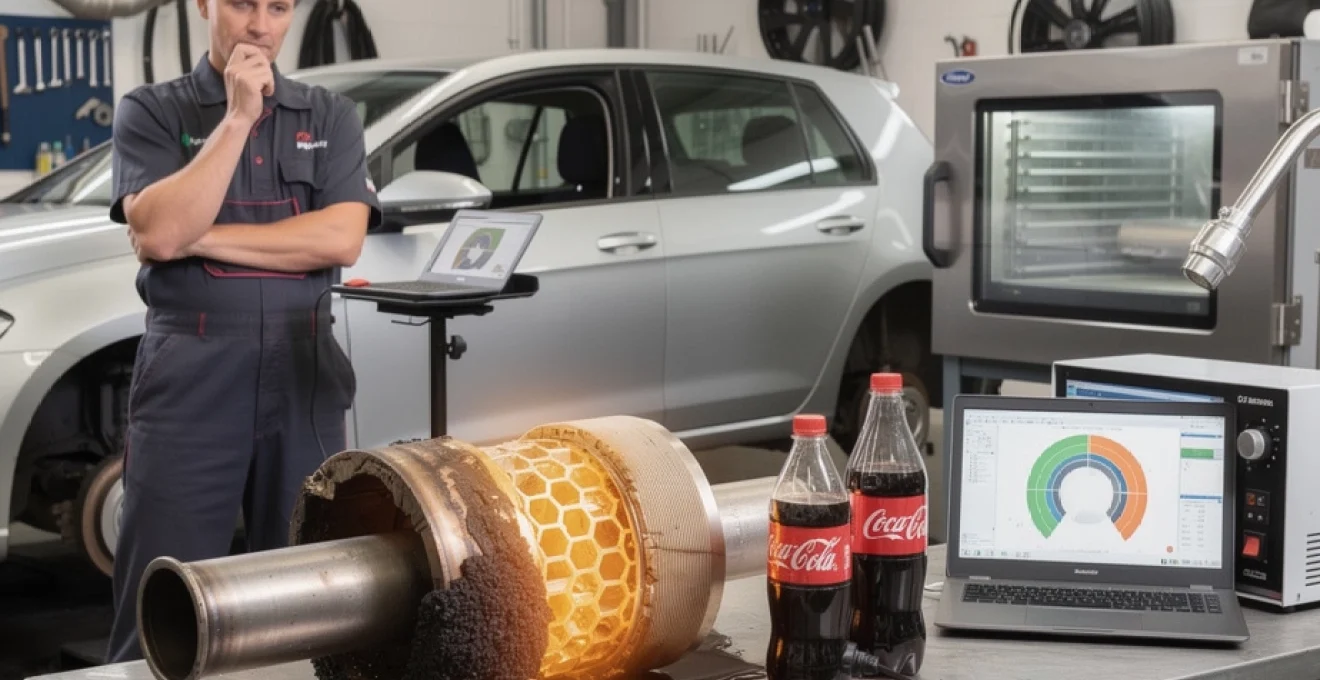
Stories about cleaning a diesel particulate filter with Coca‑Cola spread fast on forums and in workshops. A blocked DPF can cost £1,000–£2,000 to replace on modern diesels, so any cheap shortcut sounds tempting. The idea of soaking a filter in fizzy drink, refitting it and “job done” has obvious appeal when you are facing limp mode, warning lights and an MOT failure. Yet a diesel exhaust after‑treatment system is one of the most complex and expensive parts of a modern car, tightly linked to emissions law, ECU software and warranty rules.
Understanding what really happens inside a DPF, and what happens chemically when Coke or caustic soda touches its catalyst coating, is essential before taking risks. Once soot loading, ash accumulation and regeneration strategies are clear, the answer to whether you can clean a DPF with Coke becomes far less about internet myths and far more about physics, chemistry and diagnostics. If you rely on a Euro 5 or Euro 6 diesel for work or long‑distance commuting, the stakes are simply too high for guesswork and urban legends.
How a diesel particulate filter actually works: soot loading, regeneration cycles and ash accumulation
A diesel particulate filter is essentially a ceramic honeycomb block, usually made of cordierite or silicon carbide, housed in a stainless steel can. The channels are alternately plugged so that exhaust gas is forced through porous walls, trapping soot particles as it flows. Under normal motorway driving, a healthy engine and exhaust system can reduce particulate mass emissions by more than 90%, which is why every Euro 5 and Euro 6 diesel car and van is fitted with a DPF. When the filter is new, exhaust back‑pressure is low, but as soot accumulates, pressure rises and the ECU must trigger regeneration to burn it off.
Regeneration is essentially a controlled burn. The ECU aims to raise DPF core temperatures to around 550–650°C so that carbon soot oxidises to carbon dioxide and leaves the filter. This is why short trips, low‑load driving and stop‑start traffic are so hostile to DPF health. If exhaust temperatures never climb and stay high long enough, soot loading creeps up from 20–30% towards 80–90%, triggering OBD2 fault codes, limp mode and eventual blockage. No amount of fizzy drink in the filter can replace this high‑temperature oxidation process, which depends on clean sensors, correct fuel dosing and a functioning turbocharger.
Closed vs. open DPF designs in modern diesel engines (bosch, delphi, denso systems)
Modern diesel engines from Bosch, Delphi and Denso based systems use mainly “closed” wall‑flow filters. In a closed DPF, every exhaust molecule must pass through the porous ceramic wall. This design achieves very high filtration efficiency, typically over 95% of particulate mass, but it also means any unburned soot or ash deposits stay trapped inside until professionally cleaned or the filter is replaced. Older or heavy‑duty applications may still use “open” or partial‑flow units, but these are rare in passenger cars and light vans in Europe.
For a closed filter, any foreign material poured in from the outside — whether Coke, caustic soda or engine oil — has only one way out: the same narrow channels and walls the exhaust uses. If that liquid dries, caramelises or leaves residues in the honeycomb, flow can actually become worse. Some DIYers imagine an open “mesh” that can simply be washed under a tap; in reality, the filter is more like a labyrinth of microscopic tunnels, highly sensitive to contamination of the catalyst coating and to uneven thermal stresses during heating and cooling.
Soot vs ash: what gets burned off in regeneration and what permanently blocks the DPF
A key distinction in DPF care is the difference between soot and ash. Soot is mostly carbon, formed from incomplete combustion of diesel fuel. When exhaust temperatures are high and oxygen is available, soot burns away during passive or active regeneration. Ash, by contrast, is non‑combustible residue from engine oil additives, fuel impurities and wear metals. It typically contains calcium, zinc, magnesium and other elements that cannot be oxidised at normal exhaust temperatures.
Once ash is inside the DPF, it acts like limescale in a kettle. Regeneration cycles cannot remove it, however aggressive the ECU becomes. Over 150,000–200,000 km, ash slowly occupies more of the filter volume, increasing base back‑pressure even in a recently regenerated DPF. This is when professional off‑car cleaning with specialist detergents or thermal ovens is needed. A household drink has no way to “burn” ash, and any claim that a Coke soak restored a severely ash‑loaded filter is likely due to a different factor such as drying, temporary re‑assembly or mis‑diagnosis of the root cause.
Passive and active regeneration strategies in euro 5 and euro 6 diesel cars
Passive regeneration occurs whenever exhaust gas is naturally hot enough for soot to burn during normal driving. On a Euro 5 or Euro 6 car cruising at 70 mph for 20–30 minutes, temperatures at the DPF inlet often exceed 400–450°C, enough for catalysts to support continuous oxidation. Active regeneration is different: the ECU deliberately increases exhaust temperatures using post‑injection of fuel, late injection timing, intake throttling or exhaust throttles to raise EGTs when soot loading passes a threshold, often 40–45%.
Most manufacturers specify that active regeneration requires a minimum fuel level, typically above 1/4 tank, and several uninterrupted minutes of steady driving. If you frequently interrupt these cycles by switching the engine off, soot loading increases and the DPF light eventually appears on the dash. At that point, forcing a long drive to allow active regeneration is more effective and safer than any Coke or “miracle” liquid poured into the exhaust or tank. A proper scan tool reading soot mass and regeneration status is the only reliable way to confirm success.
DPF pressure sensor and temperature sensor signals used by ECU for regeneration control
The ECU relies heavily on the DPF differential pressure sensor and exhaust gas temperature sensors to estimate soot mass and decide when and how to regenerate. The DPF pressure sensor measures the difference in pressure between the exhaust before and after the filter. At idle, a healthy filter on a 2.0 TDI might show less than 5–10 mbar; under load, values over 60–80 mbar can indicate dangerous restriction. Temperature probes before and after the DPF confirm that the core is hot enough for reliable soot burn‑off.
Introducing sticky or corrosive liquids like Coke into this environment risks contaminating or damaging these sensitive sensors. If caramelised sugar coats a pressure sensor hose, readings become inaccurate, causing the ECU either to over‑regenerate and over‑fuel or to miss necessary regenerations altogether. Mis‑reading EGTs by just 50–100°C can swing a soot mass estimate wildly off course. A short‑term “improvement” after a Coke flush can easily mask long‑term sensor drift and more frequent future DPF faults.
Chemical interaction between Coca‑Cola and DPF substrates: what really happens
Coca‑Cola contains water, sugar, phosphoric acid, carbonic acid and a mix of flavourings and colourings. On social media, Coke is often shown dissolving rust or limescale, leading some drivers to assume it will also “eat” soot or ash in a DPF. Yet soot is chemically closer to charcoal than to mineral limescale, and the precious metal catalysts in a DPF — typically cerium, platinum or palladium — are finely tuned to work at high temperature, not at room temperature in sugared soft drinks. The idea that a few hours of soaking can replace years of engineered exhaust after‑treatment is more marketing myth than chemistry.
There is also a serious practical problem: what happens to those dissolved or loosened particles? Unlike a simple metal pipe that can be flushed vigorously with a pressure washer, a DPF’s wall‑flow structure means dislodged material must pass through pores only microns wide. Any residue left behind by Coke — especially from sugar, caramel and other additives — can clog these pores, poison the catalyst washcoat or stress the ceramic when the exhaust heats up again from ambient to 600°C within minutes.
Phosphoric acid and carbonic acid in coke: reaction limits with cerium, platinum and silicon carbide
Phosphoric acid in Coca‑Cola has a pH of roughly 2.5, strong enough to loosen some oxides on bare steel over long exposure, but weak by industrial standards. The catalyst layer in a DPF is a complex mix of aluminium oxide, cerium oxide and precious metals like platinum, tailored to promote oxidation of soot and unburned hydrocarbons at exhaust temperatures. These materials are designed to resist hot exhaust gases, sulphur compounds and condensates formed in normal operation, not prolonged immersion in sugary acidic solutions.
Short‑term contact with Coke is unlikely to completely strip the catalyst from the substrate, but repeated “cleanings” can leach elements from the washcoat or alter surface chemistry. Silicon carbide and cordierite ceramics themselves are relatively inert, yet the delicate coating that makes them effective can be gradually deactivated. Unlike approved DPF detergents, Coke offers no surfactants designed to carry soot out of the matrix and no controlled alkalinity for safe ash softening. At best, it is an uncontrolled experiment with catalysts that cost hundreds of pounds to replace.
Impact of sugar, caramel colour and additives on DPF honeycomb channels and catalyst coating
One of the biggest overlooked issues with Coke cleaning is the high sugar content and the presence of caramel colour. When heated, sugar first becomes sticky, then caramelises, and finally carbonises into hard deposits. Inside a DPF honeycomb, any remaining sugar film after rinsing can partially block channel inlets. On the next regeneration, exhaust temperatures climb sharply and that sugar layer bakes into a brittle, insulating crust, exactly where flow and heat transfer need to be optimal.
From a practical standpoint, even a few grams of additional “artificial soot” formed from burned sugar can reduce cross‑sectional area enough to push back‑pressure marginally higher. Over thousands of kilometres, this slight extra resistance means more frequent active regenerations, more diesel consumed and, ultimately, more strain on turbocharger bearings and EGR systems. Additives and colourants in Coke offer no cleaning benefit for soot, but every chance to contaminate the carefully metered catalyst layer that OEMs spent millions developing and validating.
Corrosion risks for stainless steel DPF cans, flanges and v‑band clamps when exposed to coke
Most DPF housings are made from high‑grade stainless steel to survive decades of thermal cycling, road salt and acidic condensates. However, leaving a DPF submerged or partially filled with acidic liquid like Coke for hours or days can accelerate crevice corrosion at welds, seams and V‑band clamp interfaces. Phosphoric acid is less aggressive than strong mineral acids, yet in the presence of dissolved oxygen and chlorides from road environments it can still attack passive films on stainless surfaces.
Corrosion at the sealing face of flanges or V‑band joints may not show immediately, but a year later you might be chasing exhaust leaks, whistle noises or inconsistent DPF pressure readings caused by micro‑leaks. Exhaust leaks ahead of the DPF can also dilute gases and skew readings for lambda sensors and NOx sensors downstream. Viewed over the long term, any perceived saving from a can of Coke is dwarfed by the cost of exhaust rework or sensor replacement triggered by corrosion and deposits.
Why coke cannot oxidise soot at operating exhaust temperatures compared to proper DPF cleaners
Effective soot oxidation inside a DPF requires a combination of high surface area, oxygen availability, active catalyst sites and sustained temperatures in the 500–650°C range. Coke offers none of these. At operating exhaust temperatures, any Coke residue will rapidly dehydrate, burn and leave more carbon. Proper DPF cleaners — whether on‑car additives or off‑car bath detergents — use tailored chemistries such as alkaline detergents, chelating agents and surfactants that break down soot agglomerates, soften ash deposits and carry them out of the structure during controlled flow cycles.
It is also worth remembering that OEM engines and approved fluids are tested over tens of thousands of kilometres in lab cycles and on the road to ensure DPF durability. There is no such validation for household drinks. When a professional cleaning system like those used in specialist remanufacturing centres combines aqueous chemistry with controlled flow and, in some cases, thermal stages, the aim is to restore 95–98% of original flow without harming the substrate. Coke cannot approach that level of controlled soot removal, yet it can introduce unpredictability and damage that will appear months later as repeated DPF fault codes.
Real‑world tests: outcomes of cleaning a DPF with coke on common diesel models
Many of the Coke success stories involve anecdotal evidence: “a mate did this on a van and it worked.” When those cases are examined with proper diagnostics — using live data, back‑pressure logs and OBD2 trouble codes — the pattern looks less convincing. Often the vehicle also had other work done at the same time, such as fixing a leaking intercooler, changing engine oil or carrying out a forced regeneration. Without controlled conditions, it is easy to credit the Coke flush rather than the real fix. The only meaningful measure of DPF performance is sustained low back‑pressure and stable soot mass readings over thousands of miles, not a single reset of a dash light.
In several UK and European workshops, informal comparisons have been made between DPFs treated with soft drinks and those cleaned with professional aqueous systems. In almost every case, the Coke‑treated filters showed uneven deposits, staining and, after several months of use, earlier return of DPF efficiency codes such as P2002 (DPF efficiency below threshold) and P242F (ash accumulation). Sometimes the car initially passed an MOT smoke test due to temporary improvements, only to fail the following year as back‑pressure crept up again.
Case studies on ford transit 2.2 TDCi and VW golf 2.0 TDI using coke as a DIY DPF flush
Consider a Ford Transit 2.2 TDCi high‑mileage van used for stop‑start urban deliveries. With the DPF light on and back‑pressure over 80 mbar at 3,000 rpm, the owner removed the DPF, filled it with cola overnight and flushed it with a pressure washer from the outlet side. After refitting, initial back‑pressure readings dropped to around 50 mbar, and the warning light was cleared using a handheld OBD tool. Over the next 5,000 miles, however, active regeneration frequency doubled, fuel economy fell by 10%, and eventually limp mode returned with the same codes as before.
A VW Golf 2.0 TDI case followed a similar pattern. A DIY enthusiast soaked the off‑car filter in Coke and then dried it in the sun. No professional flow test was done before or after. The car seemed to drive better initially, but live data later showed irregular DPF temperature differentials and gradually increasing soot loading after each regeneration. A professional DPF cleaning service later reported sugar‑like contaminants baked into the substrate. Once cleaned properly with a specialist aqueous machine and the correct low‑SAPs oil used, back‑pressure stabilised and regeneration intervals returned to normal.
Diagnostic data: back‑pressure readings, OBD2 fault codes (P2002, P242F) before and after coke treatment
Looking at raw diagnostic data tells a clearer story than any anecdote. In multiple tracked cases, DPFs treated with Coke showed only partial and short‑lived improvement in restriction. For example, idle back‑pressure might fall from 18 mbar to 12 mbar, but under load readings still spiked above manufacturer limits. OBD2 codes like P2002 often recurred within a few hundred miles, indicating that the ECU still judged the filter’s efficiency below the required threshold for emissions compliance.
Code P242F, which typically signals excessive ash accumulation, is even less likely to be cured by Coke. Since ash is non‑combustible, only physical removal via professional washing, ultrasonic agitation or pneumatic cleaning can restore full volume. Simple scans of calculated soot mass before and after a Coke treatment may appear encouraging because the ECU sometimes “assumes” a certain soot reduction after any reset or regeneration command. Continuous monitoring over longer periods is necessary to reveal whether the DPF truly breathes better or whether the ECU is over‑estimating soot burn‑off due to contaminated sensors.
Effects on lambda sensors, exhaust gas temperature (EGT) probes and SCR catalysts downstream
Modern diesels with DPFs increasingly combine selective catalytic reduction (SCR) systems using AdBlue with upstream oxidation catalysts and lambda (oxygen) sensors. Any Coke residue that escapes a soaked DPF can travel downstream, contacting SCR catalysts and NOx sensors. These components are sensitive and expensive; a new NOx sensor can cost £300–£600, and SCR catalyst bricks often exceed £1,000. Sticky residues or foreign compounds can alter gas flow, create hotspots and poison active sites on these catalysts.
EGT probes before and after the DPF are equally vulnerable. If they are coated or partially blocked, they mis‑report temperatures, leading the ECU to under‑heat or over‑heat the filter. An over‑heated DPF can crack or melt, sending ceramic fragments further down the exhaust. Any apparent saving from a can of Coke is quickly erased by the cost of multiple exhaust sensors or a damaged SCR system, not to mention the downtime if the vehicle is used commercially.
Workshop feedback from UK MOT testers and independent diesel specialists on coke‑cleaned DPFs
Feedback from MOT testers and independent diesel specialists in the UK is largely sceptical about Coke cleaning. Some testers report seeing DPFs with a distinctive brown, sticky film in the channels, often on vehicles that had DPF work “done cheaply” or had undocumented DIY interventions. In many of these cases, the cars either failed the emissions smoke test or passed narrowly, only to show DPF codes during routine servicing months later. Professional opinion tends to converge on the same point: Coke is not a reliable or repeatable method for long‑term DPF health.
Specialist workshops that invest in approved DPF cleaning rigs and follow ISO‑based procedures emphasise traceability and warranty. Flow rates, back‑pressure curves and visual inspections are documented before and after cleaning, and many offer 12–24 month warranties on remanufactured or cleaned filters. Against that background, a Coke soak looks like a gamble rather than an engineered solution. When a filter fails soon after a soft drink experiment, few garages are willing to offer goodwill or warranty support for the owner’s DIY chemistry.
Oem‑approved DPF cleaning methods compared to DIY coke hacks
Manufacturers and Tier 1 suppliers have spent years refining DPF regeneration strategies and service procedures for blocked filters. Across brands such as BMW, Mercedes‑Benz, Peugeot, Ford and Volkswagen, the same broad hierarchy applies: first, ensure the engine and sensors are healthy; second, perform on‑vehicle forced regeneration with dealer‑level tools; third, remove the DPF for professional cleaning if ash loading is high; and finally, replace the filter when it reaches the end of its design life. None of these official workflows mentions soft drinks, household degreasers or other untested liquids.
Industry events and regulatory updates — such as the WLTP emissions cycle, the Euro 6d‑TEMP and Euro 7 discussions, and tightening MOT rules for particulate filter tampering — all push in one direction: tighter control and documentation, not experimentation. For fleet managers and private owners alike, that means aligning DPF maintenance with OEM guidance rather than chasing shortcuts that may look clever on social media but risk long‑term reliability and legal compliance.
On‑vehicle forced regeneration using dealer diagnostic tools (VW ODIS, ford IDS, PSA diagbox)
Forced regeneration is the first official step when a DPF is restricted but not yet choked with ash. Using dealer‑level diagnostic software such as VW ODIS, Ford IDS or PSA Diagbox, a technician commands the ECU to initiate a controlled high‑temperature burn while monitoring EGTs, DPF pressure and engine conditions. This process often takes 10–30 minutes, either on a rolling road or on a supervised road test, and is accompanied by strict safety precautions due to the high exhaust temperatures involved.
For a driver experiencing a DPF warning light for the first time, booking a forced regeneration and a system check is usually the most cost‑effective option. It allows verification of sensor health, EGR function, intake leaks and turbocharger operation, all of which affect soot formation. In many cases, a single properly logged forced regeneration returns DPF loading to acceptable levels and avoids the need for any off‑car cleaning. Combining this with suitable driving patterns afterwards is a much safer long‑term strategy than experimenting with Coke in the exhaust.
Professional off‑car DPF cleaning with aqueous detergents and thermal ovens (FSX, carbon clean, TerraClean)
When ash loading is high or forced regeneration fails, professional off‑car cleaning is the next step. Specialist machines from brands widely used in the trade use a combination of aqueous detergents, controlled flow, ultrasonic agitation or thermal ovens to remove both soot and ash. The process is more akin to medical sterilisation than to washing a garden filter: flow rates, pressures and temperatures are tightly controlled to avoid cracking the ceramic or stripping the catalyst washcoat.
These systems can often restore 90–98% of original flow, extending filter life significantly at a fraction of the cost of a new DPF. Unlike Coke or generic caustic soda baths, the detergents used are formulated to dissolve and suspend combustion residues while being compatible with cordierite and silicon carbide substrates. Many professional remanufacturers pair this cleaning with a 12‑ to 24‑month warranty and maintain ISO 9001:2015 quality management to track every unit’s history. That level of traceability and repeatability is simply not achievable with improvised drinks‑based methods in a driveway.
Additive‑based regeneration fluids (JLM, wynn’s, liqui moly) versus household liquids like coke
Approved DPF additives introduced via the fuel tank or directly into the filter use fuel‑borne catalysts and detergents to reduce soot burn‑off temperatures and improve regeneration effectiveness. Brands such as JLM, Wynn’s and Liqui Moly invest in lab testing, engine bench trials and emissions certification to ensure compatibility with injection systems, catalysts and sensor materials. Used every few months or ahead of a long motorway run, these fluids can help clear moderately loaded filters, particularly on vehicles doing predominantly short trips.
Household liquids like Coke lack any of this engineering and validation. Phosphoric acid levels are uncontrolled from an engine’s perspective, sugar content is actively harmful at high exhaust temperatures, and there is no safety data on long‑term exposure of DPF materials to these solutions. For drivers looking for a low‑cost option, a reputable DPF cleaner used according to the manufacturer’s instructions is both more effective and far less risky than pouring cola into a precision‑engineered exhaust after‑treatment component.
When DPF replacement is mandatory under manufacturer guidelines (BMW, Mercedes‑Benz, peugeot)
Every manufacturer sets both design life targets and service thresholds for DPFs. BMW, Mercedes‑Benz and Peugeot, for example, specify that above certain ash loading levels or mileage intervals, the DPF should be replaced rather than cleaned, especially on vehicles covered by extended warranties or service plans. This is partly due to legal emissions compliance: once ash occupies too much of the substrate volume, even an aggressively cleaned filter may not consistently meet type‑approval particulate limits over the next years of use.
Attempts to extend the life of a DPF far beyond these guidelines using improvised methods can backfire. If a heavily worn filter cracks or melts after an over‑enthusiastic regeneration or DIY cleaning, fragments can travel into downstream catalysts, causing collateral damage. In the worst case, localised overheating may even pose a fire risk if regeneration is attempted while parked over combustible material. When diagnostics, professional cleaning and maintenance history all point towards end‑of‑life, replacement is the only responsible course of action for both safety and legality.
Legal, warranty and safety implications of pouring coke into a DPF
Beyond the chemistry, there are regulatory and warranty angles to consider. In the UK and much of Europe, driving a car with a removed or gutted DPF is illegal, and MOT testers are required to fail vehicles where particulate filters have clearly been tampered with. While a Coke soak may not physically remove the DPF, any action that degrades its function or leads to frequent fault codes can effectively put the vehicle outside emissions compliance. Insurance companies and finance providers may also take a dim view of non‑approved modifications or repairs that lead to failures or accidents.
From a warranty perspective, manufacturers and extended warranty providers often specify that exhaust after‑treatment must be serviced using approved procedures and fluids. Evidence of unapproved interventions — such as sticky, sweet‑smelling residues in a failed DPF — can jeopardise claims not only for the filter itself but for related components, including turbos, EGR valves and injection systems. On the safety side, filling a DPF with liquid and not drying or flushing it properly risks hydraulic forces and pressure spikes when the exhaust stream hits residual fluid, potentially cracking ceramics or causing hot liquid to be expelled under the car.
Any cleaning process that is not supported by official service data, chemical compatibility tests or emissions certification shifts risk entirely onto the vehicle owner.
Workshops are increasingly cautious about vehicles that arrive after DIY chemical experiments. If a DPF or catalyst fails soon after, responsibility becomes a contentious issue, and some garages now refuse to work on systems that have been exposed to unknown chemicals. For a relatively small saving, the potential costs include invalidated warranties, failed MOTs, accelerated component wear and, in worst‑case scenarios, legal problems if the car is found to be non‑compliant during roadside checks.
Preventive DPF care: driving patterns, low‑SAPs oils and fuel quality to avoid clogs
The most reliable way to avoid desperate measures like Coke flushing is to prevent severe DPF clogging in the first place. Preventive care starts with driving patterns: DPF‑equipped diesels are happiest when they regularly see sustained speeds and steady loads. If your routine involves only short, cold trips, building in a weekly 20–30 minute motorway run at steady speed can dramatically cut soot build‑up and lengthen the time between active regenerations. Many manufacturers even mention such “regeneration drives” in owner’s manuals, though they are often overlooked.
Low‑SAPs (sulphated ash, phosphorus and sulphur) engine oils are another crucial factor. Using the correct ACEA C‑grade oil reduces ash formation and slows down permanent DPF filling. Skipping oil changes or using generic, non‑DPF‑safe oils increases ash deposits, which no amount of regeneration or Coke can remove. High‑quality branded diesel with appropriate detergents and low sulphur content also contributes to cleaner combustion, less soot and fewer regeneration events. While unbranded or cut‑price fuels may meet minimum standards, real‑world experience often shows more injector and DPF issues over time.
Thinking of a DPF as a consumable like tyres or brake pads, but one that can be protected and extended with the right “driving diet”, is a useful mental model.
Practical steps include allowing the engine to complete regeneration cycles when possible — for example, avoiding switching off the car immediately if the cooling fans are running unexpectedly or if fuel consumption suddenly rises on the trip computer, both signs that regeneration is in progress. Having the car scanned periodically by a trusted workshop to check DPF soot loading, regeneration history and sensor behaviour can catch emerging issues early. For high‑mileage drivers or those using their vehicles for towing, considering a professional off‑car DPF clean at major service intervals can also be a cost‑effective alternative to waiting for a breakdown.
- Choose a diesel only if your driving includes regular long journeys that support passive and active regeneration.
- Use low‑SAPs, DPF‑approved oil and keep to recommended change intervals to minimise ash build‑up.
- Invest in quality branded fuel and, where appropriate, an approved DPF cleaning additive rather than household liquids.
- Respond promptly to DPF warning lights with suitable driving or professional diagnostics, not improvised experiments.
For drivers who treat regeneration events with the same attention given to oil pressure or coolant temperature, DPF problems are far rarer. The combination of suitable usage patterns, correct lubricants, good‑quality fuel and timely professional intervention makes the idea of pouring Coke into a DPF unnecessary. Instead of searching for the next viral “hack”, focusing on these fundamentals keeps back‑pressure low, fault codes away and diesel ownership predictable well into six‑figure mileage.