
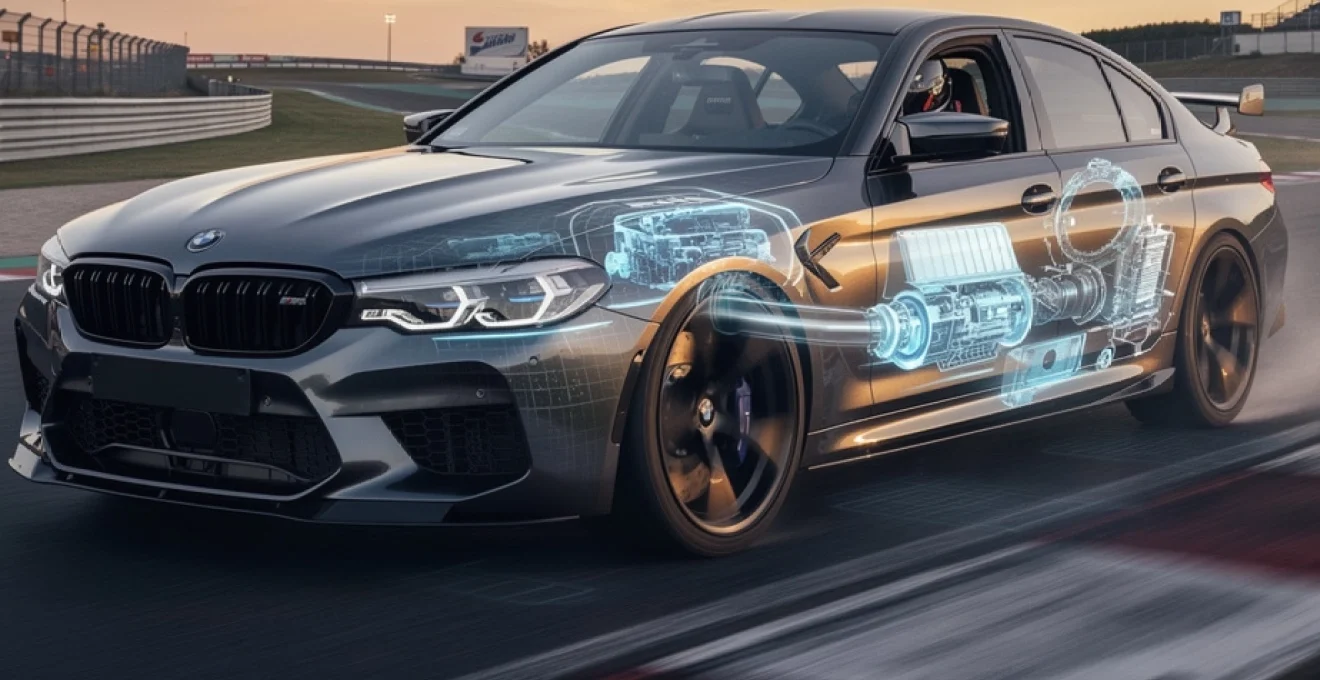
The BMW M5 Competition (F90) stands at an intriguing crossroads for high-performance saloons. It is the last fully internal-combustion M5, yet it feels anything but old-fashioned. With a 4.4‑litre twin‑turbo V8, sophisticated xDrive all‑wheel drive and a deeply configurable chassis, it blends everyday luxury with supercar-baiting pace. If you want a car that can cover a school run, a cross‑continent journey and an occasional track day with the same sense of effortless authority, the F90 M5 Competition is a compelling benchmark. Understanding how the engine, drivetrain and chassis work together helps you extract that elusive mix of speed, feedback and reliability that defines a great super saloon.
BMW M5 competition (F90) overview: model years, facelift (LCI) changes and market positioning in the super saloon segment
The F90 BMW M5 debuted in 2017 as the sixth‑generation M5 and the first to adopt M xDrive all‑wheel drive. Initially launched with 441 kW (600 hp), it quickly gained the M5 Competition variant, raising output to around 625 hp and adding a sharper chassis setup. In the UK, the Competition ultimately became the default specification, particularly after the 2020 LCI (Life Cycle Impulse) facelift. That update brought redesigned headlights, a more assertive kidney grille and revised tail-lights, plus a larger central display and updated infotainment software, keeping the car competitive against newer rivals such as the latest Porsche Panamera and Audi RS models.
The LCI M5 Competition sits in a rarefied “super saloon” class alongside the Mercedes‑AMG E63 S, Audi RS7 and high-output Panamera variants. Pricing around £111,000 when new put it right in the thick of the segment, undercutting some rivals while offering near-supercar performance. Contemporary tests regularly cited 0–62 mph in 3.3–3.4 seconds and 0–124 mph in roughly 11 seconds, performance that overlaps with lighter two‑door sports cars. Importantly, the M5 does this while remaining understated, conservative in design and easy to live with, which appeals if you prefer a discreet Q‑car over something overtly aggressive.
The Competition package goes beyond power. Spring rates increase, ride height drops by about 7 mm, anti‑roll bars are re‑tuned and engine mounts stiffen. The result is more agility and precision without a dramatic sacrifice in comfort on typical UK roads. Owners frequently describe the LCI Competition as a true “all‑rounder”: manageable in city traffic, calm on motorways and highly capable on fast A and B‑roads. For many enthusiasts, this balance, combined with the last‑of‑its‑kind V8 character, makes the F90 an emerging modern classic in the performance saloon world.
S63 twin-turbo V8 engineering: powertrain architecture, 625 hp output and torque delivery
Closed‑deck 4.4‑litre V8 block, hot‑vee turbocharger layout and high‑pressure direct injection system
At the heart of the M5 Competition sits the S63B44T4, a 4.4‑litre twin‑turbo V8 that traces its lineage back through several generations of M‑power. For the F90, engineers significantly reworked the architecture with a closed‑deck aluminium block for improved rigidity and cylinder pressure tolerance. This closed‑deck design allows higher boost pressures while maintaining reliability, which is essential when you are repeatedly deploying over 600 hp and 750 Nm of torque. The engine also uses a cross‑bank exhaust manifold to optimise pulse energy to the turbos, improving spool characteristics and response at part throttle.
The turbos themselves sit in a so‑called “hot‑vee” configuration, mounted within the V of the cylinder banks rather than outside them. This shortens the distance between exhaust ports and turbine wheels, reducing lag and improving packaging. High‑pressure direct injection, operating at up to around 350 bar, ensures precise fuel metering and allows the engine to run relatively lean at cruising loads while maintaining knock resistance at high power. For you as a driver, the aggregate effect is a powertrain that feels muscular from barely above idle yet keen to rev to its 7,200 rpm red line, with a linear shove rather than a sudden on/off turbo step.
Twin-scroll turbochargers, intercooling and charge‑air temperature management under repeated launches
The BMW M5 Competition uses twin‑scroll turbochargers, each feeding one cylinder bank. Twin‑scroll design keeps exhaust pulses from paired cylinders separate as they enter the turbine, smoothing flow and improving energy extraction. Under real‑world driving, that translates into quicker boost response when you squeeze the throttle at mid‑range rpm, a key factor if you want instant acceleration out of tight junctions or hairpins. The system is assisted by a sophisticated intercooling arrangement with indirect water‑to‑air coolers mounted close to the engine, reducing charge‑air volume and helping keep intake temperatures stable.
Repeated launches and hard track use can put any turbocharged engine under intense thermal stress. Charge temperatures can soar, forcing the ECU to pull timing and boost if the cooling package is overwhelmed. The F90 combats this with high‑capacity radiators, additional low‑temperature circuits and carefully managed coolant flow. If you intend to enjoy frequent standing‑start acceleration or high‑speed Autobahn runs, it is sensible to monitor warm‑up times, allow proper cool‑down and maintain coolant quality. Treat the engine like a high‑performance athlete rather than a domestic appliance, and the system will reward you with consistent, repeatable acceleration runs.
Engine management, ECU mapping and overboost strategies in the M5 competition versus standard F90
Compared with the standard F90 M5, the Competition variant uses revised ECU calibration to unlock its extra power and sharpened response. Boost pressure increases, ignition timing is more aggressive on suitable fuel and throttle mapping becomes more immediate in the sportier modes. Crucially, the torque plateau of 750 Nm extends over a broad band from approximately 1,800 to 5,600 rpm, meaning that in day‑to‑day driving you very rarely need more than half throttle to access serious performance. Some tuners further exploit this headroom with Stage 1 and Stage 2 remaps, often quoting outputs from 720 hp to 780 hp on stock internals with supporting hardware.
These higher states of tune rely heavily on the inherent strength of the S63’s internals and cooling. Factory mapping already includes sophisticated knock control, lambda monitoring and exhaust temperature constraints to protect components. Overboost strategies in aggressive drive modes can briefly lift torque for overtaking, but the ECU constantly balances performance against longevity. If you are considering aftermarket remapping, choosing a specialist who understands the S63’s thermal and fuelling limits is vital. Safe mapping respects injector duty cycles, turbo shaft speed and exhaust gas temperature, rather than simply chasing headline dyno numbers.
Cooling package, oil circulation and reliability considerations in track use at circuits like nürburgring and spa
Track environments such as the Nürburgring Nordschleife or Spa‑Francorchamps stress cooling systems in ways ordinary road driving never will. The M5 Competition features a map‑controlled oil pump, additional oil coolers and a deep sump design engineered to cope with sustained lateral and longitudinal loads. Under heavy braking zones or long, fast corners, oil must continue to reach critical bearings, otherwise wear accelerates rapidly. BMW’s variable pump output tailors flow to engine demands, reducing drag at low loads yet ramping up under high g‑forces to maintain pressure.
If you plan serious circuit use, a few practical measures pay off. Use the highest approved oil grade, shorten service intervals versus the standard schedule and check for any signs of heat soak in ancillary systems, such as power steering fluid or gearbox oil. Monitoring temperatures via the digital cluster gives early warning of overload. Acknowledge that a 1,865 kg super saloon will work its brakes and tyres extremely hard on track; building in cool‑down laps and avoiding back‑to‑back hot sessions helps protect both the engine and ancillary systems from premature fatigue.
Xdrive M all‑wheel drive and drivetrain: rear‑biased dynamics, M active differential and launch control
Transfer case construction, variable torque split and rear‑wheel drive (2WD) mode configuration
The switch to M xDrive was controversial among purists who loved the rear‑drive character of earlier M5 generations. In reality, the F90’s system is one of the reasons it can deploy 625 hp so effectively in all weathers. At its core sits a robust transfer case integrated with the 8‑speed automatic, capable of apportioning torque between front and rear axles in milliseconds. Under normal driving, the system is heavily rear‑biased, only sending more torque forwards when the rear tyres approach their traction limits. You feel that in the way the car still pivots around its rear axle when you accelerate out of roundabouts or tight bends.
Drivers can choose between several combinations of DSC (Dynamic Stability Control) and xDrive modes. In full DSC on with 4WD, the car prioritises safety and stability. Switch to M Dynamic Mode (MDM) and 4WD Sport, and the system allows more rear slip before intervening, which suits enthusiastic road driving. For those who want a traditional rear‑wheel drive experience, you can deactivate DSC and select 2WD mode, effectively transforming the M5 into a powerful RWD saloon. That capability is more than a party trick; it allows experienced drivers to tailor the car precisely to their preferences, whether that’s secure traction in winter or playful oversteer on a dry circuit.
M active differential operation, torque vectoring logic and corner exit traction in M dynamic mode (MDM)
Complementing xDrive is the electronically controlled M Active Differential on the rear axle. This multi‑plate unit varies the locking degree from 0 to 100 per cent, shuffling torque side‑to‑side to maximise grip. Inputs from wheel‑speed sensors, steering angle, throttle position and yaw rate feed into its control logic. Imagine the differential as a smart bouncer at a club door, deciding in real time which wheel “gets in” on the available torque to keep everything under control. On a wet B‑road, that can mean the difference between a clean, boosted exit and an intrusive traction‑control cut.
In M Dynamic Mode, the thresholds for slip and yaw expand, giving you more room to adjust the car on the throttle without triggering heavy‑handed interventions. The M Active Differential then becomes a key ally, subtly tightening or loosening the car’s line depending on your inputs. Professional testers often highlight how, despite its mass, the M5 Competition can be rotated neatly into corners and driven out with a sense of adjustable balance. If you are coming from a smaller M2 or M3, the M5 will never feel quite as dart‑like, but the underlying rear‑drive feel remains surprisingly intact.
8‑speed ZF 8HP automatic gearbox ratios, shift strategies and comparison with the previous DCT in F10 M5
The F90 moved away from the dual‑clutch gearbox of the F10 M5 and adopted an 8‑speed ZF 8HP torque‑converter automatic. On paper, that might sound like a step backwards for hard‑edged performance. In practice, the latest 8HP combines quick shifts with superior refinement and durability. Gear ratios are closely stacked in the lower gears to support fierce acceleration, while taller top ratios keep revs low on the motorway, improving fuel consumption and cabin refinement. Multiple shift maps, accessed via the Drivelogic rocker, range from smooth, slurred changes to assertive, near‑instant upshifts with firm engagement.
Compared with the older DCT, the ZF unit is less abrupt at parking speeds and less prone to low‑speed judder. That matters if you use your M5 daily in stop‑start traffic. Under full load, shift times are still rapid enough that you will rarely be left wishing for the previous twin‑clutch system. Manual mode via the steering‑wheel paddles locks in your chosen gear, which is critical on track to avoid unwanted upshifts mid‑corner. For long‑term ownership, the widespread use of the 8HP across multiple brands offers reassurance in terms of parts availability and servicing expertise.
Launch control procedure, 0–62 mph (0–100 km/h) performance and real‑world acceleration tests
BMW’s Launch Control allows the M5 Competition to deliver its officially quoted 0–62 mph in around 3.3–3.4 seconds, and independent tests frequently record even quicker times in favourable conditions. The process itself follows a specific sequence:
- Bring the engine to operating temperature and select the desired M1 or M2 preset with aggressive drivetrain settings.
- Deactivate full DSC, engage S mode on the gearbox and press the brake firmly with your left foot.
- Floor the accelerator to stabilise revs at the pre‑set launch point, then release the brake smoothly.
The xDrive system and M Active Differential then manage torque distribution to extract maximum traction. Repeated launches do generate significant drivetrain and tyre stress, so moderation is wise if you intend to keep your M5 long term. On real‑world roads, you will seldom exploit the full Launch Control potential; rolling acceleration from 30–70 mph or 60–120 mph is where the car feels devastatingly fast, easily matching or beating contemporary EVs up to motorway speeds while delivering more involvement and feedback through sound, vibration and gearbox shifts.
Chassis tuning and suspension hardware: adaptive dampers, springs and competition‑specific setup
M‑specific adaptive suspension calibration, electronically controlled dampers and road/track presets
The M5 Competition uses an M‑specific adaptive suspension system with electronically controlled dampers at each corner. Three primary modes – Comfort, Sport and Sport Plus – alter damping force, body control and ride compliance. Comfort mode suits typical UK motorways and suburban roads, absorbing high‑frequency imperfections while keeping the body stable. Sport tightens things for faster A‑roads, reducing roll and pitch without becoming unduly harsh. Sport Plus is reserved for smoother surfaces or track driving, where the firmer control yields sharper responses but can feel busy on poor‑quality tarmac.
One of the strengths of this system is its independent configurability. You can, for example, pair a Comfort suspension setting with Sport Plus drivetrain response for rapid cross‑country trips, maintaining composure over bumps while enjoying an aggressive throttle map. If you are moving from a smaller sports car, the breadth of configurability may seem daunting at first. A practical tip is to create one M1 preset focused on everyday drivability and one M2 setup tailored to spirited driving, then refine those over time as you learn how the chassis communicates.
Front double‑wishbone and rear five‑link geometry, anti‑roll bars and camber settings
Underneath the F90’s relatively conservative bodywork lies a sophisticated suspension architecture. At the front, a double‑wishbone layout with aluminium components provides precise camber control as the wheels move through their travel, helping maintain tyre contact patches under heavy cornering loads. The rear uses a five‑link arrangement, balancing longitudinal stability with lateral agility. Anti‑roll bars and bushings in the Competition model are tuned stiffer than in the standard M5, sharpening responses to steering inputs and reducing body roll.
Factory camber settings aim to balance tyre wear with grip for mixed use, but there is scope for optimisation if you plan regular track days. Specialist alignment with slightly increased negative camber at the front can yield more consistent grip at high cornering speeds, albeit with some trade‑off in inner shoulder wear. Even on stock settings, the car’s ability to remain composed on fast, undulating roads is impressive for something approaching two tonnes. Drivers report that the post‑LCI cars, which adopted damper technology derived from the M8, feel notably more tied down and predictable on bumpy B‑roads than early pre‑LCI examples.
BMW M5 competition ride height, stiffer engine mounts and impact on turn‑in and body control
The Competition package lowers ride height by roughly 7 mm, a seemingly small change that nonetheless influences both appearance and dynamics. A lower centre of gravity reduces weight transfer under braking and cornering, contributing to flatter handling. Stiffer engine mounts further enhance the connection between powertrain and chassis. By limiting engine movement, they sharpen throttle‑to‑drivetrain response and improve steering precision, as the mass of the engine no longer shifts as freely relative to the front subframe.
Subjectively, you feel this as crisper turn‑in and more immediate reactions when you change direction. On tight, rutted roads, pre‑LCI Competition cars could feel edgy, especially in their firmest settings. Feedback from owners and testers indicates that the LCI calibration softens the initial impact while retaining support, making the car more exploitable at typical road speeds. If you value a dual‑role machine that can both commute and entertain, the later setup strikes a sweet spot. For the most focused use, aftermarket spring kits and alignment tweaks can take things further, but the stock Competition calibration already offers a high ceiling.
Tyre specification (pirelli P zero, michelin pilot sport 4S, cup 2) and 20‑inch wheel fitments
The M5 Competition typically runs staggered 20‑inch forged alloy wheels with wide tyres to manage its power. Factory fitment varies by market and option pack, but you will commonly encounter Pirelli P Zero or Michelin Pilot Sport 4S rubber. P Zeros can offer sharp steering and strong dry grip but may be more sensitive to temperature and wear patterns. Pilot Sport 4S tyres are renowned for their broad operating window, combining excellent wet‑weather performance with stable, predictable behaviour near the limit, which suits an all‑season performance saloon.
For occasional track use or warm‑climate driving, some owners switch to Michelin Pilot Sport Cup 2 tyres. These semi‑slicks deliver significantly higher dry‑grip levels and more immediate feedback, at the cost of poorer wet‑road security and faster wear. When considering such a move, think carefully about your usage pattern and climate; Cup 2s that never reach full temperature on cold, damp roads can actually reduce confidence. Whatever your choice, maintaining correct pressures – especially after long high‑speed runs – is crucial. A quick check before spirited driving can transform steering feel and balance, and it is one of the simplest ways for you to ensure the chassis performs as intended.
Braking systems and unsprung mass: M compound brakes, M carbon‑ceramic option and heat management
Braking performance is central to any high‑power saloon, and the M5 Competition offers two main systems: standard M compound brakes and optional M carbon‑ceramic brakes. The compound setup uses large drilled discs with aluminium hats to reduce unsprung mass, clamped by multi‑piston calipers up front and single‑piston floating calipers at the rear. For fast road use, this configuration delivers strong initial bite and good modulation, with discs sized to cope with repeated heavy stops from motorway speeds. However, on track, especially on circuits with long straights, you can quickly push the system towards its thermal limits.
The carbon‑ceramic option, recognisable by its gold‑coloured calipers, brings several advantages: significantly reduced unsprung weight, improved fade resistance and longer disc life under severe use. Pedal feel remains firm and consistent even after multiple high‑speed laps, which inspires confidence when you brake late into corners. The trade‑offs include higher upfront cost, potentially more expensive replacement parts and slightly less initial bite when cold, particularly in winter. For most owners, the choice hinges on intended use. If you frequently undertake track days or fast Alpine driving, carbon‑ceramic brakes make sense. For predominantly urban and motorway usage, the standard system is entirely adequate provided high‑quality pads and fluid are maintained.
| Brake type | Key benefit | Best suited for |
|---|---|---|
| M compound | Strong performance, lower cost | Daily driving, occasional spirited use |
| M carbon‑ceramic | Fade resistance, lower unsprung mass | Regular track use, demanding mountain roads |
Whichever system you choose, fluid choice and maintenance intervals matter. High‑boiling‑point DOT 4 fluid and regular bleeding help prevent a long pedal after repeated hard stops. If you feel judder under braking, it is often the result of uneven pad transfer rather than genuinely warped discs, so a proper bedding‑in process after pad changes is important. Treat the brakes as a finely tuned instrument rather than a commodity part, and the M5 will repay you with confidence‑inspiring stopping power that matches its prodigious acceleration.
Driving modes and configurability: M1/M2 presets, steering, throttle and gearbox customisation
One of the defining characteristics of the F90 M5 Competition is its breadth of configurability. Rather than locking you into a handful of fixed drive modes, BMW allows independent adjustment of engine response, gearbox behaviour, suspension, steering weight, stability control threshold and xDrive mode. At first, this matrix of variables can feel complex, but once you invest a little time, it lets you tailor the car precisely to your driving style and road conditions. The key tools here are the two red M1 and M2 buttons on the steering wheel, which store your preferred combinations.
A practical approach is to assign M1 to an everyday fast‑road configuration – perhaps Efficient engine, Comfort suspension, Comfort steering, 4WD and full DSC. This gives you a responsive yet relaxed setup for commuting and mixed‑traffic use. M2 can then hold a more aggressive array: Sport Plus engine, Sport or Sport Plus dampers, heavier steering, 4WD Sport and M Dynamic Mode. With one press, you transform the car from relaxed GT to focused sports saloon, without diving into submenus. It is a bit like having two personalities for the same machine, ready to deploy as traffic, weather and mood change.
The depth of the M5 Competition’s configurability means the same car can feel like a supple grand tourer in the morning and a razor‑sharp back‑road weapon in the afternoon.
Steering weight in particular is worth experimenting with. Some drivers prefer the lighter Comfort setting for better feedback and reduced effort on narrow B‑roads, while others like the added heft of Sport for high‑speed stability. Similarly, gearbox logic in the 8HP offers three Drivelogic levels: from smooth, early upshifts to aggressive, high‑rpm gear changes that hold ratios longer. If you use your M5 on track, mapping one of the presets to manual shift mode with the most assertive Drivelogic setting gives you the most predictable behaviour through corners. Over time, fine‑tuning these parameters turns the car into something that feels uniquely “yours”.
Interior, technology and driver interface: idrive, digital cluster and m‑specific ergonomics in the F90 cabin
Step inside the F90 M5 Competition and you are greeted by an interior that blends business‑class comfort with motorsport cues. Merino leather upholstery, supportive M multifunction seats and a thick‑rimmed M steering wheel create an environment that feels both luxurious and purposeful. The driving position is low and adjustable, with a wide range of seat and steering column movement to accommodate different physiques. For long‑distance driving, the combination of bolstering and cushioning reduces fatigue, which matters if you regularly undertake multi‑hour journeys.
The pre‑LCI cars employ partially analogue dials with digital sections, which many enthusiasts appreciate for their clarity and character. Post‑LCI models adopt a fully digital cluster with M‑specific graphics, including coloured rev bands and configurable displays for G‑forces, oil temperature and more. While purely digital dials divide opinion, the M5’s implementation remains clear and informative once you acclimatise. The central infotainment screen grows to 12.3 inches in the facelift, running an updated version of BMW’s iDrive that supports touch, iDrive controller input and voice commands. Navigation, media and vehicle settings are logically laid out, and over‑the‑air updates in later cars keep maps and some software features current.
Despite newer systems appearing in subsequent BMW generations, the F90’s iDrive remains intuitive and reliable, avoiding the lag and clutter that still affect some rivals.
From a usability standpoint, the mixture of physical buttons and digital interfaces hits a sweet spot. Critical functions such as climate control and audio volume retain separate controls, allowing quick adjustments without diving into menus. M‑specific shortcuts on the centre console for engine, suspension and steering modes reduce distraction when you want to change character on the move. Cabin sound insulation is substantial, yet in the sportier exhaust settings the V8’s growl and crackles still filter through, giving you that emotional connection missing from many electric performance cars.
If you are considering the F90 M5 Competition as a daily driver, cabin practicality is another strength. The saloon body offers generous rear legroom, and the boot, while not as flexible as a hatchback’s, is easily large enough for family luggage or business equipment. Build quality, from soft‑touch plastics to switchgear feel, stands up well over high mileages, contributing to the car’s long‑term appeal. With the industry moving rapidly towards hybrid and electric drivetrains, the F90’s blend of tactile controls, evocative engine note and analogue‑leaning ergonomics gives it a character many enthusiasts increasingly value in a performance car that still feels thoroughly usable in 2025.