
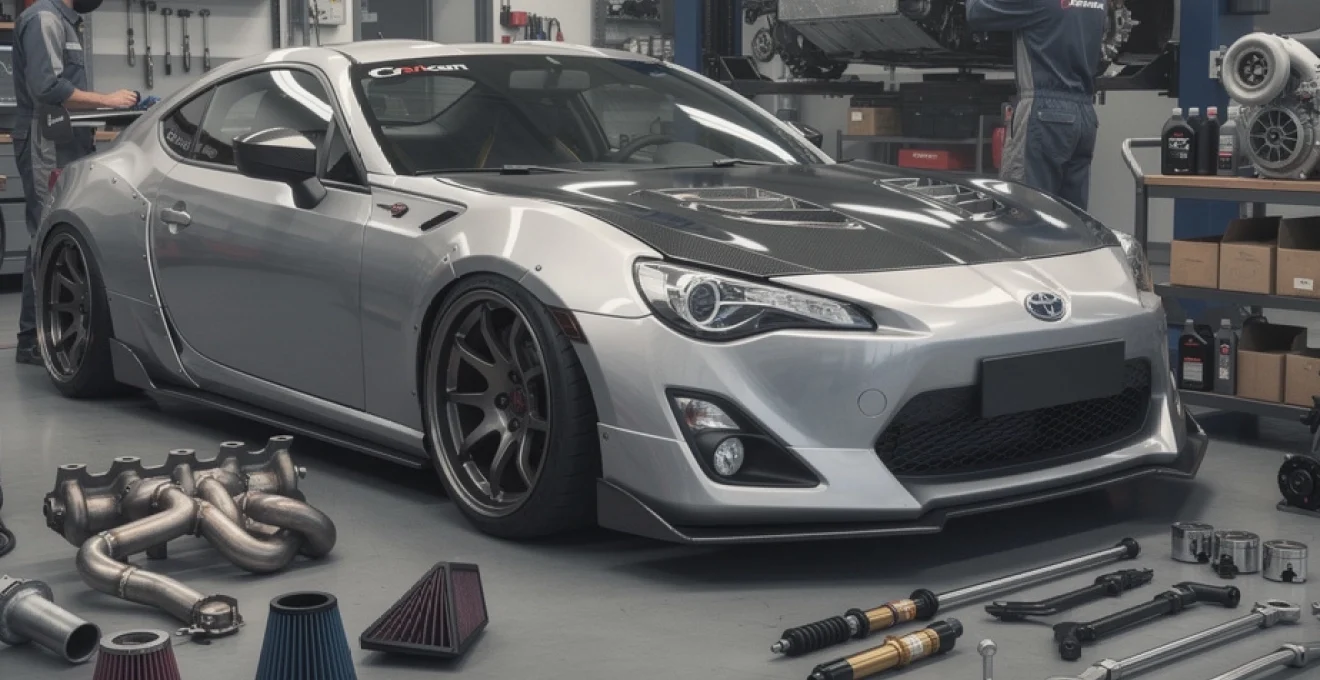
The Toyota FT-86 / GT86 / BRZ platform is one of the most rewarding modern sports cars to modify. Lightweight, rear-wheel drive and balanced straight from the factory, it reacts to changes like a proper driver’s car should. Spend money in the right places and you gain response, grip and reliability without ruining the playful character that makes the chassis so popular in club motorsport, drift and track days. Rush in with the wrong parts or poor setup and you can just as quickly create heat issues, drivability problems or a car that is noisy but no faster. Understanding how the FA20 engine, chassis and electronics work together is the key to building an FT-86 that feels cohesive, fast and robust on British roads and circuits.
Baseline preparation: essential maintenance and reliability checks before modding your toyota GT86 / FT-86
Inspecting FA20 engine weak points: RTV pickup, timing chain noise and valve spring recall verification
Before chasing more power from your FT-86, the FA20 engine deserves thorough health checks. Many cars now sit between 7 and 12 years old, so age-related issues are just as relevant as mileage. A known weak point is excess RTV sealant inside the sump from factory or previous work. If blobs of RTV break off and clog the pickup, oil starvation can occur under hard cornering – precisely the use case for a modified GT86. Dropping the sump, cleaning the pickup and fitting an upgraded oil pickup tube and baffle dramatically reduces this risk.
Timing chain tensioner noise on cold start also deserves attention. A brief rattle for one or two seconds is common, but sustained noise can hint at wear or oil pressure issues. Many experienced tuners recommend documenting the sound with a warm and cold video before any big power upgrades. The FA20 valve spring recall should also be checked via your Toyota or Subaru dealer history. If unsure, a call to a main dealer with the VIN is far cheaper than a dropped valve at 7,300 rpm.
Cooling system health check: radiator condition, water pump, thermostat and coolant bleeding on the FA20
Heat is the silent killer of tuned FA20 engines, especially on UK track days where 20–25 minute sessions are common. A blocked or corroded radiator, tired water pump or sticky thermostat can go unnoticed in daily driving yet push the car to the limit when you start using all 7,400 rpm frequently. Inspect the front of the radiator for bent fins or debris, check for crusty white deposits around hose joints and pay attention to any slow warm-up or fluctuating temperature behaviour.
Bleeding the FA20 cooling system properly is critical after any work. Air pockets near the heater core or heads can lead to localised hot spots. Using a vacuum fill tool or a careful bleed with the nose slightly raised, heater set to hot and the cap at the highest point helps purge bubbles. For cars that see repeated track use, many owners combine routine checks with a low-temperature thermostat and fresh high-performance coolant rated for track work, especially when paired with an oil cooler later on.
Differential, gearbox and driveshaft inspection on manual and automatic FT-86 models
The stock Torsen limited-slip differential is one of the FT-86’s strengths, but only if it still locks consistently. Clunks from the rear, whining under light throttle or “one-tyre-fire” behaviour when exiting tight corners can indicate worn fluid or mechanical wear. Fresh 75W90 GL-5 differential oil every 30–40,000 miles, or annually for a hard-driven track car, keeps the diff happy. Many drivers are surprised how much smoother engagement feels after a simple service.
Manual gearboxes respond well to high-quality 75W90 gear oil and a check of the shifter linkage bushings. Crunching into second or third can often be improved with fluid and bushing upgrades before considering more drastic action. Automatic FT-86 owners should not ignore transmission fluid; heat and age degrade it, especially if the car has seen spirited driving. Inspecting driveshaft CV boots for splits, listening for clicks on full lock and checking prop shaft centre bearings avoids unpleasant surprises once power and grip increase.
ECU and TCU software updates: checking for latest Toyota/Subaru calibration before aftermarket tuning
Before flashing any aftermarket map, confirming that the factory ECU (and TCU on autos) runs the latest calibration is wise. Toyota and Subaru periodically release updated software to refine idle quality, address cold-start behaviour, or improve knock control. Many tuners require a specific base revision for compatibility with modern tuning suites. Visiting a dealer for an ECU version print-out or update can solve rough running issues that owners sometimes blame on hardware.
Factory calibration also influences knock thresholds and how the ECU learns fuel trims. Starting from an up-to-date base makes subsequent ECU tuning more predictable and stable. On automatic models, TCU updates can improve shift logic, reduce hunting between gears and enhance torque converter behaviour, all of which become more obvious once torque is increased with bolt-ons or boost.
Engine breathing upgrades: intake, exhaust and header mods for NA FT-86 power gains
Cold air intake and panel filter options: HKS, blitz, K&N and stock airbox optimisation
The stock GT86 / FT-86 airbox flows surprisingly well up to around 230–240 bhp, so huge gains from an open cone filter are unrealistic. However, optimising the OEM intake and sound is still worthwhile. Many owners fit a high-flow panel filter from brands such as HKS, Blitz or K&N, then replace the serrated rubber induction hose with a smoother silicone pipe and delete the sound tube resonator. This cleans up the engine bay, removes the slightly synthetic cabin noise and gives a more natural induction note.
Dyno testing typically shows 2–3 bhp at the very top end with these intake tweaks on a tuned car, but the main advantage is throttle response and drivability when combined with a professional remap. Open “cold air intake” kits that relocate the filter can suffer from heat-soak in slow traffic, so airflow ducting and heat shielding matter more than brand names. For a fast-road naturally aspirated FT-86, a refined stock airbox with supporting parts is often the most effective solution.
Unequal-length vs equal-length exhaust manifolds: tomei UEL, HKS EL and torque dip reduction
The exhaust manifold (header) is the heart of NA power gains on the FA20. The stock manifold with primary catalytic converter creates the infamous mid-range torque dip. Replacing it with a high-flow cat or decat performance header can reduce or almost eliminate this flat spot, but design choice changes the character of the engine. Unequal-length (UEL) headers such as the popular Tomei design give the iconic Subaru “rumble” and a stronger punch from 3,000–4,500 rpm, ideal for street driving.
Equal-length (EL) headers from HKS and others favour a smoother exhaust pulse and slightly better top-end efficiency, often producing a few more horsepower above 6,000 rpm at the expense of that burbly soundtrack. Whichever route you choose, an ECU tune is mandatory to take advantage of the improved flow and maintain safe air–fuel ratios. Without tuning, gains are small and check-engine lights from catalyst efficiency codes are very likely.
Cat-back exhaust systems: invidia N1, milltek, greddy evo and UK noise regulations (MOT, track-day limits)
Once the header is addressed, a cat-back system mainly changes sound, weight and to a lesser extent flow. Popular choices such as Invidia N1, Milltek and Greddy EVO range from subtle to very aggressive. The key consideration for UK drivers is noise regulation. Many circuits now enforce 95–102 dB limits, and static tests at events like Goodwood or Bedford are notably strict. A very loud cat-back combined with a decat manifold can easily exceed these limits, forcing either swap-backs or bung usage.
From an MOT perspective, at least one working catalytic converter must remain in the system, and exhaust leaks or excessive noise can lead to failure. A resonated cat-back typically offers a deeper tone with less motorway drone, while non-resonated systems save a little weight but increase cabin boom. For a dual-use FT-86, a high-quality stainless resonated system paired with a sports cat manifold strikes an effective balance between sound and compliance.
High-flow catalytic converter and overpipe/frontpipe combinations for improved flow
Between the header and cat-back, the overpipe and frontpipe sections often remain overlooked. The factory overpipe is narrow and flattened near the subframe; aftermarket overpipes reduce back pressure and smooth the flow path, particularly useful for higher power or boosted applications. Frontpipes housing secondary cats or resonators can also be replaced with larger diameter high-flow catted units to maintain emissions control while increasing flow.
On a naturally aspirated build, the combined gains from header, overpipe and frontpipe typically reach 10–20 bhp once tuned, with a much fatter mid-range. More importantly, the engine breathes freely, reducing exhaust gas temperatures and allowing more aggressive ignition timing safely. Careful selection of catalyst location and cell density helps keep MOT compliance; a 200-cell high-flow cat placed far enough downstream is a common solution that balances performance and legality.
Integrating exhaust gas temperature (EGT) and wideband O2 sensors for safe tuning
As power increases, monitoring becomes more important than bolt-on hardware. Adding a dedicated wideband O2 sensor in the exhaust and, for higher-power builds, an exhaust gas temperature (EGT) probe, gives tuners accurate feedback on mixture and combustion heat. While the factory sensors allow the ECU to control closed-loop fuelling, they are not designed for the extended high-load monitoring that serious track work demands.
A quality wideband controller feeding data into a logging device or tablet-based dashboard allows you to see if AFRs drift during long stints. EGT sensors placed close to the collector can highlight dangerously lean running or ignition timing that is too aggressive. Think of these sensors as an early warning system: they do not add horsepower, but they help protect the horsepower you already paid for.
ECU tuning strategies: remaps, flex-fuel and knock control for the FT-86 FA20
Openflash tablet vs EcuTek vs MHD: comparing popular GT86 tuning platforms
Modern FT-86 tuning is dominated by three main platforms: OpenFlash Tablet, EcuTek and more recently MHD. Each suits a different type of owner. OpenFlash offers user-flashable off-the-shelf (OTS) maps via a handheld device, popular for budget-conscious drivers seeking a simple header and tune setup. EcuTek is widely regarded as the most feature-rich solution, with advanced boost control, flex-fuel integration and fine-grained logging; most high-end tuners use it for both NA and forced-induction packages.
MHD, well known in BMW circles, has entered the FA20 space with an emphasis on phone-based flashing and strong logging tools. The choice often comes down to tuner support in your region and long-term plans. For a basic NA build, any of the three can deliver a smooth 15–25 bhp gain with torque dip reduction. For complex turbo or supercharger projects, EcuTek’s mature feature set and safety strategies usually give it the edge.
Custom dyno tuning vs off-the-shelf (OTS) maps for stock and bolt-on FT-86 builds
Off-the-shelf maps are attractive because they are affordable and quick. For common combinations like UEL header, intake hose and cat-back, OTS tunes from reputable providers are generally safe if used with quality 97–99 RON fuel. However, every FT-86 is slightly different: age, injector health, sensor condition and regional fuel variation all affect the final outcome. A custom dyno tune tailors ignition timing, fuelling, AVCS cam phasing and throttle mapping to your specific car.
On a healthy FA20, custom tuning often unlocks an extra 5–10 bhp over OTS maps but, more importantly, improves drivability. Throttle response, part-throttle torque and hot-start behaviour are all refined. For cars that have seen extensive modification or hard track work, a custom session also allows thorough logging for knock, IAM and fuel trims, catching borderline issues before they escalate.
91/93 octane and UK 99 RON fuel maps: ignition timing, AVCS cam control and knock thresholds
Fuel quality fundamentally limits how much ignition advance and compression load an engine can tolerate. In North America, 91 and 93 octane maps are common; in the UK, 97–99 RON fuels such as Tesco Momentum and Shell V-Power offer more knock resistance. Tuners take advantage of higher octane by increasing timing in the mid to high load regions and optimising AVCS (variable cam timing) to improve cylinder filling without triggering knock.
Knock thresholds and feedback logic in the FA20 ECU use parameters such as IAM (Ignition Advance Multiplier), feedback knock and fine knock learn to adjust timing dynamically. Well-constructed 99 RON maps maintain IAM at or near 1.0 under normal conditions, with minimal learned knock. Running lower-grade fuel than the map expects will quickly show up as reduced IAM and more correction events, so aligning your tune with the fuel you actually use daily is essential.
Flex-fuel (E85) conversions: injectors, fuel pump upgrades and tuning considerations
Flex-fuel conversions using E85 or high-ethanol blends have become one of the most cost-effective ways to gain 30–40% more power on the FT-86 while remaining relatively safe at moderate boost levels. E85’s higher octane and cooling effect allow much more ignition advance and boost before knock. However, ethanol contains less energy per litre, so larger injectors and an upgraded in-tank fuel pump are mandatory to achieve the necessary fuel flow.
A flex-fuel kit typically uses a content sensor in the fuel line and an ECU strategy (usually via EcuTek) that interpolates between petrol and E85 maps based on ethanol percentage. This allows you to run anything from pure petrol to full E85, with the ECU adjusting fuelling, timing and boost accordingly. Real-world data from club racers consistently shows intake charge temperatures 10–20°C lower on E85 at similar boost levels compared with petrol-only setups, significantly improving reliability.
Data logging critical parameters: AFR, IAM, feedback knock, fine knock learn and oil temperature
Reliable power is impossible without good data. Logging key parameters after each tuning change, and periodically throughout the ownership of a modified FT-86, helps catch issues early. At a minimum, monitor AFR (air–fuel ratio), IAM, feedback knock, fine knock learn and oil temperature. AFR shows whether the engine runs safely rich under load; IAM and knock values indicate how often the ECU pulls timing due to knock events.
Oil temperature is equally important. The FA20 can exceed 120–130°C on track with stock cooling, which quickly degrades oil and reduces film strength. Many experienced drivers adopt a personal limit—such as backing off above 125°C—to protect the engine. Regularly reviewing logs after track days paints a clear picture of how the car behaves under sustained stress, informing future upgrades like larger radiators, oil coolers or intercoolers.
Forced induction kits: turbo and supercharger solutions for high-power toyota FT-86 builds
Positive displacement superchargers: edelbrock E-Force installation, boost levels and torque delivery
Positive displacement superchargers such as the Edelbrock E-Force transform the FT-86 into a torque-rich machine with instant response. These kits typically run 6–9 psi of boost on stock internals, delivering around 260–280 bhp at the crank on pump fuel. The characteristic of a roots or TVS blower suits road driving and sprint circuits where mid-range grunt out of corners matters more than peak numbers.
Installation requires careful routing of coolant lines, intercooler plumbing (where included) and often relocation of ancillary components. Because boost is almost linear from low rpm, tuning must pay particular attention to part-throttle knock and intake air temperature management. Many owners pair E-Force kits with an upgraded radiator and low-temperature thermostat to maintain consistent performance during summer sessions.
Centri supercharger systems: HKS GT supercharger, rotrex-based kits and high-RPM power curves
Centrifugal superchargers such as the HKS GT and Rotrex-based systems behave more like a belt-driven turbocharger. Boost rises with rpm, so low-end power remains close to stock, while top-end output climbs significantly. A well-set-up centri kit on the FA20 often produces 280–320 bhp with a strong charge from 5,000 rpm to the limiter, ideal for drivers who enjoy revving the engine and want a more OEM-like off-boost feel.
Because peak boost arrives at high rpm, these kits can be gentler on rods at low speed yet still demand strong fuelling and cooling at the top end. Oil cooler upgrades and premium 99 RON fuel become non-negotiable above about 300 bhp. Belt tension, bracket quality and alignment are critical; a slipping belt under load will show up as inconsistent boost in logs and should be rectified immediately.
Turbocharger kits: AVO, full blown, tuning developments and manifold/turbine sizing
Turbo kits from AVO, Full Blown, Tuning Developments and others offer the greatest power potential for the FT-86. Carefully chosen turbo sizing allows anything from a responsive 260–280 bhp road build to 450+ bhp time-attack cars. Smaller turbine housings and compressor wheels spool quickly but can create back pressure and heat at high rpm; larger units support more power but introduce lag.
For a dual-purpose fast-road and track car, many experienced tuners recommend a conservative setup in the 280–330 bhp range. This keeps exhaust gas temperature, cylinder pressure and drivetrain stress within sensible limits while still delivering a night-and-day difference from stock. Modern turbo technology, such as twin-scroll housings and ball-bearing cores, helps reduce lag and improve transient response, but packaging and heat management on the FT-86 remain serious engineering considerations.
Supporting mods for boost: forged internals, head gaskets, ARP head studs and oil cooler selection
Stock FA20 internals are generally comfortable up to around 280–300 bhp when tuned properly and driven sensibly. Pushing beyond that on a regular basis, especially for sustained track use, shifts the conversation towards forged pistons, stronger rods, upgraded head gaskets and ARP head studs. These components increase safety margins against detonation and high cylinder pressures, but they do not compensate for poor mapping or inadequate cooling.
An external oil cooler becomes vital once repeated 120°C+ oil temps are recorded on track. Plate-and-fin coolers sized in the 10–16 row range, mounted with good ducting, offer a sensible balance for most builds. Oversizing the cooler can lead to over-cooling on the road, so thermostatic sandwich plates help maintain appropriate viscosity and pressure. Together, these supporting modifications turn a boosted FT-86 from a fragile thrill into a durable performance car.
Boost control and safety: 3-port boost solenoids, MAP sensor upgrades and overboost protection
Controlling boost precisely is central to engine safety. Many turbo kits include a 3-port electronic boost control solenoid, allowing the ECU to manage target boost dynamically based on rpm, throttle position, gear and intake temperature. The standard MAP sensor, however, is limited in how much pressure it can read. Upgrading to a higher-range sensor ensures the ECU always knows what the engine is experiencing, particularly above 1 bar of boost.
Good tuners configure multiple layers of overboost protection: hard limits in the ECU, fuel cut thresholds and limp strategies in case of sensor failure. Logging actual vs target boost during early shakedown runs is essential. Any persistent overshoot or oscillation should be addressed mechanically or in the boost control strategy before pushing power higher, rather than being “tuned around” with excess fuel or reduced timing.
Chassis and suspension tuning: coilovers, alignment and bracing for FT-86 handling
Street and track-focused coilover kits: tein flex Z, BC racing BR, ohlins road & track
The FT-86 chassis responds brilliantly to high-quality coilovers, but spring rates and damping must suit your use case. Tein Flex Z kits provide an affordable, height-adjustable option for fast-road cars, with moderate spring rates and a comfortable ride. BC Racing BR coilovers target the track-day market, offering a broad range of adjustment and stiffer rates that suit semi-slick tyres when dialled in correctly.
At the premium end, Ohlins Road & Track kits use dual-flow valve technology to combine excellent body control with impressive ride compliance. On a bumpy UK B-road, this can make the difference between a car that skips and one that flows. Whichever brand you choose, aim for a sensible drop of around 20–30 mm; going much lower can hurt roll centre geometry and reduce suspension travel, actually making the car slower and less predictable.
Geometry setup: camber, caster and toe settings for fast-road, drift and circuit GT86 builds
An intelligent alignment is one of the best-value “mods” you can make. For a fast-road GT86 on performance tyres, a starting point of around -1.5° to -2.0° front camber, -1.5° rear camber, a touch of front toe-out and neutral rear toe offers sharper turn-in without excessive inner tyre wear. Drift setups may run less rear camber and more rear toe-out to encourage breakaway, while circuit-focused alignments usually adopt more negative camber front and rear to keep tyre temperatures even across the tread.
Caster affects steering feel and self-centring. Increasing caster slightly via top mounts or lower control arms can add stability at speed and more feedback mid-corner. Think of geometry as the fine-tuning of the car’s personality: you can make the FT-86 agile and playful or calm and planted depending on numbers chosen and how you use the car.
Adjustable top mounts, lower control arms and rear camber arms (cusco, SPC, hardrace)
The factory adjustment range on the FT-86 is limited, especially at the front where MacPherson struts rely on camber bolts for minor changes. For more serious builds, adjustable pillowball top mounts offer wider camber and caster tuning. Brands such as Cusco, SPC and Hardrace provide front lower control arms and rear camber arms with on-car adjustability, simplifying track-side alignment tweaks and corner-weighting.
Adjustable arms with high-quality spherical bearings sharpen steering response and reduce compliance, at the cost of slightly more NVH (noise, vibration, harshness). For a road-biased car, a mix of OEM rubber and polyurethane bushings is usually preferable; for competition use, the precision of spherical joints quickly becomes addictive once experienced.
Anti-roll bars and chassis bracing: whiteline, TRD and cusco options for roll and flex control
Anti-roll bars (sway bars) allow you to tune roll stiffness without resorting to excessively stiff springs. Whiteline, TRD and Cusco offer bars in various diameters with multiple adjustment holes. A stiffer rear bar can increase rotation on turn-in, while a stiffer front bar supports front-end grip under heavy load. Changes should be made in small steps, assessing tyre temperatures and driver confidence each time.
Chassis braces, particularly front strut tower braces and underbody reinforcement, help reduce flex and sharpen steering feel. The FT-86 comes with some bracing from the factory, but tying the top mounts together and adding strategic underfloor braces creates a more cohesive structure. The car feels as though it moves in one piece instead of twisting over mid-corner bumps, which is especially noticeable on sticky tyres.
Bushing upgrades: polybush vs spherical bearings for precision steering feedback
Rubber bushings provide isolation and comfort but allow the suspension to deflect under load. Polyurethane bushes reduce this deflection, giving more precise geometry control at the cost of slightly firmer ride and occasional noise. For most enthusiast FT-86 builds, a combination of front control arm, rear subframe and differential polybushes delivers a tangible improvement in feedback and traction.
For drivers chasing lap times, spherical bearings in key locations convert the FT-86 from a road car with track capability into a genuine club racer.
However, spherical joints transmit far more vibration and require periodic inspection. They suit those who value steering feel and consistency over NVH, such as Time Attack competitors or serious track-day regulars running slick or semi-slick tyres.
Wheel, tyre and brake upgrades: optimising contact patch and stopping power
Wheel fitment on GT86: 17 vs 18 inch, offset choices and clearing Brembo/Performance pack calipers
Wheel choice affects not just aesthetics but unsprung mass, gearing and tyre selection. Many FT-86 owners favour 17×8J wheels with ET35–40 offsets as a sweet spot between stance, clearance and weight. This size comfortably supports 225 or 235-section tyres without aggressive arch work and usually clears most off-the-shelf big brake kits. Moving to 18-inch wheels allows larger brake rotors and lower profile tyres but adds weight if not chosen carefully.
When planning a future Brembo or performance pack caliper upgrade, check spoke design and inner barrel diameter; some wheels with the right offset still foul bulky calipers. A fitment test or confirmation from other owners running the same combination helps avoid expensive mistakes. Lighter forged wheels reduce rotational inertia, improving acceleration and brake response noticeably, especially in third and fourth gear pulls.
Tyre compounds for UK roads: michelin PS4, yokohama AD08R, nankang AR-1 and wet grip vs track use
Tyres define how confidently you can use the chassis. Michelin Pilot Sport 4 and 4S provide outstanding wet grip and progressive breakaway, ideal for daily-driven FT-86s that also see the odd track day. Yokohama AD08R / AD09 and similar 200-treadwear tyres sit in the middle ground: more grip and heat tolerance for circuit work, but noisier and less effective in standing water.
Track-biased options like Nankang AR-1 or other semi-slicks deliver lap time but can be treacherous in heavy rain and take longer to warm up on the road. For most UK owners, a dual set-up works best: a high-quality road tyre for winter and commuting, and a dedicated track set on lighter wheels for summer events. This also extends the life of expensive rubber and gives flexibility in alignment, as track wheels can run more aggressive camber without ruining daily wear.
Big brake kits and pad choices: KSport, AP racing, wilwood and track-ready pad compounds
The standard GT86 brakes are adequate for road use but marginal on repeated hard track sessions. Big brake kits from KSport, AP Racing and Wilwood typically combine larger rotors, multi-piston calipers and performance pads to increase thermal capacity and pedal consistency. A 4- or 6-pot front kit with 330–355 mm discs dramatically reduces fade, especially on heavy circuits like Brands Hatch GP or Donington Park.
Pad choice is crucial. Street–track hybrid compounds offer strong cold bite and resist fade up to around 600°C, while full track pads operate happily above 700°C but often squeal and dust heavily on the road. Matching pad friction front-to-rear maintains balance; combining aggressive front pads with stock rears can cause early ABS intervention and unstable braking, particularly in wet conditions.
Braided brake lines, high-temp fluid and proper bleeding procedure on FT-86
Before jumping to a big brake kit, many FT-86 owners see substantial improvements from braided stainless brake lines, high-boiling-point fluid and meticulous bleeding. Braided lines reduce expansion under pressure, giving a firmer, more consistent pedal. Fluids rated DOT 4 or 5.1 with dry boiling points above 300°C, changed at least annually for track cars, resist fade far better than generic products.
A carefully executed brake service can transform pedal feel and confidence, even on completely stock hardware.
Bleeding in the correct sequence, tapping calipers gently to release trapped bubbles, and performing a short bedding-in procedure for new pads and discs ensures even transfer layers and avoids judder. Checking for pad taper and rotor hot spots after the first hard sessions helps catch caliper flex or slider issues early, especially as the fleet of GT86s continues to age.
Aero and exterior mods: functional styling for street, track and drift FT-86 builds
Front splitters, lips and canards: APR, TRD, valenti and reducing front-end lift
At motorway and circuit speeds, the FT-86’s clean shape generates noticeable front-end lift. Functional aero upgrades such as APR or TRD front splitters, combined with subtle canards, help create downforce and reduce high-speed float. Unlike purely cosmetic lips, a properly braced splitter extending a short distance forward can measurably improve stability in fast corners like Silverstone’s Maggots–Becketts complex.
However, road usability matters. A splitter sitting too low will meet speed bumps and ramps daily, so choosing a moderate drop and adding sacrificial skid blocks protects both aero and bumper. For drift-focused cars, canards also help manage airflow around the front wheels, improving smoke dispersion and steering feel when sideways at higher angles.
Rear wings and ducktail spoilers: voltex, TRD, rocket bunny and balancing aero loads
Aero balance is as important as total downforce. Adding a large rear wing without front changes can increase understeer at speed. High-quality options from Voltex, TRD and Rocket Bunny use proven profiles and sturdy mounts to generate real downforce rather than just drag. Mounted to the boot skin only, wings risk flex and inconsistency; chassis- or reinforcement-mounted designs transmit forces more effectively.
Ducktail spoilers sit between form and function. They typically add modest rear stability and reduce lift without the attention-grabbing presence of a full GT wing. For fast-road or mild track work, a ducktail paired with a front splitter provides a balanced package that still suits daily use and car park ramps.
Widebody kits and overfenders: rocket bunny V1/V2, pandem and wheel/tyre sizing integration
Widebody kits like Rocket Bunny V1/V2 and Pandem have become synonymous with extreme FT-86 styling. Beyond aesthetics, they allow significantly wider wheel and tyre setups—up to 9.5J or 10J widths with 255–265-section rubber on many builds. This increased contact patch transforms mechanical grip in both cornering and traction, particularly for boosted applications above 350 bhp.
Cutting factory arches and committing to riveted or bonded overfenders is a major step, so planning is essential. Wheel offset, tyre profile, lock-to-lock clearance and suspension travel must be modelled carefully. Too aggressive a fitment can lead to rubbing under compression or reduced steering angle, undermining the functional benefits that motivated the widebody install in the first place.
Bonnet vents, undertrays and diffuser setups for improved cooling and underbody airflow
Managing airflow through and under the FT-86 pays dividends for both cooling and stability. Bonnet vents placed in low-pressure regions behind the radiator help extract hot air, reducing underbonnet temperatures and assisting radiator efficiency. Careful positioning avoids feeding hot air directly into the intake path, especially on turbocharged cars where charge temperatures are already a concern.
Flat undertrays and rear diffusers help clean up turbulent underbody airflow, reducing lift and drag. While many aftermarket diffusers are mostly cosmetic, designs that extend forward beneath the fuel tank and rear subframe, combined with modest rear rake, can generate real benefits. Together with side skirts and a front splitter, a coherent aero package makes the FT-86 feel more composed at the higher speeds that serious engine modifications enable.
Interior, seats and driver interface upgrades for the toyota GT86 / FT-86
Buckets and recliners: recaro, bride and seat rail selection for correct driving position
The interface between you and the GT86 is as crucial as dyno numbers. Fixed-back bucket seats from Recaro or Bride hold you firmly in place during heavy cornering, allowing more delicate steering and pedal inputs. For cars that see daily duty, high-quality reclining sports seats offer improved lateral support without sacrificing rear access and comfort. Height and tilt adjustment via appropriate seat rails ensure that sight lines to the road and instruments remain ideal.
A lower seating position reduces the effective centre of gravity and improves helmet clearance for tall drivers using roll bars or cages. Many owners underestimate how much faster and more confident they feel once they are no longer bracing against the steering wheel or door during hard driving, especially on circuits with long, loaded corners like Oulton Park or Cadwell Park.
Steering wheel, quick-release hubs and short-shifter kits for precise driver input
A quality steering wheel with appropriate dish and diameter tightens the connection between driver and chassis. Moving from the stock wheel to a smaller suede or leather wheel can speed up inputs and improve grip, especially with gloves. Quick-release hubs add security and ease of entry, though they must not compromise the integrity of the steering column or airbag systems where required by law or regulation.
Short-shifter kits and upgraded linkage bushings reduce throw and notchiness in the FT-86’s manual gearbox. When combined with firmer engine and transmission mounts, the result is a precise, mechanical shift feel that encourages accurate gear changes at high rpm. For track work, this reduces the risk of missed shifts or money-shifts that could damage the FA20 at elevated power levels.
Data display and logging: P3 gauges, AIM solo, tablet-based dashboards via OBD-II
Modern data solutions make it far easier for you to monitor the health of a modified Toyota GT86 in real time. Discreet P3-style gauges that occupy an air vent, AIM Solo lap timers mounted on the dash and tablet-based dashboards reading from the OBD-II port all provide live insight into vital parameters. Commonly monitored channels include oil temperature, coolant temperature, intake air temperature, knock correction and lambda.
Think of a well-configured data display as a second set of eyes, quietly tracking what the car is doing while you focus on the road.
For track driving, overlaying lap data with video allows you to correlate driver inputs with vehicle behaviour, helping refine lines, braking points and throttle application. Over time, this feedback loop often delivers larger improvements in lap time than another small hardware upgrade.
Roll bars, half-cages and harness mounting for track-day and time attack GT86s
As speeds and grip levels increase, occupant protection and harness mounting points become critical. Rear bolt-in roll bars or half-cages designed specifically for the FT-86 provide strong anchor points for 4-, 5- or 6-point harnesses while adding rollover protection. Proper installation that ties into structural points rather than thin sheet metal is essential to ensure effectiveness in an impact.
Harness bars without additional bracing can position belts correctly but offer little structural benefit. For regular track-day use, a high-quality half-cage with door bar options strikes a good balance between safety, stiffness and practicality, still allowing limited rear storage or even occasional seating in some designs. Padding on any bar within head-strike range and adherence to motorsport regulations ensure that safety upgrades genuinely protect rather than introduce new risks.