
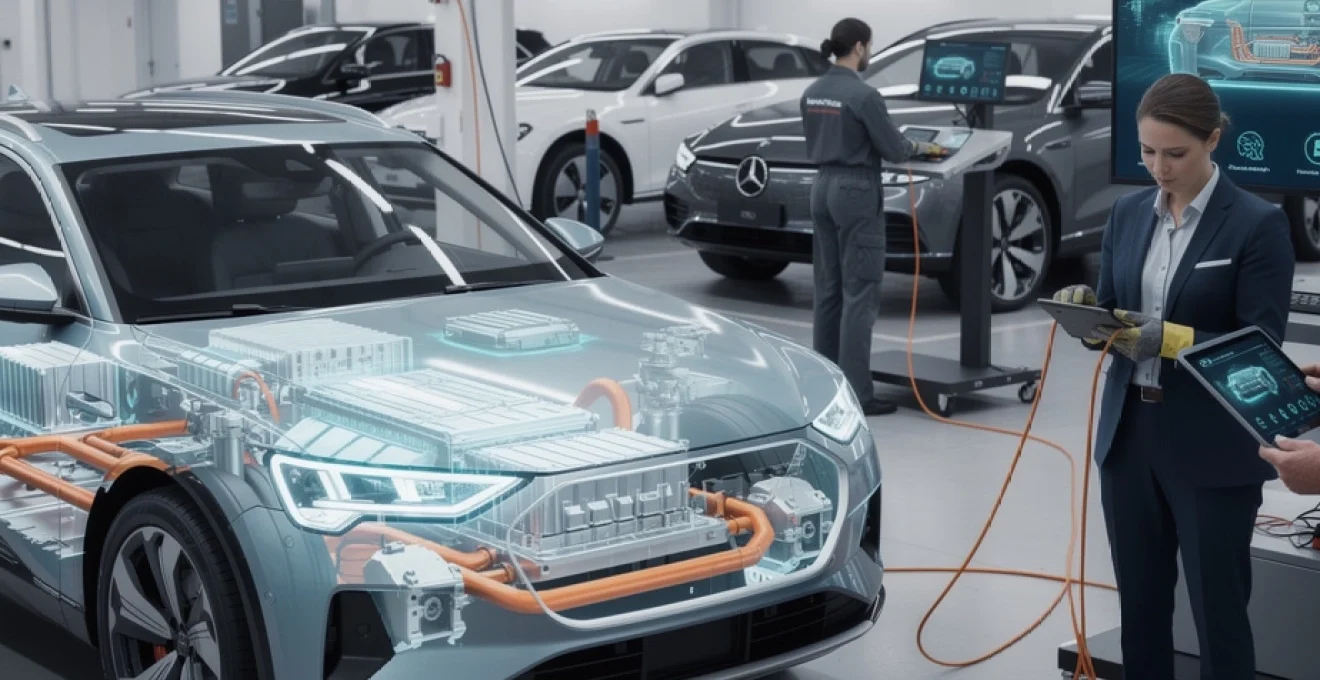
The high-voltage battery is the heart of an Audi e-tron, yet for many drivers it is also the least understood component. A clear view of the Audi e-tron battery warranty can make the difference between buying confidently and worrying about every percentage of range loss. As electric cars move from early adopters to the mainstream in the UK and Europe, questions around battery lifespan, degradation and repairability are appearing in almost every serious EV purchase conversation.
The Audi e-tron platform uses advanced lithium-ion technology designed for more than a decade of service life, but like a smartphone or laptop, capacity does decline over time. The key point for you is how far Audi stands behind that battery: in legal terms, in practical dealer processes, and in real-world cases where drivers have seen problems. Understanding where the warranty draws the line between normal ageing and a defect helps you judge risk, negotiate used car prices and look after your own car day to day.
Audi e-tron high-voltage battery warranty: core terms, duration and mileage limits
Standard 8-year / 160,000 km audi e-tron battery warranty parameters in the UK and europe
For UK and most European buyers, the Audi e-tron high-voltage battery is covered by a dedicated warranty of 8 years or 160,000 km (100,000 miles), whichever comes first. This sits alongside the standard vehicle warranty of up to 3 years or 60,000 miles, but has distinct terms and conditions. The coverage is designed around typical private use: industry data shows that average annual mileage for EVs in Europe is around 10,000–15,000 km, so the time limit is usually reached before the distance limit.
Within that 8-year window, Audi undertakes that the traction battery will retain at least a defined minimum capacity and will remain free from manufacturing defects. That commitment is similar in principle to the way the base vehicle is warranted against defects in manufacture and workmanship, but with EV-specific criteria for the battery pack. Any repair or replacement work is carried out at an Audi Centre and must follow strict high-voltage safety procedures using Audi Genuine Parts and trained high-voltage technicians.
A useful detail for you as a future seller: this EV battery warranty is transferable. If the car is sold, the remaining balance of the 8-year / 160,000 km coverage passes to the new owner automatically, provided the terms have been respected. For an Audi Approved Used e-tron under 8 years old, a multipoint check and battery health certificate are typically provided, which gives buyers a clearer view of remaining capacity and SoH when comparing new and used electric vehicles.
State of health (SoH) and capacity retention thresholds for audi e-tron traction batteries
The crucial metric for warranty assessment is the battery’s State of Health (SoH). SoH expresses remaining usable capacity as a percentage of the original battery capacity when new. Under Audi UK’s current policy, if the e-tron’s battery is measured by an Audi Centre and found to be below 70% of its original capacity during the 8-year / 160,000 km period, Audi will repair or replace components so that the pack returns to at least 70% of the starting value, subject to full warranty terms and exclusions.
Why 70%? Data from hundreds of thousands of EVs worldwide suggests that most modern lithium-ion packs lose roughly 2–3% capacity in the first year and then around 1–2% per year afterwards, depending on use. Hitting 70% capacity within 8 years would usually indicate a defect or abnormal degradation pattern rather than simple age. Audi Centres can carry out a high-voltage battery health check, generating a formal SoH value that is recorded on a battery health certificate for new or Approved Used electric Audi models.
SoH is different from day-to-day state of charge (SoC). SoC is like the fuel gauge, while SoH is closer to the size of the fuel tank. An e-tron with reduced SoH will still charge to 100% on the dashboard, but that 100% represents a smaller absolute energy content, reducing real-world range. Audi’s warranty focuses on that underlying capacity, not the displayed SoC.
Coverage differences between audi e-tron 55 quattro, e-tron 50 quattro and e-tron sportback variants
From a warranty perspective, the main e-tron 55 quattro, e-tron 50 quattro and e-tron Sportback models all sit under the same high-voltage battery warranty framework in the UK and wider Europe. The 95 kWh battery used in early e-tron 55 and Sportback models, and the slightly smaller pack in some e-tron 50 variants, are each engineered with repairability in mind: up to 100% of battery components are designed to be repairable under normal use conditions.
Where differences do appear is in efficiency and range. Early 2019–2020 e-tron SUVs and Sportbacks saw EPA-rated ranges around 204–218 miles, with real-world used data showing maximum ranges between roughly 163 and 236 miles for most owners, and outliers as low as 88 and as high as 279 miles. In 2020 and again in 2021, software updates and redesigned auxiliary systems unlocked more usable capacity from the same physical pack, adding around 12 miles of range in some cases. These changes do not alter the warranty duration, but they influence how capacity tests are interpreted, because the reference “starting value” is based on the official usable capacity for that specific variant and software level.
From a buyer’s point of view, the key message is that an e-tron 55 quattro, a 50 quattro or a Sportback of the same age all benefit from the same time and mileage coverage, the same 70% capacity threshold, and the same diagnostic process. What changes between variants is the initial range and efficiency, not how Audi handles a warrantable battery fault.
Warranty start date, first registration and in-service date: how audi defines the coverage period
Understanding exactly when the 8-year clock starts matters, especially when buying used. For a new Audi e-tron, the battery warranty normally begins on the in-service date, often the same as the first registration date. That date is recorded in Audi’s systems and determines the end of both the general vehicle warranty and the high-voltage battery warranty.
For an Audi Approved Used e-tron, the battery warranty does not restart; instead, the remaining balance of the original 8-year period carries across. For example, a 3-year-old e-tron will typically have 5 years of battery warranty remaining, assuming mileage is under 160,000 km. The additional 12 months’ Approved Used Warranty that comes with many used Audis covers a range of mechanical and electrical components, but does not typically extend the original high-voltage battery degradation warranty.
All-in from Audi and Audi Extended Warranty products add further layers of protection for out-of-warranty vehicles, but these plans are structured mainly around the base car, engine-equivalent systems and electronics. Where battery cover is included, it is usually limited or explicitly excludes degradation. As a practical tip, checking the warranty start date on Audi’s system before purchasing a used e-tron helps you understand exactly how many months of high-voltage coverage remain.
What the audi e-tron battery warranty actually covers: components, failure modes and exclusions
High-voltage cell modules, battery management system (BMS) and cooling circuit components under warranty
The e-tron’s high-voltage battery is a complex assembly of individual cell modules, a structural case, cooling plates and coolant lines, plus a sophisticated Battery Management System (BMS). Under the 8-year warranty, Audi covers manufacturing defects in these factory-fitted components, provided the car has been used and maintained correctly. That includes cell modules themselves, as well as current sensors, voltage taps and BMS control units necessary for safe operation.
Most components are intended to be replaceable at module or sub-module level, rather than resorting to a complete pack swap. The battery has been designed so that in typical failure scenarios, only specific sections need intervention. Audi’s technical literature notes that 100% of electric Audi vehicle battery components are designed to be repaired when subjected to normal use, reducing waste and repair costs compared with a full replacement.
The sealed cooling circuit, including coolant distribution elements attached to the battery, is also part of this high-voltage ecosystem. Failures due to manufacturing defects in the cooling components that directly affect the traction battery’s performance or safety can be covered, whereas external damage or corrosion from misuse may fall outside the warranty.
Covered failure modes: internal short circuit, cell imbalance, rapid degradation and BMS faults
What kind of problems actually trigger a valid e-tron battery warranty claim? The most common covered failure modes fall into a few categories. Internal cell defects, such as micro short circuits, can cause localised heating, faster-than-normal degradation or sudden voltage drops under load. The BMS may detect these events as abnormal cell voltage spreads, flagging a high-voltage system fault or restricting power to protect the pack.
Another covered scenario is rapid, unexplained capacity loss. If an e-tron loses significantly more capacity than expected based on age, mileage and usage, and a formal SoH test at an Audi Centre records a value below 70% during the warranty period, Audi may approve partial module replacement or, in rarer cases, a complete battery swap. BMS hardware or software faults that cause incorrect cell balancing, misreported SoC, or repeated limp-mode events can also be considered manufacturing defects.
Think of the BMS as the “operating system” of the battery. Just as a corrupted operating system can cripple a computer even if the hardware is fine, a faulty BMS can render an otherwise healthy pack unusable. Under warranty, such BMS failures are treated distinctly from normal ageing processes, and technicians will follow structured diagnostics to determine root cause.
Exclusion criteria: collision damage, water ingress, misuse, tuning and unauthorised software modifications
The Audi e-tron battery warranty is robust, but not unlimited. A central exclusion is improper use, handling or maintenance of the high-voltage battery. If defects are traced to misuse or external factors, the warranty can be voided. Examples include collision damage that distorts the battery housing, significant water ingress linked to flooding or off-road misuse, and fire damage not linked to a covered manufacturing defect.
Behavioural misuse also matters. Repeatedly operating the car outside specified limits, such as unauthorised towing, extreme track use or ignoring critical warnings, can provide grounds to decline a claim. Unauthorised software modifications, “tuning” of the power electronics, or third-party attempts to alter the BMS or charging behaviour may also invalidate the battery warranty. From Audi’s perspective, such modifications alter how the pack is stressed and charged, making it impossible to guarantee performance.
Environmental regulations also come into play. Under The Waste Batteries and Accumulators Regulations 2009 in the UK, batteries must be taken back free of charge when requested, and Audi Centres work to ensure high-voltage batteries are disposed of or recycled properly. This responsibility does not extend to covering damage caused by external events like floods; instead, those risks usually fall under insurance rather than warranty.
Degradation vs defect: how audi and dealers distinguish normal wear from a warrantable battery fault
Every lithium-ion battery degrades. The art lies in distinguishing normal degradation from a genuine defect. Audi and its dealers approach this using objective SoH measurements, error code logs, and charging and usage history where available. A typical EV in temperate climates might retain around 90–95% capacity after 3 years and 80–85% after 8–10 years, depending on use. If an e-tron’s measured SoH at 5 years is, for example, 88%, that pattern is usually treated as normal wear and not warrantable.
By contrast, if an e-tron shows 65% capacity at 4 years and 60,000 miles, technicians will look closer. They will consider whether the car has spent most of its life at 100% SoC, has been fast-charged multiple times daily, or operated in extreme climates. Even then, the 70% threshold is the guiding line. If SoH is above 70%, capacity loss is almost always classified as normal ageing. If it is below 70% and no exclusions apply, it is treated as a defect for warranty purposes.
This distinction is similar to tyre wear: a tyre worn out after 60,000 miles is normal, while one falling apart after 5,000 miles on gentle driving would indicate a fault. For you as an owner, the lesson is clear. Expect some capacity loss; the warranty is there for abnormal or excessive loss, not for returning a 7-year-old battery to “as new” performance.
Audi e-tron battery warranty vs general vehicle warranty and audi extended warranty products
A new Audi of any powertrain type comes with up to 3 years or 60,000 miles of general manufacturer warranty in the UK. This base warranty covers defects in manufacture and workmanship across factory-fitted components, including labour, and can be extended to 4 or 5 years at purchase for an additional cost. For fully electric cars, Audi layers the 8-year / 100,000-mile high-voltage battery degradation warranty on top, while plug-in hybrids usually receive 5 years or 100,000 miles of specific battery cover.
Once the original general warranty expires, you can opt into an Audi Extended Warranty, with three levels of cover: Extended Warranty Essentials, Extended Warranty Standard and Extended Warranty Plus. These products are priced according to vehicle model, age, expected annual mileage and chosen excess. They focus on mechanical and electrical failures in components like motors, suspension, infotainment and driver-assistance systems, and guarantee the use of Audi Genuine Parts and Audi Trained Technicians.
However, it is important to understand that most extended warranty products treat high-voltage batteries differently from the rest of the car. The original 8-year / 160,000 km battery warranty remains the primary protection for degradation and cell defects. Extended Warranty plans may cover associated electronics or systems, but they rarely extend the capacity retention guarantee beyond the factory 8-year term. If budgeting for long-term ownership, it is worth mapping out where the general warranty ends, where Extended Warranty starts, and where the battery warranty still applies independently.
Real-world examples of audi e-tron battery warranty claims and dealer diagnostics
Diagnostic workflow: guided fault finding (GFF), ODIS reports and high-voltage safety checks
Behind every accepted or rejected e-tron battery warranty claim lies a structured diagnostic workflow. Audi Centres use a factory diagnostic suite known as ODIS (Offboard Diagnostic Information System) which incorporates Guided Fault Finding (GFF) routines. When you report a suspected battery issue—such as sudden range loss, repeated charging failures or high-voltage system warnings—the technician connects ODIS, retrieves fault codes and follows GFF steps tailored to the e-tron platform.
High-voltage safety checks come first. Technicians isolate the battery, confirm safe voltage levels and inspect external connectors, coolant lines and visible housing. ODIS then records cell voltages, temperature distributions and BMS event logs. In some cases, a controlled capacity test is carried out, charging the battery to a defined level and then discharging under known conditions to measure usable energy. All of this data is compiled into a report that is submitted to Audi technical support for authorisation if a warranty claim is being considered.
This process ensures that decisions are evidence-based. Rather than relying on anecdotal impressions of “my range feels lower”, the dealer and Audi UK work with quantified SoH readings, error histories and usage profiles. For you, it means that preparing accurate information on your charging habits and any recurring symptoms will help technicians reach a faster, fairer conclusion.
Case study: early-capacity-loss claim on an audi e-tron 55 quattro and how audi assessed SoH
Consider a typical scenario reported in EV owner communities: a 3-year-old Audi e-tron 55 quattro, with around 40,000 miles on the clock, presenting with noticeably reduced motorway range. The owner previously saw around 200 miles at 100% charge in mild weather, now reduced to 160–170 miles under similar conditions. Concerned about early capacity loss, the owner books a battery health check at an Audi Centre.
During diagnostics, ODIS logs show no critical high-voltage faults. A formal SoH test returns a figure of 86%, consistent with moderate but not abnormal degradation for the age and mileage, especially given the owner’s heavy use of DC rapid charging. The dealer explains that, while the drop in day-to-day range is real, the battery remains above the 70% threshold and therefore does not qualify for a warranty repair.
This case illustrates how range changes alone rarely decide a claim. Temperature, speed, tyre choice and driving style all influence real-world consumption. Audi bases its assessment on measured SoH, not subjective range impressions. For transparent communication, some dealers now offer printed SoH certificates showing baseline values, giving you a documented reference if future degradation accelerates.
Partial pack replacement vs complete high-voltage battery swap under warranty
In more serious cases—such as a failed module causing frequent high-voltage errors or a SoH reading of, say, 65% at 5 years—Audi may authorise physical intervention. The preferred route is typically partial pack replacement: removing and replacing only the defective cell modules or sub-assemblies. This aligns with Audi’s design goal that all e-tron battery components should be repairable after normal use.
Partial replacement has several advantages. It reduces cost, shortens repair time and avoids scrapping a mostly healthy pack. Industry estimates suggest that module-level repair can be significantly cheaper than a complete pack swap, sometimes by more than 50%. After such work, the pack is rebalanced and recalibrated using ODIS routines to ensure stable performance.
Complete pack replacement is relatively rare and usually reserved for severe damage or complex internal faults that make module-level repair impractical. Examples include major internal short circuits, irreparable housing damage, or multi-module defects. After replacement, the new pack inherits the remaining warranty period of the original battery, not a fresh 8-year term, which is a subtle but important detail if the car is already several years old.
Warranty authorisation: audi UK technical support, photo documentation and cost approvals
Any major high-voltage battery work under warranty requires approval from Audi technical support and, in many cases, from Audi UK or the relevant national organisation. Dealers submit a detailed dossier: ODIS logs, SoH reports, photos of physical damage or corrosion (if any), and a costed repair proposal. High Voltage Specialist Centres may also become involved if specialist tooling or deeper diagnostics are necessary.
Authorisation workflows are designed to ensure consistency across the dealer network. Two similar cases should receive similar treatment, regardless of geography. For large claims, such as a full pack replacement, manufacturers typically require extensive photographic evidence and sometimes even physical component return for further analysis. This feedback loop helps Audi refine future battery designs and software strategies, especially as newer e-tron models and the Q4 e-tron enter the market with different cell chemistries and pack architectures.
From your perspective, this means warranty decisions might not be instantaneous. Complex claims can take days or weeks while data is reviewed and approvals are granted. Keeping records of servicing, charging habits and any previous related repairs can help support your case if a borderline situation arises.
How to protect your audi e-tron battery warranty through correct operation and maintenance
Protecting an Audi e-tron battery warranty is about more than simply avoiding misuse; it is about adopting habits that support long-term battery health. Audi explicitly notes that driver behaviour can influence lifespan, and that AC charging is often better for the battery than frequent DC rapid charging. That does not mean avoiding DC altogether, but using it judiciously—mainly on longer journeys where rapid charging is essential for convenience.
Charging targets are another powerful tool. For everyday use, many e-tron drivers set a maximum charge of 80% using the MMI interface. This leaves “headroom” in the pack and reduces the stress associated with keeping cells at high SoC. For long trips, raising the target to 100% shortly before departure is recommended, as it maximises available range while limiting time spent at the highest SoC levels. This pattern aligns with best-practice advice across the EV industry.
Temperature management also matters. Where possible, parking in shade during heatwaves, avoiding repeated 0–100% cycles, and using preconditioning to warm or cool the cabin while plugged in will all help limit stress on the pack. Some e-tron models offer battery preconditioning as part of winter packages, improving efficiency and reducing cold-weather strain. Regular servicing at an Audi Centre ensures that any early signs of coolant leaks, connector corrosion or software anomalies are caught before they risk voiding warranty coverage.
- Use predominantly AC charging at home or work for routine top-ups to protect long-term battery health.
- Set daily charge limits around 80% and reserve 100% charges for longer journeys or specific needs.
- Follow Audi’s recommended service schedule and record all work at authorised Centres to maintain full warranty validity.
Think of battery care like caring for a high-end mechanical watch: it will keep working with neglect, but correct handling and periodic checks preserve value and reliability. For used buyers, asking for the latest battery health certificate and any previous SoH measurements is a practical way to verify that previous owners have followed similar principles.
Comparing audi e-tron battery warranty with tesla, BMW ix and mercedes EQC coverage
How does the Audi e-tron battery warranty stack up against other premium EVs? The overall 8-year / 160,000 km pattern is broadly aligned with the segment. Tesla, for example, offers between 8 years/100,000 miles and 8 years/150,000 miles on Model 3 and Model Y batteries depending on variant, typically with a similar 70% capacity retention guarantee. BMW’s iX and other BMW i models carry an 8-year / 160,000 km high-voltage battery warranty, again with around 70% capacity assurance in most markets.
Mercedes-Benz EQC and newer EQ models follow a comparable strategy, usually offering 8 years and up to 160,000 km of coverage. Where Audi differentiates itself more clearly is in the emphasis on repairability—designing the e-tron battery such that 100% of components are repairable in normal use. This aligns with a wider industry trend, accelerated by EU sustainability regulations, towards modular, repairable battery packs rather than sealed “throwaway” units.
| Brand / Model | Battery warranty duration | Mileage / km limit | Capacity retention threshold |
|---|---|---|---|
| Audi e-tron (SUV & Sportback) | 8 years | 100,000 miles / 160,000 km | Approx. 70% SoH |
| Tesla Model Y | 8 years | Up to 120,000 miles (variant dependent) | 70% battery capacity |
| BMW iX | 8 years | 100,000 miles / 160,000 km | Approx. 70% SoH |
| Mercedes EQC | 8 years | Approx. 100,000 miles / 160,000 km | Approx. 70% SoH |
Recent developments, such as software-enabled range boosts for 2019–2020 e-trons and net-zero-certified factories for some Audi EV production, show that manufacturers are increasingly treating battery performance and sustainability as a long-term promise rather than a short-term selling point. For you as a buyer or owner, the key comparison is not only the headline years and miles, but how accessible diagnostics are, how transparent SoH reporting is, and how practical repairs are once a claim is accepted.
As EV adoption accelerates across Europe, used battery health is becoming a central factor in valuation, much like service history and timing belt changes were for combustion cars. Understanding how the Audi e-tron battery warranty works, what the 70% threshold really means, and how your daily charging habits feed into long-term capacity gives you a tangible edge when choosing between an e-tron, a Tesla, a BMW iX or a Mercedes EQC, especially in a rapidly evolving electric vehicle market.