
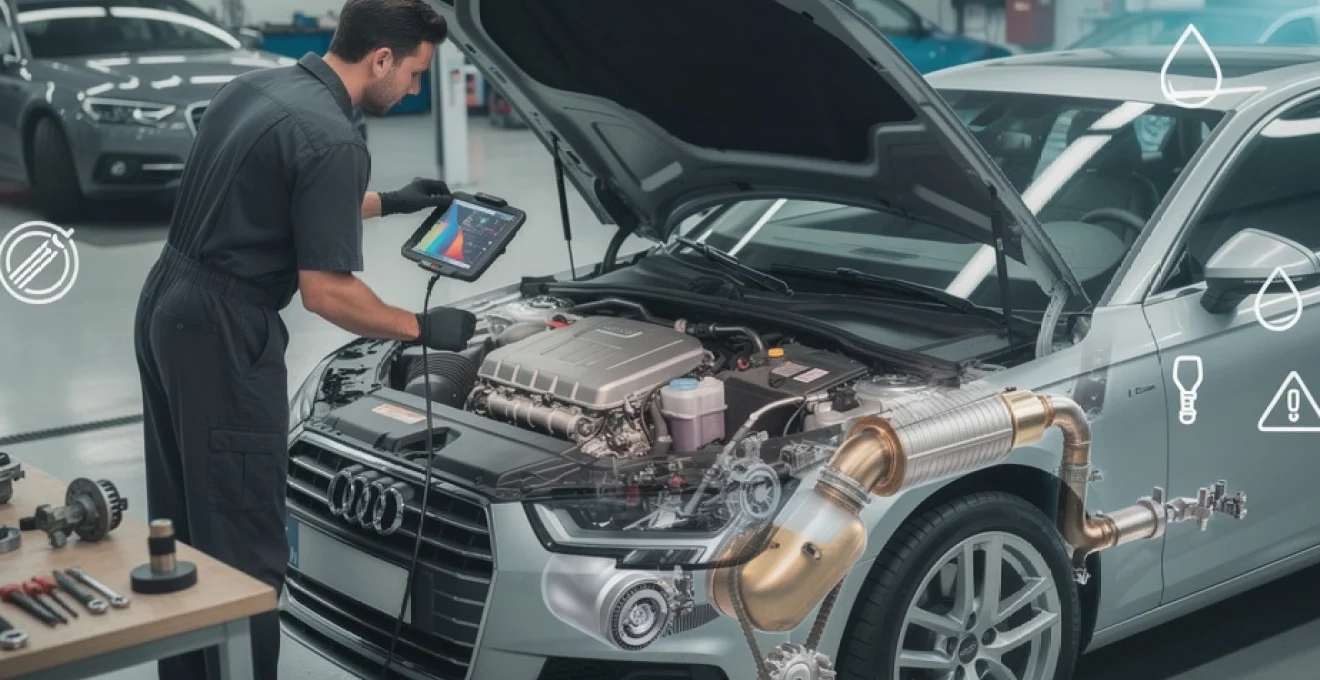
The Audi A4 2.0 TDI has become a default choice for drivers who want premium refinement with diesel economy. In saloon and Avant form, it can comfortably exceed 50 mpg on a long run, yet still deliver enough torque for relaxed motorway cruising and confident overtaking. For many owners, the same car has to cover high annual mileages, commute in traffic, and stay reliable well past 100,000 miles. Understanding how the different generations of 2.0 TDI work – and where they fail – is the key to choosing the right model and looking after it properly so that you are not budgeting for a new engine or gearbox at 150k miles.
Audi A4 2.0 TDI engine overview: EA188 vs EA189 vs EA288 generations
Engine codes and variants: BRD, BPW, CAGA, CGLC, CJCA, CNHA and others in the audi A4 B7, B8 and B9
The Audi A4 has used several generations of 2.0 TDI engine across the B7, B8 and B9 platforms. Early B7 cars (roughly 2004–2008) used the EA188 unit with engine codes such as BRD, BPW and BLB. These are the well-known 140 PS pump‑duse engines with balance shaft modules and an external oil pump drive – very strong when maintained, but with some notorious weak points discussed later.
The B8 A4 (2008–2015) introduced the EA189 common‑rail 2.0 TDI with codes like CAGA, CAGB, CGLC, CJCA and CGLD. Outputs ranged from 120 PS to 177 PS, with significantly smoother refinement and better real‑world fuel economy. These engines are often considered the sweet spot for a used A4 diesel when paired with a manual or S tronic gearbox and a strong maintenance history.
The B9 A4 (from 2015) moved to the EA288 generation, with units such as CNHA, DEUA and DFBA. These 2.0 TDIs deliver 150–190 PS, more sophisticated emissions control and quieter running. However, they are also more complex, with integrated exhaust aftertreatment, more sensors and tighter emissions calibration, especially on SCR‑AdBlue models.
Common-rail vs pump‑duse (PD) injection systems in 2.0 TDI applications
Early A4 2.0 TDI engines used the pump‑duse (PD) system, where each injector has an integrated high-pressure pump driven by the camshaft. This design allows very high injection pressures (over 2000 bar) but puts extra stress on the cam lobes and requires precise oil quality. PD engines like the BRD and BPW have a distinctive clatter at idle and a strong mid‑range “thump” of torque when the turbo spools.
The move to common‑rail (CR) on EA189 and EA288 unified fuel pressure in a shared rail, with either piezo or solenoid injectors metering fuel. This allowed multiple injection events per stroke, far finer control of combustion, and a large reduction in noise and NOx emissions. From a driver’s point of view, CR 2.0 TDIs feel smoother, quieter and more linear, especially in the 140–177 PS CAGA and CGLC engines that many buyers specifically seek out for daily use.
From a reliability perspective, PD engines can suffer from cam wear and injector issues, while early CR units had some injector recalls and high‑pressure fuel pump failures. However, the later CR engines, if run on correct low‑ash oil and serviced frequently, tend to offer the best blend of durability and refinement for an Audi A4 daily driver.
Euro 4, euro 5 and euro 6 emissions standards and their impact on 2.0 TDI design
Emissions standards heavily shaped how the Audi A4 2.0 TDI evolved. Euro 4 compliant A4 B7 models typically used a simpler EGR system and, in many markets, ran without a diesel particulate filter (DPF). This simplicity often translates into fewer expensive emissions‑related repairs, making late B7 cars attractive if you cover high motorway mileages.
Euro 5 brought widespread DPF fitment on A4 B8 2.0 TDIs, along with more sophisticated EGR control and higher injection pressures to cut NOx and soot. By around 2010, almost all 2.0 TDI A4s were DPF‑equipped. For drivers doing mainly short journeys, this change is critical: frequent cold starts and low‑speed use can prevent DPF regeneration, leading to clogging and limp mode.
Euro 6 in the B9 era added SCR‑AdBlue systems on most 2.0 TDIs. This technology injects urea solution into the exhaust to convert NOx into harmless nitrogen and water, allowing leaner combustion without breaking regulations. The trade‑off is increased complexity: AdBlue tanks, heaters, pumps and NOx sensors add more potential failure points, especially as cars age beyond their initial warranty periods.
Power and torque ranges: from 120 PS to 190 PS in saloon, avant and quattro models
Across B7, B8 and B9 generations, the A4 2.0 TDI covers a wide power spread while retaining broadly similar economy. Early PD A4s offered 136–140 PS with around 320 Nm of torque, enough for a 0–62 mph time in the low 10 seconds range. Quattro variants typically ran slightly higher outputs and different gearing to cope with extra weight and drivetrain losses.
B8 common‑rail cars brought 120 PS entry‑level versions (ideal for company car use or budget‑conscious buyers), 143 PS and 150 PS mid‑spec models, plus higher‑output 163 PS and 170–177 PS variants. Torque climbed to around 350–380 Nm, giving relaxed motorway performance even when fully loaded. Many drivers report real‑world consumption of 50–60 mpg on long distances, especially with the 143 PS CAGA engine.
The B9 EA288 2.0 TDIs deliver 150–190 PS and up to 400 Nm in some quattro S tronic saloons and Avants. Despite stronger performance, WLTP figures and independent road tests show these engines can still average over 55 mpg in mixed driving. This blend of power, torque and economy is one reason the 2.0 TDI remains popular with high‑mileage private owners and fleet drivers alike.
Technical specifications of the audi A4 2.0 TDI engine: powertrain, injection and emissions
Displacement, bore and stroke, compression ratio and cylinder block design
All A4 2.0 TDIs share a swept volume of 1968 cc, achieved via an 81.0 mm bore and 95.5 mm stroke. The long‑stroke design favours torque at low to mid revs and helps deliver that typical diesel flexibility you feel when pulling from 1500 rpm in a higher gear. Compression ratios vary slightly between generations and emission standards, but typically sit between 16.0:1 and 18.5:1.
The cylinder block is a cast‑iron construction in EA188 and EA189 engines, chosen for strength and durability under high combustion pressures. EA288 uses a lighter yet robust design with optimised cooling passages to reach operating temperature faster, improving efficiency and reducing emissions. Aluminium cylinder heads house double overhead camshafts and four valves per cylinder, with hydraulic tappets eliminating the need for regular valve clearance adjustment.
For longevity, the basic mechanical design of the 2.0 TDI is fundamentally sound; most failures stem from ancillary systems, lubrication issues or neglected servicing rather than the core block and head.
Turbocharger types: garrett and BorgWarner variable-geometry units, boost control and intercooling
Audi A4 2.0 TDIs use single variable‑geometry turbochargers (VNT/VGT) from manufacturers such as Garrett and BorgWarner. Variable vanes in the turbine housing adjust exhaust gas flow, allowing rapid spool at low rpm and sustained boost at higher engine speeds. This design is a major reason the 2.0 TDI feels responsive from low revs while still pulling strongly past 3000 rpm.
Boost levels on stock maps typically range from around 1.2 to 1.6 bar (gauge), depending on output level and generation. Charge air passes through a front‑mounted intercooler to reduce intake temperature, improving density and combustion stability. Modern EA189 and EA288 engines use electronically controlled actuators for more precise boost regulation, whereas some early units used vacuum actuators that can stick or leak as they age.
On a healthy engine, you should feel smooth, progressive boost from roughly 1500–1800 rpm. Hesitation, surging or limited revs can indicate sticking vanes, actuator faults or boost leaks, which are common troubleshooting areas when diagnosing Audi A4 turbo problems.
Fuel injection technology: piezo vs solenoid injectors, injection pressures and ECU mapping (EDC16, EDC17)
PD EA188 engines rely on mechanically actuated unit injectors driven by the camshaft, with control handled by Bosch EDC16 ECUs. Injection pressures can exceed 2000 bar, but the system is relatively limited in the number of injection events and timing flexibility. This is why PD engines are noisier at idle and have a more abrupt combustion “knock” compared with later common‑rail units.
EA189 A4 2.0 TDIs introduce common‑rail injection with both piezo and solenoid injectors depending on year and market. Control is via advanced Bosch EDC17 ECUs, which allow multiple pre‑ and post‑injections per cycle. Rail pressures of 1600–2000 bar are typical, with some later engines pushing beyond this for finer mixture preparation and lower particulate formation.
EA288 2.0 TDIs continue with solenoid common‑rail injectors but pair them with even more capable ECUs that integrate tightly with emissions systems, automatic gearboxes and drive‑select modes. For you as an owner, this means mapping is more complex but also more tunable, making Stage 1 and Stage 2 remaps particularly effective when carried out by a reputable specialist who understands the interaction between injection timing, boost and exhaust aftertreatment.
Emissions control: EGR, DPF, SCR‑AdBlue and NOx reduction in B8 and B9 2.0 TDI engines
To meet tightening regulations, A4 2.0 TDIs use a combination of EGR (exhaust gas recirculation), DPF (diesel particulate filter) and, on many B9 models, SCR‑AdBlue systems. EGR recirculates a controlled quantity of exhaust gas back into the intake, lowering combustion temperatures and cutting NOx. DPFs trap soot particles, periodically regenerating by burning them off at high temperature. SCR then injects AdBlue (urea solution) upstream of a catalyst to further reduce NOx.
This layered approach is effective environmentally, but each element adds potential failure modes. Blocked DPFs, leaking EGR coolers, stuck EGR valves and failed NOx sensors are now among the most frequent causes of warning lights and limp mode on higher‑mileage cars. In urban use, where the engine rarely reaches full temperature, DPF regeneration can struggle, which is why usage profile matters so much when choosing an A4 2.0 TDI as a mainly city car.
Modern emissions systems on the Audi A4 2.0 TDI work best when the engine regularly reaches full operating temperature and sees sustained motorway speeds that allow passive or active DPF regeneration.
Drivetrain integration: S tronic, multitronic, tiptronic and manual gearboxes with front‑wheel drive and quattro
The 2.0 TDI has been paired with several gearbox types in the Audi A4. Manual six‑speed boxes are generally robust when serviced, offering a direct driving experience and lower long‑term costs. Multitronic CVT gearboxes, used mainly on front‑wheel drive B7 and early B8 models, are known weak points if oil changes are missed, with many owners reporting juddering, control unit failures and expensive rebuilds beyond 100k miles.
S tronic dual‑clutch transmissions (DSG) combine fast shifting with good economy, particularly in B8.5 and B9 A4 2.0 TDI models. Regular fluid and filter changes (often every 38k–40k miles) are crucial to keep these gearboxes healthy. Traditional Tiptronic torque‑converter automatics, used in some quattro variants, tend to be smoother and more tolerant of higher torque, though they are slightly less efficient.
Quattro four‑wheel drive improves traction and stability, especially in poor weather, but adds complexity: centre and rear differentials, a propshaft and, on some models, a centre driveshaft bearing that can whine or fail. When considering a used A4 2.0 TDI quattro, factor in potential costs for differential oil changes, propshaft bearings and slightly higher tyre and brake wear compared with front‑wheel drive cars.
Common audi A4 2.0 TDI engine issues and weak points by generation
Oil pump drive and balance shaft failures on early EA188 2.0 TDI (B7) engines
One of the most serious issues on early A4 B7 2.0 TDI engines is the oil pump drive and balance shaft module. Certain EA188 engines used a hex‑drive shaft between the balance shaft and oil pump. Over time, this small shaft can round off, causing sudden loss of oil pressure. If not caught immediately, the result can be catastrophic bearing and turbo damage, often requiring a full engine rebuild or replacement.
Symptoms can be subtle at first – a flickering oil light at hot idle, unusual bottom‑end noise, or in worst cases, an instant red oil pressure warning. Preventive upgrades to a revised gear‑driven module, or at minimum, proactive inspection around 100k miles, are highly recommended if you own or are buying a PD 2.0 TDI A4 of this vintage. Regular use of correct VW 505.01/507.00 spec oil is also essential to protect cam lobes and injectors.
DPF clogging, regeneration faults and short‑trip usage in B8 2.0 TDI models
On B8 EA189 2.0 TDIs, DPF clogging is one of the most frequently reported issues, especially for cars used mainly for urban or short‑journey driving. The DPF needs sustained exhaust temperatures of 600°C or more to regenerate effectively. Without this, soot accumulates and the car may show a DPF light, reduced performance, or even limp mode. Owners who do a lot of slow, short journeys are disproportionately affected.
Typical symptoms include rising fuel consumption, frequent cooling fan operation after shutdown, a strong diesel smell, and a DPF or glow plug warning light. Many drivers find that a 20–30 minute motorway run at 2500 rpm in fourth or fifth gear once a week dramatically reduces DPF‑related problems. In more severe cases, a forced regeneration or professional DPF cleaning is required; ignoring the warnings can lead to DPF replacement costs running into four figures.
EGR valve and EGR cooler carbon build‑up, leakage and fault codes (P0401, P0403)
EGR system problems affect all 2.0 TDI generations to varying degrees. Carbon buildup on the EGR valve or cooler restricts flow, triggers fault codes such as P0401 (insufficient EGR flow) or P0403 (EGR circuit malfunction), and can cause rough idle, hesitation and increased smoke. On some engines, the EGR cooler can also leak coolant internally, leading to gradual coolant loss and white exhaust vapour.
If you notice an illuminated engine management light combined with sluggish performance and poor fuel economy, EGR issues should be high on the diagnostic checklist. Cleaning the valve and associated pipework can restore function, but on high‑mileage A4s, replacement of the EGR valve or cooler is often more cost‑effective long‑term. Using good‑quality fuel and occasionally driving the car harder (for example during a motorway run) can help reduce carbon build‑up over time.
Turbocharger overboost, underboost and actuator problems on garrett VNT units
Variable‑geometry turbochargers on the A4 2.0 TDI are robust but not immune to wear. Overboost or underboost codes, lack of power, limp mode at higher speeds, or a noticeable flat spot in the rev range can all hint at turbo issues. Common causes include sticking variable vanes due to soot deposits, worn or seized actuators, cracked vacuum pipes, or boost leaks from split intercooler hoses.
In many cases, a careful diagnosis using live data (measuring requested vs actual boost) and a smoke test will pinpoint the fault without jumping straight to turbo replacement. Cleaning VNT mechanisms off‑car and fitting a new actuator can often restore proper function. However, if the turbocharger is whining loudly, producing blue smoke or consuming oil, a full replacement unit is usually the safest option to protect the engine.
Dieselgate‑related software updates and drivability changes on EA189 2.0 TDI engines
Following the diesel emissions scandal, many EA189 2.0 TDI engines in the A4 received software updates to bring NOx emissions in line with regulations. Some owners reported changes in drivability afterwards: slightly reduced low‑rpm torque, more frequent DPF regenerations, or marginally worse fuel consumption. Others noticed little or no difference, highlighting how usage patterns play a big role.
If buying a used B8 A4 2.0 TDI, it is worth confirming whether the emissions update has been applied. In some markets, cars cannot pass annual inspections without it, but in others, owners have chosen to leave the original calibration untouched. From a reliability standpoint, the updated maps are generally stable, but some technicians report an uptick in EGR and DPF complaints on heavily urban‑driven cars post‑update. A pre‑purchase diagnostic scan and test drive from cold can reveal how healthy the emissions system is on any given example.
Audi A4 2.0 TDI timing belt, water pump and ancillary drive maintenance schedule
Timing belt replacement intervals, tensioner/idler renewal and OEM vs aftermarket kits
The 2.0 TDI in the Audi A4 uses a timing belt rather than a chain, and belt maintenance is critical. Intervals vary slightly by model year and market, but a conservative rule of thumb is 60,000–75,000 miles or 5 years, whichever comes first, especially on older engines. Some manuals quote up to 120,000 miles; however, many specialists advise shorter intervals to minimise the risk of belt failure, which almost always results in bent valves and expensive cylinder head work.
Best practice is to fit a complete timing belt kit, including belt, tensioner, idler rollers and new bolts. OEM or high‑quality aftermarket brands are strongly preferred; cheap kits can have sub‑standard bearings that fail early. If you rely on your A4 2.0 TDI for long‑distance work, this maintenance is not an area to economise on. A logbook stamp showing recent belt replacement is a strong positive indicator when shopping for a used car.
Water pump replacement, coolant specification (G12/G13) and overheating prevention
On most A4 2.0 TDI engines, the water pump is driven by the timing belt. As a result, many professionals treat water pump replacement as mandatory whenever the timing belt is changed. Pumps can develop leaks from their seals or bearing play with age, which risks contaminating the belt with coolant and causing slippage or failure.
Coolant should be the correct VW‑approved G12 or G13 specification, mixed to the proper concentration to protect against corrosion and freezing. Overheating episodes are rare if the cooling system is maintained, but if you see the temperature gauge rising above 90°C under load, or the heater output fluctuates, further investigation is needed. A seized water pump, stuck thermostat or failing auxiliary coolant pump (subject to recalls on some models) can all lead to overheating and potential head gasket issues if ignored.
Auxiliary belt, alternator pulley and crankshaft damper inspection
The auxiliary (serpentine) belt drives ancillary components such as the alternator, power steering pump and air conditioning compressor. Over time, belts crack, glaze or stretch, and tensioners lose preload. A squeaking or chirping noise at idle, especially on cold starts, often points to an ageing auxiliary belt or failing tensioner.
Another known wear item is the overrunning alternator pulley, designed to decouple alternator inertia from sudden engine speed changes. When this pulley fails, you may hear rattling noises from the belt area or feel vibration through the steering wheel at idle. In extreme cases, belt alignment issues can cause premature failure of the crankshaft damper pulley. Regular visual inspection of the belt, tensioner and pulleys every 20,000–30,000 miles is a simple way to avoid roadside breakdowns.
Workshop procedures: locking tools, torque settings and alignment for 2.0 TDI timing
Correct timing belt replacement on the Audi A4 2.0 TDI requires proper locking tools and adherence to torque settings. Camshaft and crankshaft must be locked in position using manufacturer‑specified tools; paint marks alone are risky, particularly on engines with balance shafts. Failure to lock everything correctly can leave the engine a tooth out, causing poor starting, rough idle or even piston‑to‑valve contact.
Professional workshops follow a precise sequence: support the engine, remove the right‑hand mount, strip covers, lock shafts, replace belt and components, tension to specification, then rotate the engine by hand at least two revolutions before rechecking alignment marks. DIY mechanics who are experienced and have access to the right tools can do this reliably; if not, entrusting the job to a specialist is a wise investment.
Preventive maintenance for audi A4 2.0 TDI longevity and reliability
Engine oil specification (VW 507.00, 504.00) and longlife vs fixed service intervals
Oil quality and change intervals are among the most important factors in keeping a 2.0 TDI healthy. Most modern Audi A4 diesels specify low‑SAPs oil meeting VW 507.00 (for DPF‑equipped engines) or VW 504.00/507.00 for certain long‑life applications. While the factory longlife regime allows up to 18,000–20,000 miles between services, many specialists recommend fixed 10,000‑mile or annual oil changes, especially on cars that see short trips or heavy use.
Using the correct viscosity and specification oil helps protect turbocharger bearings, hydraulic tappets, cam lobes and, critically, PD or common‑rail injectors. If you have recently bought a used A4 with unknown history, an immediate oil and filter change with the right spec fluid is one of the best ways to “reset” maintenance and extend engine life. Treat oil changes as cheap insurance rather than a cost to delay.
Fuel filter, air filter and intake system maintenance to protect injectors and turbo
Fuel filters on A4 2.0 TDI engines should typically be replaced every 20,000–40,000 miles, depending on service schedule and fuel quality. A partially blocked filter makes the high‑pressure pump work harder, can reduce performance and, over time, contribute to injector wear. If you notice hesitation at high load or a subtle loss of power, a neglected filter is a simple first check.
Air filters, meanwhile, play a direct role in turbocharger health. A clogged filter increases vacuum at the compressor inlet, which can cause oil to be drawn past turbo seals and lead to premature bearing wear. Many owners find that changing the air filter slightly more frequently than the official schedule, particularly in dusty or urban environments, keeps performance consistent and reduces intake soot buildup.
| Component | Typical Interval | Reason |
|---|---|---|
| Engine oil & filter | 10,000 miles / 12 months | Turbo and bearing protection |
| Fuel filter | 20,000–40,000 miles | Injector and HP pump health |
| Air filter | 20,000–30,000 miles | Turbo efficiency, reduced soot |
| Timing belt kit | 60,000–75,000 miles | Avoid catastrophic belt failure |
Intake manifold and swirl flap cleaning to reduce carbon build‑up
Over time, a mixture of oil mist from the crankcase ventilation system and soot from EGR causes carbon deposits inside the intake manifold and on swirl flaps. Excessive build‑up restricts airflow, disturbs swirl patterns and can trigger fault codes or limp mode. On some manifolds, swirl flap linkages wear or break, leaving flaps stuck in the wrong position which further degrades performance.
If your A4 2.0 TDI feels breathless at higher revs, smokes more under load or logs air mass‑related codes, an intake clean can make a remarkable difference. This typically involves removing the manifold and physically scraping/chemical‑cleaning deposits, then checking flap operation and linkages. Combined with fresh filters and a healthy EGR system, this work can restore much of the engine’s original responsiveness, especially on higher‑mileage B8 and early B9 cars.
Monitoring DPF load, regeneration frequency and using diagnostic tools like VCDS or ODIS
For owners comfortable with basic diagnostics, tools such as VCDS or manufacturer software like ODIS provide valuable visibility into DPF status, ash loading and regeneration history. By reading measured soot load and the distance since last regeneration, you can see whether the car is regenerating as expected, or whether short‑trip use is pushing the DPF to its limits.
As an analogy, think of the DPF as a bin that regularly empties itself; if you constantly fill it with tiny amounts of waste without ever letting it empty, it eventually overflows. If you notice regenerations happening too frequently (for example every 100 miles or less), or soot load consistently creeping towards the limit, adjusting your driving patterns or addressing underlying EGR/turbo issues can prevent forced regenerations and premature DPF replacement.
Coolant, glow plugs and battery health for reliable cold starts in TDI engines
Reliable cold starting on a 2.0 TDI depends on three main elements: correct coolant temperature control, effective glow plugs and a strong battery. Glow plugs pre‑heat the combustion chamber; if one or more fail, the engine can crank longer, misfire briefly on start‑up, or produce excessive white smoke. On modern CR engines, fault codes for individual glow plugs are usually stored and can be read easily with a basic diagnostic scanner.
A weak or ageing battery increases starter motor load and slows cranking speed, which can be enough to prevent a cold 2.0 TDI from firing quickly. In colder climates, a battery older than 5–6 years is often worth pre‑emptive replacement. Finally, maintaining the correct coolant mixture with VW‑approved antifreeze ensures the engine reaches and holds 90°C quickly, improving combustion efficiency, reducing soot formation and making those first few minutes after start‑up much smoother.
Performance tuning, remapping and reliability considerations for the audi A4 2.0 TDI
Stage 1 and stage 2 ECU remaps: typical power gains on CAGA, CGLC and CJCA engines
The 2.0 TDI is highly tuneable when approached sensibly. On popular B8 engines like CAGA (143 PS), CGLC (163/170 PS) and CJCA (150/177 PS), a reputable Stage 1 remap typically lifts power to 175–200 PS with torque in the 380–420 Nm range, often without any hardware changes. This alone can transform overtaking flexibility and high‑gear acceleration while still returning 45–55 mpg when driven sensibly.
Stage 2 maps, combined with hardware upgrades such as a larger intercooler and less restrictive exhaust, can push outputs beyond 210 PS and 430+ Nm. At this point, clutch or DMF upgrades may be needed on manual cars, and S tronic gearboxes must remain within their rated torque limits. A conservative tuner will prioritise safe exhaust gas temperatures (EGTs) and modest peak cylinder pressures over headline dyno numbers, particularly for a daily‑driven A4.
Upgraded intercoolers, exhausts and clutch kits for tuned 2.0 TDI a4s
On a remapped Audi A4 2.0 TDI, intake air temperatures can rise significantly, especially during repeated high‑load pulls. An upgraded front‑mount intercooler with greater core volume and better end‑tank design reduces temperature rise, protects against detonation‑like knock and helps maintain consistent performance. For drivers who tow, live in warm climates, or frequently use the extra power, this upgrade is highly worthwhile.
Less restrictive exhausts (while keeping the DPF intact where legally required) can also reduce back pressure and EGTs. On manual cars, once torque climbs above about 400 Nm, OE clutches and dual‑mass flywheels can start to slip or rattle under load. Reinforced clutch kits and, in some builds, single‑mass flywheel conversions are common on higher‑powered setups, though they may introduce more drivetrain vibration at idle.
DPF, EGR and swirl flap delete strategies: legal, MOT and insurance implications in the UK
Some owners consider removing or disabling emissions components such as the DPF, EGR valve or swirl flaps to avoid recurring faults or to simplify tuning. From a pure mechanical perspective, deleting EGR can reduce intake soot build‑up, and removing the DPF can lower exhaust back pressure. However, in the UK and many other regions, these modifications are not legal for road use.
Current UK MOT rules require that if a DPF was fitted as standard, it must be present and appear functional. Tampering with DPF or EGR systems can result in an MOT failure if detected, and using a car with these deletions on public roads is an offence. Insurers may also void cover if undeclared emissions modifications are discovered after an accident. For a daily‑driven A4 2.0 TDI used on the road, keeping emissions equipment intact and functioning correctly is the most defensible and future‑proof approach.
Monitoring EGT, boost and AFR to protect turbo and pistons under higher loads
When increasing power on a 2.0 TDI, monitoring critical parameters becomes more important. Exhaust gas temperature (EGT) is a key indicator of combustion stress; sustained EGTs above roughly 900–950°C can drastically shorten turbo and DPF life. Many performance‑focused owners fit EGT gauges or log EGT via diagnostics during testing to ensure safe margins are maintained.
Similarly, tracking actual vs requested boost helps confirm that the turbocharger and actuator are keeping up with the new map, while air‑fuel ratios (AFR) indicate whether the engine is running excessively rich (sooty, high EGTs) or lean (potentially hotter combustion). Think of these values like vital signs for your engine; checking them periodically, especially after making changes, can catch problems early before they turn expensive.
Recommended diagnostic logging and maintenance schedule for modified 2.0 TDI engines
A modified Audi A4 2.0 TDI benefits from a slightly more proactive maintenance and diagnostic routine than a standard car. Logging boost, EGT, fuel rail pressure and DPF status every few months or before long trips gives reassurance that the tune is still operating within safe parameters. Oil changes at shortened intervals, such as every 7,500–10,000 miles, help cope with increased thermal stress and soot production under higher loads.
Additional checks worth adding to the schedule include more frequent inspection of intercooler hoses and boost pipe clamps, regular assessment of clutch slip on high‑torque manual cars, and monitoring for any new noises from the turbo or DMF. If you approach tuning with the mindset of building a stronger, not just faster, 2.0 TDI, the engine can comfortably handle increased output while continuing to deliver the long‑distance reliability that makes the Audi A4 diesel so appealing in the first place.