
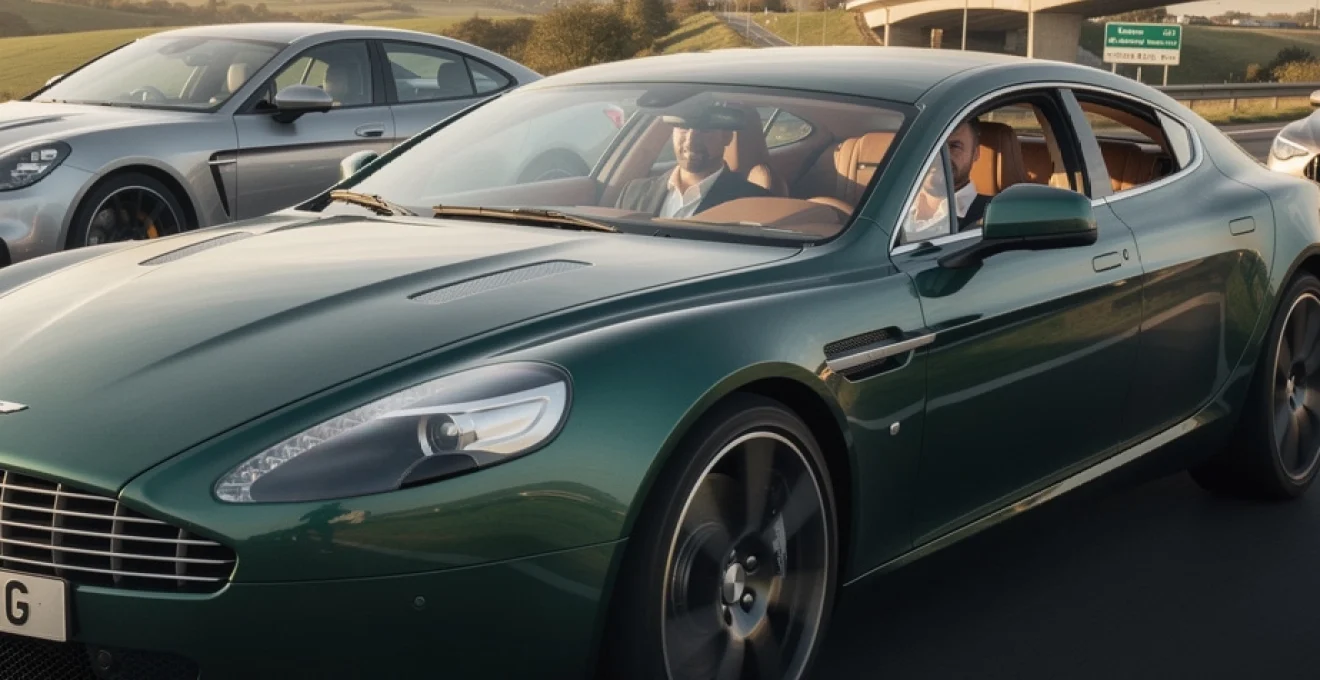
The Aston Martin Rapide S sits in a rarefied corner of the car world, where a hand-built 6.0‑litre V12 shares space with four individual seats and a hatchback boot. It is a grand tourer in the classic sense: long-legged, dramatic and deeply charismatic, yet shaped around real-world journeys rather than track-day lap times. For buyers who value theatre and craftsmanship as much as performance figures, few cars blend sports car drama and luxury saloon usability in quite the same way. If you are considering a high-performance four-door and want something with more emotional appeal than a traditional limousine, the Rapide S deserves very serious attention.
Aston martin rapide S grand tourer positioning in the high-performance luxury saloon segment
The Aston Martin Rapide S occupies a niche between super-saloon and coupé, competing with the most potent four-door GTs while retaining an overtly sporting character. Launched as a heavily reworked evolution of the original Rapide, the Rapide S luxury grand tourer gained a more assertive grille, increased power and sharper chassis tuning. Unlike a traditional limousine, it is unapologetically driver-focused: the V12 sits far back in the bay, the driving position mirrors a two-door GT, and the rear seats are sculpted rather than bench-like. For someone cross-shopping performance saloons and super-coupés, the Rapide S feels like a bridge between the two worlds.
Comparative analysis vs porsche panamera turbo, Mercedes-AMG GT 4-door coupé and maserati quattroporte GTS
Against a Porsche Panamera Turbo, the Rapide S trades digital precision for analogue involvement. The Porsche is quicker cross-country and offers more infotainment technology, yet many drivers find the Aston more engaging at realistic speeds. The naturally aspirated V12 responds linearly and the steering is richer in feedback, especially on tight British B-roads. Compared with the Mercedes‑AMG GT 4-Door Coupé, the Rapide S feels less brutal and more elegant, with a softer approach to ride and cabin ambience. The Maserati Quattroporte GTS, meanwhile, is perhaps its closest spiritual rival, sharing an Italianate glamour and a charismatic engine but lacking the Rapide’s hatchback practicality and unique hand-built feel.
From an ownership perspective, the German rivals tend to offer more advanced driver assistance and a broader dealer network. However, the Aston Martin counters with exclusivity: annual production volumes were a fraction of Panamera or AMG 4-Door output. If you park a Rapide S at a hotel entrance, it still attracts more attention than almost any modern saloon, precisely because it is both rare and instantly recognisable as an Aston Martin.
Role of the rapide S within aston martin’s VH-era line-up alongside DB9, vanquish and vantage
Within Aston Martin’s VH-era line-up, the Rapide and Rapide S effectively formed the four-door counterpart to the DB9. All shared the same bonded aluminium VH platform architecture, with the Rapide S using a stretched wheelbase and a unique rear structure. The DB9 provided the core GT template, the Vanquish sat above as the more extreme flagship, and the Vantage delivered a shorter, more agile sports car. The Rapide S extended that family DNA into a car capable of carrying four adults and luggage, but with the same long bonnet, rear-set cabin and muscular haunches familiar from its two-door siblings.
This positioning explains much of the car’s character. Rather than emulate a chauffeur-driven limousine, the Rapide S behaves like a DB9 that happens to have extra doors. Chassis tuning, steering feel and power delivery were all engineered to maintain that sports car lineage. For buyers already familiar with a Vantage or Vanquish, stepping into a Rapide S feels like slipping into a more practical variation of a very similar theme, with familiar switchgear, instrumentation and driving dynamics.
Target buyer profiles and GT use-cases: continent-crossing, chauffeur usage and daily usability
The Aston Martin Rapide S appeals to buyers who might once have chosen a traditional coupé but now require extra seats, without surrendering emotional appeal. Typical owners use the car for long-distance European touring, airport transfers, or as an occasional family car alongside a more practical daily driver. The blend of a 317‑litre boot, folding rear seats and a hatchback tailgate makes it surprisingly versatile for a low, sleek grand tourer. Golf bags, weekend luggage and even a compact pushchair will fit with careful packing.
Chauffeur usage is less common than with a Bentley Flying Spur or Mercedes S‑Class, primarily because the rear compartment is more cosseting than expansive. However, for high-net-worth individuals wanting to be driven occasionally while still enjoying the car personally, the Rapide S works well. Rear passengers sit in individual buckets with their own climate controls and optional entertainment screens, creating an intimate, first-class-cabin feel. Daily usability depends heavily on expectations: ride comfort is firm compared with a limousine, and fuel consumption in city traffic will frequently drop into single figures (mpg). Yet for someone used to a sports car, the extra refinement, accessibility and practicality are transformative.
Market evolution from rapide (2010) to rapide S and rapide AMR in the UK and EU
The original Rapide launched in 2010, initially built by Magna Steyr in Austria before production moved back to Gaydon. Early cars offered around 470 bhp and a 6‑speed automatic gearbox. Market response in the UK and EU was muted at first, hampered by the global financial climate and limited rear space compared with more conventional luxury saloons. Residual values in the early years reflected this, with significant early depreciation. The Rapide S performance saloon, introduced in 2013, was conceived to reset the narrative and correct those early shortcomings.
Rapide S brought a substantial power hike to around 550–552 bhp, the dramatic new full-height grille, a reinforced body shell and a more refined chassis. A further update in late 2014 introduced the ZF 8‑speed Touchtronic III gearbox, raising top speed to 203 mph and cutting the 0–62 mph sprint to about 4.4 seconds. Later still, the Rapide AMR pushed the formula towards a track-biased, limited-run variant with sharper suspension and more extreme styling. In the UK and EU used market, these later 8‑speed cars are now the most sought-after, combining improved efficiency (official motorway consumption up to 31 mpg) with significantly better performance and refinement.
VH architecture, chassis tuning and ride refinement in the aston martin rapide S
Bonded aluminium VH platform engineering shared with DB9 and vanquish
The Rapide S sits on Aston Martin’s second-generation VH platform, a bonded aluminium structure shared with the DB9 and Vanquish. This architecture uses extruded aluminium sections and cast nodes bonded and riveted together, delivering high torsional stiffness with relatively low weight. For a four-door car, maintaining rigidity is crucial to steering precision, NVH control and crash safety. The challenge lay in adding two extra doors and a longer wheelbase without compromising the inherent stiffness that makes the two-door GTs feel so taut.
Engineers addressed this by reinforcing the sills and floorpan, optimising crossmembers and employing high-strength bonding techniques. The result is a platform that supports both the Rapide S’s performance credentials and its refinement targets. In everyday driving, you feel this as a lack of flex or creaks over rough surfaces, even after a decade of use. For anyone stepping out of a conventional steel-bodied saloon, the Rapide’s structure feels more akin to an aluminium supercar than a traditional four-door.
Adaptive damping system (ADS), bilstein components and GT-oriented damper mapping
The Aston Martin Rapide S uses an Adaptive Damping System (ADS) with Bilstein monotube dampers, allowing the car to switch between comfort-biased and sportier settings at the touch of a button. In Normal mode, the damper mapping targets grand touring comfort: it smooths high-frequency ripples while keeping body movements well controlled over undulations. Engage Sport and the system tightens significantly, reducing roll and pitch for more aggressive cornering, albeit at the expense of ride plushness on broken tarmac.
On earlier 6‑speed cars, some owners found the ride a little too firm across the board, especially on UK roads with poor surfaces. The 8‑speed Rapide S revisions softened the baseline mapping slightly in Normal mode, better suiting the car’s role as a long-distance GT. For buyers, the key benefit of ADS is flexibility: you can arrive at a hotel after hours of motorway cruising feeling relaxed, then select Sport for a fast, flowing mountain road the next morning without needing a fundamentally different car.
Wheelbase, track width and weight distribution optimisation for high-speed stability
The Rapide S uses a wheelbase extended by around 250 mm over the DB9, primarily to create space for the rear doors and seats. This longer wheelbase brings inherent advantages at high speed: the car feels planted, with a calm, unhurried gait on the motorway or autobahn. Combined with a wide track and a near-ideal 51:49 front‑to‑rear weight distribution, the Rapide S remains stable and predictable even approaching its 203 mph top speed in 8‑speed guise.
To achieve that balance, the heavy V12 is mounted as far back as possible in a so‑called “front mid-engined” layout, pushing more mass within the wheelbase. The rear-mounted transmission further shifts weight rearward, improving traction and reducing nose-heaviness. On sweeping A‑roads, the Rapide feels secure and confidence-inspiring, with a sense of inertial stability comparable to a long-wheelbase luxury saloon but with the more precise responses of a GT car.
Steering geometry, rack ratio and feedback characteristics on british b-roads
Steering feel is one of the Rapide S’s standout attributes. The hydraulic power steering system, increasingly rare in an era of electric racks, provides genuine feedback through the rim. Turn-in is quick but not nervous, with a rack ratio chosen to mirror the feel of the DB9 while compensating for the extra length. On narrow British B‑roads the front end feels accurate and predictable, allowing you to place the car with surprising precision for something over five metres long.
Camber changes and surface imperfections feed back subtly rather than intrusively, giving you confidence in available grip. Professional testers often remark that the Rapide S “shrinks around the driver” once up to speed, and the steering geometry is a major reason for that. For anyone used to the filtered, somewhat synthetic feel of many modern electric systems, the Rapide’s helm can be a revelation, particularly in wet or mixed conditions where nuanced information matters.
Braking hardware, brake bias and fade resistance with steel vs carbon-ceramic options
Braking is handled by substantial dual-cast discs: typically 400 mm at the front with six-piston calipers and 360 mm at the rear with four-piston calipers. The dual-cast design combines an aluminium hub with a cast-iron friction surface, reducing unsprung weight while maintaining thermal capacity. Brake bias is tuned to keep the front end stable under hard deceleration, yet the rear contributes meaningfully, helping shorten stopping distances and maintain composure.
On spirited drives or occasional track use, fade resistance is generally strong, although the car’s 190 kg weight penalty over a DB9 does mean the system works hard. Some later or special-order cars were fitted with carbon-ceramic options, enhancing fade resistance and cutting unsprung mass further, though at significant replacement cost. On a used Rapide S, checking disc thickness and surface condition is essential: a full set of rotors and pads can exceed £2,000 before labour, and heavy use on high-speed tours or track days accelerates wear.
AM29 6.0-litre V12 powertrain, transmission calibration and performance data
Technical breakdown of the AM29 naturally aspirated V12: displacement, compression ratio and valvetrain
At the heart of the Rapide S sits Aston Martin’s AM29 6.0‑litre V12, an all-alloy, quad overhead camshaft unit with 48 valves. Displacement is 5,935 cc, with a relatively high compression ratio (around 11:1 in later forms) to maximise efficiency and torque from the naturally aspirated design. The valvetrain uses variable valve timing to broaden the torque curve, delivering strong low‑ to mid-range pull without sacrificing the top-end rush for which this engine family is renowned.
Unlike the latest wave of downsized, turbocharged V8s, this V12 relies on capacity and breathing rather than forced induction. Response is instant, with no lag and a creamy, linear delivery that encourages precise modulation on throttle. For high-speed touring, the engine barely idles along at low revs, yet a gentle squeeze summons effortless overtakes. Reliability-wise, the design is mature and well-proven across multiple Aston Martin models, though it demands diligent servicing and oil-level monitoring to remain healthy over high mileage.
Power and torque outputs across model years: 2013 rapide S vs 2015-onwards revisions
The shift from the original Rapide to the Rapide S brought a significant power increase. Early Rapide S models from 2013 produced around 550 bhp, rising to approximately 552 bhp in the revised late‑2014 cars. Torque figures also climbed by around 10%, with peak torque available from as low as 2,500 rpm, materially improving in-gear acceleration for real-world driving. Official 0–62 mph times dropped from about 5.2 seconds in the original Rapide to 4.9 seconds for the initial Rapide S, then to around 4.4 seconds once the 8‑speed gearbox arrived.
These changes may sound incremental on paper, but on the road the difference is marked. The later calibration allows the Rapide S to surge forward even from motorway speeds with an ease more in line with contemporary super saloons. For long-term ownership, the later AM29 tune also tends to deliver slightly better fuel efficiency on steady-state cruises, making cross‑continent journeys a touch less punishing at the pumps.
ZF 6HP vs ZF 8HP touchtronic III automatic gearbox: ratios, shift logic and cruising refinement
The transmission plays a huge role in defining the Rapide S driving experience. Early cars used a rear-mounted 6‑speed ZF automatic (Touchtronic II), while later Rapide S models adopted the acclaimed 8‑speed ZF 8HP (Touchtronic III). The 6‑speed gearbox offers relaxed cruising and smooth shifts, but its wider ratios and older shift logic feel dated compared with modern dual-clutch systems. Kickdown can be a fraction slower, and the gaps between gears make it harder to keep the engine perfectly in its sweet spot.
The 8‑speed Touchtronic III transforms the car. Additional ratios allow shorter lower gears for stronger acceleration, combined with tall overdrives for lower rpm at motorway speeds. At 70 mph, engine speed drops significantly versus the 6‑speed, reducing noise and improving economy. Shift logic is more intelligent, holding gears under enthusiastic driving and slipping into the highest ratios unobtrusively when you relax. If you value cruising refinement and rapid, almost seamless manual shifts via the paddles, the 8‑speed Rapide S is the configuration to prioritise.
Performance metrics: 0–60 mph, 0–100 mph, in-gear acceleration and vmax comparison
In hard numbers, the Rapide S competes credibly with its high-performance luxury saloon rivals. The 8‑speed version accelerates from 0–60 mph in roughly 4.2 seconds and reaches 100 mph in a little over 9 seconds, depending on conditions. Top speed is a quoted 203 mph, placing it comfortably in supercar territory. More relevant for day-to-day use is in‑gear acceleration: 50–70 mph takes only a few seconds, making overtakes on single-carriageway roads feel effortless and safe.
Against a Porsche Panamera Turbo or Mercedes-AMG GT 63 4‑Door, the Aston loses out slightly in raw acceleration figures due to the absence of turbocharging and all-wheel drive. However, the subjective sense of speed is heightened by the V12 soundtrack and the more intimate driving position. For many owners the appeal lies less in tenth-of-a-second metrics and more in the way the Rapide S delivers its performance: progressive, visceral and accompanied by a soundtrack few turbocharged engines can match.
Exhaust system architecture, valve control and sound signature in normal vs sport modes
The Rapide S exhaust system is a key part of its character, using bypass valves to modulate volume and tone according to mode and throttle position. In Normal mode at low revs, the system keeps the valves mostly closed, allowing the car to cruise quietly enough for early-morning departures from upmarket suburbs. As revs rise or throttle opening increases, the valves progressively open, deepening the note and letting more of the V12’s natural bark escape.
Engage Sport and the valves open earlier and more often, sharpening the soundtrack. From around 3,500 rpm to the 6,500 rpm redline, the Rapide S emits a guttural roar under load, overlaid with a metallic wail reminiscent of Aston’s GT racing cars. On overrun, gentle pops and crackles underscore the car’s motorsport lineage without straying into artificial theatrics. If you value acoustic drama as much as outright speed, this V12 exhaust architecture is a major selling point compared with quieter, more filtered turbocharged competitors.
Exterior aerodynamics, proportions and aston martin design language on the rapide S
One-77-inspired front fascia, revised grille and aerodynamic front splitter design
The Rapide S update brought a striking new front fascia, clearly influenced by the limited-run One‑77 hypercar. The full-height aluminium grille, machined and finished by hand, gives the car a more assertive, almost architectural presence. Beyond aesthetics, the grille and lower splitter manage airflow for both cooling and stability, channelling air to the radiators while reducing front-end lift at speed. Subtle re-profiling of the bumper and lower intakes also improved aerodynamic efficiency compared with the original Rapide.
From a design perspective, this grille became a visual shorthand for the Rapide S, immediately distinguishing it from earlier cars. For buyers considering a used example, the larger grille and slightly more aggressive front-end treatment of the S contribute to stronger kerbside appeal and, in many enthusiasts’ eyes, a more cohesive overall stance.
Fastback roofline, rear diffuser and high-speed aero balance at motorway and autobahn velocities
The Rapide S’s defining visual feature is its long, sweeping fastback roofline. Unlike many four-door coupés, which can look truncated or awkward from certain angles, the Rapide manages a cohesive profile from nose to tail. The rear window and hatchback integration are carefully tapered to smooth airflow, while the subtle lip spoiler and underbody diffuser help maintain downforce and stability at high speed. Later S models gained a slightly larger spoiler to fine-tune this aero balance.
On the motorway or autobahn, the aero work manifests in calm, predictable behaviour. Crosswinds have less impact than you might expect from such a large surface area, and the car feels settled even well into triple-digit speeds (mph). Wind noise remains impressively subdued thanks to laminated glass and careful attention to mirror design and sealing, further supporting the Rapide’s grand tourer mission.
Lighting technology: bi-xenon headlamps, LED DRLs and rear light cluster design evolution
Lighting technology on the Rapide S reflects the evolutionary nature of the VH platform. Bi‑xenon headlamps provide strong, consistent illumination, paired with distinctive LED daytime running lights that trace the edge of the clusters. Rear light graphics echo contemporary DB9 and Vanquish designs, using LEDs for both brake and tail functions, enhancing visibility and giving the car a recognisable night-time signature.
Later cars benefitted from minor updates to internal lens design and software, improving clarity and response times. While the hardware may not match the matrix LED or laser systems of the latest German saloons, real-world performance remains very competent. For frequent night driving on unlit roads, a careful check of headlamp alignment and lens condition on a pre-owned car is advisable to maintain optimal performance.
Wheel designs, tyre sizing and pirelli P zero homologations for the rapide S
Factory wheel options for the Rapide S include several 20‑inch designs, ranging from elegant multi-spoke patterns to more aggressive, diamond-turned styles introduced with later model years. Tyre sizing is typically 245‑ or 245/40 at the front and 295/35 at the rear, delivering a broad contact patch and a visually muscular stance. Many cars were supplied with bespoke Pirelli P Zero tyres developed specifically for the Rapide’s weight distribution and chassis characteristics.
Tyre choice has a marked effect on ride comfort and steering feel. Fresh, premium rubber will help the car track straight and resist tramlining, while worn or budget replacements can make the steering feel nervous and the ride brittle. When inspecting a used example, matching brands and correct AO or Aston-specific homologation codes are strong signs of conscientious ownership, particularly if combined with alignment records and even wear across the tread.
Cabin architecture, 2+2 layout and grand touring ergonomics
Handcrafted interior materials: bridge of weir leather, alcantara and real metal switchgear
The Rapide S cabin showcases Aston Martin’s craft-led approach. Seats, dashboard and door cards are trimmed in Bridge of Weir leather, often with contrasting stitching and intricate quilting on higher-spec cars. Alcantara appears on headlining and some trim inserts, adding both tactile variety and visual warmth. Real metal switchgear, including the crystalline gear-selection “glass key” slot and solid-feel HVAC controls, reinforces the sense of a hand-assembled, bespoke product rather than a mass-produced saloon.
Each embroidered Aston Martin logo on the seats can contain over five thousand stitches, underlining the labour-intensive nature of the interior. Over time, high-use areas such as the driver’s bolster and steering wheel can develop patina, which many owners find adds to the car’s charm when carefully maintained. For a buyer valuing craftsmanship, stepping into a Rapide S still feels special even alongside newer, more tech-heavy rivals.
Front seating ergonomics, driving position and long-distance comfort configuration
The front seats in the Rapide S are designed primarily for enthusiastic driving, yet prove comfortable over long distances. The driving position is low-slung and reclined, with ample adjustment in both seat and steering column. Pedal placement is well aligned, reducing fatigue on extended journeys. Bolstering strikes a balance between lateral support and ease of entry; you feel securely held in corners without the sense of climbing in and out of a racing shell.
For long-distance grand touring, seat heating and optional ventilation contribute significantly to comfort. Many owners find that setting the adaptive dampers to Normal, selecting a high gear via the paddles and letting the V12 hum at low revs creates an environment that feels calmer than many ostensibly more luxurious SUVs. If you are taller than average, head and legroom in the front are generous enough to avoid the compromises sometimes associated with coupé-like saloons.
Rear individual bucket seats, legroom constraints and isofix considerations
The rear of the Rapide S features two individual bucket seats separated by a high central console, echoing the front architecture. These seats are beautifully contoured and trimmed, with integrated headrests and optional entertainment screens mounted in the front seatbacks. Legroom, however, is best described as adequate rather than expansive; adults up to around 6 ft can travel comfortably for medium-length journeys, but prolonged trips may reveal the limitations of the low roofline and the high sill you must step over to enter.
Isofix mounting points allow the installation of compatible child seats, and a bespoke child seat was even offered from the factory. For parents, this transforms the Rapide S from indulgent toy into a realistic family GT, at least for one or two children. The side-opening “swan wing” rear doors, which rise slightly as they open, help avoid kerbing the lower edges and make it easier to access the rear seats in tight parking spaces, even if lifting younger children over the sill demands a bit of practice.
Boot capacity, split-fold capability and luggage solutions for GT touring
Boot space is quoted at around 301–317 litres with the rear seats up, expanding to roughly 750 litres when they are folded flat. The hatchback tailgate opens high, providing better access than a traditional saloon boot and allowing awkwardly shaped luggage – such as ski bags or suitcases stacked vertically – to be loaded more easily. This flexibility makes the Rapide S a genuinely usable grand touring sports saloon, not just an occasional-weekend toy.
Factory accessories included tailored luggage sets designed to maximise space and anchor securely within the boot. When planning continent-crossing journeys, soft bags often work better than rigid suitcases, allowing more efficient use of the available volume around the wheel arches and beneath the rear parcel shelf. For those used to a traditional coupé, the combination of folding seats and a hatch will feel liberating; for owners coming from a large SUV, it will still require some downsizing and careful packing strategy.
Infotainment, driver assistance systems and everyday usability in the rapide S
Infotainment is one of the Rapide S’s weaker points by modern standards. Early cars use a Volvo-derived navigation system with a small monochrome information display and a separate pop-up colour screen for mapping. Menu structures can feel unintuitive, and response times lag behind even mid-market hatchbacks from the same era. Later updates improved the interface slightly, adding new interior trim options and dual-tone leather seats, but the underlying hardware remained largely the same. Bluetooth connectivity and basic media streaming are available, though integration with the latest smartphones is limited compared with current premium saloons.
Driver assistance systems are minimal: expect traction control, stability control, multiple airbags (front, side and curtain) and ABS, but not the full suite of radar cruise, lane-keeping and automated emergency braking that has become common after 2018. For many enthusiasts this is a benefit rather than a drawback, as it leaves the driving experience largely undiluted. Everyday usability hinges instead on visibility, parking ease and reliability of basics such as climate control. The Rapide S scores well on effective air conditioning, demisting and general ergonomics, while the rear parking sensors and optional camera help mitigate the long tail and relatively small rear window in tight urban environments.
Running costs, reliability considerations and residual values in the UK and EU markets
Running an Aston Martin Rapide S in the UK or EU requires realistic expectations. Official combined fuel consumption rarely reflects real-world use: spirited driving frequently returns single-digit mpg, while careful motorway cruising in an 8‑speed car might achieve 25–31 mpg at best. CO₂ emissions of 300–355 g/km place the car in the highest road tax brackets, and insurance premiums align with those of other six-figure performance vehicles. Tyres, brakes and servicing are all priced accordingly; a full set of premium tyres can easily exceed £1,000, and major services are typically four-figure events.
On the reliability front, the V12 engine is broadly robust if maintained properly, with regular oil changes and attention to warm-up procedures. Known issues include occasional oil leaks from cam covers, corrosion or bubbling around aluminium panel edges, and wear or leakage in the adaptive dampers. A replacement set of dampers can cost around £4,000, and front discs and pads roughly £600 plus labour. Recalls have addressed transmission switch circuitry and Park-mode communication faults, so ensuring recall work has been completed is essential. Residual values have stabilised in recent years compared with the brutal early depreciation faced by the first Rapide; the S and especially 8‑speed cars hold their value relatively better, supported by growing recognition of their future-classic potential.
Buying guide: pre-owned aston martin rapide S inspection checkpoints and specialist support
Approaching a pre-owned Rapide S purchase calls for a methodical, informed process. A pre-purchase inspection by a marque specialist or main dealer is close to mandatory, particularly given the aluminium structure and complex suspension. Underbody panels must often be removed to check for corrosion, fluid leaks or prior accident repairs, and structural issues can be expensive to rectify. Bodywork should be inspected carefully around panel edges and lower door sections for paint bubbling, an indicator of corrosion beneath the surface that may require professional treatment.
Inside, pay attention to leather condition on high-contact areas, functionality of seat motors and the operation of the complex “window choreography”, where frameless glass drops and realigns as doors open and close. Electrical gremlins can manifest in window regulators, infotainment screens and occasionally the Bang & Olufsen audio turrets that rise from the dashboard. On a test drive, evaluate all Adaptive Damping modes, listen for clunks or knocks over rough surfaces, and check for any warning lights. The gearbox in 8‑speed cars should shift cleanly without jolts; in 6‑speed examples, ensure kickdown is smooth and that cold shifts are not unduly harsh.
Service history is crucial. The Rapide S has a service interval of 10,000 miles or 12 months, with a major service due around 70,000 miles. Evidence of annual maintenance, even at low mileage, is more important than odometer readings alone. Invoices should show timely replacement of consumables such as pads, tyres and fluids, plus any recall campaigns completed. Working with an independent Aston Martin specialist can significantly reduce running costs versus main dealer-only servicing, while still maintaining the car properly. For buyers prepared to approach ownership with this level of diligence, the Rapide S rewards with a uniquely engaging blend of V12 performance, hand-crafted luxury and genuine grand touring capability.