
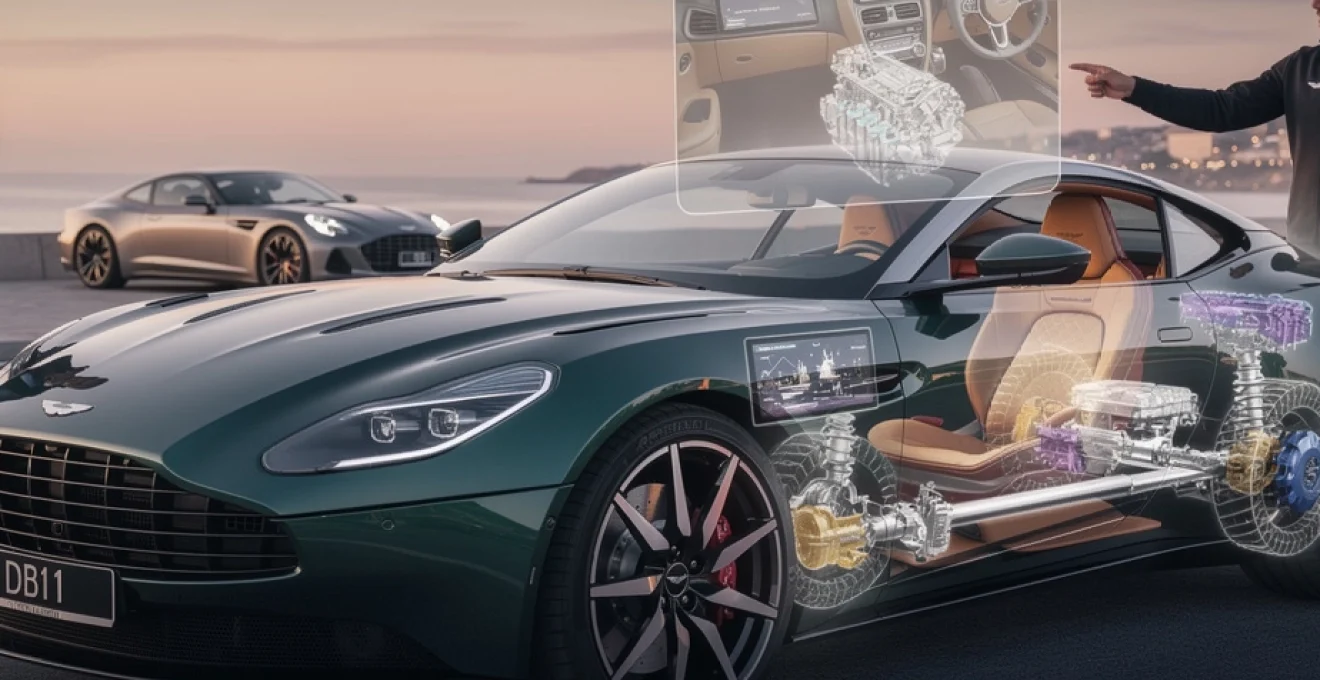
The all‑new Aston Martin DB11 arrives as a pivotal grand tourer, carrying the weight of a legendary badge while answering modern expectations for design, performance and technology. It blends hand‑built craftsmanship with cutting‑edge engineering, mixing a thunderous twin‑turbo V12 with AMG‑sourced V8 power and a bonded aluminium chassis. For drivers, that means a GT that feels as special at 25 mph through the city as it does running near 200 mph on an autobahn. For enthusiasts and collectors, it represents one of the final front‑engined luxury GTs with a charismatic combustion heart, yet shaped by hybrid‑ready thinking. Understanding what has truly changed in this latest DB11 helps you decide whether it is the right Aston to put on the drive, or the perfect upgrade from an older DB9 or Vantage.
Exterior design evolution of the all‑new aston martin DB11: aero profile, signature grille and LED lighting
The exterior evolution of the Aston Martin DB11 is subtle enough to respect the brand’s heritage yet radical enough to make older DB models look instantly dated. The proportions are deliberately classic GT: a long bonnet, set‑back cabin and muscular rear haunches, but every millimetre has been tuned in the wind tunnel. The iconic Aston Martin grille is now larger and more sculpted, feeding both the cooling system and the aero management that runs nose to tail. The silhouette is lower and more planted, aided by Aston Martin Aeroblade technology that uses hidden channels to clean up airflow instead of relying on a huge rear wing. The result is a car that looks like sculpture yet behaves like a serious aero device at speed, giving you high‑speed stability without compromising elegance on the driveway.
Reworked front fascia: new aston martin grille geometry, matrix LED headlamps and aerodynamic front splitter
The reworked front fascia is where the “all‑new” DB11 makes its first bold statement. The grille geometry has been opened up and gently re‑angled to improve both cooling and drag, while still reading unmistakably as an Aston from 100 metres away. Beneath it sits an aerodynamic front splitter that helps manage front‑end lift; on a wet motorway, you feel that stability as a reassuring calm through the steering wheel rather than nervousness at the rim. New Matrix LED headlamps bring sharper illumination, adaptive beam patterns and a distinctive DRL signature. Compared with early DB11s that launched in 2016, the revised lighting tech offers crisper cut‑off, better side illumination on dark country roads and a more modern visual signature that aligns with the latest DB12 and Vantage design language.
Side body surfacing: clamshell bonnet, sharper character lines and revised glasshouse proportions
From the side, the all‑new DB11 keeps the dramatic one‑piece clamshell bonnet, a hallmark introduced to reduce shut lines and emphasise the clean surfacing over the front wheels. That single panel also allows tighter panel gaps, improving both perceived quality and aerodynamic cleanliness. Sharper character lines now run from the front wheel arch to the rear shoulders, tightening up the car’s stance and visually lowering its mass. The glasshouse has been subtly re‑proportioned, with slimmer pillars and a more tapered rear quarter, giving you a better over‑the‑shoulder view and a sleeker coupé profile. For a grand tourer aimed at long‑distance driving on varied roads, that improved outward visibility makes a noticeable difference when threading through tight Alpine villages or busy city streets.
Rear architecture: integrated spoiler, LED light blade design and diffuser optimisation
The rear architecture is where aerodynamics and aesthetics meet most dramatically. Instead of a bolt‑on wing, the DB11 uses an integrated spoiler formed by the bodywork, fed by aero channels in the C‑pillars that create a virtual wing. This Aeroblade concept reduces lift at high speed without resorting to a towering rear spoiler, making the car look clean yet planted. Slim LED light blades stretch across the rear, giving the DB11 a crisp night‑time signature and enhancing perceived width. Below, a re‑profiled diffuser works with the flat underbody to vent airflow and stabilise the car in fast sweepers. You sense this as a confident, almost serene high‑speed balance: the car feels like it “sits down” on the road rather than floating over it, even as speeds climb well into three figures.
Paint finishes and personalisation: Q by aston martin colours, contrasting roof strakes and wheel options
Visual customisation plays a huge role in the DB11’s appeal, especially if you see it as a long‑term keeper. The Q by Aston Martin programme opens up a vast catalogue of paint finishes, from classic metallic Silvers and Greens to bold satin and pearlescent hues that echo limited‑run specials. Contrasting roof strakes and floating roof treatments can accentuate the cab‑back stance, while wheel designs range from elegant multi‑spokes to more aggressive forged options that shave crucial unsprung mass. For buyers cross‑shopping a Bentley Continental GT or Ferrari Roma, this level of visual tailoring helps create a genuinely individual car. It also has a practical edge: carefully chosen colour and trim combinations can enhance resale appeal in a market where tasteful specifications carry a premium.
Updated powertrains and performance: twin‑turbo V12, AMG‑sourced V8 and hybrid‑ready architecture
Under the sculpted bonnet, the all‑new Aston Martin DB11 continues to offer two distinct personalities: a charismatic Aston‑designed V12 and a razor‑sharp AMG‑derived V8. Both are twin‑turbocharged, both are paired with a ZF eight‑speed automatic, and both send power to the rear wheels only. This engine line‑up not only underpins the DB11’s dual nature as refined GT and serious performance car, but also reflects the industry shift towards efficiency and emissions compliance. Cylinder deactivation, stop‑start and sophisticated turbocharging strategies show that this DB11 is more than just a big‑capacity bruiser; it is engineered to survive tightening regulations while remaining thrilling to drive. For anyone considering a high‑end GT as an everyday car, that balance of performance and modern efficiency is crucial.
Revised 4.0‑litre V8 from Mercedes‑AMG: power output, torque curve and turbocharging strategy
The 4.0‑litre twin‑turbo V8 is the same core M177 unit found in several AMG models, but tailored specifically for Aston Martin. Power sits around 528 bhp with 498 lb ft of torque available from as little as 2,000 rpm, giving a broad, flat torque curve that feels effortlessly strong in real‑world driving. Hot‑V turbocharging, where the turbos sit between the cylinder banks, reduces lag and sharpens response, so the car reacts instantly when you flex your right foot. In independent tests, V8 DB11s sprint from 0–62 mph in roughly 4.0 seconds and are capable of near‑200 mph, yet can return up to 24 mpg on a steady motorway cruise. Many testers argue that this lighter V8 actually makes the DB11 feel more agile and responsive on a twisty road than its V12 sibling.
Enhanced 5.2‑litre twin‑turbo V12: internal upgrades, thermal management and emissions compliance
The 5.2‑litre twin‑turbo V12 is very much an Aston Martin signature, developed in‑house and delivering up to 630 bhp and 516 lb ft in AMR tune. Internal updates over early DB11 V12s include revised turbo calibration, improved cooling circuits and enhanced thermal management for greater durability during extended high‑load driving. To satisfy ever‑tougher emissions rules, the engine employs cylinder deactivation – Aston calls it Intelligent Bank Activation – shutting down one cylinder bank under light loads, as well as start‑stop technology in urban environments. WLTP combined figures of 18–22 mpg may not sound frugal, but for a 200+ mph GT they represent a sophisticated compromise. The character, however, remains gloriously old‑school: a deep‑chested surge from 1,500 rpm and a cultured, metallic howl as the needle swings past 4,000 rpm.
Eight‑speed ZF automatic transmission: shorter ratios, shift mapping and launch control calibration
Both engines feed power through an eight‑speed ZF automatic gearbox mounted at the rear axle for optimal weight distribution. Shorter intermediate ratios give the DB11 a harder punch in overtakes, while longer top gears keep revs low at cruising speeds, improving refinement and fuel economy. Updated shift mapping in GT, Sport and Sport+ modes changes not only shift speed but also the gearbox’s willingness to hold gears, letting you decide whether the car feels relaxed or urgent. A calibrated launch control system manages wheelspin off the line; used correctly, it helps the V12 AMR reach 62 mph in as little as 3.7 seconds. For daily driving, the transmission’s smoothness is striking, slipping through ratios almost imperceptibly when left in automatic, yet responding crisply to paddle inputs when you want more involvement.
Performance metrics: 0–62 mph, top speed and in‑gear acceleration versus outgoing DB11 and DB12
On paper, the performance metrics place the all‑new DB11 squarely in super‑GT territory. V12 AMR models deliver 0–62 mph in around 3.7–3.9 seconds, with a top speed quoted at 208 mph. V8 versions are only a fraction behind, posting 4.0 seconds to 62 mph and top speeds around 187–200 mph depending on configuration. Compared with early DB11 V12s rated at 600 bhp, the AMR’s 630 bhp and recalibrated drivetrain translate to sharper in‑gear acceleration and more controllable power delivery, especially on damp roads. Against the latest DB12, which brings further chassis and infotainment upgrades, the DB11 remains slightly softer and more GT‑oriented, which may actually suit you better if long‑distance comfort matters more than ultimate lap times.
Chassis, suspension and dynamics: adaptive dampers, bonded aluminium structure and electronic aids
The DB11’s dynamic character rests on a bonded aluminium architecture shared with the DBS and Vantage, combined with adaptive suspension and a suite of electronic aids. This structure provides the stiffness needed for precise suspension tuning while avoiding the weight penalties of steel. The result is a GT that can cross countries at high speed yet still entertain on a favourite B‑road. If you have driven earlier Aston models like the DB9, the DB11’s composure over poor surfaces will feel like a generational leap. The goal is not to turn the car into a track‑only weapon, but to offer a broad dynamic bandwidth: supple enough in GT mode for long autoroute hauls, firm and controlled in Sport+ when the road opens up.
Bonded aluminium platform: torsional rigidity, weight distribution and structural adhesive technology
The underlying platform uses bonded and riveted aluminium sections, a technique inspired partly by low‑volume sports‑car constructors. Structural adhesives and strategic rivets create a strong, light “safety cell” with impressive torsional rigidity while keeping kerb weight around 1,760–1,870 kg depending on engine and trim. Mounting the transmission at the rear and using a carbonfibre prop shaft contribute to a near‑50:50 weight distribution, which you feel as neutral balance in fast corners. Compared with a traditional welded aluminium structure, this approach offers better resistance to flex and can be tuned for specific models, from Vantage to DB11 and DBS, by altering section thicknesses and bonding strategies. For you as a driver, the benefit is simple: less scuttle shake, more precise steering response and a calmer ride over sharp impacts.
Adaptive suspension and active dampers: GT, sport and sport+ modes tuning on UK b‑roads
The suspension uses double wishbones at the front and a multi‑link layout at the rear, paired with adaptive dampers that respond to both road inputs and drive mode selection. In GT mode, the DB11 delivers a long‑travel, loping ride that feels ideally matched to smooth A‑roads and motorways, soaking up expansion joints without losing body control. Switch to Sport and the dampers firm up, reducing roll and pitch for more precise cornering on flowing B‑roads. Sport+ brings the most aggressive calibration, trimming body movements further but still avoiding the crashiness sometimes found in hardcore sports cars. On bumpy UK B‑roads, the car can occasionally feel a touch floaty if driven flat‑out, but for a grand tourer the blend of compliance and composure is impressively judged.
Electronic stability control, torque vectoring and updated traction control algorithms
Electronic stability control and traction control play a major role in harnessing up to 630 bhp, especially in wet or cold conditions. Updated algorithms monitor steering angle, yaw rate and wheel slip, subtly trimming power or braking individual wheels before things get out of hand. A brake‑based torque vectoring system gently nudges the car into a more neutral stance mid‑corner by slowing the inside wheels; you feel this as a willingness to turn, rather than understeer. The calibration on later DB11s, particularly the AMR, is much more transparent than early cars, which could feel snatchy and nervous at the limit. With systems active, the DB11 allows a satisfying level of slip and rotation without punishing the driver, ideal for spirited yet safe cross‑country driving.
Steering calibration: electric power‑assisted steering (EPAS) feel, rack ratio and feedback
The move to electric power‑assisted steering, or EPAS, allows Aston Martin to tailor weight and response across driving modes. The rack ratio is quick for such a large car, giving the DB11 an unexpectedly eager turn‑in on twisty roads. While ultimate road feel is not as talkative as classic hydraulic systems, later steering calibrations sharpen communication and build weight naturally as loads increase. In GT mode, assistance remains light for easy manoeuvring and long‑distance comfort; in Sport and Sport+, the helm gains heft and a more direct sense of connection. Reviewers consistently highlight how the chassis seems to lean onto the outside rear wheel in fast corners, encouraging you to drive the car off the throttle and steer with delicate inputs rather than brute force.
Cabin redesign and materials: analogue‑meets‑digital cockpit, leather craftsmanship and carbon fibre
Step inside the all‑new Aston Martin DB11 and the blend of analogue warmth and digital clarity becomes immediately apparent. The architecture is driver‑centric, wrapping major controls around the driver while still presenting a clean, symmetrical dashboard. Traditional craftsmanship is visible in the hand‑stitched leather, intricate seat quilting and precisely finished metal rotary controls, while digital elements such as the configurable instrument cluster and central display acknowledge modern expectations. Compared with the earliest DB11 interiors, which drew criticism for borrowed Mercedes interfaces and somewhat busy design, the latest cockpit treatments are cleaner, better integrated and more cohesive. For you as a driver or passenger, the effect is a cabin that feels special in a way that mass‑produced luxury cars rarely achieve, without sacrificing usability on long journeys.
New dashboard architecture: driver‑centric layout, configurable digital cluster and physical switchgear
The dashboard’s architecture subtly angles the central stack towards the driver, with key functions grouped logically: drive modes by the steering wheel, climate controls low on the console, infotainment in the upper zone. A configurable digital cluster replaces traditional analogue dials, but retains round virtual “instruments” to preserve an intuitive, classic feel. Critical data such as speed, revs and navigation directions remain legible at a glance, even in bright sunlight. Crucially, Aston Martin has not succumbed to the temptation of putting every interaction through a touchscreen. Frequently used controls retain physical buttons or rotary knobs, reducing distraction compared with purely digital interfaces. That balance of tactile and digital elements suits a grand tourer that might spend hours at a time in motion.
Bridge of weir leather, alcantara and open‑pore wood veneers in DB11 interior trims
Material quality is fundamental to the DB11’s identity. Soft, aromatic Bridge of Weir leather wraps most surfaces you touch, from seats and door cards to the upper dashboard. Alcantara can be specified for headlining and inserts, giving a sportier ambience and subtle extra grip on spirited drives. Open‑pore wood veneers, carbon fibre and metallic trims are all available, allowing you to tailor the mood from traditional club‑room luxury to contemporary performance. Stitching patterns, seat quilting and even seatbelt colours can be personalised, meaning that two DB11 cabins rarely look the same. For anyone used to the more industrial feel of German sports cars, the sense of artisanal craftsmanship in a DB11 interior can be a powerful draw.
Sports plus seats, rear 2+2 packaging and long‑distance GT comfort enhancements
Front seats can be specified in standard or Sports Plus form, the latter adding extra lateral support without compromising long‑distance comfort. Adjustable lumbar support, heating and optional ventilation help prevent fatigue on extended journeys; many owners routinely report day‑long stints behind the wheel without feeling stiff or tired. The rear seats follow a 2+2 layout and will accommodate children or small adults for shorter trips, though most owners treat them as additional luggage space for weekend bags. Boot volume around 10 cubic feet is sufficient for a pair of soft bags and smaller items, complementing the rear seating area when touring. Double‑glazed side windows and targeted sound insulation help keep tyre and wind noise at bay, letting the engine soundtrack dominate only when you actively summon it.
Infotainment, connectivity and driver assistance: from legacy mercedes COMAND to aston martin’s new OS
Technology is one of the areas where the DB11 needed to move furthest from its early iterations. Initial cars relied on older Mercedes‑sourced systems that, while an improvement over previous Astons, felt dated next to the latest luxury GT rivals. The all‑new DB11 benefits from a much more modern infotainment hardware stack and significantly improved software, bringing it closer to the experience drivers expect from premium vehicles in 2025 and beyond. Fast processors, a high‑resolution display and expanded connectivity make the car easier to live with daily, whether navigating unfamiliar cities or streaming high‑bit‑rate audio on a long run. For many buyers, the combination of traditional craftsmanship with up‑to‑date tech is what ultimately seals the decision.
Touchscreen infotainment platform: high‑resolution display, UX redesign and voice control integration
The central infotainment unit now uses a high‑resolution touchscreen with responsive, smartphone‑like gestures and clean graphics. A redesigned user experience focuses on shallow menu structures, minimising the number of taps needed to adjust commonly used settings such as navigation zoom or media sources. Voice control integration allows you to set destinations, place calls or change music with natural speech, reducing the need to take hands off the wheel. Unlike earlier setups that clearly revealed their Mercedes origins, the latest interface feels more bespoke and consistent with Aston Martin’s visual identity. This helps reinforce the sense that you are in a unique, hand‑crafted GT rather than a rebadged derivative of a mass‑market luxury car.
Apple CarPlay, android auto and connected navigation with real‑time traffic and over‑the‑air updates
Modern connectivity expectations are fully addressed with standard Apple CarPlay and Android Auto integration, allowing you to mirror apps like Spotify, Waze and messages directly onto the main display. Connected navigation supports real‑time traffic data, dynamic rerouting and points of interest pulled from online databases, making long European journeys far easier to plan. Over‑the‑air updates keep map data and certain software modules current without requiring a dealer visit, reflecting the wider industry shift towards software‑defined vehicles. For you as an owner, that means fewer frustrations with outdated maps and a system that subtly improves over time rather than feeling frozen at the point of purchase.
Premium audio systems: bowers & wilkins and bang & olufsen sound tuning for the DB11 cabin
The DB11’s relatively intimate cabin and high‑quality materials create a promising environment for premium audio, and the available sound systems take full advantage. Optional Bowers & Wilkins or Bang & Olufsen setups offer outputs of 700–1,000 watts, multiple carefully positioned speakers and bespoke tuning for the DB11’s interior acoustics. Whether you prefer classical, jazz or bass‑heavy electronic music, these systems deliver clarity and depth even at motorway speeds, without unwanted rattles or distortion. Acoustic glass and careful isolation of vibration sources help preserve audio fidelity, making the DB11 a surprisingly effective rolling listening room on long journeys. Many owners report spending extra time in the car simply to enjoy curated playlists or high‑resolution audio streams.
ADAS suite: adaptive cruise control, lane‑keeping assistance and 360‑degree camera systems
Advanced driver‑assistance systems, or ADAS, have become an essential ingredient in any modern GT, and the DB11 is equipped accordingly. Adaptive cruise control manages speed and distance to the car ahead in traffic, easing the burden on long motorway stretches. Lane‑keeping assistance provides gentle steering inputs if the car begins to drift, though it is tuned to be supportive rather than intrusive, respecting the driver’s intentions. A 360‑degree camera system with front and rear parking sensors makes manoeuvring this wide, low‑slung coupé far less stressful in tight car parks or city centres. Optional self‑park functionality can even handle steering inputs for parallel or bay parking, useful if you find urban spaces particularly tight relative to the DB11’s footprint.
Positioning, rivals and customisation: DB11 versus bentley continental GT, ferrari roma and porsche 911 turbo
The Aston Martin DB11 sits in a fiercely contested segment of luxury grand tourers, rubbing shoulders with machines such as the Bentley Continental GT, Ferrari Roma and Porsche 911 Turbo. Each offers a different take on the same core idea: covering big distances at high speed in comfort and style. The DB11 leans more towards emotional appeal and hand‑built character than outright practicality, targeting buyers who value individuality and heritage as much as lap times. As values of earlier DB11s have dipped to the level of well‑specified sports cars like the Porsche Cayman GTS, the model has also become an intriguing proposition for enthusiasts stepping up from more conventional Performance cars into the rarefied world of British GTs.
Market positioning within the aston martin line‑up: DB11 vs vantage, DBS and DB12
Within Aston Martin’s own range, the DB11 slots above the Vantage and below the DBS in terms of price, power and perceived status. The Vantage offers a more compact, sports‑car experience with sharper handling and less emphasis on long‑distance comfort, ideal if you plan to frequent track days. The DBS, with even more power and more aggressive styling, serves as the halo super‑GT, trading some refinement for drama. The newer DB12 evolves the DB11’s concept with further chassis and interior improvements, but the DB11 maintains a slightly more relaxed, traditional GT character. If you are looking for a car that can genuinely cover ground like a continent‑crushing express yet still feel manageable and welcoming in daily use, the DB11 occupies a sweet spot in this internal hierarchy.
Competitive benchmark: power‑to‑weight, refinement and GT credentials against key rivals
Against its key rivals, the DB11 compares favourably on power, refinement and character. A typical DB11 V12 AMR with 630 bhp and a kerb weight around 1,795 kg offers a power‑to‑weight ratio of roughly 357 bhp per tonne, placing it close to a Ferrari Roma and ahead of many versions of the Bentley Continental GT V8. While the Bentley often wins for outright cabin space and cross‑continent suppleness, the Aston feels more engaging and alive on a twisty road. Compared with a Porsche 911 Turbo, the DB11 is less clinical and less devastatingly fast point‑to‑point, but compensates with a more dramatic sense of occasion and a more relaxed GT gait. If you value emotional connection and the sensation of driving something rare and special, the Aston often proves the more compelling choice.
| Model | Engine | Power | Weight | 0–62 mph | Top speed |
|---|---|---|---|---|---|
| Aston Martin DB11 AMR | 5.2‑litre V12 twin‑turbo | 630 bhp | 1,795 kg | 3.7 s | 208 mph |
| Bentley Continental GT V8 | 4.0‑litre V8 twin‑turbo | 542 bhp | 2,165 kg | 4.0 s | 198 mph |
| Ferrari Roma | 3.9‑litre V8 twin‑turbo | 611 bhp | 1,570 kg | 3.4 s | 199+ mph |
Looking at the numbers alone only tells part of the story, of course. The DB11’s combination of bonded aluminium structure, long‑travel suspension and sophisticated powertrains generates a driving experience that is more than the sum of its specs. If you imagine the market as a spectrum from comfort‑first luxury (Bentley) to track‑focused aggression (some Porsche 911 variants), the DB11 sits somewhere between, closer to the comfort end but with enough agility and feedback to entertain keen drivers.
Bespoke commissioning: Q by aston martin one‑off specifications, interior themes and performance packs
For buyers seeking a truly singular GT, the Q by Aston Martin commissioning service turns the DB11 into a blank canvas. Beyond the extensive standard palette of colours and trims, Q allows one‑off paints, unique interior themes and even bespoke embroidery or inlays. It is not unusual for clients to reference personal items – a favourite watch, a piece of art, or even a particular landscape – as inspiration for colour and material choices. Performance‑oriented packs can add lightweight forged wheels, carbon‑ceramic brakes or specific chassis calibrations tailored to preferred usage, whether that is regular trips across Europe or occasional track days. Engaging with this level of personalisation transforms the DB11 from a highly desirable production car into something closer to functional art, tailored precisely to how you want to drive and enjoy it.
The latest evolution of the DB11 feels like the car that the original concept always promised: a refined yet involving grand tourer that honours tradition while embracing modern expectations for performance, comfort and technology.
For anyone considering a high‑end GT today, the all‑new Aston Martin DB11 remains a compelling answer to a deceptively simple question: how do you want to experience speed, luxury and distance in a single, coherent machine?