
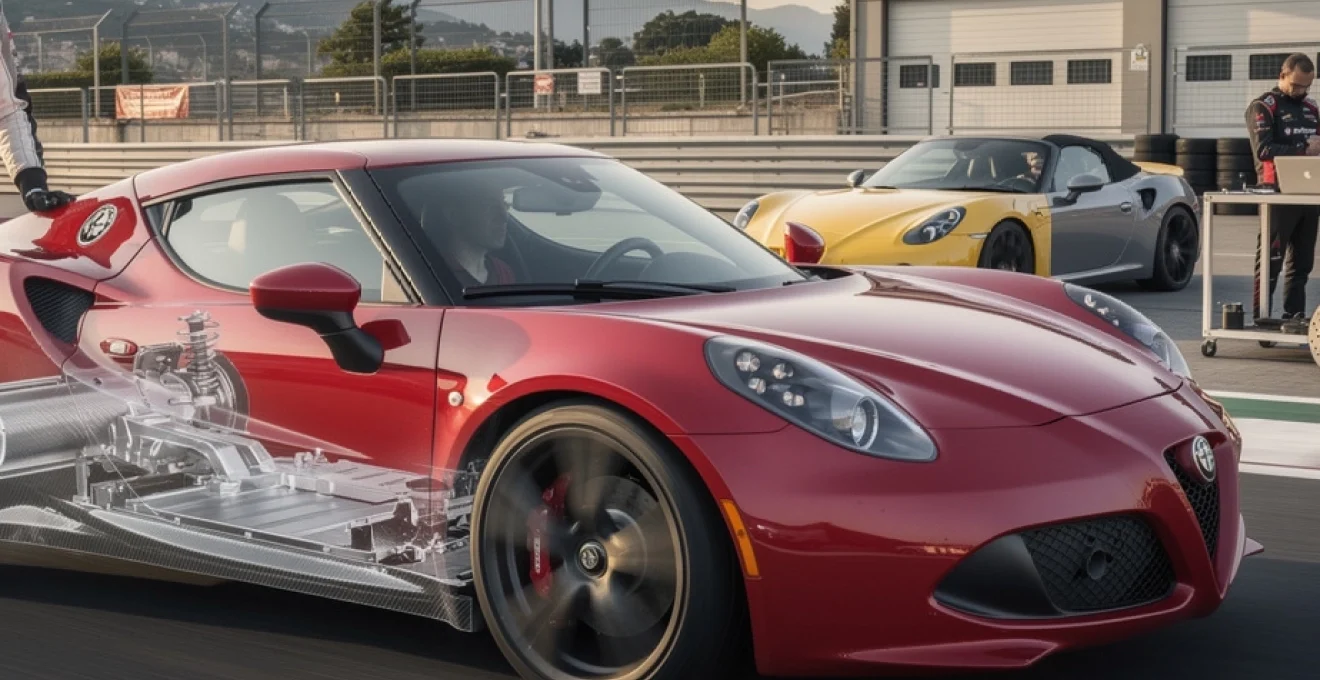
The Alfa Romeo 4C is one of those rare sports cars that feels more like a race car with number plates than a conventional road vehicle. Built around a carbon-fibre monocoque and powered by a compact but ferocious 1.75‑litre turbo engine, it delivers a raw driving experience that many modern, electronically cushioned sports cars simply cannot match. If you are interested in lightweight engineering, analogue steering feel and the kind of performance usually reserved for much more expensive exotics, the 4C deserves close attention. Launched in the 2010s and now discontinued, it is already developing a cult following on both sides of the Atlantic, which makes understanding its specifications, strengths and weaknesses extremely valuable if you are considering buying, maintaining or modifying one.
Alfa romeo 4C overview: model history, production years and positioning in the sports car segment
The Alfa Romeo 4C was first shown as a concept at the 2011 Geneva Motor Show and went into production in 2013, with UK deliveries from 2014. Coupé production ran until the end of the 2018–2019 period in most markets, while the 4C Spider carried on until the 2020 model year in the United States. Built at Maserati’s Modena facility, the 4C was conceived as a “compact supercar”: mid‑engined, rear‑wheel drive and focused unashamedly on driving purity rather than everyday usability. With an initial price in the £50,000–£60,000 bracket in Europe and around $55,000 in the US, it sat between lightweight specialist cars such as the Lotus Elise and more refined rivals like the Porsche Cayman and Audi TTS.
Positioning in the sports car segment was unusual. The 4C offered a carbon‑fibre tub, a feature typically associated with six‑figure supercars, at roughly half the cost. At the same time, its uncompromising cabin, minimal luggage space and firm ride placed it closer in spirit to track‑biased specials than to everyday sports coupés. Many reviewers described it as a “junior Ferrari” or “baby supercar”, while others felt its edgy dynamics and manual steering made it more demanding than a Cayman or Boxster. Production volumes remained low; early UK allocations sold out quickly, and global output never approached that of mainstream rivals. That rarity underpins growing interest among enthusiasts and collectors looking for a distinctive, lightweight Italian sports car.
Carbon-fibre monocoque chassis: alfa romeo 4C lightweight engineering and torsional rigidity
Dry weight, power-to-weight ratio and EU kerb weight figures of the alfa romeo 4C coupé and spider
At the heart of the Alfa Romeo 4C is a carbon‑fibre monocoque weighing just 65 kg, helping the original European‑spec coupé achieve a quoted dry weight of only 895 kg. That allows a power‑to‑weight ratio of under 4 kg per horsepower, an impressive figure usually associated with far more powerful machines. EU kerb weight, including fluids and a driver, typically sits just above the one‑tonne mark, depending on options such as the larger wheel and tyre packages or upgraded audio. US‑spec cars are heavier – around 2,495 lb (approximately 1,132 kg) – due to additional safety equipment, yet still remain roughly 500 lb lighter than a contemporary Porsche Cayman.
The 4C Spider adds structural bracing and removable roof hardware, bringing dry weight up by around 45 kg to roughly 940 kg. Even so, the convertible retains a distinct advantage against heavier open‑top rivals, which often exceed 1,300–1,400 kg. For you as a driver, this obsession with mass means sharper responses and shorter braking distances rather than just headline acceleration numbers. It also reduces consumable wear: lighter cars typically eat through tyres and brakes more slowly in normal use, an advantage that translates into lower running costs over time if the car is maintained correctly.
Carbon-fibre tub construction by adler plastic and comparison with lotus elise and KTM X-Bow
The 4C’s structural tub is built from pre‑preg carbon fibre using Formula 1‑inspired techniques, supplied by specialist partner Adler Plastic. The monocoque serves as the central load‑bearing cell, to which aluminium subframes and suspension components are bolted. This layout delivers high torsional rigidity, contributing to precise handling and improved crash safety. Unlike many cars that merely use cosmetic carbon trim, the 4C’s visible weave around the sills and footwells is truly structural, and you can see the tub exposed below the doors and floor mats.
How does this compare to other lightweight sports cars? The Lotus Elise relies on a bonded aluminium tub rather than carbon, which is cheaper to repair and extremely light but not quite as stiff for a given mass. The KTM X‑Bow goes all‑in with a full carbon chassis and minimal bodywork, but that car is even more extreme and track‑oriented, with very limited weather protection. The 4C sits in the middle: more usable than an X‑Bow, more exotic than an Elise. For drivers wanting a road‑legal car with genuine carbon‑fibre supercar construction yet some semblance of cabin trim and weather protection, the 4C offers a distinctive sweet spot.
Front and rear aluminium subframes, crash structures and suspension mounting points
Complementing the carbon tub, the front and rear of the Alfa Romeo 4C are built around aluminium subframes and crash structures. Alfa engineers adopted a new section profile, produced using the `Cobapress` process that combines casting and forging under high pressure. This technique yields a component that is both lighter and stiffer than a conventional rectangular strut, improving crash performance and suspension location accuracy. Mounting points for the double‑wishbone front suspension and MacPherson rear arrangement are integrated into these subframes to maintain precise geometry under load.
From a safety and repair perspective, this hybrid architecture brings clear benefits. In a significant impact, damage is more likely to be confined to the bolt‑on aluminium structures rather than the carbon cell, which is very difficult and expensive to repair correctly. The approach resembles that of higher‑end mid‑engined exotics, where energy‑absorbing aluminium frames protect the passenger cell. For you as an owner, it means that while serious accidents are still costly, there is at least some separation between sacrificial crash structures and the irreplaceable central tub.
Aerodynamic bodywork, underbody design and drag coefficient (cd) of the alfa romeo 4C
The 4C’s bodywork is moulded from low‑density SMC (Sheet Moulding Compound), a composite that is roughly 20 per cent lighter than steel and around half the density of aluminium. Combined with PUR‑RIM polyurethane bumpers and carefully profiled underbody elements, the design aims to minimise drag while generating stable downforce at speed. Alfa Romeo quoted a respectable drag coefficient in the 0.33 range, but the more significant achievement is the high‑speed stability produced without resorting to oversized wings.
Details such as the fixed, sealed front bonnet underscore the priority given to aerodynamics. Opening lines would have disturbed flow around the nose, so Alfa chose to bolt the panel shut and route service access from beneath, even though this complicates oil changes. The smooth undertray and rear diffuser help manage airflow under the car, improving stability on fast autobahn runs and circuit use. If you plan track days, paying attention to ride height and ensuring underbody panels are properly secured is essential; small changes in underfloor airflow can be felt at the steering wheel given how communicative the chassis is.
1.75 TBi turbo engine: performance, torque delivery and tuning potential
Inline-four 1750 turbo specifications: bore, stroke, compression ratio and injection system
Powering the Alfa Romeo 4C is the familiar but heavily re‑worked `1750 TBi` inline‑four, also seen in the Giulietta Cloverleaf. In 4C guise, the all‑aluminium unit displaces 1,742 cc, with a square‑ish bore and stroke configuration (around 83 mm by 80.5 mm, depending on source) and a relatively high compression ratio for a turbocharged engine, approximately 9.25:1. Direct petrol injection, variable valve timing and a high‑flow intercooler allow the engine to produce 237 bhp (240 PS) and 350 Nm of torque while still meeting modern emissions standards.
The injection system runs at high pressure, delivering atomised fuel directly into the combustion chamber for better efficiency and knock resistance. This permits more aggressive ignition timing, particularly useful given the significant boost levels used. For you, the end result is a compact, efficient powerplant that behaves like a much larger naturally aspirated engine once on boost, while still offering reasonable official economy figures around 41.5 mpg (combined) in EU tests and 28 mpg combined by EPA standards.
Turbocharger characteristics, boost pressure and torque curve in dynamic and race modes
The turbocharger is a key part of the 4C’s character. Boost pressure can reach close to 1.5 bar (over 21 psi) in peak conditions, creating the distinctive whoosh, whistle and surge that enthusiasts often crave. There is noticeable turbo lag at low revs; press the throttle at 2,000 rpm and the engine gathers itself before delivering a strong, almost violent wave of torque from around 2,200 rpm. This spiky power delivery has been widely reported and is part of what makes the car so engaging – and occasionally challenging – to drive smoothly on tight roads.
Alfa’s `DNA` modes influence not only throttle mapping but also how boost is deployed. In Natural or All Weather, the car softens response and limits peak torque for better traction and refinement. Switch to Dynamic, and the throttle becomes razor sharp, with a more aggressive boost strategy and louder exhaust note. Hold the selector to engage Race mode and stability control is disabled, traction thresholds raised and the engine maps configured for maximum performance. On track, Race mode combined with manual gear selection allows consistent lap‑after‑lap power delivery, as long as intake temperatures are managed.
Acceleration figures, top speed and real-world performance vs porsche cayman and abarth 124
On paper, the 4C’s performance figures are strong but not astronomical: 0–100 km/h (0–62 mph) in about 4.5 seconds for the coupé and roughly 4.7 seconds for the Spider, with a top speed around 160 mph (257 km/h). Independent testing has recorded even quicker 0–60 mph times of 4.2 seconds for the Spider, thanks to the car’s launch control and short gearing. By comparison, a similarly priced Porsche Cayman S of the same era sits in the 4.6–4.9 second range to 62 mph, while weighing significantly more. An Abarth 124 Spider, although entertaining, is in a completely different league at around 6.8 seconds to 62 mph and far less exotic in construction.
Real‑world performance feels even more dramatic than the numbers suggest. The combination of low seating position, minimal sound insulation and the engine sitting just behind your ears means that full‑throttle runs can feel closer to a GT3 race car than a compact roadster. One professional reviewer described the experience as “hanging on” rather than simply accelerating, and that aligns with feedback from many owners who report that even everyday commutes feel special. On tight B‑roads, the light weight and short wheelbase make the 4C feel hyper‑alert – a sensation that some love and others find too nervous compared with the calmer, more progressive Cayman chassis.
Aftermarket remaps, intake, exhaust and turbo upgrades from pogea racing and alfaworks
The `1750 TBi` engine offers significant tuning headroom, and specialist tuners have developed packages that transform the 4C’s performance. Well‑known names such as Pogea Racing and Alfaworks offer staged remaps, intake upgrades and freer‑flowing exhaust systems, including Akrapovič centre‑exit exhausts that amplify the car’s already dramatic soundtrack. Mild ECU calibrations can safely push power towards the 280–300 bhp region, while more extreme builds with upgraded turbos and intercooling have exceeded 400 bhp in some documented projects.
If you are considering tuning, a few practical points matter. First, the standard clutch packs in the `TCT` gearbox have limits; sustained high torque can shorten their life if launch control is abused. Second, intake temperatures are critical in a mid‑engined bay with limited airflow, so high‑quality intercooler and ducting solutions are preferable to cheap “bolt‑on” kits. Finally, remember that the stock chassis is already very quick; many owners find that investing in tyres, alignment and driver coaching offers a bigger lap‑time gain than chasing an extra 30 bhp.
TCT dual‑clutch gearbox: transmission mapping, ratios and launch control
Six-speed TCT architecture, wet clutches and gear ratio spread for road and track
The Alfa `TCT` (Twin Clutch Transmission) in the 4C is a six‑speed dual‑clutch unit using wet multi‑plate clutches for durability and heat management. Unlike some rival DSG or PDK systems that try to mimic a torque‑converter automatic at low speed, the 4C’s gearbox feels unapologetically mechanical. Select drive via the console buttons – `1`, `N`, `R` and `A/M` – and the system engages first gear with a distinct clunk. Around town, shifts in automatic mode can feel abrupt, but once on the move and especially in manual paddle mode, gearchanges are rapid and consistent.
Gear ratios are closely stacked to keep the engine in its boost band. First and second are short for rapid 0–100 km/h runs, while third and fourth cover typical back‑road speeds. Fifth and sixth are longer, providing a degree of relaxed cruising and contributing to the respectable fuel‑economy figures at motorway pace. On track, many drivers use third and fourth almost exclusively at circuits like Goodwood or Silverstone’s tighter sections, appreciating how the TCT blips the throttle automatically on downshifts for stability under braking.
Alfa DNA selector (all weather, natural, dynamic, race) and gearbox shift strategies
The `DNA` selector is central to how the TCT behaves. In All Weather, throttle and shift maps are softened, with early upshifts and a more conservative torque limit designed for low‑grip conditions. Natural mode suits daily use, blending reasonable shift comfort with decent response. Select Dynamic, and the gearbox holds gears longer, downshifts more aggressively and responds faster to paddle inputs, effectively transforming the 4C from compact coupé into something approaching a track car.
Hold the switch beyond the Dynamic detent to access Race mode, and the strategy changes again. Stability and traction aids are dialled back or disabled, the gearbox prioritises manual control and launch control becomes available. In this configuration, the 4C feels about as digital‑free as a modern dual‑clutch car can be, placing responsibility squarely in your hands. For spirited road driving, many experienced owners prefer Dynamic with manual shifts, reserving Race for familiar circuits where run‑off is generous.
Launch control activation procedure, 0–100 km/h times and repeatability on circuit
Launch control on the Alfa Romeo 4C is straightforward once the sequence is familiar. With the engine warm and the car stationary on a suitable surface, the usual procedure is:
- Select Race mode with the `DNA` selector.
- Ensure the gearbox is in first gear and stability aids are disabled.
- Firmly depress the brake pedal with your left foot and apply full throttle.
- Release the brake; the car manages wheelspin and clutch engagement for maximum acceleration.
Factory figures of 4.5 seconds to 100 km/h rely on this system and good surface grip. In practice, repeatability depends heavily on ambient temperature and tyre condition. The 4C’s low mass means that even modest wheelspin can cost tenths, so choosing warm tyres and avoiding dusty launch areas makes a noticeable difference. On circuit days, using launch control repeatedly is not advisable; it generates significant heat in the wet clutch packs, and Alfa’s own guidance is to use the feature sparingly to preserve drivetrain longevity.
Common TCT issues, software updates and preventive maintenance practices
Overall, the 4C’s `TCT` has proved more durable than early dual‑clutch systems from other brands, but a few known issues and considerations exist. Some owners report hesitant engagement or jerky low‑speed behaviour, often improved by the latest factory software updates that refine clutch control algorithms. Occasional warning lights related to transmission temperature can appear after prolonged stop‑start traffic or repeated hard launches, signalling that the system needs a cool‑down period.
For preventive maintenance, regular fluid changes using the correct specification oil are crucial, especially for cars seeing frequent track use. Avoiding excessive “riding” of the transmission in traffic – for example, by selecting neutral rather than holding on the brake – can also reduce clutch wear. If you test‑drive a used 4C, pay attention to how smoothly the car pulls away from rest and whether any warning messages appear under hard acceleration. A car that feels excessively reluctant to engage first or exhibits pronounced shuddering may need clutch calibration or, in worse cases, mechanical attention.
Chassis dynamics: suspension geometry, steering setup and braking hardware
Double-wishbone front and MacPherson rear suspension kinematics and camber settings
The Alfa Romeo 4C uses a sophisticated double‑wishbone front suspension combined with a MacPherson rear layout. The choice reflects a balance between packaging, cost and performance: double wishbones at the front allow precise control of camber gain and roll centre during cornering, while the simpler rear design saves weight and space. Static camber settings are relatively aggressive from the factory, contributing to strong front‑end grip and a keen turn‑in response, especially on the optional 18‑inch front and 19‑inch rear wheels fitted with performance tyres.
Alfa offered a Racing Pack with firmer springs, revised dampers and thicker anti‑roll bars, ideal for track drivers but quite uncompromising on poor roads. Many owners choose to stick with the standard suspension if the car sees mainly road use, as the default set‑up already feels firm. Proper alignment is crucial; incorrect toe or camber can turn the naturally agile chassis into something nervous and tiring. If you purchase a used 4C, investing in a four‑wheel laser alignment by a specialist familiar with the platform is among the most effective ways to restore its intended balance.
Unassisted steering, steering rack ratio and feedback compared with modern EPS systems
One of the 4C’s headline features is its unassisted steering. At parking speeds it can feel heavy, particularly on wider front tyres, but once moving the rack comes alive, delivering feedback that most modern electric power steering (`EPS`) systems cannot match. The ratio is quick, requiring small inputs for significant direction changes, which makes the car feel darty until you adapt your driving style. On smooth tarmac, this results in extraordinary precision; you can place the car to within a few centimetres, feeling the grip build and release through your fingertips.
However, the same sensitivity can become tiring on bumpy or cambered roads. Several road tests noted that the wheel “wriggles” in your hands as the tyres follow surface imperfections, and this kickback can be disconcerting if you are used to numb, filtered steering. Think of it as the difference between a high‑end mechanical watch and a digital display: the mechanical piece tells you more, but it also demands more of your attention. Drivers who appreciate analogue interaction tend to fall in love with the 4C’s steering feel; those seeking long‑distance comfort may find it more work than pleasure.
Brembo brake calipers, disc sizes, pad compounds and brake fade resistance on track
Braking hardware on the 4C is well matched to its low weight. The car uses large ventilated discs with aluminium bells and cast‑iron friction rings, a hybrid design that can save up to 2 kg per disc compared with conventional one‑piece rotors. Front callipers are typically four‑piston Brembo units, while the rear uses simpler sliding callipers integrated with the parking brake mechanism. Pedal feel is firm and requires a decisive shove, consistent with the car’s uncompromising character.
On road, fade is rarely an issue thanks to the modest mass the brakes need to slow. On track, sustained lapping can reveal the limits of the factory pad compounds and fluid, especially on tight circuits with repeated heavy braking zones. Many enthusiastic owners switch to higher‑temperature pads and performance brake fluid, which significantly improve consistency without the need for big‑brake kits. If you test a used car, inspect the discs for cracks and check that the pedal remains strong after several firm stops from motorway speeds; a long, soft pedal may indicate old fluid or overheating history.
OEM vs aftermarket suspension upgrades from öhlins, KW and bilstein
The standard and factory Racing Pack suspension set‑ups are only part of the story. Aftermarket specialists such as Öhlins, KW and Bilstein offer coilover kits that can transform the 4C’s ride and handling balance. High‑quality adjustable dampers provide independent control of compression and rebound, allowing you to dial out some of the factory car’s vertical harshness without sacrificing body control. For mixed road and track use, a well‑set‑up KW or Bilstein kit can make the car more compliant over broken surfaces while sharpening response on circuit.
Before upgrading, it is worth considering your primary use case. If you mainly drive on smooth roads or track, the stock suspension with slightly tweaked alignment may already be ideal. For daily use on rougher surfaces, a carefully chosen aftermarket kit can reduce fatigue and help tyres maintain contact over bumps. In all cases, proper corner‑weighting and alignment are essential; simply bolting on parts without set‑up undermines the benefits of the 4C’s advanced chassis. Viewed correctly, the car is more like a small GT3‑style track special than a conventional coupé, and it rewards time spent on chassis tuning.
Interior design, ergonomics and driver-focused cockpit of the alfa romeo 4C
The Alfa Romeo 4C’s cabin is unapologetically driver‑focused. Climbing over the wide carbon sill and lowering yourself into the low‑mounted bucket seat instantly signals that you are in something more akin to a racing car than an everyday runabout. Once seated, the simple dashboard cants slightly towards the driver, with a digital TFT instrument cluster displaying revs, speed, gear selection and trip information. Exposed carbon fibre around the sills and footwells reinforces the sense of being bolted directly to the chassis, while aluminium pedals and a flat‑bottomed steering wheel add to the motorsport vibe.
Ergonomically, compromises are inevitable. Taller drivers may find headroom marginal and knees splayed around the steering column, and the fixed seatback angle offers limited lumbar support. Noise levels are high; the engine sits just behind the cabin, and minimal sound insulation means long journeys can be tiring, especially with the sports exhaust. Storage is sparse, with no conventional glovebox and only a small rear luggage compartment of about 110 litres, which doubles as roof stowage in the Spider. Yet if you value immersion over comfort, the 4C’s sparse interior becomes part of the appeal, stripping away distractions such as large infotainment screens and complex driver aids.
Special editions, colourways and option packs: launch edition, competizione and spider italia
During its production run, the Alfa Romeo 4C spawned several special editions and noteworthy option packs that can influence used values and desirability. The 2014 Launch Edition, limited in many markets, featured unique wheels, carbon‑fibre exterior details, special badging and often a numbered plaque, appealing to collectors. Later, the Competizione variant emphasised a sportier aesthetic with darker finishes, distinctive alloy designs and, in some configurations, additional carbon trim. These versions typically command a premium on the used market, especially in low‑mileage, unmodified condition.
Towards the end of its life, the 4C Spider gained the Italia and 33 Stradale Tributo editions. The Spider Italia stood out with Misano Blue Metallic paint, glossy black bumper inserts and an aluminium dashboard insert bearing the model logo, alongside a numbered centre‑console plate. The 33 Stradale Tributo paid homage to Alfa’s iconic 1960s 33 Stradale, with Rosso Villa d’Este paint, grey‑gold wheels and a two‑tone black‑and‑tan interior. For you as a buyer, these final‑year cars combine the most refined factory calibration with strong long‑term collectability, especially given that 2020 marked the end of 4C production with no direct replacement announced.
Used alfa romeo 4C buyer’s guide: reliability, known issues and maintenance costs
Considering a used Alfa Romeo 4C involves weighing its exotic construction and thrilling dynamics against practical ownership factors. Official fuel consumption figures of 41.5 mpg (combined) in Europe and 28 mpg (combined) in the US are respectable for a 160 mph sports car, and many owners report real‑world averages around 30 mpg when driven sensibly. Road tax (VED) in the UK is moderate at around £175 for many model years, and official servicing intervals are typical for a performance four‑cylinder. However, insurance sits in the top Group 50 bracket, reflecting both performance potential and repair complexity, and company‑car tax may still be significant despite relatively low 157 g/km CO₂ emissions.
From a reliability standpoint, the 1.75‑litre turbo engine and TCT gearbox derive from proven Alfa components, and the relative mechanical simplicity – no complex adaptive dampers or extensive driver‑assistance suites – actually works in the 4C’s favour. The carbon tub is corrosion‑resistant and extremely strong, and the composite body panels are less prone to minor dings than steel. Potential issues include turbo and exhaust heat management in the tightly packed engine bay, minor electronic niggles, and the aforementioned TCT calibration quirks. The key red flag is accident damage to the tub or subframes; always check for evidence of proper crash repair and insist on geometry printouts showing that the chassis sits within factory tolerances.
Maintenance costs vary with usage. Regular servicing is not ruinous, but the factory requirement to check and re‑torque subframe and tub bolts at 12, 36 and 60 months (or equivalent mileages) adds several hundred pounds to service bills. Tyres and brakes last surprisingly well given the performance, thanks to the low kerb weight, but frequent track use accelerates wear. If you plan to drive your 4C hard, budgeting for upgraded pads, quality synthetic oil and more frequent fluid changes is sensible. Depreciation has stabilised; early cars now retain roughly 50 per cent of original value after three years/30,000 miles, and limited‑edition Spiders and late‑model examples may appreciate as supply dwindles.
When inspecting a potential purchase, practical tips include checking for stone‑chipping on the low nose, listening for suspension knocks over bumps and confirming that the removable Spider roof mechanism operates smoothly if applicable. Interior wear on seat bolsters and exposed carbon edges can indicate heavy use or careless entry and exit. A thorough road test should include cold start, low‑speed manoeuvring, a full‑throttle pull to redline and several firm brake applications. Treated as an exotic that happens to share some parts with mainstream Alfas, rather than as a conventional coupé, the Alfa Romeo 4C rewards careful ownership with a level of driver involvement that remains rare in the modern performance‑car market.