
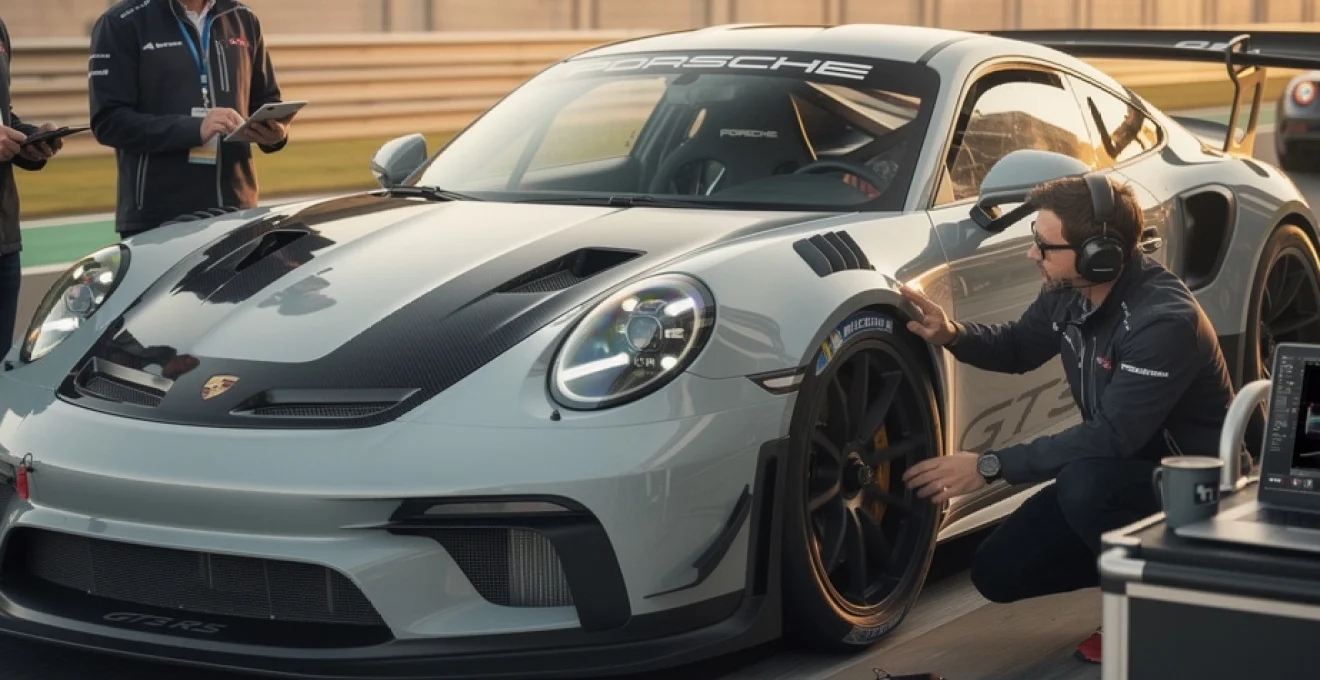
The 2025 Porsche 911 GT3 RS sits at a point where road car and race car all but merge. With a 4.0-litre naturally aspirated flat-six howling to 9,000rpm, active aerodynamics generating race-car levels of downforce and a chassis born on the Nürburgring, it targets drivers who want more than straight-line fireworks. If you are considering a track-focused 911 or simply want to understand why the GT3 RS has become an icon, the 2025 evolution is a fascinating study in how marginal gains add up to huge lap time advantages. Instead of chasing headline power numbers, Porsche has refined airflow, response and data, leaving you with a machine that feels sharper, more precise and more rewarding every time you drive it.
Overview of the 2025 porsche 911 GT3 RS: key upgrades over the 992 GT3 RS
The current 992-generation Porsche 911 GT3 RS already set a benchmark, lapping the Nürburgring Nordschleife in 6m49.328s and delivering up to 860kg of downforce at 177mph. The 2025 Porsche 911 GT3 RS keeps the same core recipe but focuses on detail optimisation rather than a wholesale reinvention. Power from the 4.0-litre flat-six remains at an approximately 518bhp level, yet software tweaks, cooling refinements and aero recalibration aim to unlock extra consistency and repeatability in hard circuit use. Think of it less as a new generation and more as a deeply developed evolution of the original 992 GT3 RS concept.
The 2025 GT3 RS continues to use the wide Turbo body shell, with its lateral air intakes and track-focused stance, but integrates lessons learned from the latest 2025 GT3 and GT3 with Touring Package. Those models introduced revised aero bars, updated underbody fins and a shorter final-drive ratio for the PDK transmission, all of which influence the RS approach. For you as a driver, the main benefit is a car that feels more immediate on throttle, more stable in high‑speed corners and better able to manage heat, from brakes to intake air, over long sessions. This is essentially a race car with number plates, engineered for repeated abuse on track days rather than occasional sprints.
The 2025 911 GT3 RS shows how incremental engineering changes – in aerodynamics, cooling, calibration and materials – can deliver a car that feels significantly more focused without a dramatic spec-sheet overhaul.
Aerodynamic redesign: active aero, swan-neck wing and nürburgring-focused downforce
Aerodynamics are the true superpower of the GT3 RS. The raw numbers are extraordinary: around 860kg of downforce at 177mph and roughly 406kg at 124mph, more than double the downforce of the previous 991.2 GT3 RS. For 2025, Porsche’s engineers concentrate on how that downforce is generated, controlled and shed, using updated software, slightly reprofiled surfaces and wind-tunnel-derived tweaks to make the car more predictable at the limit. The aim is clear: give you massive grip and stability in high-speed sections of circuits like Spa and the Nürburgring, while allowing rapid drag reduction on straights for higher terminal speeds.
Active rear wing profiles, DRS integration and drag reduction strategies derived from 911 GT3 R
The hallmark of the GT3 RS is the towering swan-neck rear wing with its hydraulically actuated element. This system, often described using motorsport jargon such as DRS (Drag Reduction System), borrows heavily from Porsche’s 911 GT3 R and RSR race cars. In high-downforce mode, the active flap and static main plane generate the 70% rear / 30% front aero balance Porsche targets. Hit the DRS function under the right conditions and the rear element flattens, reducing overall downforce to around 306kg at 177mph. That drop in drag is crucial if you want to squeeze extra km/h out of long straights without sacrificing cornering speeds elsewhere.
For 2025, the logic that decides when and how quickly the DRS can be deployed is more closely integrated with the car’s dynamic systems. Inputs from steering angle, brake pressure and yaw rate help determine the safest window to open the wing. Practically, that means you can concentrate on positioning the car, knowing that the electronics are working constantly in the background to balance stability with straight-line efficiency. It’s an elegant example of track-derived active aerodynamics adapted for road-legal use.
Reprofiled front fascia, NACA ducts and underbody air management for high-speed stability
Up front, the 2025 911 GT3 RS continues the single central radiator layout that frees space either side in the bumper for active aero flaps and larger ducts. The front splitter and bumper corners are reprofiled to manage air more cleanly around the wider track, improving stability when you turn in at very high speeds. Additional refinement of the S-duct concept, first seen on RS race cars and the GT3 RS road car, helps evacuate hot air efficiently through the bonnet nostrils without upsetting the flow over the roof.
NACA ducts and carefully shaped underbody channels combine with wing-profiled front wishbones to generate an impressive contribution to downforce from the front axle alone – around 40kg at top speed simply from those suspension arms. For you, that translates into clearer front-end bite and less understeer on initial turn-in. It is comparable to placing a hand out of a moving car window and feeling the force build as you adjust the angle: the GT3 RS applies the same principle across virtually every surface.
Revised side intakes, rear diffuser geometry and cooling flow optimisation for track use
Side intakes and rear diffuser geometry also receive subtle yet important refinements for 2025. The challenge is to feed the naturally aspirated engine with cool, dense air while expelling hot radiator air and brake heat effectively. The latest RS integrates black fins on the bonnet and blades on the roof that push hot air away from the engine intakes, preventing power loss that can reach 10–15bhp if intake temperatures rise by 10°C. This kind of thermal management is especially relevant for owners in hotter climates or those running extended sessions on demanding circuits.
At the rear, the diffuser works harder in conjunction with the wing to keep the aero balance stable as speed, yaw and ride height change. The result is a car that feels eerily locked down in fast direction changes, even on less-than-perfect track surfaces. If you have driven earlier RS generations, the impression is of a bigger operating window: the GT3 RS is less spiky at the limit and more communicative as it approaches slip.
Wind tunnel validation, CFD simulations and nürburgring lap time targets for the 2025 GT3 RS
Modern GT cars are born as much in virtual space as in the physical world. For the 2025 GT3 RS, Porsche leans heavily on CFD (computational fluid dynamics) to iterate aero concepts before validating them in the wind tunnel and on-track. That process is guided by specific lap-time targets, with the Nürburgring Nordschleife used as the ultimate yardstick. With the previous car already below 6m50s, development runs focus on consistency, tyre life and ease of use for skilled amateurs rather than simply chasing another headline record.
Industry observers have noted that the GT3 RS aero philosophy is influencing the wider 911 range, including updated GT3 models with trickled-down aero bars and revised diffusers. For you, this matters because it shows Porsche is committed to a long-term motorsport-led approach to road car design, not a short-lived marketing exercise. The 2025 RS stands as the most concentrated form of that philosophy.
In an era obsessed with power figures, the 2025 GT3 RS demonstrates that managing air – not just adding horsepower – remains the smartest way to get faster on a circuit.
Powertrain evolution: 4.0-litre naturally aspirated flat-six and revised PDK calibration
At the heart of the 2025 Porsche 911 GT3 RS beats the familiar 4.0‑litre, naturally aspirated, flat‑six engine, a configuration that has become almost spiritual to enthusiasts. Output remains in the region of 518bhp (510PS for the GT3, 518PS for the RS) with peak power arriving at 8,500rpm and the rev limiter set at 9,000rpm. On paper, that is only 15bhp more than a standard GT3 and around 5bhp more than the previous 991.2 GT3 RS, but the real story lies in how that power is delivered and how the seven-speed PDK transmission deploys it on track. For drivers seeking an analogue feel in a digital age, this engine is a rare gem.
Engine internals, redline characteristics and throttle mapping changes versus 2023 GT3 RS
The RS powerplant uses a DOHC, 24‑valve layout with an aluminium block and heads, along with dry‑sump lubrication optimised for sustained lateral loads on slick or Cup tyres. While internal hardware – pistons, rods, crank – stays broadly familiar for 2025, incremental friction reduction and revised camshaft profiles contribute to sharper response in the upper third of the rev range. Drivers report an even keener rush from 7,000rpm to the 9,000rpm cut, with the engine feeling happier to live near the limiter in track scenarios.
Throttle mapping is subtly altered to provide finer modulation in circuit-specific drive modes. In practice, you get more linear correlation between pedal travel and torque delivery, making it easier to balance the car on the edge of grip in long, loaded corners. This kind of fine control matters most on technical sections of circuits such as Sector 2 at the Nordschleife or Maggotts–Becketts at Silverstone, where even small inputs can disturb the car.
Exhaust system, particulate filter tuning and sound engineering for european WLTP compliance
Achieving current WLTP and Euro 6 emissions standards while retaining the signature GT3 RS soundtrack is a significant challenge. The 2025 car continues to use a carefully tuned exhaust with integrated OPF (gasoline particulate filters), optimised internal flow paths and active valves. Calibration focuses on preserving the high‑frequency howl that enthusiasts value, particularly above 5,000rpm, while controlling low-frequency boom and emissions during part‑throttle cruising.
From the cabin, you still hear that unmistakable mechanical orchestra: induction roar, valvetrain whir and a metallic rasp from the tailpipes. The result feels much closer to a Cup car than to a turbocharged 911 Turbo S. For those who use a GT3 RS regularly on the road, the dual nature – civilised enough at low load, intense above 7,000rpm – makes it surprisingly tolerable between circuit outings.
Seven-speed PDK shift logic, shorter final drive and launch control updates for circuit performance
The seven‑speed PDK gearbox is central to how the 911 GT3 RS delivers lap time. Compared with the GT3, it runs a shorter final‑drive ratio for 2025, mirroring similar changes seen on the latest GT3 models. This results in stronger in‑gear acceleration and keeps the engine in its sweet spot more of the time. Shorter gearing is one reason the GT3 RS feels explosively responsive exiting medium‑speed corners, even though its peak power figure is modest next to some turbocharged rivals.
Shift logic in the most aggressive mode is tuned for track use, favouring downshifts under heavy braking and holding lower gears through corners to maximise response. Launch control maps are updated as well, helping the car hit 0–100km/h (62mph) in around 3.2 seconds, matching earlier test data. For many owners, what matters more is the PDK’s ability to withstand repeated hot laps without heat-soak or shift degradation, an area where the Porsche dual‑clutch system remains one of the benchmarks.
Performance figures, 0–100 km/h times and top speed compared to 991.2 GT3 RS and 992 GT3
While exact 2025 figures can vary slightly depending on options and conditions, representative data for the 992 GT3 RS compared to key relatives is shown below:
| Model | Power | 0–100 km/h | Top speed | Downforce @ ~285 km/h |
|---|---|---|---|---|
| 991.2 911 GT3 RS | 520PS | 3.2s | 312km/h | ~350kg |
| 992 911 GT3 | 510PS | 3.4s (PDK) | 318km/h | significantly lower than RS |
| 2025 992 911 GT3 RS | ~518PS | 3.2s | 296km/h | ~860kg |
The GT3 RS sacrifices a little top speed versus a GT3 in favour of immense downforce and corner speed. On a typical Grand Prix circuit, that trade pays off handsomely: you might be several seconds quicker per lap, with net gains especially visible in high‑speed sections and braking zones.
Chassis, suspension and braking: track-honed hardware for the 2025 911 GT3 RS
The chassis hardware of the 2025 Porsche 911 GT3 RS is where the “race car for the road” description becomes more than marketing. Double-wishbone front suspension, rear-axle steering, huge PCCB brakes and motorsport-derived tyres all converge to create a platform that is both ruthlessly fast and astonishingly communicative. For track-day drivers, this delivers not only outright lap time, but also repeatability: the car feels consistent from lap one to lap twenty, assuming you manage tyre and brake temperatures smartly.
Revised PASM adaptive dampers, spring rates and anti-roll bar configurations
The RS uses a specific calibration of PASM (Porsche Active Suspension Management) with revised spring rates and damping curves to suit its aero load. As downforce rises, the suspension must support not just the static weight of the car (around 1,450kg at kerb with weight‑saving options) but potentially over a tonne of combined load at speed. The 2025 tune targets improved body control over kerbs and through rapid transitions, reducing pitch and roll without making the car unusably harsh on smooth roads.
Anti‑roll bars front and rear are adjustable, giving you scope to fine‑tune balance for different circuits or tyre choices. A stiffer front bar, for example, can sharpen initial turn‑in at a relatively smooth track such as Silverstone, while a softer setting might suit bumpy surfaces or wet conditions. Access to these adjustments, combined with damper and aero settings, means the GT3 RS behaves more like a serious club‑level race car than a conventional road-going coupé.
Rear-axle steering tuning, front axle geometry and alignment setups for spa and silverstone
Rear‑axle steering is another cornerstone of the GT3 RS dynamic package. At low speeds, it turns opposite to the front axle to reduce the effective wheelbase, aiding agility in hairpins and tight chicanes. At higher speeds, it turns with the front wheels to enhance stability. For 2025, software adjustments provide a more progressive build‑up of rear‑steer effect, making the car feel more natural as you lean on it on fast circuits.
Front axle geometry is optimised for track alignments with more aggressive camber and toe settings than a regular 911. Owners often run bespoke set‑ups depending on where they drive most: for example, Spa-Francorchamps rewards a slightly more stable rear for high‑speed sweeps like Blanchimont, while Silverstone’s fast changes of direction may invite a sharper front-end configuration. Consulting with an experienced setup specialist before your first serious track day is highly advisable.
PCCB ceramic brakes, calliper revisions and cooling ducting for endurance track sessions
Stopping power comes from massive steel discs as standard, with optional Porsche Ceramic Composite Brakes (PCCB) available for those prioritising fade resistance and reduced unsprung mass. The RS package includes slightly revised calliper hardware and reshaped cooling ducts to keep temperatures under control during long runs. On a demanding circuit, this can mean the difference between consistent braking points all afternoon and a soft pedal after just a handful of laps.
Proper brake management is one area where driver technique still matters enormously. Short, firm applications keep discs and pads working efficiently, whereas constant light braking builds heat without adding much deceleration. The GT3 RS rewards good habits with outstanding consistency, making it a valuable training tool as well as a devastatingly fast machine.
Michelin pilot sport cup 2 R and cup 2 tyre options, compound choices and staggered sizing
The 2025 GT3 RS typically runs Michelin Pilot Sport Cup 2 or Cup 2 R tyres, in a wide staggered configuration tailored to the 911’s rear-engine balance. The Cup 2 R option pushes dry grip close to full slick‑tyre territory, though it demands warm ambient conditions and careful temperature management. For mixed road and track use, many owners choose the standard Cup 2, which trades a small slice of ultimate performance for better wet‑weather security and longer life.
Tyre choice is effectively one of the most powerful tuning tools at your disposal. If you are planning regular visits to circuits such as the Nürburgring, budgeting for multiple sets per year is prudent. Treat them like consumables in the same way you might think about brake pads and fluid; it is the price of accessing the car’s full potential.
Weight saving, materials and weissach package changes in the 2025 GT3 RS
Weight saving remains a core element of the GT3 RS philosophy. Although aerodynamic hardware and wider bodywork add mass compared to a standard GT3, extensive use of lightweight materials ensures the RS remains impressively lean. With a kerb weight of around 1,450kg in optimal specification, it sits only 15kg or so above an equivalent GT3 while carrying far more sophisticated aero and chassis components. For 2025, attention focuses on optimising existing solutions, rather than radical material changes.
Carbon-fibre reinforced plastic (CFRP) panels, lightweight glazing and structural bracing
The RS continues to rely on carbon‑fibre reinforced plastic (CFRP) for major exterior panels such as the bonnet, roof, front wings and that enormous rear wing. Doors can also be specified in lightweight material, while glass areas use thinner, lightweight glazing to shave further kilograms. The combination of these measures contributes significantly to a sense of agility on track, particularly in fast direction changes where every kilo of sprung mass matters.
Structural bracing in key areas – behind the seats, around the rear suspension mounts and under the front bonnet – improves torsional rigidity. This allows the suspension to do its job more accurately and makes damper and alignment changes more predictable. The net benefit for you is clearer feedback through the steering wheel and seat, especially when running high-downforce settings.
Weissach package upgrades: exposed carbon elements, magnesium wheels and roll cage options
For drivers seeking the most extreme interpretation of the GT3 RS concept, the Weissach Package remains a compelling option. It exposes more carbon‑weave elements inside and out, replaces some metal components with CFRP and, crucially, offers forged magnesium wheels that can save several kilograms of unsprung weight per corner. The result is even faster suspension response and slightly improved ride quality over bumps, despite the car’s stiff base settings.
In addition, the Weissach Package can include a bolted roll cage, crafted in a carbon‑weave finish to echo Porsche Motorsport’s factory race cars. While primarily a safety feature – particularly when combined with six‑point harnesses and helmet use – the cage also improves rigidity. For frequent track users, this option is one of the most worthwhile, both from a performance and protection standpoint.
Mass reduction strategy compared with 992 GT3 and 992 GT3 RS clubsport configurations
Against a standard 992 GT3, the RS adds aero hardware, wider tyres, active systems and cooling, yet clever light‑weighting keeps the deficit modest. Compared with Clubsport‑equipped GT3s – which already feature roll cages and bucket seats – the RS prioritises absolute performance over day‑to‑day flexibility. There is no rear seat option, front‑boot storage is effectively sacrificed to accommodate the central radiator, and sound insulation is reduced.
For road‑biased users, those compromises might seem steep. For dedicated track‑day drivers, however, the trade‑off is entirely logical. If you plan to own both a more civilised 911 (such as a Carrera or Turbo) and a GT3 RS, the focus and single‑mindedness of the RS become significant positives rather than drawbacks.
Interior, ergonomics and driver interfaces: motorsport-inspired cockpit updates
The interior of the 2025 911 GT3 RS is unashamedly motorsport‑inspired. While the basic architecture mirrors other 992‑generation 911 models, the materials, seats and controls are oriented towards serious driving rather than everyday comfort. Yet there is still enough adjustability and refinement to make long motorway hauls or trips to the Alps perfectly realistic, provided you accept some extra noise and a firmer ride. The digital interfaces receive incremental improvements, especially around track data and customisable driving profiles.
Full bucket seats, six-point harness provision and FIA-compliant roll-over protection
Full carbon-fibre bucket seats come as standard or as key options, carrying through the lightweight ethos of the GT3 RS cabin. These seats offer excellent lateral support for high‑g cornering, while still incorporating heating and limited power adjustment for comfort. Crucially, they are designed with helmet clearance and harness routing in mind, making them suitable for serious circuit use.
Six‑point harness provision is integrated into the seat and roll‑cage layout, simplifying the process if you decide to fit them later. The optional cage provides FIA‑compliant roll‑over protection in many track‑day contexts, though regulations can vary by country and event, so checking specific requirements remains essential. For drivers who view safety equipment as non‑negotiable, the GT3 RS architecture provides a highly competent base.
Motorsport steering wheel, rotary mode selectors and customisable drive profiles
The steering wheel is another clear link to Porsche’s competition programmes. Wrapped in high‑grip Race‑Tex and featuring a series of rotary selectors, it allows on‑the‑fly adjustments of key parameters. You can independently tweak rebound and compression for the adaptive dampers, alter traction and stability thresholds, or change the DRS and differential behaviours without taking hands from the wheel longer than necessary.
This level of control might seem overwhelming at first, but with experience it becomes an invaluable tool. For example, you might run a softer damper map over kerb-heavy sections while tightening the differential and increasing downforce for faster parts of the circuit. Treat the interface like a sophisticated instrument panel: the more you understand it, the more precisely you can tune the car to your driving style.
Track telemetry, porsche track precision app integration and data logging enhancements
Data has become as important to performance driving as raw power or tyre grip. The 2025 GT3 RS integrates closely with Porsche’s track telemetry ecosystem, including the Porsche Track Precision App. This allows you to log lap times, GPS traces, throttle and brake inputs, steering angle and more, then analyse them between sessions. Used effectively, such data can highlight where you are leaving time on the table long before you feel it subjectively.
For drivers who enjoy continuous improvement, treating this like a personal coaching tool is highly rewarding. You might compare different damper or wing settings, or examine how braking points shift as fuel load drops. Think of it as the motorsport equivalent of a fitness tracker, but with much bigger stakes – and far more engaging feedback.
Material choices, alcantara, Race-Tex and lightweight sound insulation changes for 2025
Material choices in the GT3 RS cockpit reflect both function and emotion. Extensive use of Alcantara‑type Race‑Tex, visible carbon‑weave finishes and minimal brightwork create an environment that feels purposeful, almost clinical. For 2025, sound insulation is subtly pared back in key areas, trimming a little mass while allowing more of the engine and road noise into the cabin.
If you are used to a 911 Turbo or a Panamera, this might initially feel raw. Yet for many GT3 RS owners, the extra sensations – the hum of the tyres, the thrum from the engine mounts, the faint whoosh of air over the body – are precisely what make the experience special. It is an immersive driving environment, not a luxury salon.
Pricing, options and positioning in the porsche 911 range and GT product hierarchy
In the UK and many other markets, pricing positions the 2025 Porsche 911 GT3 RS as one of the most expensive non‑limited 911 variants, often well above £190,000 before options. By the time essential extras such as PCCB, Weissach Package, bucket seats and telemetry upgrades are added, real‑world transaction prices can climb significantly higher. In markets like the Middle East or the US, premiums and market adjustments can elevate figures closer to supercar territory, often rivaling or surpassing high‑spec 911 Turbo S models.
Within the GT range, the hierarchy is clear. The 911 GT3 is the base GT car, offered in winged and Touring forms, balancing everyday usability with serious track pace. The GT3 with Touring Package caters to those who want understatement and occasional circuit visits. The GT3 RS, by contrast, is engineered first and foremost for lap times and circuit performance, with road legality treated almost as a bonus. If you already own a Taycan or a G‑Class for daily use, the RS makes far more sense as a dedicated toy than as a do‑everything sports car.
Key options to consider if you are configuring a 2025 GT3 RS for serious use include the Weissach Package, PCCB brakes, magnesium wheels, full bucket seats, roll cage and telemetry integration. Budgeting for consumables – tyres, pads, high‑temperature brake fluid and regular servicing – is also crucial, especially if multiple track days per year are planned. Approached thoughtfully, the GT3 RS becomes not just a thrilling object of desire, but a highly effective tool for developing driving skills and experiencing what modern track-focused engineering can achieve.