
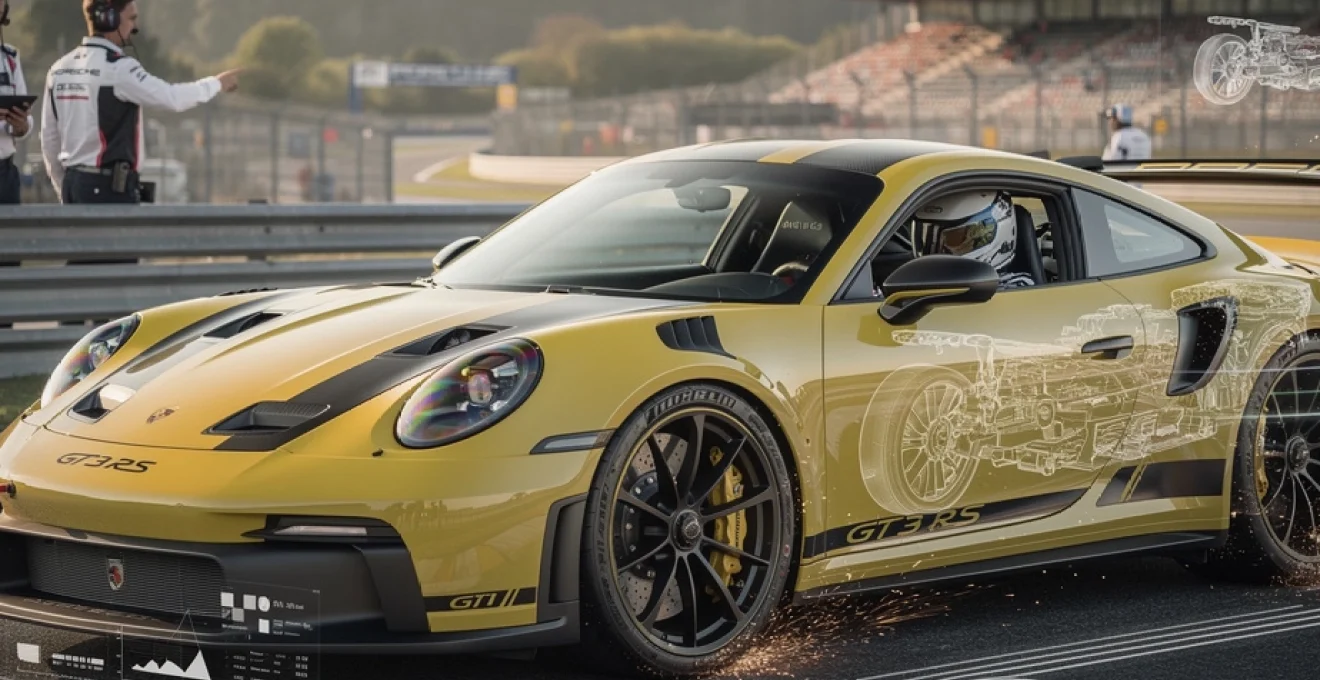
The 2024 Porsche 911 GT3 RS stands at the sharpest end of the 911 family, a road-legal car that behaves like a full-blown race machine. It takes the already ferocious 992 GT3 and dials up the focus with more downforce, more control and more adjustability than any previous RS. For anyone who spends serious time on circuit days or wants a car that feels as alive at 250 km/h as it does at 50 km/h, this GT3 RS is a uniquely compelling proposition. It embodies the motorsport DNA honed at places such as the Nürburgring Nordschleife, Daytona and Le Mans, yet still offers the reliability and usability associated with a modern 911.
What makes this generation special is not raw power alone, but the way that power, aerodynamics, chassis and electronics are blended. If you are looking at a high-performance track tool and wondering how far a road car can really go toward pure race-car feel, the 2024 Porsche 911 GT3 RS provides a very clear answer.
Engine architecture and powertrain engineering in the 2024 porsche 911 GT3 RS
4.0-litre naturally aspirated flat-six: rev ceiling, bore and stroke, compression ratio
At the heart of the 2024 Porsche 911 GT3 RS lies a 4.0‑litre naturally aspirated flat‑six that is closely related to Porsche’s GT3 R and RSR race engines. Displacing 3,996 cc with a square-ish bore and stroke configuration, it delivers up to 518 hp (approximately 525 PS) at around 8,500 rpm and revs right out to a 9,000 rpm ceiling. That rev limit is not a marketing flourish; on circuit you will find yourself using the last 1,000 rpm frequently, because the engine breathes freely right to the top of the tachometer.
The compression ratio sits in the region of 13.0:1, extremely high for a road-going production engine running on standard high-octane pump fuel. This high compression is key to the efficiency and response of the GT3 RS powertrain, improving thermal efficiency and allowing the 4.0‑litre flat-six to deliver a power density of over 129 hp per litre without resorting to turbocharging. For you as a driver, that translates into instant throttle response, clean power delivery and a soundtrack that builds from metallic bark to a race-car shriek as the revs rise.
Motorsport-derived internals: titanium con-rods, forged pistons and dry-sump lubrication
The engine architecture is filled with race-grade hardware. Lightweight titanium con‑rods reduce reciprocating mass, allowing the 4.0‑litre to spin to 9,000 rpm safely while minimising stress on the crankshaft and bearings. Forged aluminium pistons provide strength and excellent heat resistance, critical when a car is lapping at high speed for long stints with sustained cylinder pressures. These components are not marketing add-ons; they come directly from experience with GT3 Cup and GT3 R programmes.
Oil supply is managed by a true motorsport‑style dry-sump lubrication system with multiple scavenging stages. Instead of oil sloshing in a conventional sump, it is held in a separate reservoir and pumped through the engine. That prevents oil starvation under high lateral loads — something you will very much appreciate on slick tyres in long, fast corners where many road engines would be at risk. From a longevity perspective, this is one of the key reasons the GT3 RS can survive thousands of hard track kilometres without complaint.
Throttle response, torque curve and power delivery versus 992 GT3 and 991.2 GT3 RS
On paper, the jump from the 992 GT3’s 510 hp to the GT3 RS’s 518 hp looks modest. The transformation comes in how the engine works with the rest of the package. Compared with the 991.2 GT3 RS, torque is broader and more accessible, with around 470 Nm on tap and a curve that remains usefully flat from roughly 3,000 rpm onwards. That broad spread matters when you are accelerating out of medium‑speed bends and need strong mid‑range punch rather than a peaky top-end hit.
Throttle response is a standout feature. With individual throttle bodies and ultra‑short intake paths, the 4.0‑litre reacts almost telepathically to your right foot. Versus the 992 GT3, calibration in the GT3 RS feels even more immediate, particularly in the sharper modes. Against the 991.2 GT3 RS, the new 2024 car combines that same hyperactive response with more sophisticated traction, allowing you to exploit every kilowatt more consistently, even on bumpy or uneven surfaces.
Exhaust system, particulate filters and acoustic tuning for track and road legality
Emissions compliance has not been allowed to suffocate character. The GT3 RS features a lightweight stainless-steel exhaust system with optimised back pressure, integrated gasoline particulate filters and electronically controlled flaps. These allow the car to meet stringent Euro 6d and global noise regulations while still sounding like a genuine motorsport engine when driven in anger. In quieter modes the system reins in volume for early‑morning departures or strict track-day noise limits.
Under full load, particularly beyond 6,000 rpm, the exhaust note turns into what many enthusiasts describe as the classic “Porsche howl” — a high‑frequency, motorsport timbre that sets this car apart from turbocharged rivals. From a technical standpoint, the particulate filters slightly increase exhaust back‑pressure, but careful tuning of the manifolds and silencers means the impact on performance is negligible. For you as a driver, the main impression is of a car that feels entirely at home both on the road and doing repeated flat‑out laps on circuit.
Aerodynamic package and active aero borrowed from the 911 RSR and 911 GT3 R
Swan-neck rear wing with DRS: profiles, angle-of-attack and nürburgring set-ups
The most visually dramatic element of the 2024 Porsche 911 GT3 RS is the towering swan‑neck rear wing. Inspired by the 911 RSR GTE car, the swan-neck mounts attach from above, leaving the underside of the main plane clean and highly efficient. Across its multiple profiles and adjustable flaps, this wing system can generate in excess of 800 kg of downforce at around 285 km/h. In maximum-attack Nürburgring configuration, total aerodynamic load approaches 860–900 kg.
Adding another layer of sophistication, the GT3 RS debuts a Formula 1‑style DRS (drag reduction system) for a series-production 911. At the press of a steering‑wheel button, angle-of-attack is reduced, cutting drag for high-speed straights. On a circuit such as the Nordschleife, that means quicker runs through sections like Döttinger Höhe while still enjoying enormous downforce under braking and cornering. For those who chase personal bests, experimenting with wing angles and DRS strategy can yield meaningful lap time gains.
Front splitter, side blades and underbody airflow management for downforce balance
Of course, a massive rear wing is only useful if the car remains balanced front to rear. At the nose, a multi‑stage front splitter, detailed canards and side blades work to generate front‑axle downforce and manage air around the body. Air is directed both under and around the car to keep the front tyres pressed into the asphalt and to minimise turbulence along the flanks. The splitter itself is manually adjustable, allowing fine‑tuning for different track profiles or tyre selections.
The underbody has been extensively panelled and sculpted to ensure smooth airflow, reducing lift and helping the rear diffuser work effectively. This is one of the reasons the GT3 RS can deliver three times the downforce of a standard 992 GT3: it is not about one dramatic element, but hundreds of subtle details working in harmony. For you, the result is a 911 that feels extraordinarily stable in ultra‑high‑speed corners, where many other road cars still feel light or nervous.
Front wheel-arch louvres, NACA ducts and bonnet vents for brake and engine cooling
Cooling and aerodynamics are intertwined on the 2024 Porsche 911 GT3 RS. The car uses a single, central radiator in the nose — a layout borrowed from the 911 RSR — which frees the front corners for dedicated brake cooling. Hot air from the central radiator exits through large bonnet vents, generating a low‑pressure area that also adds downforce over the front axle. Aggressive louvres over the front wheel arches allow high‑pressure air in the wheel housings to escape, reducing lift and helping front‑axle grip.
Integrated NACA ducts on the front bonnet and underbody feed cool air directly to the braking system. This approach minimises drag compared with more conventional, protruding intakes while still delivering the airflow required for repeated heavy stops. On a demanding circuit like Spa‑Francorchamps or Silverstone, that cooling efficiency translates into more consistent braking performance and reduced fade during long sessions.
Adaptive aero maps in track, sport and individual modes for high-speed stability
The active elements of the aerodynamic package are tied into the car’s drive modes. In road‑oriented settings, the GT3 RS operates with a more conservative aero map, keeping drag and fuel consumption reasonable. Switch into track modes and the system deploys higher downforce levels, while DRS becomes more aggressive in its activation to maximise straight‑line speed. In Individual mode, you can tailor how much the car prioritises grip versus top speed, which is particularly helpful if you frequent a variety of circuits.
Aero maps also communicate with stability control and ABS. Under hard braking from high speed, the rear wing can automatically rotate to a steep angle, acting almost like an air brake and shifting more load to the rear axle. That extra stability encourages later braking markers and shorter stopping distances. For anyone transitioning from a road‑biased performance car to a serious track weapon, the confidence this gives in high‑speed environments is significant.
Lightweight chassis, suspension kinematics and track-focused geometry
Double-wishbone front axle, multi-link rear and 911 GT3 cup-inspired geometry
The 2024 Porsche 911 GT3 RS goes far beyond simple spring and damper tweaks. At the front it uses a double‑wishbone axle conceptually similar to the 911 GT3 Cup car, replacing the traditional 911 MacPherson strut arrangement. This allows far more precise control of camber gain and toe change as the suspension moves through its travel, ensuring the tyre contact patch remains optimised in high‑load situations. The rear end continues with a sophisticated multi‑link layout tuned for maximum traction.
Geometry is aggressively track‑biased, with significant static negative camber and reduced compliance in the locating elements. Compared with the standard 992 GT3, the RS sits lower, runs a wider track and uses unique kinematic points. On circuit, this manifests as immediate steering response and a sense that the car is pivoting right around the driver’s hips rather than rolling lazily onto its outer tyres. If you are used to road‑car geometry, the precision of the GT3 RS will be a revelation.
Manually adjustable camber, toe and anti-roll bars for circuit-specific set-up
Unlike most modern performance cars, the 2024 GT3 RS assumes that you will want to adjust it. Camber and toe can be altered at both axles, while the anti‑roll bars are manually adjustable with multiple positions. This invites you to tailor the car for specific circuits, driving styles or tyre compounds. For example, you might dial in more front camber and a stiffer rear bar for a very smooth, high‑speed track, then soften things slightly for a bumpier venue.
From a practical standpoint, having these adjustments built in saves time and money. Instead of resorting to aftermarket arms and shims, you or a trusted specialist can make meaningful changes using factory hardware and documented settings. For an owner who regularly visits places like Silverstone, Hockenheim or the Nürburgring, maintaining a notebook of preferred alignments quickly becomes part of the GT3 RS ownership experience.
Porsche active suspension management (PASM) calibration for slicks and semi-slicks
Porsche Active Suspension Management in the GT3 RS is significantly more advanced than in a standard 911 Carrera. The dampers are two‑way adjustable from the cockpit, allowing separate tuning of compression and rebound. This level of control used to be the preserve of full race cars. You can, for instance, stiffen front rebound to sharpen turn‑in while slightly softening rear compression to maintain traction over kerbs.
The PASM calibration is designed to work with both semi‑slick tyres such as Michelin Pilot Sport Cup 2 R and full racing slicks, which many dedicated track‑day drivers will fit for non‑road sessions. Having factory support for this breadth of tyre options is enormously valuable. It means that as your track driving evolves, the chassis electronics can evolve with you rather than holding the car back.
Wider track, stiffer bushings and uniball joints for enhanced turn-in precision
The GT3 RS runs a notably wider track than the 992 GT3, both front and rear. This helps lateral stability and allows more aggressive camber settings without compromising straight‑line behaviour. Stiffer bushings are used extensively throughout the suspension, and key pick‑up points use metal uniball joints instead of rubber. The result is minimal compliance steer and extremely direct feedback through the chassis.
On track, turn‑in is one of the car’s defining characteristics. Initial steering input produces a crisp, almost instantaneous response from the front axle, while the rear follows with remarkable composure. If you are used to more softly bushed sports cars, it can feel like stepping from a road bicycle onto a full carbon racing machine: every small input produces an immediate, precise reaction.
Braking systems, tyres and unsprung mass optimisation
Porsche ceramic composite brakes (PCCB) versus standard steel discs for track duty
The 2024 Porsche 911 GT3 RS is equipped as standard in many markets with Porsche Ceramic Composite Brakes (PCCB), although high‑performance steel discs remain an option in some regions. PCCB discs are lighter and more resistant to fade at extreme temperatures, making them well suited to heavy track use with repeated high‑speed stops. A typical front PCCB rotor on the GT3 RS weighs roughly 50% less than its steel equivalent, a saving that directly benefits unsprung mass and response.
However, steel brakes have their own advantages, including lower replacement costs and more forgiving behaviour in cold, wet conditions. For a driver who spends the majority of time on the road with occasional circuit days, high‑quality steel discs with motorsport pads can be a very sensible choice. For someone who lives at track-days and chases tenths, PCCB will unlock greater consistency over long sessions.
Six-piston front and four-piston rear calipers with motorsport brake pad compounds
Hardware at each corner is serious. Six‑piston monobloc calipers clamp the front discs, with four‑piston units at the rear. These calipers are derived from Porsche’s racing catalogue and designed to accept a range of pad compounds. For track‑focused use, many owners step up to motorsport‑grade pads with higher operating temperatures and stronger initial bite. This move alone can trim meaningful distance from braking zones.
Brake bias is carefully tuned to match the chassis and aerodynamic balance. Under heavy deceleration, the aero package shifts load rearwards, allowing the rear axle to contribute more work than in a conventional 911. You feel that through the pedal as a firm, confidence‑inspiring response and a car that remains arrow‑straight even from 280–300 km/h down to hairpin speeds.
Michelin pilot sport cup 2 R and track-optimised tyre pressures for the GT3 RS
The reference tyre for the 2024 GT3 RS is the Michelin Pilot Sport Cup 2 R, a semi‑slick compound that sits just this side of a full racing tyre for the road. Sizes are generous, with up to 275‑section rubber at the front and 335‑section at the rear depending on market specification. Cold pressures are typically set relatively low, allowing the tyres to build to optimal working pressures as temperatures rise on track.
Tyre management is a crucial part of extracting the best from the GT3 RS. Monitoring hot pressures and temperatures across the tread will allow you to adjust camber and pressures to achieve even wear and maximum grip. For example, on a hot day at a circuit with long right‑handers, you might find the left‑hand tyres overheating; small adjustments to pressures and damping can quickly bring the car back into balance.
Forged alloy and optional magnesium wheels to reduce unsprung mass
Standard wheels are ultra‑light forged alloys, carefully optimised for strength and weight. Unsprung mass — everything not supported by the suspension springs — is the enemy of grip and ride control. Removing even a few kilograms at each corner improves the suspension’s ability to keep the tyres in contact with the surface over bumps and kerbs. This is one reason the GT3 RS feels so composed at high speed despite its stiff setup.
For those seeking every last advantage, the Weissach Package (covered below) introduces magnesium wheels that trim several additional kilograms. On a demanding European circuit with many direction changes, this reduction in rotational inertia and unsprung mass subtly sharpens the car’s responses. It is not about headline acceleration figures, but the way the car changes direction under combined braking and cornering loads.
Weight reduction, materials engineering and weissach package upgrades
Extensive carbon-fibre reinforced plastic (CFRP) in body panels and aero elements
Lightweight engineering is fundamental to the GT3 RS philosophy. Carbon‑fibre reinforced plastic (CFRP) features extensively in the bonnet, front wings, roof, rear wing elements and many of the aero add‑ons. Using CFRP instead of steel or even aluminium saves significant mass while maintaining stiffness. On average, CFRP panels can be up to 40–50% lighter than equivalent steel items, a saving that influences everything from acceleration to braking and tyre wear.
Beyond pure weight, CFRP allows more complex aerodynamic shaping. The extreme curvature of the swan‑neck wing elements, for instance, would be far harder to execute in metal at an acceptable mass. Material choice and shape are therefore inseparable: the GT3 RS uses carbon not as a styling flourish, but as an enabler of performance.
Lightweight glass, reduced sound deadening and integrated roll-over protection
The weight‑saving story continues with lightweight glass for the side and rear windows, as well as a thinner windscreen compared with regular 911 models. Sound deadening is reduced throughout the cabin, which is why the GT3 RS feels and sounds more intense than a Carrera or Turbo from the moment you shut the door. For long‑distance touring this may feel like a compromise; for drivers who prioritise feedback, the extra mechanical and road noise is part of the attraction.
Integrated roll‑over protection is available via the Clubsport or Weissach options depending on market, providing a bolt‑in rear roll cage that stiffens the bodyshell as well as enhancing safety. The combination of lighter glazing, pared‑back insulation and additional bracing is reminiscent of a factory race shell, though still fully compatible with road regulations.
Weissach package: exposed carbon components, magnesium wheels and extra rigidity
The Weissach Package represents the ultimate expression of the GT3 RS concept. Visually, it brings exposed carbon weave for the bonnet, roof, mirror caps and parts of the rear wing, underscoring the car’s motorsport character. More importantly, it introduces a carbon‑fibre roll cage in place of the standard steel unit in some markets, as well as the aforementioned magnesium wheels. Combined, these changes can save more than 20 kg versus an already light standard car.
From behind the wheel, the Weissach Package sharpens everything. Reduced mass improves damping control, while the stiffer cage structure increases torsional rigidity, allowing the suspension to do its job more accurately. For serious track users, this option meaningfully closes the gap between the road car and Porsche’s factory Cup and GT3 R machinery.
Driver interface, data logging and motorsport-derived electronics
Track-optimised cockpit layout with GT3 RS steering wheel and mode switches
Sit in the 2024 Porsche 911 GT3 RS and the intent is obvious. The cockpit is dominated by a GT‑style steering wheel with integrated mode switches for PASM, traction control, differential settings and DRS activation. This allows you to adjust key dynamics on the fly without taking your hands off the wheel — a clear motorsport influence. Alcantara or Race‑Tex trim enhances grip, while clear, high‑contrast instruments prioritise revs, gear position and tyre data over infotainment frills.
Switchgear and menus are simplified compared with more luxury‑oriented 911s, placing emphasis on what matters on track. If you value a driver‑centric environment where essential functions are always within reach, the GT3 RS will feel like slipping into a well‑designed race cockpit rather than a conventional road car interior.
Multi-stage traction control, stability control and nine-position ABS settings
Electronic aids in the GT3 RS are not blunt safety nets; they are precision tools. Traction control and stability control offer multiple levels of intervention, up to fully disabled. ABS features up to nine positions in track modes, allowing you to tailor brake behaviour to grip levels, tyre type and personal preference. On slicks in the dry, you can choose a very lenient ABS map that permits more wheel slip and shorter stopping distances; in heavy rain on road tyres, a more conservative map makes sense.
Rather than constraining skilled drivers, the electronics in the 2024 Porsche 911 GT3 RS are designed to extend the usable envelope and provide repeatable, data‑driven performance.
For someone progressing from intermediate to advanced track driving, this granularity is hugely beneficial. It lets you gradually peel back assistance as confidence and skill increase, instead of presenting a binary choice between “on” and “off”.
Porsche track precision app, telemetry logging and lap timing at circuits like silverstone
Modern track driving is as much about data as it is about seat‑of‑the‑pants feel. The GT3 RS integrates seamlessly with tools such as the Porsche Track Precision App, allowing detailed telemetry logging directly from the car’s sensors. You can record lap times, GPS traces, throttle and brake usage, steering angles and even video overlays. After a day at Silverstone, for example, reviewing where you braked, how early you picked up the throttle and how much steering lock you used becomes straightforward.
Access to accurate, high‑resolution data turns every track session into a structured learning opportunity, rather than just a collection of exciting laps.
If you are serious about improving, combining telemetry with instructor feedback is one of the fastest ways to find free lap time. The electronics in the GT3 RS are designed with exactly this kind of development in mind.
Bucket seats, six-point harness preparation and fire extinguisher integration
Seating and safety hardware also reflect the GT3 RS’s dual road‑and‑track mission. Deeply contoured carbon‑fibre bucket seats derived from the 918 Spyder provide exceptional lateral support while keeping weight low. They are designed to accept six‑point harnesses, and many cars are pre‑wired or pre‑prepared for harness installation from the factory. For spirited road use, three‑point belts remain fully functional, but on track, harnesses transform the way you feel and control the car.
Factory fire extinguisher mounting points are available, particularly when the Clubsport or Weissach configurations are selected. This not only adds a layer of safety but satisfies the regulations of many organised track events and club races. Together with the roll cage, seats and harnesses, the 2024 GT3 RS offers a near‑turnkey solution for drivers wanting to step into more serious motorsport without committing to a full race car build.
On-track performance, nürburgring lap time and comparison with rivals
Nürburgring nordschleife lap data versus 992 GT3, 991.2 GT3 RS and 911 turbo S
The Nürburgring Nordschleife remains the de facto yardstick for high‑performance cars. The 2024 Porsche 911 GT3 RS laps the 20.8‑km reference configuration in around 6:49 minutes, depending on tyres and conditions, putting it roughly 10 seconds ahead of the already formidable 992 GT3 and significantly faster than the 991.2 GT3 RS. Those numbers may sound abstract, but on a track of that length, a 10‑second gap is enormous — the difference between glimpsing a rival in the distance and having them right on your bumper.
Interestingly, the GT3 RS also outpaces the 911 Turbo S around the Nordschleife despite the Turbo’s higher power output and all‑wheel drive traction. The reason is simple: aero and chassis. In medium and high‑speed sections such as Schwedenkreuz, Mutkurve and Hohe Acht, the RS carries far more speed, and its braking points are substantially later. For a driver focused on circuit performance rather than straight‑line sprints, that balance is very appealing.
Performance benchmarks against Mercedes-AMG GT black series and ferrari 488 pista
Looking beyond the Porsche stable, the 2024 GT3 RS sits in the same orbit as cars like the Mercedes‑AMG GT Black Series and Ferrari 488 Pista. The AMG, with its twin‑turbo V8 and vast aero kit, posts comparable lap times on many European circuits, often trading blows with the RS depending on track layout. The Ferrari, slightly older now, still offers staggering performance but cannot match the downforce or adjustability of the latest RS package.
| Model | Power | Kerb weight (approx.) | Nordschleife lap (20.8 km, approx.) |
|---|---|---|---|
| 2024 Porsche 911 GT3 RS | 518 hp | ≈ 1,450 kg | ≈ 6:49 |
| Mercedes‑AMG GT Black Series | 730 hp | ≈ 1,540 kg | ≈ 6:43 |
| Ferrari 488 Pista | 720 hp | ≈ 1,385 kg | ≈ 7:00 |
Raw numbers tell only part of the story. From a professional perspective, one of the GT3 RS’s greatest strengths is how approachable it feels relative to its pace. Where some rivals can be intimidating at the limit, the Porsche communicates clearly and offers a broad window between “quick” and “truly on the edge”. If you value a car that grows with you over years of track driving, that trait is invaluable.
High-speed cornering behaviour, braking zones and sector analysis on european circuits
On a fast European circuit such as Paul Ricard, Mugello or the Red Bull Ring, the GT3 RS’s character is defined by high‑speed stability and precise, neutral balance. Turn‑in is crisp, mid‑corner grip is immense, and exits can be finessed with small throttle and steering adjustments rather than big corrective inputs. The car rewards a smooth driving style: arrive with the right speed, commit to the aero and let the chassis work beneath you.
Sector analysis typically shows the RS gaining most of its time in quick direction changes and heavy braking zones. Compared with a less focused sports car, you might brake 10–15 metres later into a corner like Silverstone’s Stowe, yet still arrive with greater composure. Over a full lap, those small advantages accumulate. For a driver, the sensation is a little like switching from a road‑going superbike to a full‑blown MotoGP machine: outright speed jumps, but — crucially — so does control. With the 2024 Porsche 911 GT3 RS, that blend of speed and precision is what keeps you coming back for “just one more lap”, long after the chequered flag has fallen.